Wise Backend Pair Programming Interview: Practical Coding, Edge Cases, and Collaboration
Quick Overview
Prepare for Wise’s backend pair-programming interview with official format and language guidance, dated candidate reports, and an original batch-processing exercise. Work through deduplication, currency grouping, revision conflicts, cancellation edge cases, and complexity, then rehearse how to clarify changing requirements and collaborate through a failing test.
A strong Wise backend pair-programming rehearsal should leave you with working code, explicit edge cases, and a clear account of how feedback changed your solution. Start with a small practical task, agree on its behavior, implement a baseline, and test it before extending it. Practicing only silent algorithm solving misses the collaboration this round is designed to expose.
This guide separates Wise’s published format from candidate accounts and original preparation advice. Use the PracHub Backend Engineer question collection for follow-up practice; the batch-processing exercise below is an original mock, not a Wise interview question.

What Wise confirms about the backend round
Official facts, checked September 8, 2026: Wise describes a 60-minute backend pair-programming session on HackerRank, including an introduction and five minutes for your questions. Its backend is primarily Java, but it makes a best effort to accommodate your preferred language; raise a non-Java preference with the recruiter early. This is not a guarantee that every language is available.
The published evaluation covers technical competency, problem solving, and communication/collaboration. Wise emphasizes practical, reasonably functioning code, understandable decisions, edge cases, and responsiveness to feedback. System design belongs to another interview. If you forget syntax, communicate the gap and ask the interviewer for help. Wise’s backend pair-programming guide
Candidate reports: In a June 2026 Reddit discussion, a recent interviewee described completing a circuit-breaker feature in supplied boilerplate on HackerRank. A separate June 22, 2026 Glassdoor submission described a similar skeleton-code task involving failures within a time window. These are separate public accounts, but their anonymous authors’ independence and exact hiring cohorts cannot be verified. They support preparing to work inside an existing interface, not predicting one mandatory question. Reddit account, Glassdoor reports
Preparation inference: Rehearse reading unfamiliar code, making one useful change, and explaining the tests that justify it. Do not build your entire plan around reproducing a reported circuit breaker or assume that one candidate’s execution environment applies to you.
Confirm the setup, then prepare your working language
Before the appointment, confirm the language and version, available libraries, how code is run, and whether you will receive starter code. Ask about permitted documentation, external tools, and AI assistance. A platform’s capabilities do not establish the employer’s permissions, and guidance for Wise’s frontend interview should not be treated as backend policy.
Prepare the operations you reach for repeatedly: iterating a collection, looking up a key, sorting with a tie-break, representing a small record, and asserting an expected result. If you choose Java, be ready to explain the difference between object identity and value equality in your chosen representation. If you choose Python, know the behavior of dictionaries, tuples, sorting keys, and exceptions.
Avoid switching languages solely because the company uses Java. Your agreed language should let you spend attention on behavior rather than syntax recovery. Run a tiny program in the confirmed environment before the interview when a practice environment is available.
Original mock: summarize a transfer batch
Imagine an internal reporting function receives transfer records. It must summarize paid transfers by recipient and currency. This is a pure, in-memory batch calculation: it does not send money, change balances, call exchange-rate services, or implement a production payment system.
Begin by asking four questions that change the implementation: What identifies a duplicate? Can an ID have conflicting records? Which statuses contribute? How must the output be ordered?
For this mock, agree on the following contract:
- Each record is
(id, recipient, currency, amount, status). IDs and recipients are nonempty strings; currency is an uppercase three-letter code. Input fields are already structurally valid. - Amounts are positive integers in minor units. Status is either
PAIDorCANCELLED. Do not convert or combine currencies. - An identical repeated record counts once. Any reuse of an ID with different payload fields rejects the entire batch with
ValueError, including conflicts involving cancelled records. - Only unique
PAIDrecords contribute. Return(recipient, currency, count, total)rows sorted by recipient, then currency. Empty input returns an empty list.
The explicit validity assumptions let you focus the rehearsal. In an actual prompt, establish whether parsing and validation are part of your task before omitting them.
Use this small input:
(t1, Ana, GBP, 1200, PAID)
(t2, Ana, EUR,  700, PAID)
(t1, Ana, GBP, 1200, PAID)
(t3, Bo,  GBP,  500, CANCELLED)
(t4, Ana, GBP,  300, PAID)
The expected output is (Ana, EUR, 1, 700) followed by (Ana, GBP, 2, 1500). There is no Bo row. The duplicate contributes nothing, and EUR remains separate from GBP.
State the invariant before coding: each accepted transfer ID has one payload, and every output total contains only paid records for one recipient/currency pair. This gives your partner a way to check your reasoning while you work.
Implement a baseline you can explain
A map from ID to payload handles duplicate detection. A second map from (recipient, currency) to counters handles aggregation. Keeping those responsibilities separate makes the next requirement change easier to discuss.
def summarize(records):
    unique = {}
    for transfer_id, recipient, currency, amount, status in records:
        payload = (recipient, currency, amount, status)
        if transfer_id in unique and unique[transfer_id] != payload:
            raise ValueError("conflicting transfer ID")
        unique[transfer_id] = payload

    totals = {}
    for recipient, currency, amount, status in unique.values():
        if status != "PAID":
            continue
        key = (recipient, currency)
        count, total = totals.get(key, (0, 0))
        totals[key] = (count + 1, total + amount)

    return [(recipient, currency, *totals[(recipient, currency)])
            for recipient, currency in sorted(totals)]
This implementation follows the mock’s valid-input assumptions. It stores all unique records before aggregating, so a late conflict raises an error before any result is returned. Its local maps do not mutate the caller’s input.
For n input records, u unique IDs, and g output groups, expected time is O(n + g log g) with ordinary hash-map assumptions. Auxiliary space is O(u + g), excluding input. Sorting only the groups avoids sorting every transfer. If IDs or strings can be arbitrarily long, account for hashing and comparison costs rather than assuming every key operation has fixed cost.
Explain the tradeoff plainly: a two-stage batch implementation is easy to audit, but retains every unique ID. Calling it “constant space” because it uses two maps would be incorrect.
Test boundaries that could change the answer
Choose tests that catch different mistakes. Run the normal example, then test a boundary that attacks your current assumptions.
| Test | Expected behavior | Bug it can reveal |
|---|---|---|
| Empty batch | Empty output | An assumed first record |
| Same ID and identical payload twice | One contribution | Counting every input row |
| Same ID with a different amount | Reject the batch | Silent last-write-wins behavior |
| Same recipient, two currencies | Separate groups | Adding incompatible amounts |
| Only cancelled records | Empty output | Filtering status too late or not at all |
| Cancelled and paid payloads share an ID | Reject the batch | Filtering before conflict detection |
| Input order reversed | Same sorted output | Accidental reliance on arrival order |
Add a fixed-width integer overflow discussion if your chosen language requires it. Define amount and batch-size bounds before selecting the accumulator type. This mock’s Python implementation uses integers without a fixed-width overflow boundary, but that does not eliminate application-level limits in a real service.
When a test fails, name the counterexample and the mistaken assumption. “I filtered cancelled rows before checking IDs, so I concealed a conflicting record” is an actionable diagnosis. Make one correction and rerun the normal example as well as the failing case.
Adapt when records become revisions
Now ask your practice partner to change the contract: every record has a nonnegative integer revision. Higher revision wins for an ID, regardless of input order. Equal revisions with different payloads reject the batch, even when that revision is older than the winning one. Identical repeats remain harmless.
The selected latest record may be cancelled or may change recipient, currency, or amount. Select the winning record first, then filter and aggregate. Otherwise, a cancelled revision can disappear before it has a chance to supersede an earlier paid record.
Apply these independent changes to the original example:
| Revision change | Correct output effect |
|---|---|
t4 revision 2 becomes CANCELLED | Ana/GBP becomes count 1, total 1200 |
t1 revision 2 changes amount to 1300 | Ana/GBP becomes count 2, total 1600 |
t2 revision 2 changes recipient to Bo | Ana/EUR disappears; Bo/EUR becomes count 1, total 700 |
| A lower revision arrives last | It does not overwrite the winner |
| Two conflicting revision-1 payloads arrive after revision 2 | Reject despite having a newer winner |
Assign revision 1 to the original rows before trying each change. Each row above starts from that baseline; the changes are not cumulative.
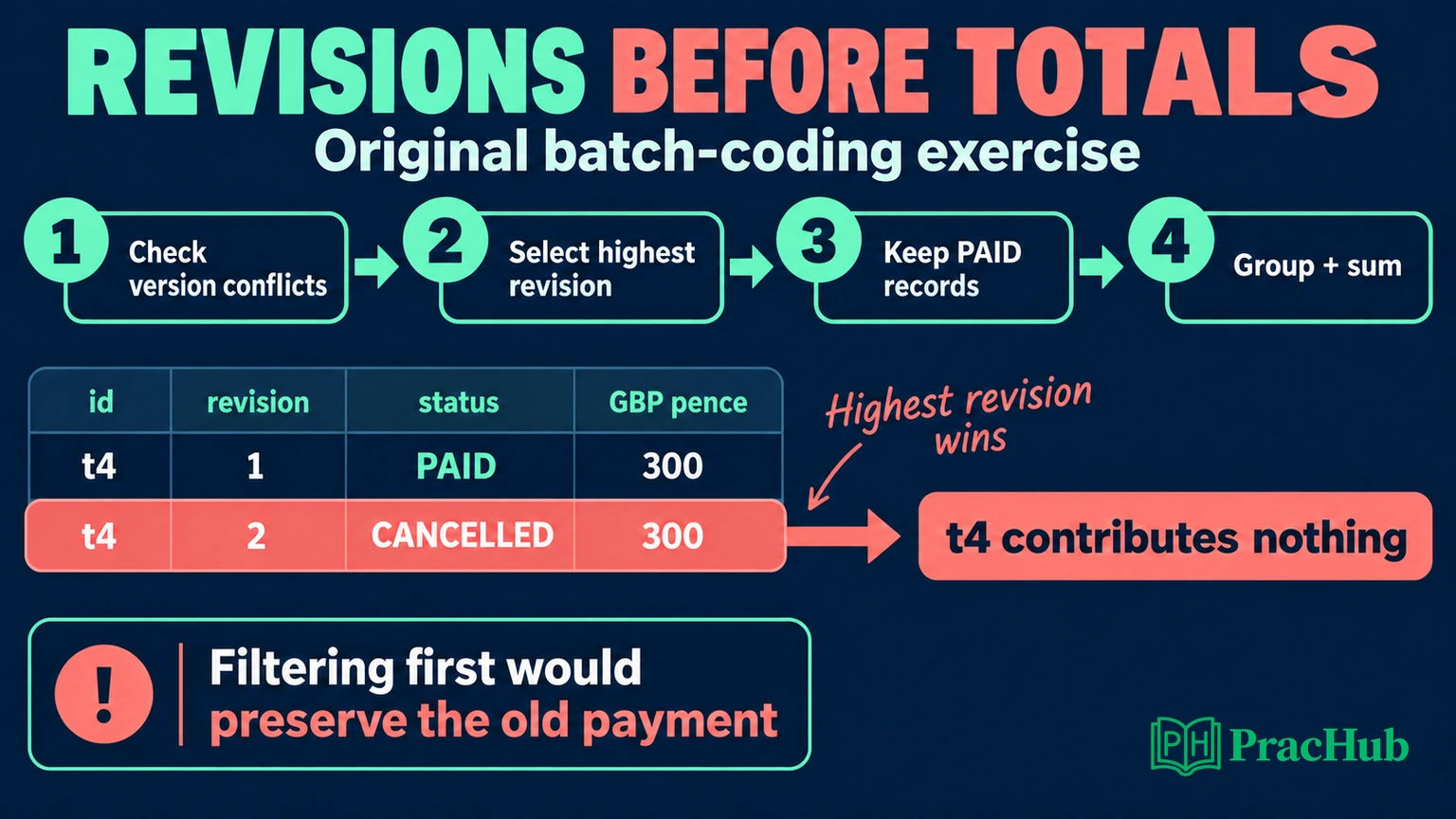
A map holding only the latest record cannot detect every conflict under this stronger contract. Retain a second map keyed by (id, revision) to validate repeated versions. Then maintain the highest revision per ID and reuse the original aggregation stage.
This increases retained state to O(v + g) for v distinct ID/revision pairs. It is a deliberate cost of detecting historical version conflicts. If the interviewer relaxes that requirement, you can discuss dropping historical payloads. Do not silently weaken it to keep an attractive complexity claim.
Collaborate through a requirement change
Use a short exchange in your mock rather than a memorized speech:
Partner: “A cancelled record can arrive after a paid one. Can we just skip cancellations?”
Candidate: “Under the new revision rule, cancellation replaces the earlier state. If I skip it first, I still count the old payment. I’ll add that case before changing selection.”
Partner: “Do we need to remember old revisions?”
Candidate: “Only because our contract rejects conflicting equal revisions anywhere in the batch. If that guarantee is unnecessary, we can retain less state. Which behavior should the caller get?”
Connect each clarification to a code change and a test. Accepting every suggestion without checking its consequences is not useful collaboration. Neither is defending your first design after the contract has changed.
If you need a quiet minute, explain the exact task: “I’m checking whether this older revision should affect conflict detection.” Return with a test or a decision. Constant narration can consume the time you need to implement the agreed behavior.
Keep extensions bounded. A request to process revisions does not automatically require Kafka, a database schema, distributed locking, or a currency-conversion service. Finish the function that the current contract describes.
Make your rehearsal observable
Use one 60-minute mock appointment as a preparation exercise. Reserve time for setup and closing questions, then let your partner introduce the revision change after the baseline works. The purpose is to expose your response to new information, not to guarantee a particular interview schedule or task sequence.
At the end, review three pieces of evidence: a runnable baseline, a test that caught a real defect, and a requirement change reflected in both implementation and explanation. If one is missing, make it the target of your next session.
A concise closing status could be: “The baseline and latest-revision cancellation case pass. Equal-version conflicts are checked across the batch. I have not added malformed-input handling because we agreed the records are structurally valid.” That gives your partner a precise view of what is complete.
Five questions for focused follow-up practice
These are verified PracHub records from other companies, selected for transferable coding skills. They are not claims about Wise’s question bank. The tasks target ordering, changing contracts, and boundary reasoning.
| Practice question | What to make visible while solving |
|---|---|
| Deduplicate and Order Batch and Streaming Logs | Define identity and ordering before choosing state for duplicates. |
| Evolve Duplicate Detection for Sliding Windows and Read-Heavy Queries | Revise the data structure when query and retention requirements change. |
| Return the K Most Frequent Values with a Larger-Value Tie-Break | Apply one explicit tie-break during selection and final ordering. |
| Compute the Union of Two Sorted Interval Lists | Test touching endpoints, containment, duplicates, and empty inputs. |
| Find Bugs in an LRU Cache | Explain a minimal failing case before modifying unfamiliar code. |
Choose the exercise that matches your observed gap, then continue with the Backend Engineer collection. Record the invariant and failed assumption from each attempt so the next rehearsal changes how you work.
Comments (0)