Xiaozhaobao Review: Graduate Interview Questions, Reference Answers, and Role Filters
Quick Overview
Review Xiaozhaobao graduate question filters, company-label limits and login-gated generated answers, with a precise independent C++ lifetime exercise. Dated public observations and original exercises distinguish official descriptions, tested behavior and unverified capabilities.
Xiaozhaobao, or 校招宝, lets graduate candidates filter public interview-question titles by technical direction and category. We could narrow the index to technical questions and then C++, but the inspected virtual-destructor question’s reference answer required login. Its footer said questions were organized from public reports and answers were generated by the site. Keep those evidence classes separate when deciding what to study.
Start with PracHub’s C++ ownership-and-lifetime question and explain who owns the object before predicting destruction. A familiar question title becomes useful preparation only when the answer survives a precise language rule.
Checked November 3, 2026: this review covers xiaozhaobao.com.cn/interview and one public C++ question detail. Counts and company labels are provider displays. We did not log in, read the gated answer or verify original candidate accounts. The C++ example below is our own documentation-supported exercise; no undefined behavior was executed. PracHub publishes interview-preparation content and is the publisher of this review.

What the graduate question index exposes
The site combines graduate recruitment information with interview-question browsing. The public interview page distinguishes technical and nontechnical material and offers category, company and difficulty controls. That can help a candidate move from a broad campus-recruitment search toward a concrete topic.
During our visit, the technical direction displayed 641 questions. Selecting C++ narrowed the visible result count to 85, with fewer pages. These are current catalog displays, not independently audited counts or estimates of how often an employer asks each question.
We verified the filter change in the native browser. A separate direct HTTP request received 403, while the normal browser page was readable. We preserve that access difference rather than treating the failed automated fetch as proof that the public site was unavailable.
Filtering is useful when it changes the work you choose. A C++ category can lead you toward ownership, containers and object lifetime. It cannot establish that your graduate assessment uses C++, that a company label is current or that the difficulty tag matches your own preparation level. Check the actual role description and invitation alongside the index.
The inspected question and its provenance boundary
We opened “请简述虚析构函数的作用!” The page labeled it C++, easy and Huawei. Its reference-answer area displayed a login requirement, so we did not read the current answer text.
The page also stated that question titles were organized from public interview reports and that answers were generated by Xiaozhaobao for reference. Preserve that disclosure when citing the page. An attributed question and a site-generated explanation are different objects; neither should be presented as a verbatim candidate answer or an employer-approved solution.
Related public titles included vector implementation and growth, virtual dispatch, memory alignment, smart pointers and constructor exceptions. Those entrances can suggest follow-up topics. We did not review every linked answer or determine whether each company association could be traced to an original account.
| Public field | What we could inspect | Evidence limit |
|---|---|---|
| Question title | Virtual-destructor prompt | Exact original wording unverified |
| Category | C++ | Useful topical organization |
| Difficulty | Easy | Provider label, not a readiness measure |
| Company | Huawei | Indexed association, not current process proof |
| Reference answer | Login gate | Current explanation not reviewed |
| Footer disclosure | Public-report titles and generated answers | Separate provenance for question and answer |
This is enough to assess public discovery and the answer-access boundary. It is not enough to rate the gated explanation or promise that a Huawei interview will contain the question.
A precise independent answer starts with ownership
Our original exercise concerns ordinary single-object deletion through a base pointer. Assume a Derived object is allocated dynamically and owned through Base*. The deletion path is an ordinary non-destroying delete, and the base destructor is accessible.
With a virtual base destructor, destruction proceeds through the derived object and then its base subobject. A small example is:
struct Base {
    virtual ~Base() = default;
};

struct Derived : Base {
    ~Derived() override = default;
};

Base* owned = new Derived;
delete owned;
The relevant primary reference is the C++ working draft’s delete-expression rule. Under these ordinary-deletion assumptions, deleting a derived object through a base pointer whose destructor is nonvirtual produces undefined behavior. It is inaccurate to promise a safe, deterministic trace in which only the base destructor runs.
That distinction is our independently checked language point. We are not correcting or endorsing Xiaozhaobao’s gated answer, which we did not read. We also did not execute the invalid variant and treat one compiler’s output as a language guarantee.
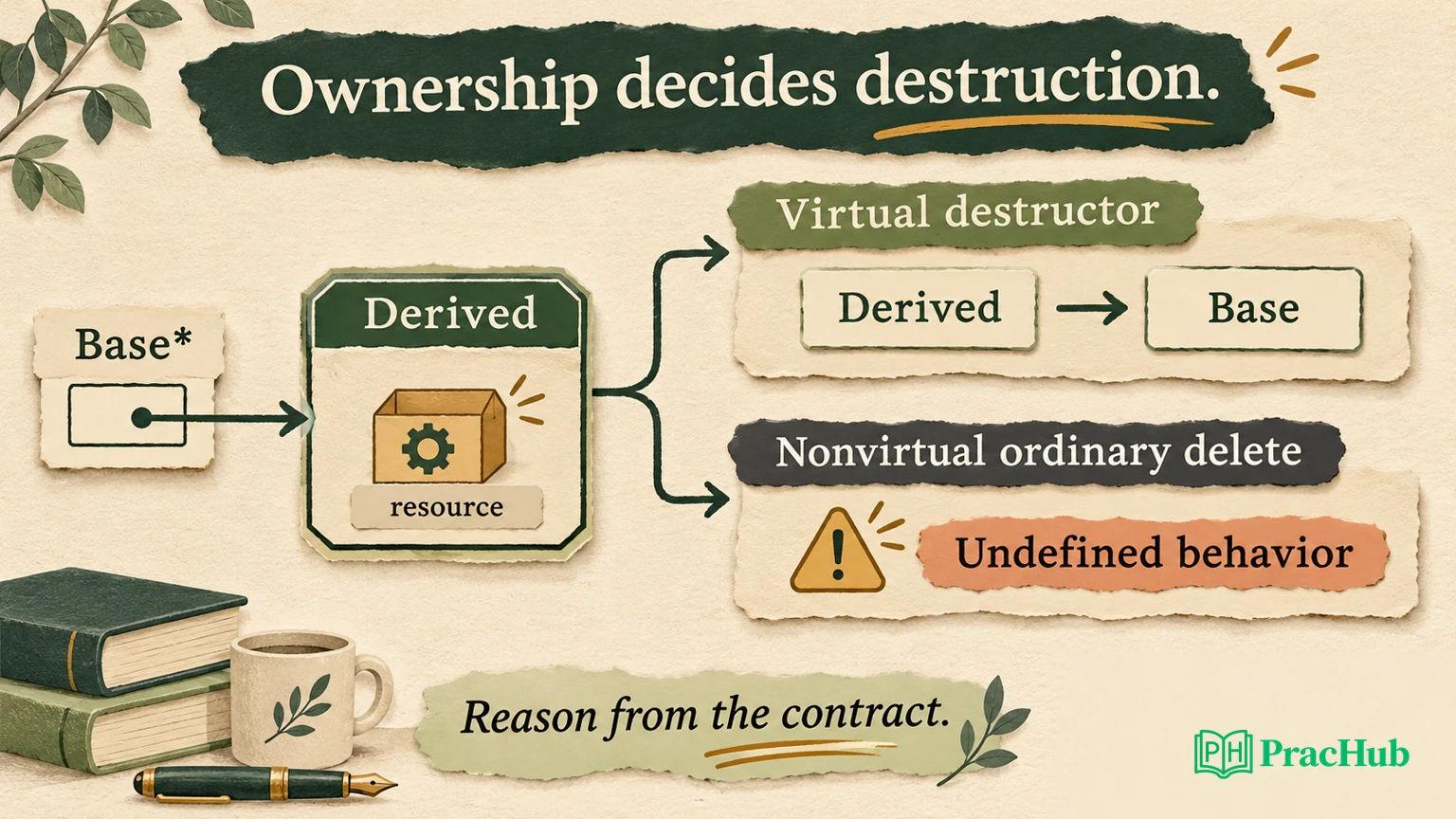
Name the ownership premise before predicting a destructor trace. Merely having a pointer or reference to a base does not mean you will delete through it. An interface used only for nonowning access has a different design question from a base intended for polymorphic ownership. Explain the operation that makes the destructor rule relevant.
A short title can hide several follow-up questions
An interviewer can ask who is permitted to destroy the object, whether the base is intended to be used polymorphically, or how a smart pointer changes ownership. Naming unique_ptr does not automatically repair an incorrectly designed deletion contract; you still need to understand the stored pointer and deleter.
Another follow-up concerns object slicing. Copying a derived object into a base value is different from referring to the complete object through a base pointer. The destructor question should not turn into a blanket claim that inheritance always preserves the derived part in every operation.
You may also be asked about constructor failure. If construction throws, the completed subobjects and acquired resources need the appropriate cleanup behavior. That is a different path from deleting a fully constructed derived object. Keeping these cases distinct shows more understanding than reciting a definition of virtual dispatch.
For preparation, draw one object, one owner and one destruction operation. Then change only one condition. A controlled change makes it easier to explain which language rule applies and what conclusion is no longer justified.
Use a reference answer as a claim to verify
Since the current answer was gated, we cannot assess its completeness, examples or treatment of exceptions. The site’s generated-answer disclosure nevertheless suggests a useful reading habit for any answer you later access: identify one claim that can be checked independently.
For a C++ lifetime answer, that check may be a language rule and a valid ownership example. For a container answer, it may concern invalidation after a particular operation. For a complexity statement, define the operation and relevant assumptions rather than relying on a broad sentence that “hash maps are O(1).”
Distinguish a simplified explanation from an incorrect guarantee. A short answer can reasonably omit advanced cases if it states its scope. It becomes misleading when it promises behavior the language does not guarantee. Keep the scope beside your own answer so a follow-up can refine it without forcing a contradiction.
Also avoid using a single observed run as the only authority for undefined or implementation-dependent behavior. A program can appear to work while violating the contract. A reliable preparation artifact connects the code, the applicable rule and the boundary of the conclusion.
Map filters to the evidence your role needs
A category filter is a study organizer. Your target role determines how deeply to rehearse the topic. A general graduate SWE role might require a clear ownership explanation; a systems role may add allocator, ABI or concurrency questions; a test role may ask how to expose the failure safely.
| Practice target | Artifact to prepare | Useful changed condition |
|---|---|---|
| Object lifetime | Owner-to-object destruction trace | Base destructor becomes nonvirtual |
| Containers | Small operation and invalidation example | A growth or erase operation occurs |
| Smart pointers | Ownership and deleter explanation | Ownership moves across an interface |
| Concurrency | Shared-state invariant | Two callers race on the same resource |
| Project discussion | Personal decision and evidence | A failure invalidates an assumption |
This mapping is ours. It does not describe a Xiaozhaobao assessment format or a current employer rubric. Its purpose is to prevent a difficulty badge from deciding your whole preparation plan.
If a question labeled easy exposes a rule you cannot explain, practice it. If a hard-looking title repeats an algorithm you can already defend, move to a changed input or constraint. Your observed performance should guide depth more than the catalog label.
What company labels and counts cannot establish
A company tag can help you discover adjacent material, but it does not establish that every team uses the question or that the association is current. We did not obtain original candidate URLs or independent same-cycle reports for the inspected item.
For a process claim, current official role or hiring information and traceable accounts would be needed. This review remains a product-discovery and practice-boundary review. It does not infer round counts, pass rates, interview timing or offer outcomes from a question index.
Counts also describe collection structure, not candidate probabilities. The 85 C++ entries are not 85 independent interviews, and the 641 technical total does not measure complete technical coverage. Some topics can overlap, while some role-specific skills may be absent.
Use the counts to navigate, then inspect exact titles and constraints. A manageable set of independently explained examples provides more preparation evidence than a large number of unchecked completion marks.
A graduate practice session with a clear stopping point
Choose one role-relevant category and one question you cannot yet explain precisely. Record the title, indexed company label and any source limitation. If the answer requires login, decide whether you need it; you can often begin the technical investigation with primary documentation and your own small example.
Write a concise answer with its assumptions. For the destructor exercise, name ordinary polymorphic deletion and distinguish valid destruction from undefined behavior. Then answer one follow-up about ownership or a smart pointer without changing the underlying facts.
Finish by explaining the example aloud. If you cannot connect the pointer’s static type, the object’s dynamic type and the destruction operation, the definition is not yet secure. Revise that explanation before collecting another set of titles.
Five PracHub questions for C++ transfer
These verified destinations extend lifetime and polymorphism into ownership bugs and language fundamentals. They are separate from Xiaozhaobao’s generated answers and do not predict a named company’s next interview.
| PracHub question | Focused follow-up |
|---|---|
| C++ Basics: const vs static, Non-Virtual Base Destructors, and Stack vs Heap Memory | Distinguish ordinary invalid polymorphic deletion from a guaranteed output trace. |
| Explain Encapsulation, Inheritance, and Polymorphism in C++ | Connect inheritance and dispatch with the actual object and owner. |
| Find and Fix C++ Ownership Bugs: Double Free, Shallow Copy, and Object Slicing | Find a concrete ownership defect and explain the repaired lifetime. |
| Explain C++ References, Pointers, Virtual Methods, and Overrides | State static type, dynamic type and the operation under discussion. |
| Explain C++ virtual dispatch and object lifetime | Draw the destruction path and identify the rule that makes it valid. |
Xiaozhaobao’s public filters can help graduate candidates choose a technical starting point. Its reference-answer gate and provenance disclosure remain important limits. Finish with the C++ lifetime prompt, identify the owner and defend the applicable destruction rule before trusting a remembered output or a difficulty label.
Comments (0)