C++ Systems Programming For Infrastructure
Asked of: Software Engineer
Last updated
What's being tested
Interviewers are probing practical mastery of writing high-performance, correct C++ system code for infrastructure: safe concurrency, predictable memory behavior, and observability under load. Expect to demonstrate applying the C++ memory model, correct synchronization (`std::atomic`, fences), resource ownership patterns (RAII, `std::unique_ptr`/`std::shared_ptr`), and performance engineering (cache locality, allocation strategies, profiling). They want crisp tradeoffs: simple correct design vs low-latency/high-throughput optimizations and how you'd validate them.
Core knowledge
-
C++ memory model (C++11+): understand sequential consistency,
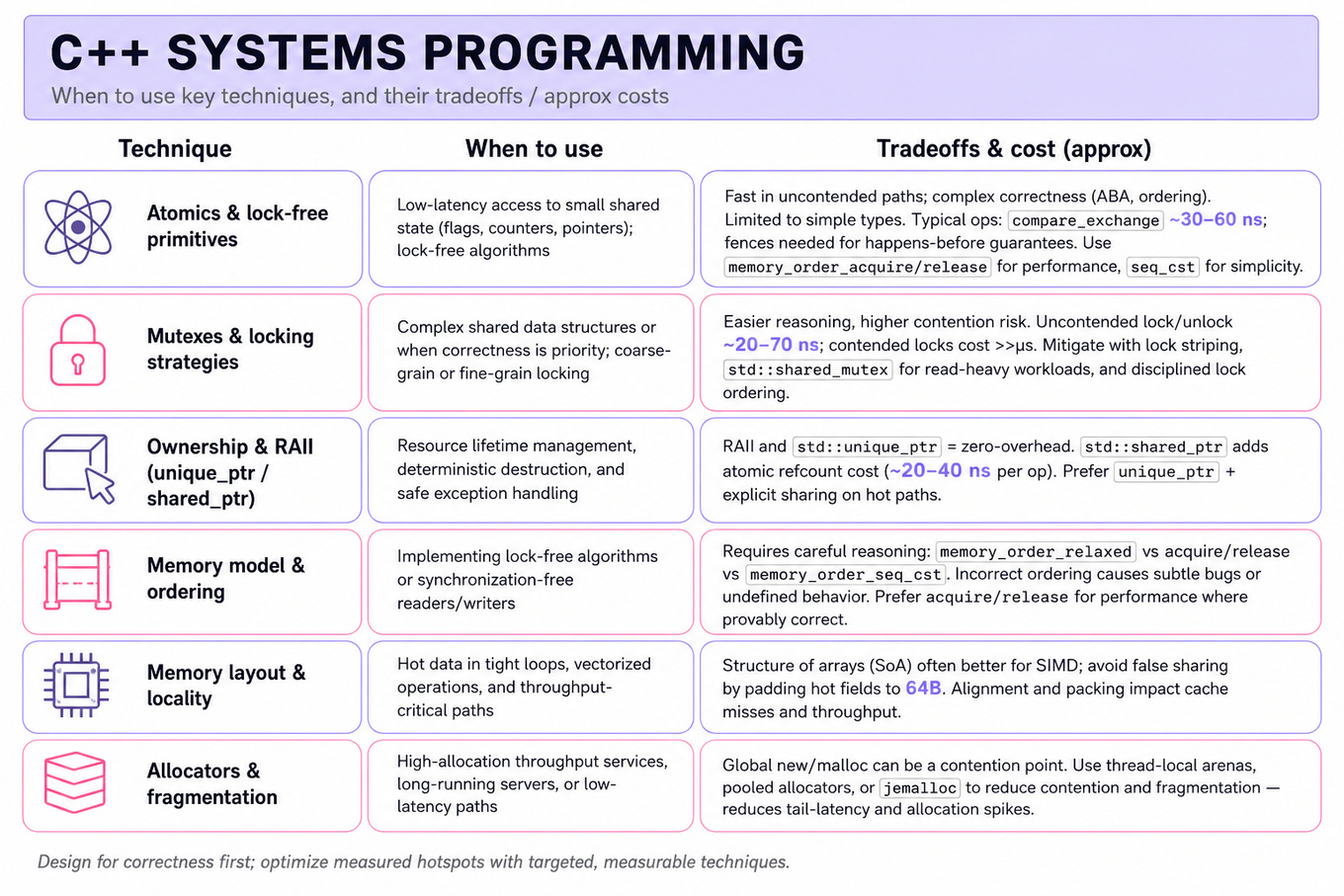
`memory_order_seq_cst`,`memory_order_acquire`/`release`,`memory_order_relaxed`, and when fences are necessary to enforce happens-before relationships for lock-free algorithms. -
Atomics and lock-free primitives:
`std::atomic<T>`,`compare_exchange_weak`/`strong`, ABA problem, and practical limits: lock-free for pointers/integers is common; complex structures usually need synchronization. -
Mutexes and locking strategies:
`std::mutex`,`std::shared_mutex`, and`std::unique_lock`; know coarse-grain vs fine-grain locking, lock striping, and deadlock-avoidance by lock ordering. -
Ownership & lifetime: RAII, Rule of Five,
`std::unique_ptr`for exclusive ownership,`std::shared_ptr`atomic refcounts cost ~20–40ns per operation; prefer`unique_ptr`+ explicit sharing when throughput matters. -
Undefined behavior (UB) traps: strict aliasing, iterator invalidation, data races (even read/write), use of
`std::launder`/placement new; UB can invalidate reasoning and optimizations. -
Memory/layout & locality: object packing/padding,
`alignas`,`offsetof`; avoid false sharing by padding hot data to cache-line (typically 64 bytes); prefer SoA vs AoS for vectorized access. -
Allocators and fragmentation: general-purpose
`new`/`malloc`may be a bottleneck at high concurrency; use pooled allocators, thread-local arenas, or`jemalloc`for heavy-allocation workloads to reduce contention. -
I/O and syscalls for infra services: use async multiplexing (
`epoll`/`kqueue`), nonblocking sockets, and zero-copy (`sendfile`/`splice`) where appropriate to reduce context switches and copies. -
Profiling, sanitizers, and observability: iterate with
`perf`/`flamegraphs`,`clang-tidy`,`clang-asan`/`ubsan`for UB,`tsan`for data races,`valgrind`for memory errors; add`p99`/`p95`latency metrics and structured tracing. -
Concurrency testing & correctness: deterministic unit tests are insufficient; use stress tests, fuzzers, model checkers, and death tests; log invariants and fail-fast on invariant violations.
-
Performance tradeoffs quantification: always attach numbers — e.g., switching
`std::mutex`to lock-free atomics may reduce latency by X% but increase code complexity and risk; measure before optimizing.
Tip: For low-latency paths, prefer single-producer-single-consumer (SPSC) designs and per-thread buffers to avoid shared contention.
Worked example — "Implement a thread-safe LRU cache in C++"
First 30 seconds: clarify capacity, required concurrency level (single writer vs many readers), eviction policy ties, persistence, and TTLs. Frame success criteria: correctness (no races), throughput (ops/sec), and eviction latency. Skeleton answer pillars: data structures (hash map + doubly-linked list for recency), concurrency model (coarse `std::mutex` vs striped locks vs `std::shared_mutex` for readers), and memory management (store values in `std::unique_ptr` to avoid copies). Explicit tradeoff: a single global `std::mutex` is simplest and safe but serializes access — acceptable for small caches, not for high throughput; lock striping or per-bucket locks increase parallelism but complicate eviction across buckets. Mention implementation details: move semantics for values, careful handling of iterator invalidation when removing nodes, and constant-time eviction via list splicing. Close by saying: if more time, I'd add benchmarks vs real workload, a TTL background reaper, and consider a segmented LRU (multiple independent LRU shards) to reduce contention.
A second angle — "Design a high-throughput logging ring buffer"
This problem stresses the same foundations but with different constraints: single-producer-single-consumer (SPSC) vs multiple producers changes choice of primitives. For SPSC, a circular buffer with two `std::atomic<size_t>` indices works; use `memory_order_relaxed` for head/tail in tight loops and `memory_order_acquire/release` when crossing ownership. Avoid false sharing by padding indices to separate cache lines. If multiple producers are required, use `compare_exchange` on write position or a producer queue per thread to avoid contention. Also cover blocking vs spinning: use `futex`/`condition_variable`/`eventfd` to sleep when empty/full, and measure whether busy-waiting is acceptable for your latency targets.
Common pitfalls
Pitfall: Thinking
`std::shared_ptr`is free — analysts often overuse`std::shared_ptr`without considering atomic refcounting cost; for hot paths replace with`std::unique_ptr`+copy-on-write or manual ref management.
Pitfall: Not asking about failure and memory constraints — ignoring eviction policies, TLS size, or crash-consistency can make an otherwise-correct design unusable in production.
Pitfall: Equating "passes unit tests" with correctness — missed concurrency bugs surface only under stress; always run TSan, long-running stress tests, and real-load profiling.
Connections
Interviewers may pivot to adjacent areas: memory allocators and how allocator design affects fragmentation and throughput, or networking stack choices (`epoll` vs async IO) for services. They might also ask about distributed consistency implications when a local cache is used across nodes.
Further reading
-
C++ Concurrency in Action (Anthony Williams) — authoritative on the C++ memory model and concurrency idioms.
-
Herb Sutter — “Atomic<> Weapons” — blog posts on atomics, memory ordering, and practical C++ concurrency guidance.
Related concepts
- C++ Concurrency, Memory Ownership, And RAII
- Performance Profiling And Capacity Planning For C++ Services
- Low-Level System Design For High-Throughput C++ Services
- C++ STL Performance And Interview Idioms
- C++ Systems, Memory, Concurrency, And VirtualizationSoftware Engineering Fundamentals
- C++ Concurrency And Memory Model