Data-Driven Product Decisions
Asked of: Product Manager
Last updated
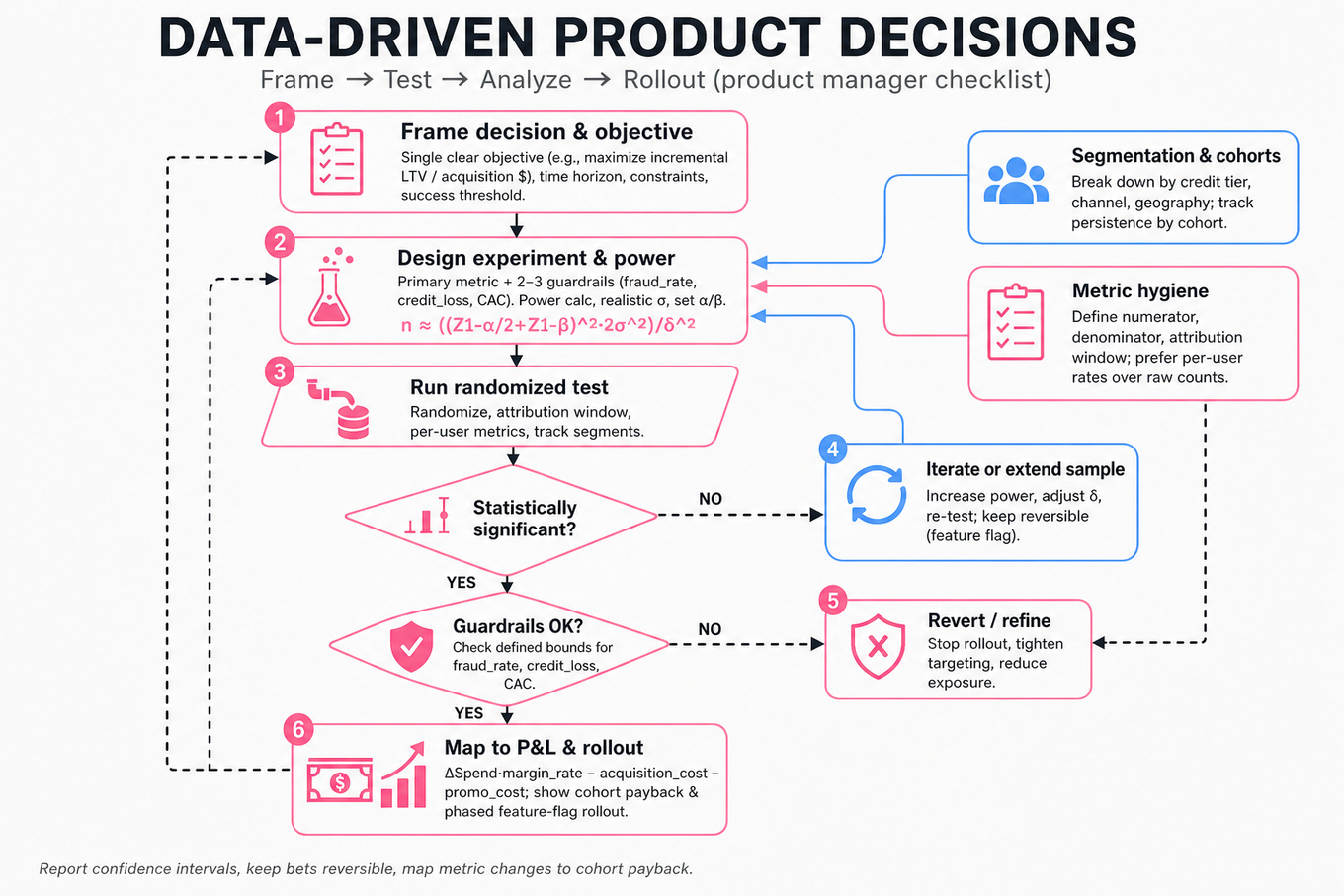
What's being tested
Interviewers are probing your ability to convert data into defensible product choices: framing decisions, selecting the primary metric, designing diagnostics and experiments, and balancing business upside versus risk. They want to see pragmatic statistical literacy (power, uncertainty, incremental impact), segmentation thinking, and stakeholder communication that keeps launches reversible and measurable. At Capital One, this demonstrates you can run acquisition/partnership pilots, promotions, or UX changes while protecting credit/risk and P&L guardrails.
Core knowledge
-
Decision framing: Start with a single clear objective (e.g., maximize incremental
LTVper acquisition dollar) and state the time horizon, constraints, and success threshold before analyzing data. -
Primary metric vs guardrails: Declare one primary metric (e.g., incremental sign-ups or net card spend) and 2–3 guardrails (
fraud_rate, credit-loss,CAC) that cannot degrade beyond defined bounds during tests or rollout. -
Incrementality & causality: Use randomized experiments or credible quasi-experiments to measure incrementality; observational lifts often conflate selection bias with treatment effect.
-
Experiment design basics: Power calculation (sample size) from desired detectable effect δ: — set α, β, and realistic σ based on historical variance.
-
Segmentation and cohorts: Always break down effects by key segments (credit tier, geography, acquisition channel); effects can mask countervailing trends in subgroups — use cohort analysis to track persistence.
-
Metric hygiene: Define metrics precisely (numerator, denominator, attribution window). Prefer per-user or per-customer metrics to avoid volume-driven artifacts (e.g., % of active cardholders vs raw transactions).
-
Uncertainty & reversibility: Report confidence intervals and expected range of outcomes; favor reversible bets (limited-time pilots, feature flags) when uncertainty is high or downside risk is non-linear.
-
P&L mechanics: Map metric changes to P&L: incremental margin = Δ(Spend)*margin_rate − acquisition_cost − promotional_cost; show payback period and cohort payback curves.
-
Tradeoff framing: Quantify short-term acquisition lift vs long-term credit loss or margin dilution; use simple NPV/IRR or cohort
payback = acquisition_cost / monthly_marginmodels to compare offers. -
Diagnostic plan: For any metric change, predefine diagnostics: funnel conversion, channel mix, new vs returning user rates, credit-risk signals, and anomalous logging. Diagnostics turn signal → root cause.
-
Data quality & confidence: Validate event definitions and completeness; if upstream data is noisy, surface that to stakeholders and delay definitive calls or widen confidence intervals.
Tip: Always present a back-of-envelope worst-case, base-case, best-case to show asymmetric risk and the value of guardrails.
Worked example — "How do you make data-driven decisions?"
First 30 seconds: ask clarifying questions — what decision are we making (launch/promo/tiering), the time horizon, constraints (regulatory, credit exposure), and what data sources exist. Frame the approach: (1) define a primary metric and guardrails, (2) choose analysis method (experiment vs observational), (3) plan diagnostics and success thresholds, (4) translate outcome to P&L and rollout plan. Organize answers around measurement, risk, segments, and operationalization. A strong candidate specifies experiment mechanics (randomization unit, sample size, test length) and pre-commits to analysis windows and multiplicity corrections if multiple metrics are tested. Flag a tradeoff: faster, broad rollouts accelerate growth but increase exposure to credit risk; prefer phased rollouts with risk-triggered cutoffs if downside is large. Close by outlining next steps: run a powered pilot, monitor diagnostics daily, and have an agreed rollback criterion; "if I had more time, I'd model long-term cohort economics and simulate credit-loss sensitivity."
A second angle — "Capital One Credit Card: Acquisition & Promotion Strategy"
Here the same data-driven scaffolding focuses on acquisition economics and channel optimization. Start by segmenting target customers by expected LTV and acquisition CAC. Define success as incremental net_margin_per_acquired_customer over a 12–36 month horizon; compute break-even using cohort payback. Design channel-specific pilots (paid search, affiliate, partnership) with consistent attribution windows; run randomized offers where possible to measure incremental signups rather than correlated volume. Emphasize strategic value (brand fit, incremental deposits) in addition to short-term ROI and include credit-safety guardrails (max approval rate by tier, expected charge-off). This framing shifts emphasis from product usage metrics to cohort P&L and credit-risk controls.
Common pitfalls
Pitfall: Confusing lift with volume. Measuring total sign-ups without a counterfactual can mistake seasonality or channel spend increases for product impact.
Quantitative mistake — over-interpreting underpowered tests. Running many underpowered experiments inflates false negatives and encourages chasing noise; always compute required sample size for a meaningful δ and report confidence intervals, not just p-values.
Communication mistake — hiding assumptions. Presenting a headline lift without disclosing attribution window, segment mix shifts, or data quality issues breaks trust. State assumptions, show diagnostics, and explicitly call out what would change your recommendation.
Depth mistake — ignoring long-run economics. Choosing a promotion solely on immediate sign-ups without modeling cohort-level LTV, churn, and credit-loss leads to toxic growth. Translate short-term metrics into multi-period P&L before approving large-scale rollouts.
Connections
Interviewers may pivot to experimentation infrastructure (how to implement randomized rollouts), risk/credit modeling (impact on loss rates), or partnership evaluation (incremental economics vs strategic benefits). Be ready to move from metric measurement to operational controls and legal/regulatory constraints.
Further reading
-
Running Controlled Experiments at Scale (Kohavi et al.) — practical guide to experimentation design and pitfalls.
-
Lean Analytics (Alistair Croll & Benjamin Yoskovitz) — frameworks for metric selection, experiments, and growth-stage decisions.
Practice questions
- Capital One Credit Card: Acquisition & Promotion StrategyCapital One · Product Manager · Technical Screen · medium
- Improve Capital One ShoppingCapital One · Product Manager · Onsite · medium
- Recommend Build vs Buy for RestaurantsCapital One · Product Manager · Onsite · medium
- Evaluate a Credit Card PartnershipCapital One · Product Manager · Onsite · medium
- Redesign the DMV ExperienceCapital One · Product Manager · Onsite · medium
- How do you make data-driven decisions?Capital One · Product Manager · HR Screen · medium
Related concepts
- Product Metric Design And Diagnostic Deep DivesAnalytics & Experimentation
- Product Metric Frameworks And Diagnostic AnalyticsAnalytics & Experimentation
- Quasi-Experimental Analysis for Product Decisions
- Ambiguous Project Leadership And Product ImpactBehavioral & Leadership
- Product Metrics, Guardrails, And Launch Decisions
- Stakeholder Leadership And PrioritizationBehavioral & Leadership