What to expect
A comprehensive guide to the Apple software engineer interview process in 2026, covering all 4–8 rounds from the initial recruiter screen to the final onsite loop. Learn how to nail the unique "Why Apple?" question, prepare for production-quality coding rounds without IDE autocompletion, master privacy-first system design with on-device processing and offline-first architecture, and navigate Apple's craftsmanship-driven behavioral culture. Includes a detailed comparison of Apple vs. Google, Amazon, and Meta interview styles, top coding topics (concurrency, graph traversal, data structure design), sample system design questions like the iOS QuickType suggestion engine, and frequently asked questions about hiring timelines and difficulty level. Built for software engineers targeting Apple teams like Siri, iCloud, Apple Intelligence, and WebKit.
The Apple software engineering interview consists of 4 to 8 rounds spanning coding, system design, and behavioral assessment, with a unique emphasis on privacy-first architecture, hardware-software integration, and obsessive user-experience craftsmanship that no other FAANG company matches.
Unlike Google or Meta, Apple's interview process is highly decentralized like each product team (Siri, iCloud, Apple Intelligence, WebKit) runs its own hiring pipeline with team-specific technical deep dives.
Apple is the most secretive of the FAANG companies, and this extends to its hiring. There is no single public "interview playbook" like Amazon's Leadership Principles. But after extensive research into hundreds of 2026 candidate reports, a clear pattern has emerged across all Apple engineering loops.
This guide provides the exact interview structure, the unique Apple-specific signals interviewers are trained to detect, and the critical preparation strategies that separate rejected candidates from those who receive the offer.
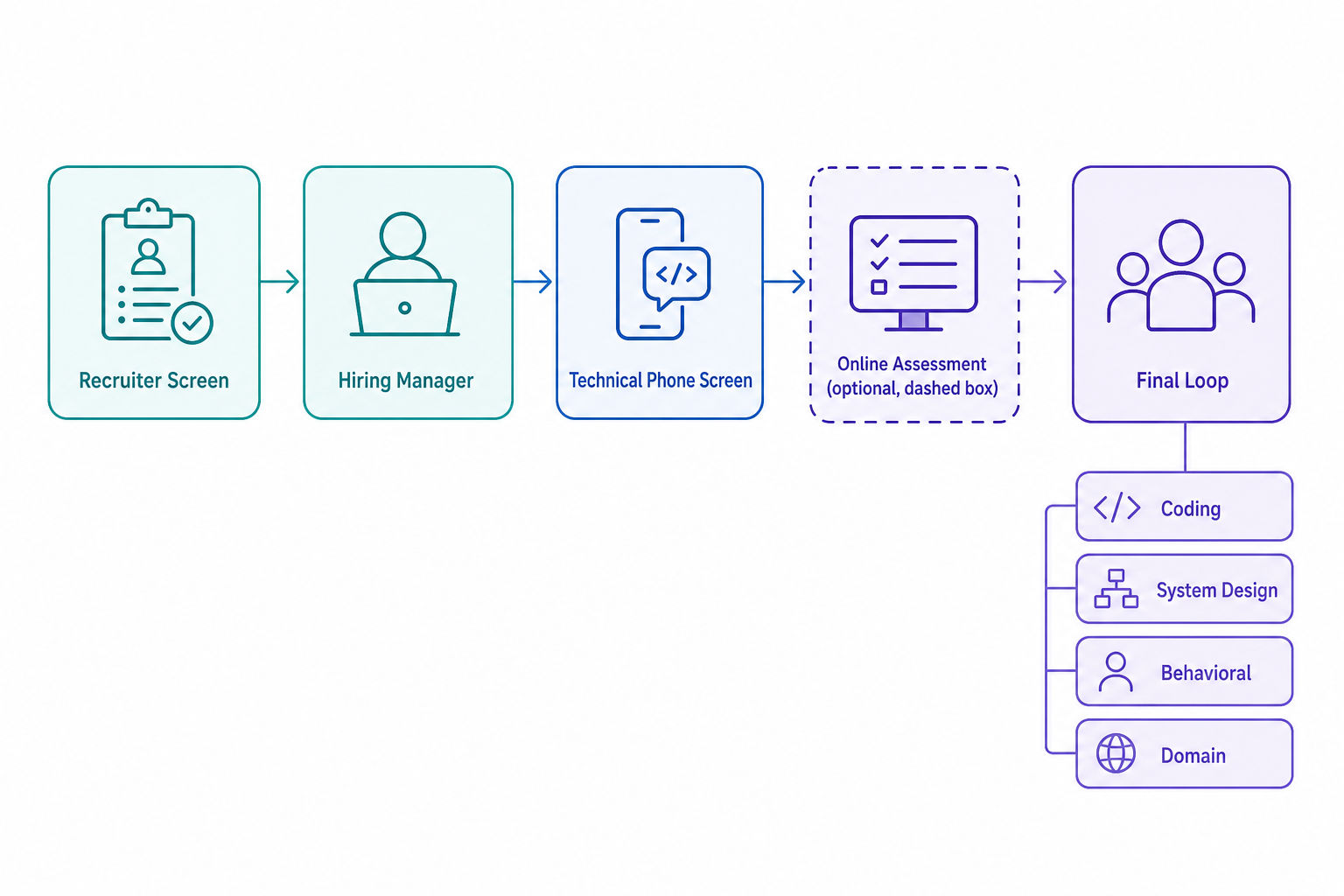
A typical end-to-end process includes:
- A recruiter screen
- A hiring manager or team conversation
- One or two technical screens
- A final loop of several interviews covering coding, design, behavioral judgment, and domain depth
Two themes run through the whole thing:
- Engineering quality over raw speed. Apple tends to weight clean implementation, performance and memory trade-offs, product impact, and your ability to explain technical decisions, not just how fast you reach a correct answer.
- The team's lens. You're usually evaluated against the needs of one specific team, so prep that matches that team's stack and domain pays off far more than generic grinding.
The process commonly takes a few weeks, but delays and extra rounds are common, so don't read a slow timeline as a bad sign.
Interview rounds
The rounds below are typical, not guaranteed. Teams add, drop, or reorder steps, so treat this as a map of what you might encounter rather than a fixed script.
Recruiter screen
A short phone or video call (often around 30 minutes) covering background fit, communication, and your interest in Apple and the specific team. Expect practical questions too: location, work authorization, target level, and compensation expectations. Have a clear, concrete answer ready for why Apple and why this product area - vague enthusiasm reads poorly here.
Hiring manager or team screen
Usually 30 to 60 minutes with the hiring manager or a lead engineer. The focus is how relevant your past work is to the team, how much ownership you've carried, how you handle trade-offs, and whether your communication fits a cross-functional environment. Some teams add light technical probing or coding here to test domain familiarity early.
Technical phone screen
Commonly a 45 to 60-minute live coding interview in a shared editor, centered on core data structures and algorithms, coding fluency, debugging, and edge-case handling. Interviewers often push past your first correct solution to ask for optimizations, a complexity discussion, or implementation improvements, so keep narrating your reasoning instead of going silent once it "works."
Online assessment (HackerRank or similar)
Not universal, but some teams use a timed coding test before live interviews (often in the 60 to 90-minute range). It's typically one or two coding problems, sometimes with multiple-choice questions on language or framework fundamentals for backend or platform roles. When a team uses it, the problems tend to reflect that team's stack rather than generic algorithm trivia.
Final loop
The onsite-style loop usually combines several of the following:
- Coding (round 1): about 45 minutes with an engineer, focused on correctness, code clarity, testability, and how you reason through follow-ups. Apple tends to reward clean, practical code over clever-but-unmaintainable solutions.
- Coding (round 2): another ~45-minute session. It may be a second algorithmic problem, or some teams swap in debugging, refactoring, or language-specific tasks to see whether you can improve imperfect code, not just solve textbook problems.
- System design: generally 45 to 60 minutes, weighted more heavily for mid-level and senior candidates (though many teams use it across levels). Backend roles cover architecture, scalability, reliability, performance, and trade-offs; client-side roles often shift toward app architecture, memory usage, responsiveness, networking, and energy efficiency.
- Behavioral / collaboration: usually about 45 minutes on teamwork, ownership, judgment, resilience, and communication. Expect questions about disagreements, deadlines, ambiguity, and how you keep standards high while working across partner teams.
- Domain-specific round: typically 45 to 60 minutes going deep into the team's actual technical area. Topics vary by role: Swift, ARC, and app architecture for iOS; Java/Spring, APIs, caching, and distributed systems for backend; C/C++, memory, concurrency, and OS internals for systems; ML pipelines and on-device inference for AI/ML. This is where team-specific preparation matters most.
Extra rounds
Additional conversations are not rare at Apple. You may see a senior-manager round, a final alignment call, an extra technical interview if feedback is mixed, or a cross-team discussion if more than one team is interested. These often happen after the main loop, so don't assume you're done the moment the onsite-style interviews end.
What they test
Across roles, Apple is evaluating three things at once. The table below maps each dimension to what a strong signal looks like and the common way candidates fall short.
| Dimension | What "strong" looks like | Common pitfall |
|---|---|---|
| Coding ability | Clean, readable, tested code; clear complexity analysis; handles edge cases unprompted | Reaching a correct answer fast but leaving it messy and untested |
| Performance & trade-offs | Discusses memory, latency, battery, reliability; justifies design choices | Defaulting to "scale it horizontally" without engaging real constraints |
| Product-minded judgment | Ties decisions to user experience, privacy, accessibility, quality | Treating the problem as pure algorithm trivia with no user lens |
| Communication | Narrates reasoning, invites feedback, adapts to hints | Going quiet, getting defensive about hints, or over-explaining trivia |
| Team/domain depth | Speaks fluently about the team's stack (Swift, OS internals, distributed systems) | Generic LeetCode prep with no depth in the team's actual domain |
A few specifics worth internalizing:
Coding ability, but broader than LeetCode speed. Be comfortable with arrays, strings, linked lists, stacks, queues, hash maps, trees, graphs, recursion, DFS/BFS, sorting and searching, and sometimes dynamic programming. Equally important: explaining time and space complexity, writing readable code, naming things clearly, handling edge cases, and discussing how you'd test your solution. Some teams use debugging or refactoring exercises, so practice reading and improving existing code under time pressure.
Performance and technical trade-offs. Apple puts more weight than many peers on efficiency and the decisions that affect the end user. In design and domain rounds you may discuss APIs, storage, caching, reliability, observability, partitioning, consistency, concurrency, and failure handling. For client and systems roles, memory behavior, responsiveness, rendering, latency, and battery impact come up often; for backend and platform teams, expect distributed-systems fundamentals, resiliency patterns, and stack-specific depth.
Product-minded judgment. You're expected to show that your technical decisions improve quality, privacy, accessibility, and user experience, not just system correctness. Connecting a design choice to a concrete user outcome is a reliable way to stand out.
Top Apple Behavioral Questions (2026):
Why Apple? (The critical opener — see above.) Tell me about a product you shipped that you are most proud of. What made it special? Describe a time you fought for a detail that others thought was insignificant. Tell me about a time you collaborated with a designer or hardware engineer to solve a problem. How do you balance perfection with shipping on time?
How to prepare by track
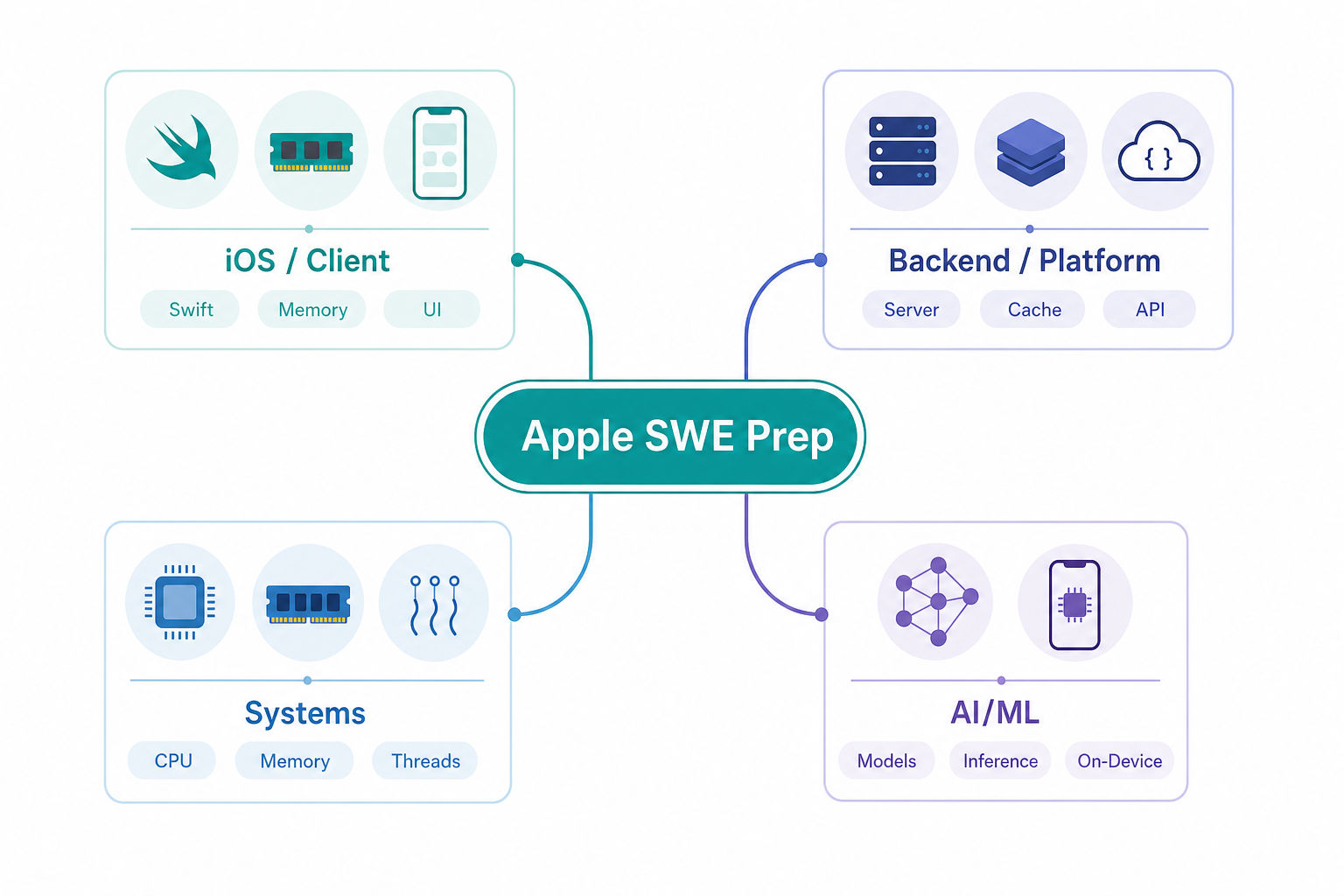
Apple isn't one loop, so your prep plan should branch by the team you're matched to. Ask your recruiter early which product area and stack you're interviewing for, then weight your time accordingly.
iOS / client
- Go deep on Swift, memory management (ARC, retain cycles, weak/unowned), and value vs reference semantics.
- Be ready to discuss app architecture (MVC, MVVM, unidirectional data flow), responsiveness, and main-thread work.
- Expect design discussions about offline behavior, networking, caching, and energy/battery impact.
Backend / platform
- Solidify distributed-systems fundamentals: load balancing, caching layers, replication, consistency models, and partitioning.
- Practice API design and failure handling (timeouts, retries, idempotency, backpressure).
- Be fluent in your primary stack (commonly Java/Spring) and its concurrency model.
Systems / low-level
- Refresh OS internals: processes vs threads, scheduling, virtual memory, and synchronization primitives.
- Expect C/C++ questions touching pointers, memory layout, and undefined behavior.
- Be ready to reason about performance at the level of cache locality and lock contention.
AI/ML
- Know the model lifecycle: data pipelines, training/serving split, and especially on-device inference constraints.
- Be ready to discuss latency, model size, quantization, and privacy-preserving design.
Whatever your track, build a base of practiced coding problems first, then layer domain depth on top.
Apple vs. Other FAANG Interviews
| Dimension | Apple | Amazon | Meta | |
|---|---|---|---|---|
| Hiring Authority | Team-local (Hiring Manager decides) | Centralized (Hiring Committee) | Bar Raiser + Hiring Manager | Hiring Committee |
| Behavioral Focus | Craftsmanship & Privacy | Googleyness & Ambiguity | 16 Leadership Principles | Core Values (Move Fast) |
| System Design Constraint | Privacy-first, on-device processing | Massive global scale | Cost optimization (Frugality) | Speed of iteration |
| Coding Style | Production quality, clean code | Algorithmic optimization | Working solution + testing | Practical + move fast |
| Secrecy Factor | Extremely high (NDA culture) | Moderate | Low | Low |
How to stand out
- Find out your team's focus early. Ask which team, stack, and product area you're interviewing for, then tailor prep to that exact domain instead of treating Apple as one uniform process.
- Prepare one or two deep project walkthroughs. Be ready to explain ownership, trade-offs, performance constraints, what went wrong, and what you'd improve today.
- In coding rounds, write clean, runnable code and proactively raise edge cases, tests, and complexity instead of waiting to be prompted.
- In design interviews, name the trade-offs Apple cares about: memory, latency, reliability, and user impact, since efficiency and polish often weigh as much as feature completeness.
- Show you can balance speed with quality. Interviewers tend to respond well when you explain how you deliver under pressure without lowering engineering standards.
- Lean on cross-functional examples. Behavioral stories involving product, design, platform, hardware, or partner engineering teams land well, because Apple strongly values collaborative execution.
- Stay patient and follow up professionally. Longer, less predictable timelines and extra rounds are common, so treat scheduling slowness as normal rather than a warning sign.
A worked behavioral example
Behavioral rounds reward structured, specific answers. The STAR pattern (Situation, Task, Action, Result) keeps you concrete.
For instance, suppose you're asked: "Tell me about a time you disagreed with a teammate on a technical decision."
Situation: "Our service was missing its latency target during peak traffic." Task: "I owned the read path and needed to bring p99 down without a risky rewrite." Action: "A teammate wanted to add a new cache layer immediately. I argued we should profile first; we found a single unindexed query was the real cost, so we fixed that and added a small targeted cache instead of a broad one." Result: "p99 dropped back under target, and we avoided the operational overhead of a cache we didn't need. I wrote up the profiling approach so the team reused it later."
That is an illustrative template, not a script - fill it with your own real project. Notice it shows disagreement handled with data, a clear trade-off, and a measurable outcome.
Practice next
- Drill real, company-tagged questions in the full question bank.
- Focus your reps on Apple interview questions to match the format and topics above.
- Broaden coverage with other software engineer interview questions across companies.
- Browse more prep guides and resources for behavioral and system design depth.
How to Use This Page as a Prep Plan
Do not treat this as passive reading. Convert the ideas in this page into a short weekly loop: learn one idea, practice it under interview conditions, then write down what changed. That is the fastest way to turn advice into visible interview behavior.
| Prep area | What you need to prove | Practice artifact |
|---|---|---|
| Understand | Turn the prompt into a concrete goal. | Clarifying questions and success criteria. |
| Practice | Use realistic constraints and timed reps. | Worked examples with edge cases. |
| Explain | Make reasoning visible. | Tradeoffs, assumptions, and test strategy. |
| Improve | Review misses quickly. | A short feedback log and next action. |
For Apple Software Engineer Interview Guide 2026, the strongest candidates usually do three things well: they make their assumptions explicit, they use concrete examples instead of vague claims, and they review mistakes quickly enough that the next practice rep is better than the last one.
Video Walkthrough
Ruthuvikas Ravikumar walks through the Apple Software Engineer loop first-hand. It is one candidate's account rather than an official spec, so treat the round order as indicative.
FAQ
How long does the Apple software engineer interview process take?
The Apple hiring process typically takes 4 to 8 weeks from the initial recruiter call to a final offer. However, Apple is known for being slower than other FAANG companies due to its decentralized team-based hiring model, where multiple rounds of internal alignment may be needed before an offer is extended.
Does Apple ask system design questions for entry-level roles?
It varies by team. System design is weighted most heavily for mid-level and senior candidates, but some teams include a lighter design or architecture discussion even for early-career roles. Ask your recruiter what to expect for your level and team.
Is the Apple interview the same across all teams?
No. Apple's process is unusually team-dependent. The recruiter and hiring-manager stages are broadly similar, but the technical and domain rounds reflect the specific stack - iOS, backend, systems, or AI/ML - so prep should be tailored to the team you're matched with.
How important is LeetCode-style practice for Apple?
It's necessary but not sufficient. You need solid data-structures-and-algorithms fluency, but Apple also values clean code, testing, complexity reasoning, and domain depth. Pair algorithm practice with the team's actual technical area and clear communication of your reasoning.
What programming language should I use in coding rounds?
Use the language you're strongest in unless the team specifies one. Many candidates use Python, Java, or Swift. The interviewer cares more about clean, correct, well-tested code and clear reasoning than the specific language, though for some iOS or platform teams familiarity with Swift or the team's stack helps.
How should I answer "why Apple" in the recruiter screen?
Be specific to the product area you're interviewing for, not generic brand admiration. Tie your interest to the kind of engineering the team does - performance, user experience, privacy, or a particular platform - and connect it to your own past work or strengths.