Who this guide is for
This is a practical playbook for software engineers preparing for a Netflix interview loop in 2026. You'll get a round-by-round breakdown of the process, what each interviewer is actually scoring, how Netflix's culture shapes the behavioral rounds, and a concrete prep plan with example answers and a self-assessment checklist. The emphasis is on what makes Netflix different from a standard FAANG loop, because preparing the same way you would for a generic algorithm screen tends to leave candidates underprepared on the dimensions Netflix weights most.
How Netflix's interview process differs from other companies:
What to expect
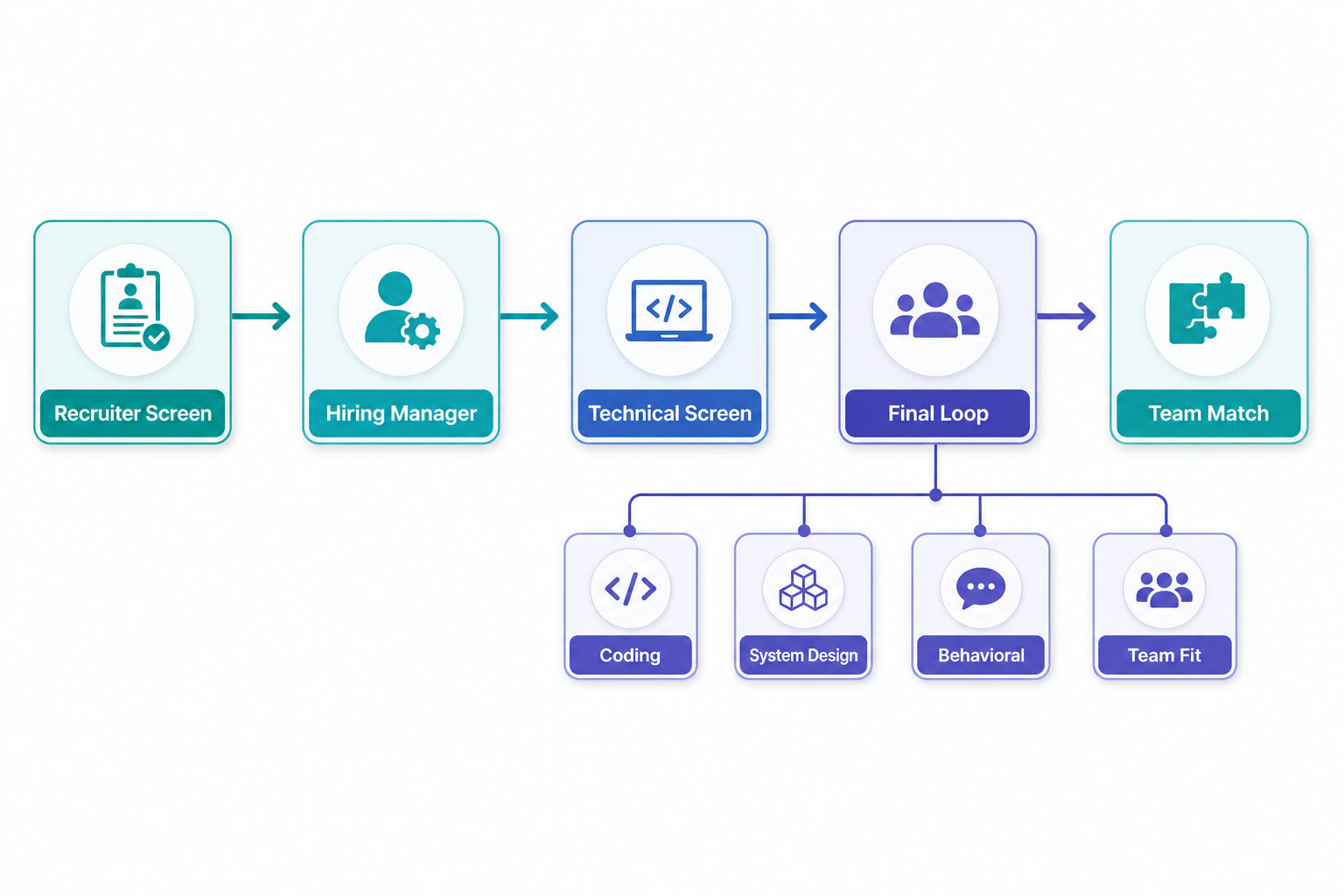
Netflix's software engineer interview is typically less standardized than the loops at many large tech companies. The exact structure depends on the team and level, but candidates most often go through a recruiter screen, a hiring manager conversation, a live technical screen, and then a final loop covering coding, system design, behavioral, and team-fit interviews.
Compared with peer companies, Netflix tends to weight system design, real-world engineering judgment, and culture alignment more heavily than raw algorithm speed. Expect follow-up questions in almost every round. Interviewers usually push past your first answer to test trade-offs, production thinking, candor, and how you operate under ambiguity.
The full process commonly takes a few weeks, though team matching and scheduling can stretch it longer. Because Netflix hires onto specific teams rather than into a general pool, timing depends heavily on whether the right team has an open seat when you finish the loop.
How Netflix differs from a typical FAANG loop
| Dimension | Typical large-company loop | What Netflix tends to emphasize |
|---|---|---|
| Coding | Speed on standard algorithm puzzles | Readable, production-style code and extending real systems |
| System design | Often optional for junior roles | High weight, especially for mid-level and senior |
| Behavioral | Generic "tell me about a time" | Deep culture probing: candor, judgment, ownership |
| Process style | Rigid, scripted rounds | Conversational, follow-up heavy, team-specific |
| Outcome | Hire into a pool | Hire onto a specific team that must want you |
Treat this table as a directional comparison rather than a fixed rulebook. Loops vary by team and level, and individual interviewers run their rounds differently.
Interview rounds
Recruiter screen
A short phone or video call with a recruiter. You'll discuss your background, what you've built recently, why Netflix interests you, role and level alignment, and compensation expectations. This is mainly a calibration and fit screen, so a clear, coherent story matters more than technical depth. Have a crisp two-minute summary of your recent work and a specific reason you want this role, not a generic "I admire the company."
Hiring manager screen
A conversation with the hiring manager or a team lead, usually focused on your past projects: architecture choices, key technical decisions, domain relevance, and how you handle ambiguity or disagreement. For more senior roles, expect questions about leadership, ownership, and scope. This round often doubles as an early team-fit check, so come with questions that show you understand what the team does.
Technical screen
A live coding interview with an engineer in a shared editor, often in the 45 to 60 minute range. You're evaluated on problem solving, code quality, communication, and how you handle follow-up constraints or production-style extensions. Netflix frequently blends standard data-structure problems with more engineering-flavored tasks such as file systems, parsing, concurrency, or implementation trade-offs.
Final loop / onsite
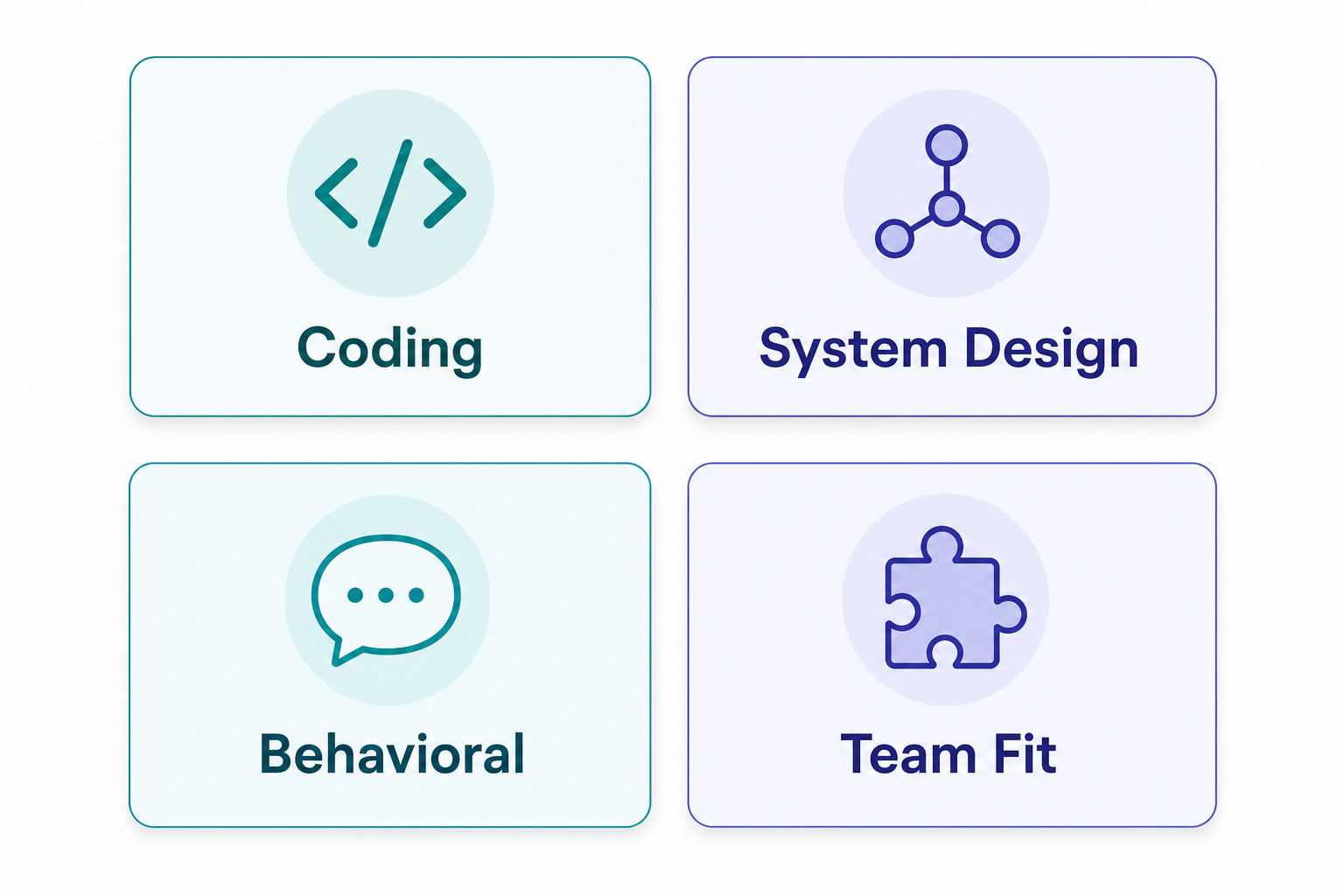
The final loop is usually a full day of interviews (sometimes split across two days), with several rounds. Its components vary by team, but commonly include:
- Coding (1-2 rounds). Beyond correctness, these probe readability, trade-offs, debugging, and extending partially defined systems. You may face ambiguous requirements, discuss time-space choices, or adapt a solution for caching, concurrency, or rate limiting.
- System design. Often the most important component for mid-level and senior candidates. These tend to be conversational architecture discussions rather than rigid whiteboard sessions, with prompts tailored to the team's domain: scale, resilience, multi-region design, failover, caching, CDN strategy, latency, and service trade-offs.
- Behavioral / culture fit. A round focused heavily on Netflix's culture: judgment, candor, ownership, resilience, and whether you can thrive with freedom and responsibility instead of heavy process. Expect detailed questions about tough feedback, disagreeing with managers, hard calls under incomplete information, and which parts of the culture resonate with or challenge you.
- Team-fit / project deep dive. A discussion with engineers or the hiring manager from the actual team. You'll walk through one or two projects covering architecture evolution, incidents, performance tuning, trade-offs, and cross-team collaboration, so they can see whether your experience maps to the team's needs and whether you can speak concretely about impact.
Together, this stage tests whether your technical judgment, ownership style, and communication fit Netflix's high-autonomy environment.
What they test
Coding fundamentals, with a practical flavor. Be ready for arrays, hash maps, graphs, trees, BFS/DFS, dynamic programming, serialization and deserialization, string processing, and object-oriented design basics. In live coding, interviewers often prefer real-world implementation tasks over pure puzzles, so expect to parse structured data, extend an existing system, debug code, or reason about how your solution behaves under concurrency or production constraints. You can drill these patterns on the PracHub question bank and filter to software engineer problems.
System design, high weight for experienced engineers. You should be comfortable designing multi-region distributed systems and explaining trade-offs around availability, consistency, latency, replication, caching, messaging, backpressure, and failure recovery. Netflix-relevant domains come up often: video streaming, CDN and edge delivery, recommendation systems, playback analytics, global traffic routing, adaptive bitrate streaming, and infrastructure serving very large numbers of concurrent users. Interviewers also look for judgment: how you choose between alternatives, what assumptions you make, how you surface risks, and whether you reason clearly when requirements are incomplete.
Behavioral signal, not a side topic. Netflix looks closely at whether you can operate with high autonomy, give and receive direct feedback, challenge decisions respectfully, and take ownership without waiting for instructions. Expect interviewers to test for authenticity and depth, not just polished stories.
The behavioral round deserves real prep
At many companies the behavioral round is a formality. At Netflix it carries genuine weight, and weak preparation here sinks otherwise strong candidates. Netflix has published its culture philosophy openly, centered on freedom and responsibility, candor, and hiring people who behave like owners. Read the current version of that material directly and prepare honest stories that map to it.
The most common trap is rehearsing answers that sound aspirational but lack specifics. Interviewers probe for what you actually did, what trade-off you weighed, and what you'd do differently. Vague, all-positive stories read as unprepared or evasive.
Example answer (constructive disagreement): "On a prior team, my manager wanted to ship a feature behind a tight deadline using a synchronous call to a downstream service. I disagreed because that service had a history of latency spikes that would cascade to our checkout path. I wrote a one-page risk note with the latency data, proposed an async queue alternative, and brought it to our next sync. We adopted the queue. It added two days but prevented a class of timeout incidents. I owned the migration end to end." Notice the structure: a real decision, evidence, a respectful challenge, and a concrete outcome you owned.
What good vs weak behavioral answers look like
| What good looks like | What weak looks like |
|---|---|
| Specific situation with names of systems and real constraints | "I always collaborate well with my team" |
| You state the trade-off you weighed | Only describes the happy path |
| You took an action and owned the result | Credit is diffuse ("we decided to...") |
| Honest about what you'd change | No reflection or learning |
| Connects to a named culture value | Generic, could apply to any company |
Coding: practice the right shape of problem
Pure algorithm speed matters less here than at some peers, but you still need fluency in core patterns. The differentiator is being able to keep your code readable under pressure and extend it when the interviewer adds a constraint. A common pattern is: solve the base problem, then the interviewer asks you to handle concurrency, add caching, or make it resilient to bad input. Practicing the follow-up, not just the first solve, is what separates strong candidates.
When you practice, narrate as you would in the room: state assumptions, name the data structure and why, call out edge cases before the interviewer does, and test with a small example at the end. Work through realistic prompts on the PracHub question bank, and review other interview guides for adjacent companies to broaden your pattern exposure.
System design: lead with trade-offs
For mid-level and senior roles, system design is often the round that decides the outcome. Netflix interviewers tend to value back-and-forth reasoning over a recited framework. Still, a light framework keeps you organized:
- Clarify requirements and scale. Ask about read/write ratios, latency targets, consistency needs, and traffic shape before drawing anything.
- Sketch the high-level architecture. Clients, edge/CDN, services, data stores, async paths.
- Pick data stores and justify them. Tie the choice to the access pattern, not to a default.
- Drill into one or two hard parts. Caching strategy, multi-region failover, backpressure, or hot-key handling.
- Name the failure modes and how you'd detect them. What breaks at 10x, and what's your observability story.
Because Netflix operates a large global streaming platform, prompts often touch streaming delivery, edge caching, recommendation pipelines, or global traffic routing. You don't need insider knowledge of any company's real architecture; you need to reason cleanly about the general problem class. For instance, if asked to design a video delivery path, talk through adaptive bitrate, CDN edge caching, origin shielding, and how you'd fail over a region, framing each as a trade-off rather than a fixed answer.
A 4-week prep plan
This is a template you can compress or stretch based on your timeline. Adjust the weighting toward whichever round is your weakest.
| Week | Focus | Concrete actions |
|---|---|---|
| 1 | Coding foundations | Drill core patterns (graphs, trees, DP, strings); practice narrating out loud |
| 2 | System design | Do 3-4 design mocks; build your own checklist; study streaming/CDN/caching concepts |
| 3 | Behavioral | Write 6-8 stories mapped to Netflix culture values; rehearse with a peer for follow-ups |
| 4 | Integration | Full mock loops; refine two project deep dives; tighten weak spots |
How to prepare and stand out
- Know the culture. Read Netflix's culture principles closely and prepare honest examples for candor, judgment, courage, resilience, and ownership. Interviewers often probe beyond rehearsed answers.
- Clarify before you code. Ask product or production questions early instead of jumping straight into an algorithm.
- Compare alternatives out loud. When presenting a solution, explain why you chose it over the options, based on latency, resilience, complexity, or operational cost.
- Prepare two strong project deep dives. Be ready to discuss architecture evolution, incidents, trade-offs, and measurable impact in detail.
- Practice system design conversationally. Netflix tends to value back-and-forth reasoning and follow-up depth more than reciting a polished framework.
- Study Netflix-relevant domains. Focus on CDNs, multi-region failover, streaming delivery, recommendation systems, caching, and large-scale traffic routing.
- Show constructive disagreement. Have an example where you challenged a decision with evidence, stayed collaborative, and owned the outcome.
Quick readiness checklist
Use this the week before your loop. If you can't honestly check a box, that's where to spend your remaining time.
- I can summarize my recent work in two minutes with specific impact.
- I have a clear, specific reason I want this role and team.
- I can solve core coding patterns and handle a follow-up constraint without rewriting from scratch.
- I have a repeatable system design approach and can lead with trade-offs.
- I have 6-8 behavioral stories mapped to Netflix culture values, each with a real outcome I owned.
- I have two project deep dives ready, including an incident and a hard trade-off.
- I have an example of respectfully challenging a decision with evidence.
How to Use This Page as a Prep Plan
Do not treat this as passive reading. Convert the ideas in this page into a short weekly loop: learn one idea, practice it under interview conditions, then write down what changed. That is the fastest way to turn advice into visible interview behavior.
| Prep area | What you need to prove | Practice artifact |
|---|---|---|
| Understand | Turn the prompt into a concrete goal. | Clarifying questions and success criteria. |
| Practice | Use realistic constraints and timed reps. | Worked examples with edge cases. |
| Explain | Make reasoning visible. | Tradeoffs, assumptions, and test strategy. |
| Improve | Review misses quickly. | A short feedback log and next action. |
For Netflix Software Engineer Interview Guide 2026, the strongest candidates usually do three things well: they make their assumptions explicit, they use concrete examples instead of vague claims, and they review mistakes quickly enough that the next practice rep is better than the last one.
FAQ
How long does the Netflix software engineer interview process take?
It commonly runs a few weeks from recruiter screen to decision, but timing varies. Because Netflix hires onto specific teams, the wait often depends on whether the right team has an open seat and on scheduling for the loop. Treat any single timeline you hear as anecdotal.
Is system design required for junior software engineer roles?
System design carries more weight for mid-level and senior candidates, but you may still see lighter design or design-adjacent questions earlier in your career. Even at junior levels, being able to reason about trade-offs and scale is a strong signal, so it's worth preparing the basics.
How important is the behavioral round at Netflix?
Very. Netflix's culture is a core part of how it evaluates candidates, and the behavioral round is not a formality. Prepare specific stories that map to its published culture values, and be ready for interviewers to probe for what you actually did rather than a polished narrative.
What kind of coding questions does Netflix ask?
Expect core data-structure and algorithm patterns (arrays, hash maps, graphs, trees, BFS/DFS, dynamic programming, string processing) often framed as practical implementation tasks. Interviewers frequently add production-style follow-ups around concurrency, caching, or extending an existing system. You can practice these on the PracHub question bank.
How should I prepare for the culture-fit questions?
Read Netflix's current culture material directly, then write honest stories for candor, judgment, ownership, courage, and resilience. Focus on specifics: the decision you faced, the trade-off you weighed, the action you took, and the result you owned. Avoid all-positive, generic answers, which read as unprepared.
Do I need insider knowledge of Netflix's real architecture for system design?
No. You need to reason cleanly about the general problem class, such as video delivery, edge caching, or global traffic routing. Interviewers care about how you think through trade-offs, assumptions, and failure modes, not whether you can recite any company's actual internal design.