This guide is for software engineers preparing for an Uber interview loop in 2026 - from the recruiter screen to the final behavioral round. You'll get a clear map of each round, what interviewers actually score you on, a topic-by-topic prep plan, and the follow-up patterns that trip up otherwise-strong candidates. It's written for IC roles (roughly L3–L5+), with notes on how the loop shifts as you go up a level.
What to expect
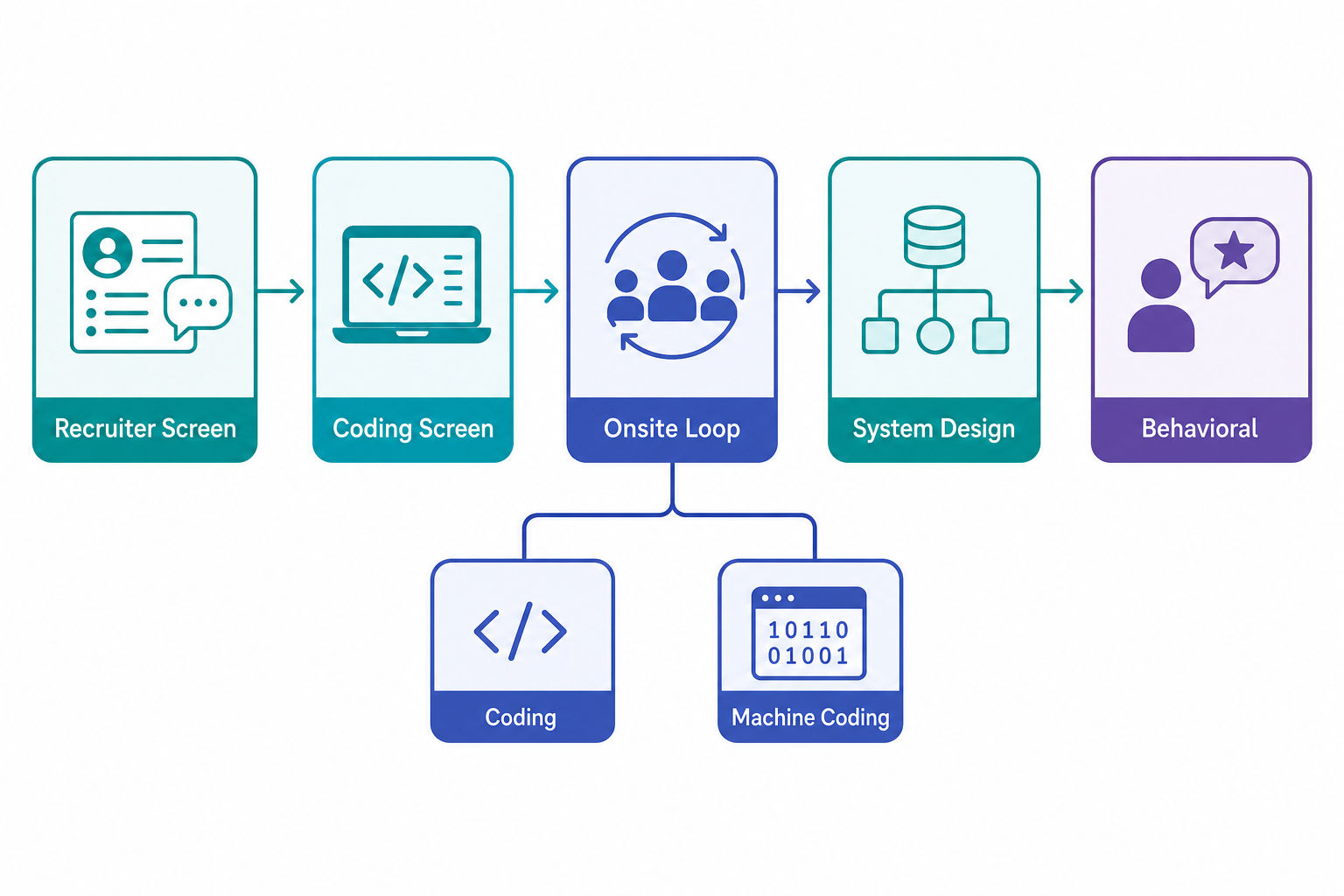
Uber's Software Engineer interview process in 2026 typically starts with a recruiter screen and moves into a technical pipeline that blends algorithmic coding, practical engineering, and collaboration-focused evaluation. Uber frames many of its interviews as real-world problem solving rather than pure puzzle solving, so alongside data-structures-and-algorithms (DSA) questions, expect follow-ups on code quality, tradeoffs, and how your solution would hold up in production.
The exact loop varies by level and team, but a common path is:
- Recruiter screen
- Coding screen or online assessment
- A virtual or onsite loop of roughly 3–5 interviews
Entry-level candidates usually see a coding-heavy process. Mid-level and senior candidates are more likely to encounter machine coding, system design, and behavioral rounds focused on ownership and cross-functional work.
To calibrate against what gets asked in practice, work through real, recently-reported Uber interview questions and the broader PracHub question bank as you read this guide.
The loop at a glance
The table below maps the rounds most candidates encounter to what each one primarily measures. Your specific loop - its length, naming, and ordering - depends on the team and level, so treat this as a map of what's common rather than a fixed checklist.
| Round | Primary focus | Who sees it most |
|---|---|---|
| Recruiter / talent screen | Fit, motivation, logistics, leveling | All candidates |
| Hiring manager chat | Project depth, judgment, ownership | All candidates |
| Online assessment / coding screen | Problem-solving, speed, correctness | Entry to mid-level |
| Technical coding rounds | DSA, clear reasoning, edge cases | All candidates |
| Machine coding / implementation | Production-quality code, design | Some teams, mid+ |
| System design | Architecture, scale, tradeoffs | Mid-level and senior |
| Behavioral / collaboration | Ownership, conflict, impact | All candidates |
| Team / cross-functional panel | Communication, working in ambiguity | Some loops |
Interview rounds
Recruiter / talent screen
A short phone or video conversation covering basic fit, communication, motivation for Uber, and logistics such as location, timeline, and leveling. Be ready to answer "why Uber" and "why this role," and to give a concise walkthrough of your background. Have a target level in mind and a one-line reason it fits - the recruiter often calibrates leveling here.
Hiring manager chat
A conversation focused on whether your experience maps to the team's work, with emphasis on project depth, judgment, and ownership. Be ready to explain tradeoffs you made, how you partnered with product or infrastructure teams, and what impact your work delivered. This is also your best early window to ask sharp questions about the team's scope and roadmap.
Online assessment or coding screen
An algorithmic screen that may be delivered as an online assessment (such as HackerRank or CodeSignal) or as a live coding session, depending on the pipeline. It evaluates problem-solving ability, coding speed, correctness, and complexity analysis. Medium-to-hard questions are common, and graph problems show up frequently.
Technical coding rounds
The onsite loop usually includes one or two live coding interviews. These assess your DSA fundamentals, your ability to structure a clear solution, and how well you explain your reasoning as you code. Expect one hard problem or two medium-to-hard problems, typically with optimization and edge-case follow-ups. Interviewers often favor custom variations over verbatim LeetCode prompts and will probe runtime, memory use, corner cases, and how you would test your solution.
Machine coding / implementation round
For some teams, Uber includes a practical coding round where you implement a small service or realistic object model. This evaluates production-quality code: organization, abstractions, object-oriented design, and sometimes concurrency awareness. Interviewers care less about raw speed than about readability, maintainability, interface design, and sound engineering choices. Practice building something compileable and runnable under time pressure, not just sketching classes.
System design round
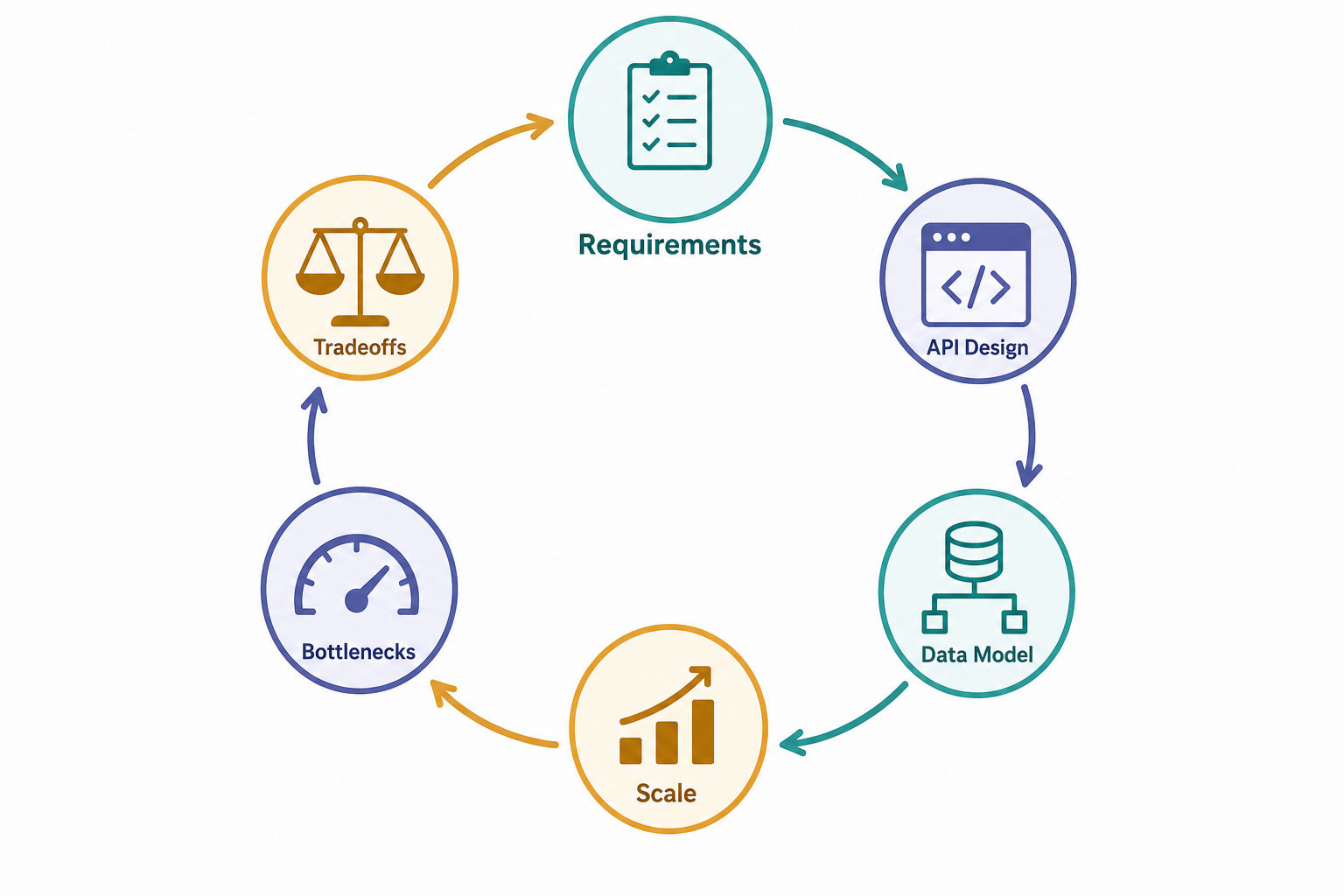
Mid-level and senior candidates commonly face a system design interview. You'll be evaluated on requirement gathering, architecture, API design, data modeling, scalability, reliability, and tradeoff reasoning. Uber tends to favor practical backend or service-design prompts, so be ready to discuss bottlenecks, schema decisions, scaling approaches, and failure handling.
Behavioral / collaboration round
A conversational round that assesses ownership, conflict resolution, cross-functional collaboration, decision-making, and impact orientation. For senior candidates especially, it can lean heavily behavioral, with questions about influence, navigating ambiguity, resilience, and how you measure outcomes. Structure answers with the STAR method (Situation, Task, Action, Result) and lead with the result.
Team / cross-functional interview
Some loops add a team or panel interview that focuses on how you communicate with teammates, work through ambiguity, and collaborate in a fast-moving environment. You may be asked to walk through prior work or discuss an exercise assigned earlier in the process.
What they test
Algorithms and data structures. Uber tests core DSA heavily, but the emphasis is more specific than "just grind LeetCode." Be especially comfortable with arrays, strings, trees, binary trees, graphs, topological sort, hash maps, sets, heaps, binary search, greedy approaches, and DFS/BFS reasoning. Dynamic programming can appear, but graph, tree, and map-heavy problems - plus follow-up pressure - come up more often than classic DP-heavy loops. In coding rounds, interviewers look for whether you clarify assumptions first, explain your approach clearly, handle edge cases, and improve your initial solution when constraints change.
Code quality and practical engineering. In machine-coding and implementation-heavy rounds, you may need to design classes, APIs, or a small service with clean abstractions and maintainable structure. Readability, modularity, SOLID thinking, interface design, and basic testing all matter, and some teams probe concurrency or other real-world concerns.
System design (mid-level and senior). For L4+ roles, expect requirements gathering, API design, database schema decisions, caching, partitioning, reliability, bottleneck analysis, and production tradeoffs.
Fundamentals and impact (varies). Early-career candidates may also see computer-science fundamentals - operating systems, networking, databases - or project walkthroughs. Across all levels, Uber is testing whether you can pair technical depth with practical judgment in a fast-moving business context.
High-frequency topics to prioritize
If your prep time is limited, weight it toward the areas that show up most often in Uber loops:
- Graphs - DFS/BFS, shortest path, connected components, cycle detection.
- Topological sort - dependency ordering and its graph variants.
- Trees and binary trees - traversal, recursion, path problems.
- Hash maps and sets - frequency counting, grouping, dedup, fast lookups.
- Heaps and binary search - top-K problems, search-on-answer patterns.
- Strings and arrays - two pointers, sliding window, interval merging.
Dynamic programming is worth knowing, but for Uber it's usually a lower-yield investment than the graph and tree work above. You can filter practice by topic and difficulty in the coding question bank.
How to prepare
- Build a graph- and tree-heavy practice base. Prioritize traversal, topological sort, and map/set-driven problems, and practice them with optimization and edge-case follow-ups rather than stopping at a first working solution.
- Rehearse thinking out loud. Get comfortable clarifying assumptions, narrating your approach, and reasoning about time and space complexity as you code.
- Practice machine coding like production work. Implement a small service or object model end to end, paying attention to naming, modularity, interfaces, and testability.
- Prepare a system design framework if you're targeting mid-level or senior roles: requirements → API → data model → scale assumptions → bottlenecks → tradeoffs.
- Stock your behavioral stories. Prepare a few concrete examples of ownership, conflict resolution, and cross-functional work, and quantify the outcomes.
- Do timed mock loops. Simulate the pressure of explaining while you code, then handling a follow-up that changes your constraints.
A worked coding example
Here's how a strong candidate handles a typical Uber-style coding prompt - the point is the process, not the specific problem.
Prompt (example): "Given a list of services and their dependencies, return a valid order to deploy them, or detect that no valid order exists."
A strong walkthrough looks like this:
- Clarify. "Are dependencies directed? Can there be cycles? Roughly how many services?" Surfacing the cycle case early is itself a signal.
- Name the pattern. "This is a dependency ordering problem, so topological sort over a directed graph. A cycle means no valid order."
- State complexity up front. "Kahn's algorithm runs in O(V + E) time and O(V + E) space."
- Code it, narrating choices. Build the adjacency list and in-degree map, push zero-in-degree nodes to a queue, pop and decrement.
- Handle the edge case. "If the output count is less than the number of services, there's a cycle - return empty or signal failure."
- Test out loud. Trace one small graph with a cycle and one without.
When the interviewer adds a follow-up ("now there are thousands of services across machines - how would this change?"), the strong candidate connects it back to partitioning and batching rather than restarting from scratch.
Common mistakes to avoid
| Do | Don't |
|---|---|
| Clarify constraints before writing code | Jump straight to coding on assumptions |
| State time/space complexity proactively | Wait to be asked, or guess vaguely |
| Push your solution past the first pass | Stop at a brute-force answer and go quiet |
| Treat machine coding as production code | Write one giant unstructured function |
| Drive system design in a clear order | Jump to databases before requirements |
| Quantify behavioral impact | Describe work only at the team level |
| Narrate your thinking continuously | Code silently for long stretches |
How to stand out
- Open with a sharp, relevant introduction. Connect your background to Uber's products, scale, or marketplace challenges instead of reciting your resume.
- Ask clarifying questions before coding. Uber interviewers often use follow-ups to test whether you noticed hidden constraints, so surfacing them early works in your favor.
- Hold up under follow-up pressure. Candidates frequently report harder optimization and edge-case probing on graph and tree problems, so practice past the first-pass solution.
- Treat machine-coding rounds as production work. Use clear naming, modular structure, and sensible interfaces, and explain why your design is maintainable.
- Drive system design in a practical order: requirements, APIs, data model, scale assumptions, bottlenecks, then tradeoffs.
- Use ownership language and quantify impact. Uber rewards candidates who show concrete results rather than describing work only at the team level.
The throughline: Uber values engineers who balance big-picture thinking with implementation detail and can move fast without sacrificing quality. Show both, and you'll match what these interviews are built to find.
How to Use This Page as a Prep Plan
Do not treat this as passive reading. Convert the ideas in this page into a short weekly loop: learn one idea, practice it under interview conditions, then write down what changed. That is the fastest way to turn advice into visible interview behavior.
| Prep area | What you need to prove | Practice artifact |
|---|---|---|
| Understand | Turn the prompt into a concrete goal. | Clarifying questions and success criteria. |
| Practice | Use realistic constraints and timed reps. | Worked examples with edge cases. |
| Explain | Make reasoning visible. | Tradeoffs, assumptions, and test strategy. |
| Improve | Review misses quickly. | A short feedback log and next action. |
For Uber Software Engineer Interview Guide 2026, the strongest candidates usually do three things well: they make their assumptions explicit, they use concrete examples instead of vague claims, and they review mistakes quickly enough that the next practice rep is better than the last one.
Video Walkthrough
Anubhav Sethi walks through the Uber Software Engineer loop first-hand. It is one candidate's account rather than an official spec, so treat the round order as indicative.
FAQ
How hard are Uber's coding interviews?
Expect medium-to-hard problems, with one hard problem or two medium-to-hard problems common in onsite coding rounds. The difficulty often comes less from the base problem and more from the follow-ups - optimization, edge cases, and constraint changes - especially on graph and tree questions.
How much LeetCode do I need for Uber?
Volume matters less than coverage and depth. Many candidates find that prioritizing graphs, trees, topological sort, and hash-map/heap patterns - and practicing each with follow-ups - beats grinding hundreds of random problems. Uber interviewers also tend to favor custom variations over verbatim prompts, so practice adapting, not memorizing.
Does Uber ask system design for entry-level roles?
System design is most common for mid-level and senior (L4+) candidates. Entry-level loops are usually coding-heavy, though early-career candidates may still see CS fundamentals or project walkthroughs. If you're unsure, ask your recruiter what rounds your specific loop includes.
What's the difference between the coding round and the machine coding round?
The coding round is algorithm-focused: DSA, complexity, and clear reasoning under time pressure. The machine coding (or implementation) round is engineering-focused: building a small service or object model with clean abstractions, good interfaces, and maintainable, runnable code. Speed matters less in machine coding than design quality.
How should I prepare for the behavioral round?
Prepare a handful of concrete stories covering ownership, conflict resolution, and cross-functional work, and structure them with the STAR method. Lead with the result and quantify impact where you can. For senior candidates, also prepare examples of navigating ambiguity and influencing without authority.
How long does the Uber interview process take?
Timelines vary by team, level, and scheduling availability, so there's no single fixed duration. Your recruiter is the best source for an estimate - ask early so you can plan, and check in if you haven't heard back within the window they gave you.
For more role-specific prep, see the software engineer interview hub and browse additional interview guides.