Algo150 Review: Frontend Labs, Layered Hints, and Practice Boundaries
Quick Overview
Read our Algo150 review for a tested latest-response lab, stale-result failures, generation guards, frontend hints, free practice and paid-access boundaries. Dated public observations and original worked examples distinguish tested behavior, author descriptions and unverified capabilities.
Algo150 combines browser-based DSA practice with frontend labs, explanations and hints. Its latest-response lab gave us a concrete feedback result: an implementation that returned every response passed two of four checks, while a generation guard passed all four. The lab tests which request retains permission to return a result.
Start with PracHub’s debounced async autocomplete question and distinguish fewer requests from correct response ordering. Debouncing can reduce how often work starts; it does not automatically prevent an older request from finishing after a newer one and replacing the interface’s current data.
Checked November 3, 2026: official descriptions, our anonymous browser test and an original local Node.js fixture are separated below. We did not purchase access, verify account synchronization or test production React behavior. No independent candidate-outcome evidence establishes hiring effectiveness. PracHub publishes this review and provides the linked preparation questions.
DSA patterns and frontend labs serve different practice needs
The Algo150 homepage presents a 150-problem DSA collection and pattern-based learning. The Interview Prep area adds JavaScript utilities, asynchronous behavior, React logic, TypeScript and frontend design material. Do not assume every area has the same hint structure, runner or scope.
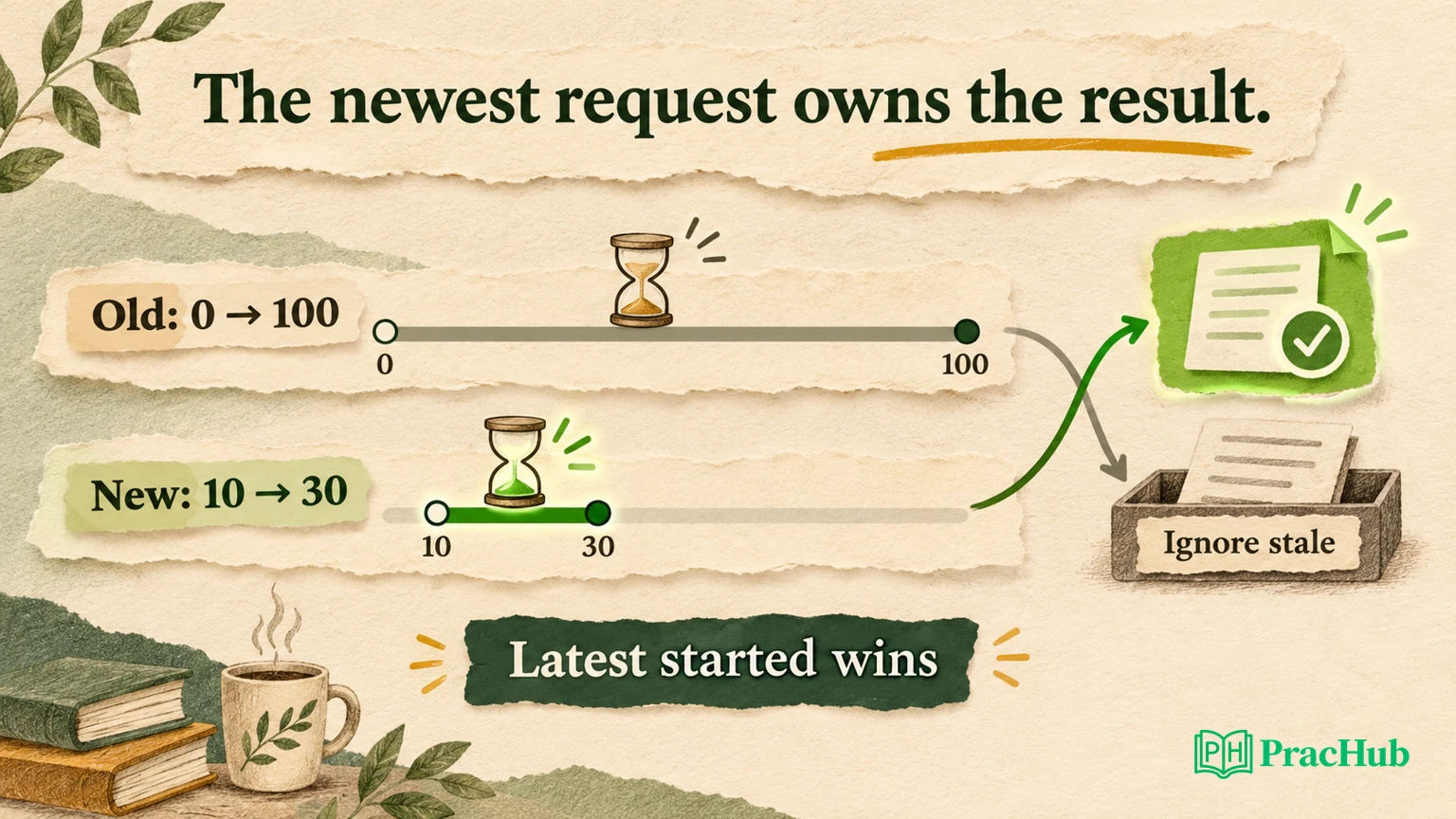
The Only the latest response lab described a wrapper around an asynchronous function. Every call still invokes the underlying function. A fulfilled call should return its value only if no newer call began before it completed; a stale fulfilled call should return undefined.
That is a latest-started contract. It differs from returning whichever request completes last, or cancelling all earlier network requests. Those alternatives can sound similar in conversation while producing different results on the same timeline.
The static lab exposed two hints and a JavaScript reference. The broader DSA material advertised five graduated hints. We would not transfer that five-hint description to this frontend task: the inspected lab had its own narrower help sequence.
Our guest workspace let us open the exercise, request a hint, enter code and run checks. The first hint pointed toward a counter shared across calls. We did not test account-based persistence or whether progress survives a move to another device.
The two-of-four failure was about stale success
Our deliberately wrong implementation returned the underlying function’s result for every invocation. It passed the single-call and non-overlapping cases, but failed the cases in which older work completed after a newer call had begun. The runner showed two of four checks passing.
In the clearest failing trace, the old call began at time zero and took 100 units. A new call began at time ten and took 20, so it finished at time thirty. The expected old-call result was undefined at time one hundred. The wrong implementation instead returned the old value.
| Call | Start | Completion | Expected fulfilled result |
|---|---|---|---|
| Old | 0 | 100 | Undefined, because New began before Old completed. |
| New | 10 | 30 | New value, assuming no further call began. |
The third-call example made the same principle visible across more than two invocations. Calls beginning at zero, ten and twenty finished in a different order. Only the latest-started call retained permission to return its value under the exercise’s contract.
After adding a generation check, the browser reported four of four checks accepted. This demonstrates that the runner distinguished the stale-success behavior in this lab. It does not establish a complete production fetch policy, a cancellation mechanism or correctness under every possible rejection pattern.
The browser outcomes refer to the active implementation in each run. We also tested a clean single-function version locally, with its own controlled completion sequence.
An original clean implementation and local check
The core idea is to assign each invocation a monotonically increasing generation. After awaiting the underlying result, compare the invocation’s generation with the current one. A newer start changes the current generation even if that newer request has not yet finished.
function latestOnly(fn) {
  let generation = 0;
  return async function (...args) {
    const mine = ++generation;
    const value = await fn.apply(this, args);
    return mine === generation ? value : undefined;
  };
}
We tested this clean implementation locally in Node.js with manually controlled promises. We started Old, then New, resolved New first and Old second, and checked that New returned its value while Old returned undefined. A separate rejection check confirmed that an underlying rejection propagated from this implementation.
These local checks are our fixture, not Algo150’s hidden tests. Manually resolving promises controls the relevant ordering without claiming precise real-world network timing. The result demonstrates the declared sequence, not a browser performance benchmark.
The code also preserves the calling receiver through apply. Whether that matters depends on the supplied function. An arrow wrapper would capture its surrounding receiver instead, which could change a method-based use case. Explain the requirement rather than adding receiver handling as a ritual.
The use of an asynchronous wrapper means every call returns a promise. A stale fulfilled call resolves with actual undefined; a display may serialize that as text. Do not mistake the displayed word for a requirement to return the string "undefined".

Acceptance leaves several frontend decisions unresolved
The generation guard does not stop the underlying request. In both the native task contract and our implementation, every invocation still calls fn. Discarding a stale fulfilled result can prevent one kind of UI overwrite while leaving bandwidth, server work and side effects untouched.
If cancellation is required, it needs its own contract and supported mechanism. Decide what the caller sees when work is aborted and whether the server may already have performed an effect. A client-side cancellation signal is not proof that a remote operation never happened.
Rejections also need deliberate treatment. Our implementation propagates them, including a rejection from an older invocation. A UI that shows every rejection could display an old error after a newer request succeeded. If the intended behavior suppresses stale errors, that is an additional policy requiring an explicit branch and tests.
The contract also says latest started, not latest successful. Suppose New starts after Old but then fails. Under the stated generation rule, Old is still stale even if it later succeeds. Falling back to Old would implement a different user experience. Ask which behavior is wanted before “improving” the accepted solution.
Finally, the wrapper alone does not demonstrate an accessible autocomplete. Keyboard navigation, focus, loading indicators, selected-item identity and screen-reader announcements are outside this utility. A frontend interview can ask for those next, so keep the accepted function result distinct from a complete component.
Check what the caller does with a stale result
Returning undefined is only half of the interaction contract. Imagine a caller that always assigns every fulfilled value to its display. New resolves first and renders its value. Old then resolves with undefined, and that caller clears the display. The wrapper followed the lab contract, while the composed interface still produced an unwanted transition.
A caller can instead treat a stale marker as an instruction to leave current state alone, provided undefined is reserved for that purpose. If valid results can themselves be undefined, the interface may need an explicit tagged outcome to avoid ambiguity. This is an original design follow-up, not a behavior tested by the four browser checks.
Explain who interprets the result and which state updates are permitted before presenting the wrapper as a complete repair. The lab isolates response ownership; the caller must preserve that decision when updating visible state.
Use the hints to expose the missing idea
The inspected lab’s first hint suggested a counter in the closure. That is useful if it helps you identify ownership across calls. Reading the reference immediately and reproducing its lines tests recognition more than independent reasoning.
Before requesting the next hint, draw the two-call timeline and write what information is missing when Old finishes. The function needs to know whether another call began since Old’s start. Once you can state that, the generation counter is a response to a specific need rather than an unexplained trick.
After a hint-assisted pass, change the order of completions. Resolve Old while New is still pending, or introduce a third call after New finishes. Predict each promise’s result before running the fixture. This tests the latest-started rule rather than memorization of one input.
Keep a note of the hint you needed and the counterexample you can now explain. A completed-item count does not show whether you can reconstruct the mechanism a week later. A short explanation of the ownership check gives you something useful to review.
Free access, paid extras and independent attribution
The pricing page described the 150 problems, hints, explanations, reference solutions and Interview Prep lessons as free. It separately listed paid learning and recorded material. During our check it displayed a one-time year purchase of $19 and lifetime access of $39 in US dollars, with Georgian-lari alternatives.
Those are official offer descriptions, not purchases we completed. “Lifetime” was described in relation to how long Algo150 operates, and a year was described as non-renewing. Read current purchase terms before treating either phrase as an unlimited service guarantee. Our free lab observation does not verify paid delivery or refund handling.
The credits page states that the 150-problem list follows NeetCode’s public list, while Algo150 supplies its own statements, hints, solutions and other teaching material. It explicitly says NeetCode and LeetCode are not connected with Algo150 and do not endorse it.
That attribution matters when comparing products with overlapping problem names. A familiar list does not establish identical explanations, test coverage or operators. Evaluate the particular learning and execution loop you use rather than assuming two sites are interchangeable because their catalog contains the same problem title.
Five questions for response-order transfer
These independent PracHub prompts extend the asynchronous-input problem into interfaces and fetch behavior. They are not Algo150 integrations or claims about a specific employer’s assessment.
| PracHub question | Focused follow-up |
|---|---|
| Implement debounced async autocomplete input | Separate debouncing starts from ignoring stale completions. |
| Implement an Accessible Autocomplete Search Component | Add keyboard and accessible-state requirements beyond a promise wrapper. |
| Implement Resilient Autocomplete Data Fetching | Choose an explicit policy for old errors and request cancellation. |
| Design a Reusable React Autocomplete Input: API, Portals, Debounce and Caching | Define the reusable component API, cache identity and portal behavior. |
| Build a Debounced Autocomplete Search Bar | Trace timer suppression and latest-response ownership independently. |
The async autocomplete question is the closest continuation. The accessible component adds focus and interaction requirements. Resilient fetching introduces failure and recovery decisions. A reusable input design asks you to defend an API, where cancellation, cache identity and ownership need clear boundaries rather than one universal wrapper.
When comparing another practice platform, use the same narrow experiment: run a plausible wrong implementation, read the mismatch and repair one behavior. PracHub’s ReactChallenges review discusses a different frontend workspace; its observations do not establish Algo150’s features, but the comparison can help you choose between utility reasoning and larger interface work.
Algo150’s inspected lab is a useful free starting point for stale-response reasoning. Use it when the gap is understanding why an earlier request must lose ownership, and extend it when your target interview requires a complete UI. For the next session, take one task from PracHub’s Frontend Engineer questions, add a rejection or keyboard requirement, and explain exactly which accepted behavior your new check changes.
Comments (0)