Amazon QAE New Grad Interview: Test Design, Coding, and Leadership Principles
Quick Overview
Separate Amazon university QAE guidance from candidate reports, then practice test design, coding, debugging, and evidence-based behavioral answers.
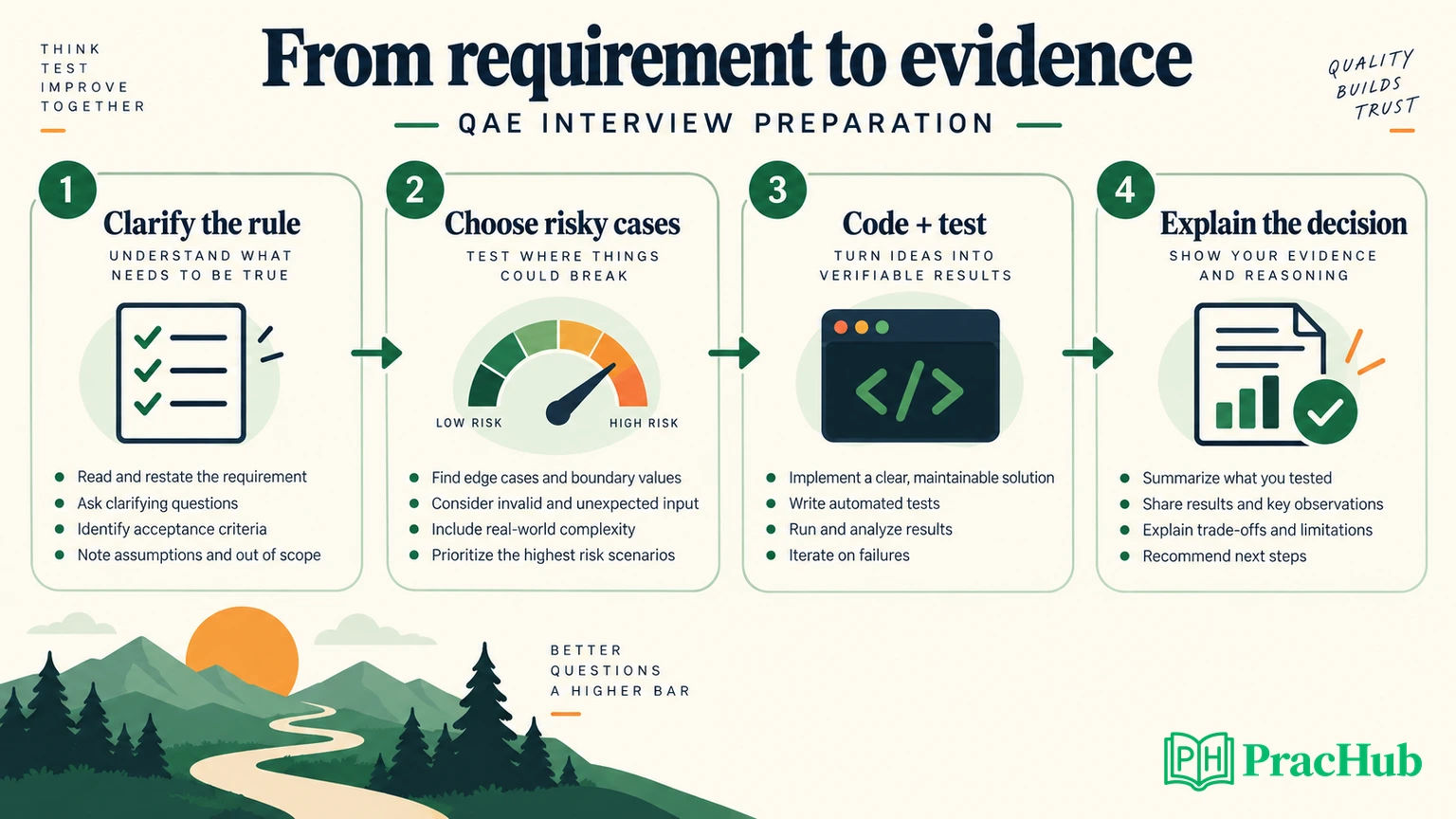
For an Amazon QAE new grad interview, prepare to connect several kinds of engineering judgment: what a product should do, how you would expose a failure, what code can verify, and how you communicate a quality decision. Preparing these as separate subjects makes it harder to explain the thread between them.
The useful preparation unit is one feature: define its rule, design revealing tests, implement a small part, and explain the evidence you would use to ship or escalate. This guide develops that approach through an original shopping-cart exercise. For broader automation and debugging practice, use PracHub's QA and SDET interview guide.
Evidence boundary: Amazon's university recruiting guidance anchors the process discussion. Public candidate accounts below have different or unverified cycles; they do not establish a universal current new-grad loop. The exercises and preparation recommendations are PracHub originals, not reported Amazon questions or actual shopping policies.
What Amazon officially says about university QAE interviews
Official guidance: Amazon describes university QAE work as end-to-end quality ownership, including testing, debugging, and collaboration across engineering and product teams. Its published full-time process starts with one 45–60-minute interview; successful candidates then complete three to four final interviews of 45–60 minutes each. The separate internship description lists two interviews in one round. Technical assessment can include verbal and coding exercises, while behavioral discussion draws on Leadership Principles. Amazon recommends STAR and directs candidates to their job description and recruiter for preparation details. Amazon university technical interview preparation
Treat that as the published university outline. Your invitation determines the actual schedule, tools, and any assessment before the interviews. Ask whether the role is QAE or SDET, which language you can use, and whether the technical discussion emphasizes product testing, automation, or another area. Do not import a senior SDET system-design loop or an SDE online-assessment format into your plan without confirmation.
What candidate reports can and cannot tell you
Candidate report, internship: A first-person account published in November 2025 and titled for the January–June 2026 internship describes testing/debugging discussion alongside coding and behavioral evaluation. It concerns an internship, not a verified full-time new-grad sequence. Read the account
Candidate report, historical: An anonymous Seattle new-grad QAE post dated January 2021 describes coding together with test-case discussion. Its age makes it historical context rather than a current scheduling guide. Read the discussion
Preparation inference: Practice explaining tests while writing code. Neither account supports a universal cutoff, guaranteed question list, or fixed offer timeline. Two independent same-cycle full-time accounts were not established; the sections below therefore teach transferable QAE work without predicting individual rounds.
Test design: turn an ambiguous feature into checkable behavior
Suppose an interviewer asks how you would test a free-shipping eligibility indicator. Immediately listing browsers, devices, and negative cases leaves the central question unanswered: what exactly makes the indicator correct?
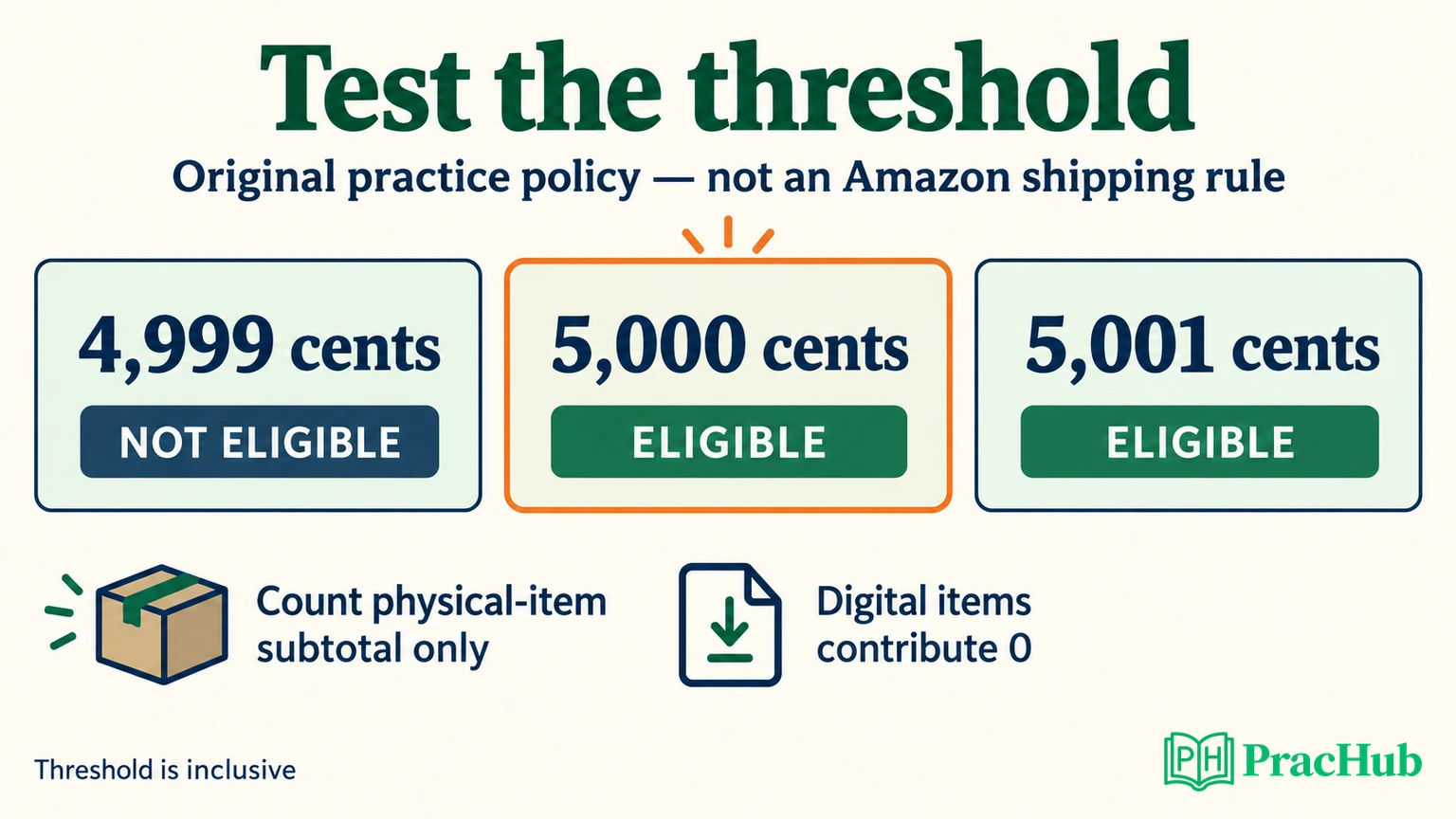
For this fictional exercise, agree on these rules: physical-item subtotal of at least 5,000 cents qualifies; digital items contribute nothing. Prices are nonnegative integer cents, quantities are positive integers, and each line has a Boolean physical-item flag. Input validation happens upstream. Tax, discounts, destination restrictions, and membership benefits are outside this small rule.
State exclusions aloud. In a real discussion, an undefined destination restriction is a requirement question, not permission to invent a policy. Your test oracle—the authoritative expected result—must come from an agreed rule rather than the current UI, which may itself be wrong.
Build a compact, risk-ranked test matrix
| Original cart case | Expected result and purpose |
|---|---|
| Empty cart | False: no qualifying subtotal. |
| One physical item at 4,999 cents | False: immediately below the boundary. |
| One physical item at 5,000 cents | True: the threshold is inclusive. |
| One physical item at 5,001 cents | True: immediately above the boundary. |
| Digital-only item at 6,000 cents | False: a large excluded price must not qualify. |
| Physical item at 2,500 cents, quantity two | True: quantity contributes to subtotal. |
| Physical items totaling 4,000 cents plus a 5,000-cent digital item | False: mixed carts still exclude digital value. |
Explain why these cases earn their place. The three boundary checks distinguish an inclusive threshold from an off-by-one implementation. The mixed cart detects a filter defect even when the displayed total looks comfortably above the limit. Quantity tests expose an implementation that sums unit prices but ignores count.
Then move beyond the pure rule. If a customer removes an item, does the indicator update? If checkout reloads the cart, does it agree with the cart page? If a price changes, which version of the price determines eligibility? Choose a small number of consequential transitions and identify the service or UI evidence you need.
A useful priority statement is: “I would establish the policy boundary and excluded-item behavior first, then verify that a cart update reaches the customer-facing indicator.” This explains the order of work. It does not pretend that seven passing examples prove the entire checkout experience.
Coding: implement the rule, then challenge your own answer
The following Python function implements only the agreed eligibility rule. It assumes already validated tuples of (price_cents, quantity, is_physical); it is not a cart API, payment service, or input sanitizer.
def qualifies_for_free_shipping(items):
    subtotal = sum(
        price * quantity
        for price, quantity, is_physical in items
        if is_physical
    )
    return subtotal >= 5000

cases = [
    ([], False),
    ([(4999, 1, True)], False),
    ([(5000, 1, True)], True),
    ([(5001, 1, True)], True),
    ([(6000, 1, False)], False),
    ([(2500, 2, True)], True),
    ([(2000, 2, True), (5000, 1, False)], False),
]

for items, expected in cases:
    assert qualifies_for_free_shipping(items) == expected
The function makes one pass over the lines: O(n) time and O(1) auxiliary space under the usual fixed-size integer model. The generator avoids constructing an intermediate list. Integer cents keep this exercise away from decimal currency-rounding ambiguity; production currency rules still need an explicit contract.
Do not stop at “all tests pass.” Ask which plausible mistake each test would catch. Changing >= to > breaks the exact-threshold case. Removing the physical-item filter breaks the digital-only and mixed-cart cases. Ignoring quantity breaks the two-unit case. These are small deliberate mutations that test whether the assertions distinguish wrong behavior from correct behavior.
You can also describe relationships between inputs. Reordering cart lines should preserve eligibility. Adding a digital line should not change the answer. Replacing two identical physical lines with one line of combined quantity should preserve it. Such properties extend your reasoning beyond memorized examples, but they supplement explicit expected outputs rather than replacing them.
For a broader coding prompt, use the same habit: clarify the contract, choose a data structure, implement readable code, state complexity, and test meaningful edge cases. If the interviewer changes the rule to “strictly above 5,000,” update both code and expected results. Explain that the old exact-threshold test now encodes an obsolete requirement rather than a product defect.
Debugging and release judgment: separate a bad rule from stale state
Continue the exercise: the eligibility function passes, but removing an item sometimes leaves the badge visible. Your first hypothesis might be a stale UI update. Another is that the backend cart subtotal still includes the removed item. The symptom alone does not distinguish them.
Capture the cart before and after removal, the request and response, the resulting subtotal, and the UI state. If the response correctly falls below the threshold while the badge remains, inspect client state propagation. If the response still includes the item, investigate the mutation or persistence path. A discriminating observation is more useful than rerunning the same journey repeatedly.
For automation, keep the exhaustive rule cases close to the function. Add an API-level transition test for removal and a focused UI check that the badge reflects the returned state. Explain what a mock would hide: a mocked correct subtotal cannot prove that the real cart service updates correctly.
If the failure remains unresolved near a release, communicate impact, reproducibility, affected paths, and available mitigation. Distinguish a misleading badge from an incorrect charge; both matter, but they may require different decisions. Present the remaining uncertainty and who owns it. Do not claim that a retry eliminated the underlying failure.
Leadership Principles: make quality decisions visible in your stories
Official fact: Amazon publishes its Leadership Principles. The mappings below are preparation suggestions, not an official QAE scoring rubric or a ranking of which principles matter most. Amazon Leadership Principles
For Customer Obsession, choose a real project where the affected user changed your priorities. Explain the consequence you were trying to prevent, not merely that you “care about quality.” For Dive Deep, show how you moved from a symptom to evidence that supported one cause over another.
For Ownership, discuss the work you personally followed through: reproducing a defect, coordinating a fix, adding a regression check, or documenting an unresolved limitation. For Insist on the Highest Standards, explain why the existing acceptance evidence was insufficient and what better evidence you introduced. Use actual experiences from coursework, open source, internships, or team projects; do not inflate your authority.
Prepare each story with a short situation and task, a substantial account of your actions, and a result with limits. A useful rehearsal prompt is: “What would my teammate say I did?” It helps separate your contribution from the team's overall outcome.
Expect your own mock interviewer to probe alternatives. Why did you prioritize that defect? Who disagreed? What evidence changed the decision? What did you fail to notice initially? If you measured faster execution, report that as speed; do not convert it into a claim about fewer customer defects without supporting data. An honest remaining weakness often makes the engineering explanation more credible.
Rehearse a disagreement without inventing a heroic outcome
Take a real project in which someone wanted to release while you still had a failing check. Reconstruct the decision: what did the failure demonstrate, how frequently could it occur, and what did your proposed delay cost? If the team chose a narrower release, explain the constraint that made it acceptable. If your concern proved wrong, explain the experiment that changed your mind.
Keep the result proportionate to your evidence. “We reproduced the bug with one request sequence and added a regression test” is a concrete outcome. “I prevented a major outage” requires evidence you may not possess. During rehearsal, have a partner interrupt after your proposed action and ask for the strongest objection. Answering that objection trains judgment more effectively than attaching several principle names to the end of a memorized story.
Five PracHub questions for targeted practice
These links combine Amazon cross-role behavioral practice with testing and debugging exercises from other employers. They are not a verified Amazon QAE question bank. Use the prompt's constraints, then explain your test oracle and evidence as part of the answer.
| PracHub question | How to use it for QAE preparation |
|---|---|
| Develop test plan and TDD for word search | Clarify word-search rules before selecting tests; distinguish different movement contracts. |
| Contrast UI vs backend testing; design UI-change test cases | Defend which boundary can reveal each failure and what a mock would conceal. |
| Debug a Concurrent Job Scheduler | Practice causal debugging and deterministic evidence; treat concurrency as extension work. |
| Answer Amazon Behavioral Questions | Rehearse concise stories with personal actions and evidence-backed outcomes. |
| Describe a complex problem you solved | Explain technical uncertainty, your investigation, and the limits of the result. |
Start with the word-search test-design exercise. Before coding, write its contract and three tests that distinguish plausible incorrect implementations. Then rehearse a project story about a time you had to resolve comparable uncertainty. That pairing keeps coding, testing, and behavioral evidence connected.
Sources and Further Reading
- Amazon university technical interview preparation, including QAE — official university process and role guidance; checked September 8, 2026.
- Amazon Leadership Principles — official values; the story prompts above are original preparation advice.
- QAE internship experience for January–June 2026 — first-person candidate account published November 2025; not full-time process evidence.
- Amazon QAE Seattle new-grad discussion — anonymous January 2021 post; historical context only.
Comments (0)