QA and SDET Interview Guide 2026: Test Strategy, Automation, Flaky Tests, and Debugging
Quick Overview
Prepare for QA and SDET interviews with practical frameworks for risk-based test strategy, automation design, flaky-test diagnosis, debugging, CI, and quality ownership.
A strong QA or SDET interview answer starts with product risk, then chooses the cheapest evidence that can reduce that risk. It explains what belongs in unit, API, integration, UI, performance, security, and exploratory testing; how automation stays maintainable; and how failures become diagnosable rather than merely rerun.
Software Development Engineer in Test (SDET): an engineer who applies software-development skills to testability, automation frameworks, quality tooling, and release confidence. The boundary between QA Engineer, Automation Engineer, and SDET varies by company, so use the current job description and recruiter guidance as the source of truth.
This QA and SDET interview guide is for candidates preparing for test strategy, coding and automation, flaky-test diagnosis, CI debugging, and behavioral ownership. Start with PracHub interview questions and written solutions, then use the framework below to make every answer risk-based and testable.
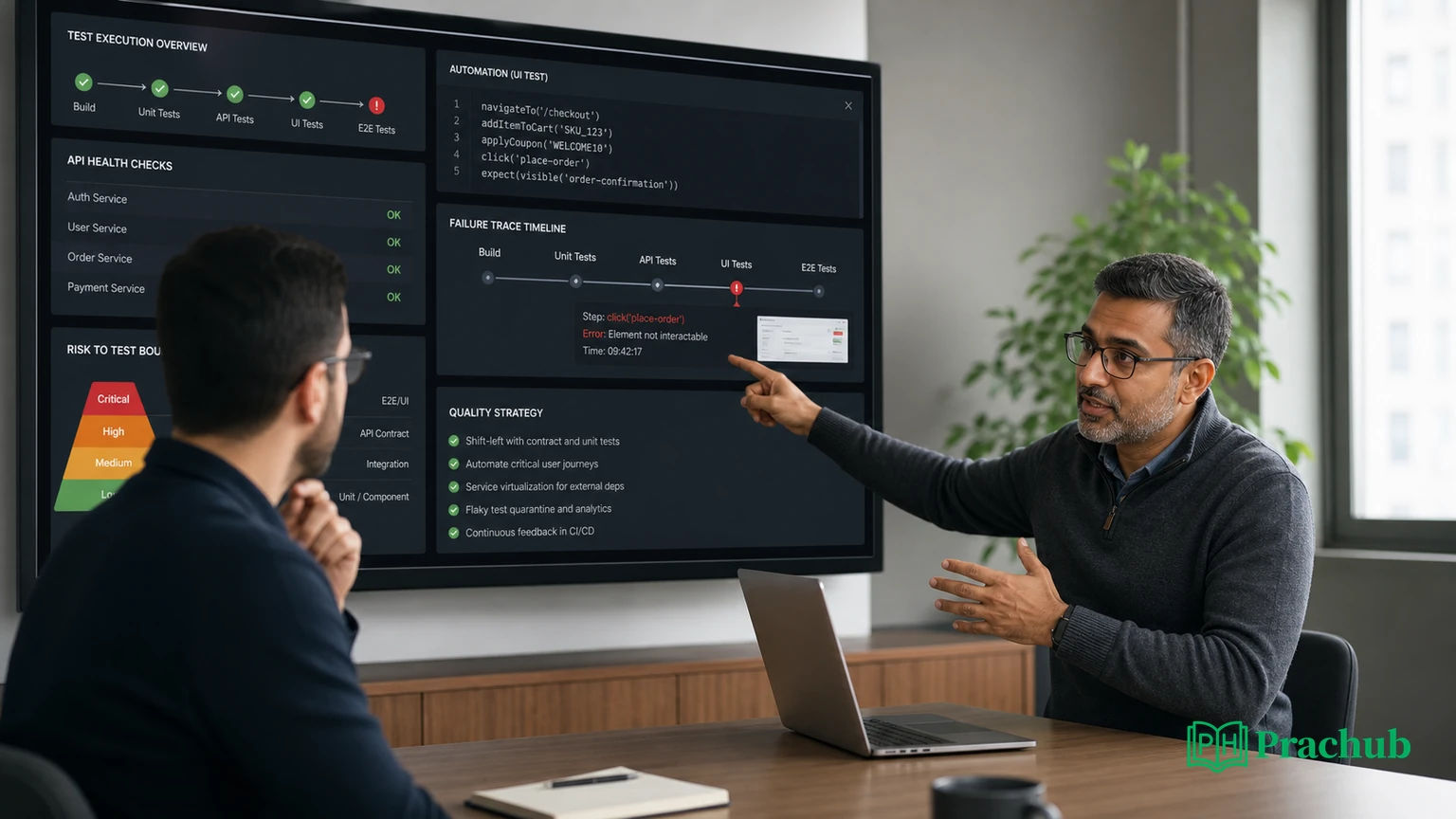
A strong SDET interview connects product risk, test boundaries, automation code, failure evidence, and release decisions.
QA and SDET interview guide: the quick answer
Prepare for five connected evaluation areas. You may be asked to design a test strategy, write or review automation code, choose API versus UI coverage, debug a nondeterministic failure, and explain how you influenced quality without becoming the only person responsible for it.
| Interview area | What a strong answer makes explicit | Weak signal |
|---|---|---|
| Test strategy | User risk, scope, quality attributes, coverage model, environments, data, and exit evidence | Listing test types without prioritization |
| Automation and coding | Interfaces, fixtures, assertions, isolation, maintainability, and failure artifacts | Reciting Selenium or Playwright commands |
| API and UI coverage | Contract boundaries, state transitions, negative cases, and what must remain real | Putting every scenario in slow end-to-end tests |
| Flaky-test debugging | Reproduction, controlled variables, evidence, root cause, containment, and ownership | Adding retries and declaring the problem solved |
| Quality ownership | Release decision, defect communication, metrics, collaboration, and prevention | Treating QA as the final gate after development |
The central interview question is: Can you build a trustworthy feedback system that finds consequential failures early and leaves enough evidence to act?
QA Engineer vs SDET: know the role boundary
Titles are inconsistent. Some QA roles combine exploratory testing, requirements review, automation, and release sign-off. Some SDET roles emphasize coding, test infrastructure, developer tooling, and production-like validation. A current Amazon SDET role describes the work as the intersection of software development and quality engineering, including scalable frameworks and tools across backend and frontend systems.
Do not answer “Why SDET?” with “I prefer testing to coding.” A stronger answer is that you enjoy building systems that make correctness observable, reduce repetitive validation, and help the whole engineering team ship safely.
What can a QA or SDET interview include in 2026?
Expect some combination of a recruiter conversation, coding screen, automation exercise, test-design case, debugging round, framework or system-design discussion, and behavioral interview. The exact mix depends on whether the role owns product validation, test infrastructure, embedded systems, mobile, APIs, performance, security, or developer productivity.
Coding may be general data structures and algorithms, production-code review, or a test-focused task such as parsing results, designing fixtures, exercising an API, or debugging concurrency. Ask the recruiter which language and execution environment are used; whether the design case is product, framework, or CI focused; and whether you should prepare a project presentation.
Use SIGNAL to structure SDET interview answers
Use SIGNAL when a prompt mixes strategy, implementation, and diagnosis:
- Scope the risk. Name the user, behavior, failure cost, constraints, and release decision.
- Identify the oracle. Define the authoritative expected result and the evidence that proves it.
- Ground the boundary. Choose the smallest realistic layer that can expose the risk.
- Neutralize nondeterminism. Control time, data, state, concurrency, network behavior, and environment.
- Analyze the failure. Preserve artifacts, form hypotheses, run discriminating experiments, and prove the root cause.
- Link to action. Decide whether to block, quarantine, fix, monitor, or accept residual risk; assign an owner and deadline.
SIGNAL is a PracHub preparation model, not an employer's official rubric. It makes an answer inspectable: the interviewer can challenge the risk, oracle, boundary, controls, evidence, or decision.
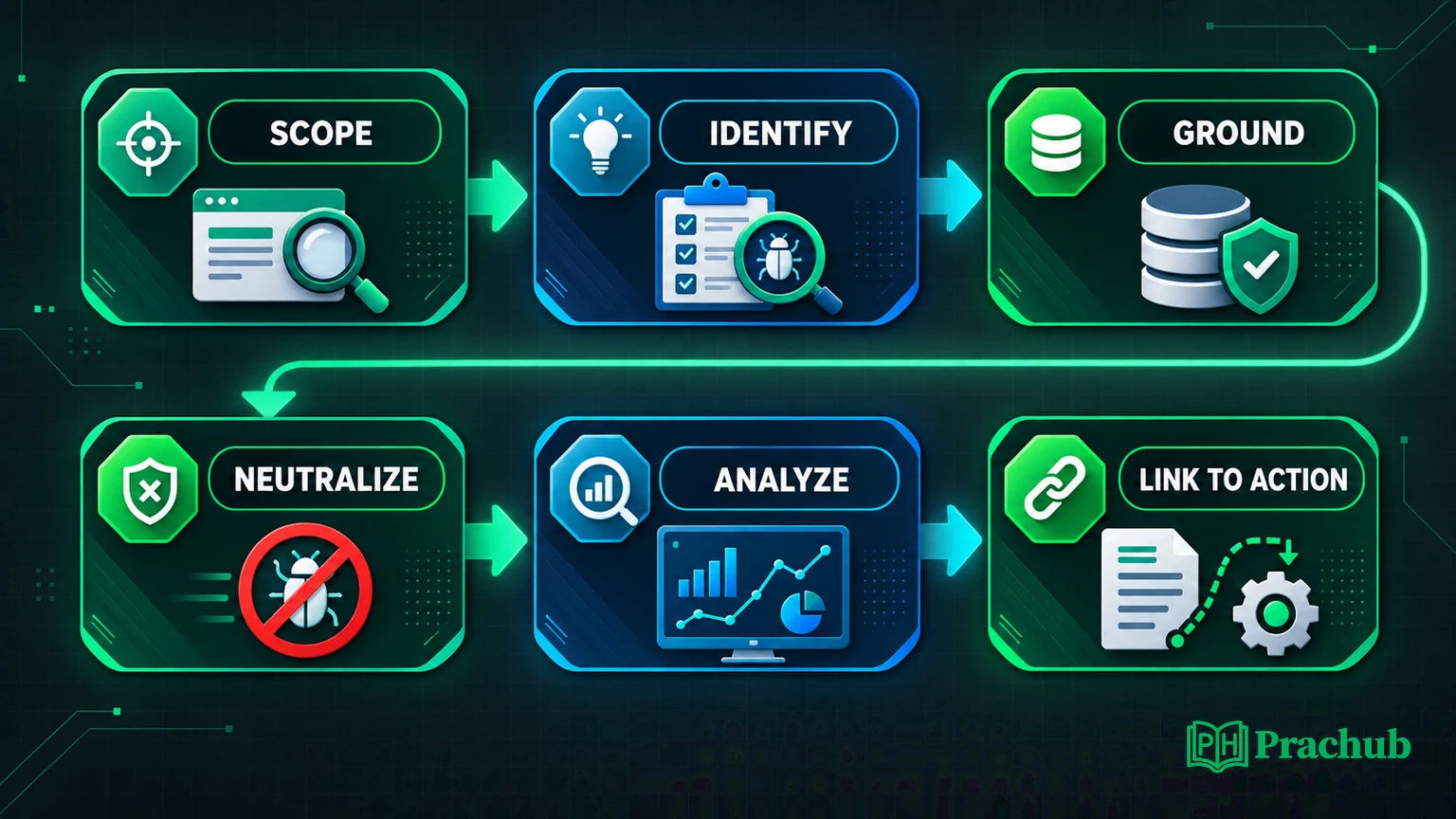
SIGNAL moves an SDET answer from product risk to reliable evidence and an accountable release decision.
Test strategy interview: prioritize risk, not test counts
A test strategy explains how the team will learn whether a product is safe enough for a specific decision. Start with users and failure impact, then identify functional and nonfunctional risks, architecture boundaries, supported platforms, data sensitivity, dependencies, and observability.
The current ISTQB Foundation Level syllabus describes test analysis as deciding what to test using measurable coverage criteria, while test design decides how to test it. It also describes risk-based prioritization: higher-impact and higher-likelihood risks receive earlier or deeper coverage.
Do not use code coverage as the strategy. Coverage can reveal unexecuted code, but it does not prove that assertions are meaningful, critical requirements are covered, or realistic failures were modeled. Define evidence such as decision-table coverage, contract cases, state transitions, supported environments, reliability thresholds, and unresolved residual risks.
Automation interview: design maintainable test software
Automation is valuable when repeated evidence is worth more than the build and maintenance cost. Discuss the system under test, interface boundaries, test-data lifecycle, fixture ownership, assertions, reporting, parallel safety, and how a failed run can be debugged.
A useful automation answer separates policy from mechanism. The test states the behavior and oracle; helpers implement transport, setup, and cleanup; configuration controls environments; and reporters preserve evidence. Avoid a framework full of generic wrappers that hide useful tool behavior or make every test share mutable state.
Official Selenium test-practice guidance recommends avoiding shared state so tests can run independently. In an interview, explain how unique data, per-test fixtures, idempotent cleanup, isolated browser contexts, and deterministic seeds support parallel execution and failure reproduction.
Choose the right boundary: unit, API, integration, or UI
The best test is not automatically the most realistic one. It is the lowest-cost boundary that can detect the target failure with sufficient fidelity.
| Boundary | Strong use | Main limitation |
|---|---|---|
| Unit or component | Pure rules, transformations, edge cases, and fast mutation of inputs | Cannot prove deployed integrations or wiring |
| API or contract | Validation, authorization, schemas, state transitions, idempotency, and service compatibility | Misses browser rendering and client behavior |
| Integration | Database, queue, dependency, serialization, configuration, and environment contracts | Slower and harder to isolate than a unit test |
| UI or end to end | Critical user journey, accessibility behavior, browser integration, and a small release smoke path | Expensive, slower, and vulnerable to unrelated dependencies |
For deeper browser-specific preparation, use the frontend testing interview questions guide. In this role-level guide, the important skill is defending the boundary and stating what remains untested.
Flaky tests: diagnose nondeterminism systematically
A flaky test produces different outcomes without a relevant change to the intended inputs or code. First verify that the instability is actually in the test signal: an unavailable dependency, exhausted runner, or real product race may be the failing component.
Collect the first-failure artifacts before retry changes the system: timestamps, seed, worker, environment, logs, network activity, trace, DOM snapshot, resource pressure, and test data. Then classify the likely cause—shared state, timing, order dependence, unstable selector, concurrency, randomness, external service, environment drift, or an ambiguous oracle—and vary one factor at a time.
Playwright's retry documentation labels a test that fails initially and passes on retry as flaky. Retries can contain disruption and gather evidence, but they do not prove health. Quarantine needs visible coverage impact, an owner, a repair deadline, and a replacement release signal for critical behavior.
Google reported in a 2016 first-party study of its own CI transitions that 84% of observed pass-to-fail transitions involved a flaky test. That historical, company-specific figure is not a universal benchmark; it illustrates why noisy suites train teams to distrust legitimate failures.
Debugging and CI: preserve an evidence trail
When a test passes locally but fails in CI, align the environment before editing the assertion: commit, dependencies, container image, browser, locale, time zone, parallelism, test order, seed, credentials, and resource constraints. Reproduce the failing shard or worker and compare a green and red run.
Playwright's current best-practices guide recommends trace-based CI debugging because traces capture actions, DOM snapshots, and network requests. Tool choice is secondary to the method: state the invariant, form a hypothesis, predict the differentiating observation, run the experiment, and verify that the fix prevents recurrence.
For pipeline-specific depth, continue with PracHub's CI/CD interview questions.
Practice with QA and SDET questions from PracHub
These question-bank records train relevant judgment. They are practice material, not predictions of your exact interview.
| PracHub question | Practice focus | Why it helps |
|---|---|---|
| Answer SDET internship behavioral interview questions | Motivation, quality mindset, trade-offs, and collaboration | Builds role-specific behavioral evidence beyond generic STAR answers. |
| Contrast UI vs backend testing; design UI-change test cases | Boundary selection, contracts, negative cases, and coverage | Forces a defensible test matrix across UI and service layers. |
| Build a Jenkins CI for graphics tests | Test orchestration, sharding, artifacts, retries, and gates | Exercises test-infrastructure design under scarce hardware constraints. |
| Debug a Concurrent Job Scheduler | Races, deterministic tests, retries, and observability | Trains coding, debugging, invariants, and test design together. |
| Walk Through Your Hardest Debugging Investigation | Hypotheses, evidence, root-cause proof, and prevention | Produces a behavioral story with technical depth and causal reasoning. |
A seven-day QA and SDET interview plan
| Schedule | Focus | Required output |
|---|---|---|
| Day 1 | Role and risk | One loop map and a risk-ranked test strategy for the target product |
| Day 2 | Coding | Two timed problems plus tests for edge cases and failure behavior |
| Day 3 | Automation | One small API or UI suite with isolated data and useful failure artifacts |
| Day 4 | Test design | One boundary matrix covering functional, negative, security, and reliability risks |
| Day 5 | Flakiness | Diagnose one intentionally unstable test using SIGNAL |
| Day 6 | CI and debugging | Reproduce a local-versus-CI difference and explain the evidence trail |
| Day 7 | Mixed mock | Run a 45-minute mock, then rewrite the weakest answer and one behavioral story |
Frequently asked questions
Do SDET interviews include data structures and algorithms?
Often, but not universally. Some employers use a standard software-engineering coding screen; others use automation, debugging, API, or framework exercises. Confirm the format with the recruiter, practice the language named in the job description, and be ready to write production-quality code with tests and complexity reasoning.
Should I memorize Selenium, Playwright, Cypress, or Appium APIs?
Know the tool named in the role, but prioritize durable reasoning: locator stability, wait semantics, isolation, fixtures, data, assertions, parallelism, artifacts, and maintainability. Interviewers can adapt a framework question; a candidate who understands the underlying failure modes can translate the answer across tools.
How do I answer “design a test strategy”?
Clarify the product, users, release decision, architecture, quality attributes, platforms, and constraints. Rank risks by likelihood and impact, choose coverage boundaries, define environments and data, state entry and exit evidence, and name residual risks. Finish with what would change the strategy as new evidence arrives.
Is a retry acceptable for a flaky test?
A limited retry can reduce immediate disruption and preserve additional evidence, but the first failure must remain visible. Treat a pass-on-retry as a flaky event, not a clean pass. Quarantine only with replacement coverage, a named owner, a deadline, and metrics that prevent the queue from becoming permanent.
What metrics should an SDET discuss?
Use metrics tied to decisions: defect escape rate by risk area, flake rate, time to diagnose, suite duration, queue time, failure-signal precision, critical-path coverage, and age of quarantined tests. Avoid optimizing test counts or code coverage alone; both can rise while release confidence stays unchanged.
Final takeaway
The strongest QA and SDET interview guide is a reasoning system, not a tool glossary. Scope the product risk, define the oracle, choose the right boundary, control nondeterminism, analyze evidence, and connect the result to an accountable release decision.
Practice the five linked scenarios on PracHub, then explain each solution aloud with SIGNAL. Your goal is to show that automation creates trusted evidence—and that you can debug the test system when the evidence itself becomes unreliable.
Sources and Further Reading
- Amazon Software Development Engineer in Test role
- ISTQB Certified Tester Foundation Level v4.0 overview
- ISTQB Foundation Level Syllabus v4.0.1
- Playwright best practices
- Playwright test retries
- Selenium guidance on avoiding shared state
- pytest documentation on flaky tests
- Google Testing Blog: Flaky Tests at Google and How We Mitigate Them
- OWASP Web Security Testing Guide
Research note: This guide was checked on September 1, 2026. QA and SDET responsibilities and interview processes vary by employer, team, product, location, seniority, and recruiting cycle; use the current job description and recruiter guidance as the source of truth.
Comments (0)