Amazon Security Engineer New Grad Interview: Security Scenarios and Preparation
Quick Overview
Prepare for the Amazon Security Engineer new grad interview with clearly labeled official guidance, one 2026 candidate account, original security scenarios, project stories, and conditional scripting practice.
For an Amazon Security Engineer new grad interview, prepare to explain a security decision from the initial uncertainty through investigation, mitigation, and verification. Build that explanation around projects you understand deeply, and prepare Leadership Principle stories with the same level of detail. Confirm coding expectations with your recruiter before deciding how much preparation time to spend on algorithms.
The evidence needs careful reading: Amazon's official general security-engineer guide and one completed 2026 new-grad account describe different loop lengths. Neither establishes a universal university-hiring format. This guide separates those sources and offers original scenarios you can rehearse. For additional story practice, use PracHub's Behavioral & Leadership questions.
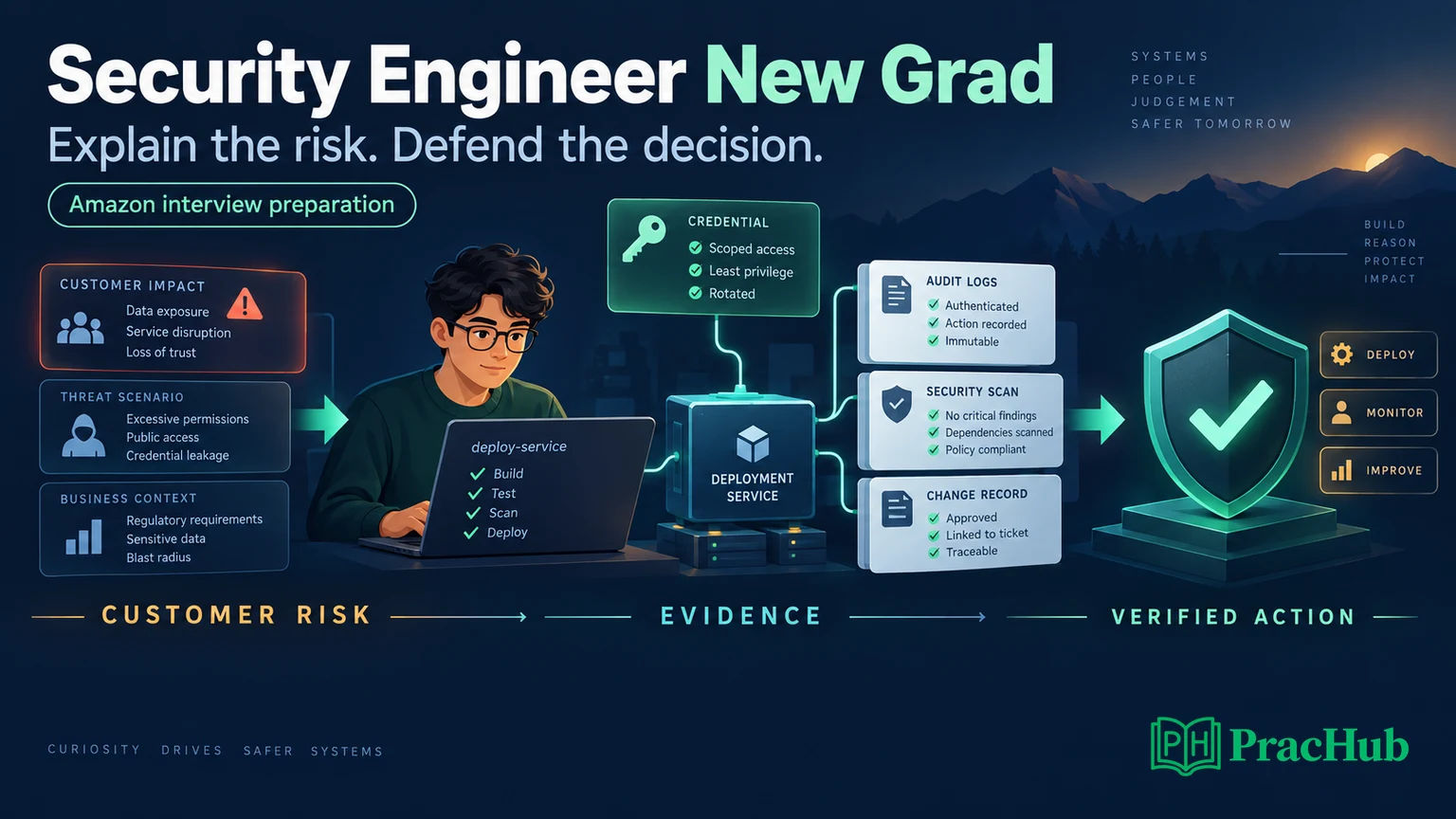
What is confirmed about the Amazon security interview?
Official fact: Amazon's general Security Engineer Interview Prep page describes one or two technical phone screens and a loop of five 60-minute interviews. It lists secure code review, scripting and automation, threat modeling, security testing, web vulnerabilities, cryptography, and security fundamentals as technical competencies. Behavioral evaluation draws on Leadership Principles; Amazon recommends structured examples using STAR.
Candidate report: One candidate described a completed August 5, 2026 new-grad loop with three interviews. Their account included a project deep dive, an incident-investigation scenario, discussion of GenAI for a security problem, and Leadership Principle questions. They reported no coding or scripting in that particular loop. Their completed-loop post and earlier recruiting thread share the same author, so they count as one experience.
Preparation inference: Keep security reasoning and project evidence central, while maintaining a coding baseline. We did not establish two independent completed reports from the same new-grad cycle. A single coding-free loop cannot justify skipping scripting, and the general official guide does not confirm your university loop's schedule.
Send your recruiter a short format check: “For this requisition, how many sessions should I expect, and which involve live coding, secure code review, security scenarios, or project discussion? Which language and tools are permitted?” Save the answer alongside your invitation.
Rehearse an incident without jumping to a verdict
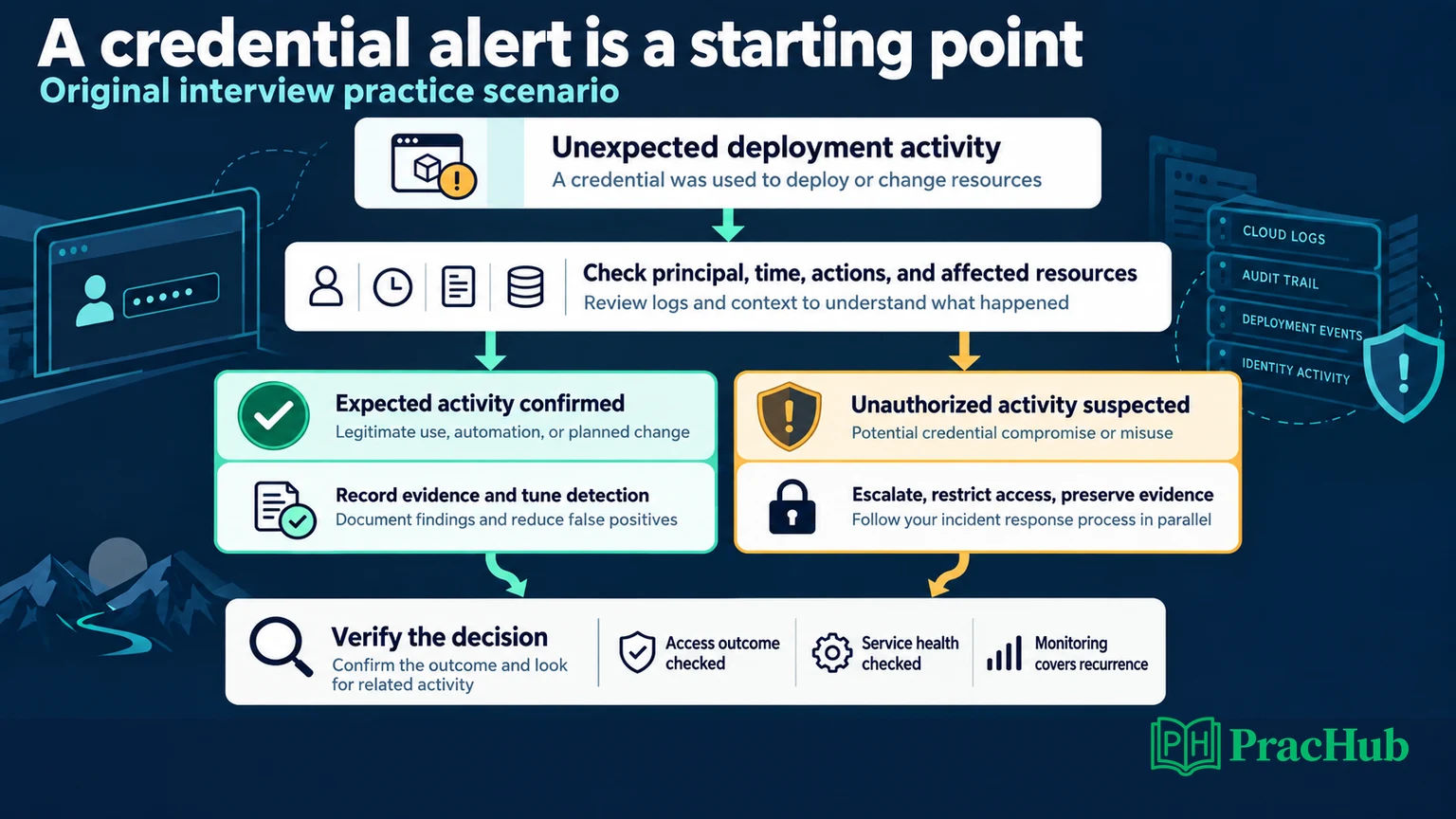
Original practice scenario, not a reported Amazon question: You helped build a campus application. An alert shows its deployment credential making unexpected requests overnight. The service is still available, and a teammate says a release might explain the activity.
Start by clarifying what the alert establishes. An unfamiliar location is a signal; it does not prove compromise. Ask which identity acted, which operations succeeded, what resources were touched, and whether the events match an approved deployment. Establish the time window and any gaps in telemetry.
Then explain two competing hypotheses: legitimate automation changed its behavior, or an unauthorized party used the credential. Name evidence that could separate them: deployment records, principal identifiers, request history, permission changes, and the service owner's account. Avoid treating a teammate's reassurance as confirmation.
If the evidence suggests active misuse, involve the incident owner and propose proportionate containment while preserving evidence. Technical background: AWS's containment guidance emphasizes limiting further damage while retaining evidence and considering service impact. That guidance supports the exercise; it is not an Amazon interview rubric.
For this hypothetical application, explain how restricting the affected identity could interrupt deployment, who can authorize the change, and what monitoring should continue. Credential replacement alone may not address already-issued sessions or permissions changed during the incident. State those as investigation questions rather than assuming every credential system behaves identically.
A concise opening answer might be:
“I would check whether the principal and actions match the scheduled release while identifying the potentially affected resources. If unauthorized activity is ongoing, I would escalate and restrict the affected access in parallel with evidence preservation. I would verify both that the restriction works and that the application remains healthy.”
Follow that with a concrete verification plan. Test the intended access restriction using an approved check; confirm legitimate deployment still works through the replacement path; inspect subsequent events; and record remaining unknowns. Describe customer exposure only as far as the evidence supports it.
Keep an investigation note with three separate fields: observed facts, working hypotheses, and the next evidence request. For example, an observed fact might be a successful deployment by a particular identity at 02:14; a hypothesis might be that a scheduled runner triggered it. The next request is the runner's execution record. If that record is unavailable, retain the uncertainty and explain how it affects your containment decision.
If new information shows the activity was legitimate, revise the hypothesis openly. Close the false positive with evidence and improve the detection rule without creating a blind spot. This makes your reasoning easier to assess than defending your first guess.
Turn the same student project into a threat model
A project discussion can reveal whether you understand why a control exists. Use the campus application's deployment pipeline as a second original exercise: a contributor submits a change, a build runner creates an artifact, and a deployment identity releases it.
Technical background: OWASP's threat-modeling overview connects system scope, threats, countermeasures, and validation. Apply that structure to this small pipeline before expanding into a catalog of vulnerabilities.
Draw the trust boundaries between contributor input, build execution, artifact storage, and deployment authority. Identify what needs protection: deployment permissions, artifact integrity, service availability, and user data. Ask whether untrusted contributions can reach secrets or influence a privileged release.
Choose one threat to explore: an untrusted change alters the artifact that will be deployed. Explain where review and artifact verification happen, which identity can approve a release, and how deployment is tied to the approved artifact. Then challenge your design: what if the build runner is compromised, or an administrator bypasses the normal path?
Your mitigation should have a testable claim. For example, “A contributor without release permission cannot promote an arbitrary artifact.” Describe a negative authorization test and a positive test for an approved release. Add the audit event you would inspect to distinguish a denied attempt from a missing log.
For a new graduate, a limited but accurate explanation is useful. Say which pieces you built, which platform controls you configured, and which assumptions you have not tested. Do not turn a classroom prototype into an invented production-security achievement.
Build Leadership Principle stories from verifiable work
Official fact: Amazon's Leadership Principles include Customer Obsession, Ownership, Dive Deep, and Earn Trust. The mapping below is our preparation advice, not a published weighting of those principles for security new grads.
Select experiences from internships, research, student teams, or maintained personal projects. Prepare a concise STAR opening: situation, task, action, and result. Then keep the technical evidence ready for follow-ups. A small project with honest boundaries gives you more to discuss than an impressive claim you cannot substantiate.
| Project moment | Principle to rehearse | Evidence and follow-up to prepare |
|---|---|---|
| You prioritized a permissions defect before a demo | Customer Obsession | Who could be affected, what access was possible, and why the chosen fix protected them |
| You closed a deployment gap outside your assigned ticket | Ownership | Your decision, the responsible owner you involved, and the lasting change |
| An alert contradicted the team's initial explanation | Dive Deep | The events you compared, rejected hypotheses, and what changed your mind |
| You disclosed a mistaken assumption in your analysis | Earn Trust | How you communicated the correction and checked its consequences |
Use real measurements with their scope. “The regression suite covered twelve permission combinations” is defensible if you ran those tests. “I prevented a breach” usually requires evidence you do not have. If there were no production users, explain the test environment and the limitation.
Rehearse interruptions: Why this control? What alternative did you reject? What did you personally do? What failed? Which result would have changed your decision? Avoid memorizing a speech so tightly that these questions break it.
Prepare scripting and code review as a conditional branch
Until the format is confirmed, keep one familiar language ready for small data-processing tasks. This is a preparation recommendation, not a claim about the frequency of Amazon security coding questions. Increase coding practice if your invitation explicitly includes it.
Try this original scripting contract: given structured authentication events with tenant, user, time, and outcome, count failures per tenant and user within a specified interval. Define the interval as start-inclusive and end-exclusive. Return groups meeting a threshold; report malformed records separately. Assume each input event appears once unless the interviewer adds duplicate delivery.
Before writing code, clarify timestamp representation, valid outcomes, threshold behavior, and ordering. Test an event exactly at each boundary, an empty input, a malformed timestamp, and identical user names in different tenants. Explain the memory cost of keeping one counter per distinct tenant-user pair. If duplicate events become possible, ask for a stable event identifier before proposing deduplication.
For a tiny check, use interval [100, 200) and threshold two. Give tenant A's user Sam failures at 100 and 199, another at 200, and tenant B's Sam one failure at 150. Only tenant A's Sam qualifies, with count two. Explain why the final timestamp is excluded and why the two tenants remain separate. These are synthetic values for practice.
Then review a small access-control function. Check whether it authorizes the authenticated caller to perform the requested operation on the requested resource. Authentication alone does not answer that question. Explain a failing permission case, the smallest correction, and the regression test you would add.
For broader topic revision, PracHub's Security Engineer Interview Guide covers the general role. Use this article for the narrower Amazon new-grad preparation decision.
Discuss GenAI through evidence and limits
The GenAI discussion in the single candidate account is a reason to prepare one thoughtful example. It is not evidence that every loop contains an AI round or permits live AI assistance.
An original practice example: you used an approved model to propose investigation queries against synthetic logs. Explain what you supplied, what sensitive context you withheld, and how you checked the queries against a known incident timeline. Compare the result with a manual baseline and identify a misleading suggestion you rejected, if that actually happened.
Separate drafting speed from correctness. A query that runs can still omit the relevant identity or use the wrong time boundary. Explain how you would detect those errors. If you have not used GenAI in security work, say so and discuss a hypothetical evaluation clearly; do not invent a project. Follow the interview's stated tool rules.
Five practice questions to use selectively
These are adjacent-role practice records, not a verified Amazon Security Engineer new-grad question set. Four are tagged Amazon Software Engineer; the parsing exercise is tagged Apple Software Engineer. Use each for the specific skill listed, without treating its company or round tag as a prediction.
| PracHub question | How to use it for this preparation |
|---|---|
| Taking Ownership of a Technically Risky Project | Defend your individual decision and its measured consequences |
| Describe projects and handle challenges | Rehearse project detail, feedback, and alternatives |
| Evaluate an AI-Assisted Engineering Workflow | Explain permitted context, verification, and a comparison baseline |
| Design a risk management ticketing system | Focus on authorization, ownership of findings, and auditability |
| Parse and Summarize HTTP Access Logs | Practice strict parsing and accurate counts if scripting is relevant |
Start with one story from PracHub's Behavioral & Leadership questions. Record a short answer, then ask a practice partner to challenge your evidence and one technical decision. Finish by checking your confirmed interview format and rehearsing the security scenario aloud.
Sources and Further Reading
- Amazon: Security Engineer Interview Prep — official general-role guidance.
- Amazon: Leadership Principles — official principle definitions.
- 2026 candidate's completed new-grad loop — one firsthand, unverified account.
- Same candidate's earlier recruiting thread — timeline context, not independent corroboration.
- AWS Security Incident Response: Contain — technical background.
- OWASP: Threat Modeling — technical background.
Evidence checked September 8, 2026. Team, location, requisition, and hiring cycle can change the process; use your recruiter and invitation to confirm your format.
Comments (0)