Security Engineer Interview Guide 2026: Threat Modeling, Coding, and Security Design
Security engineer interviews are hard for a reason: the prompt may sound narrow, but the interviewer is watching how you move from an incomplete threat to an engineering decision. A candidate who lists vulnerabilities can still underperform if they never define the asset, trace the trust boundary, prioritize the risk, or explain how a control will be verified.
This guide gives you a repeatable way to handle that ambiguity. Start with PracHub interview questions with written solutions, then use the frameworks below to practice threat modeling, coding, security design, incident judgment, and cross-functional communication as one connected skill.
Quick Answer: What Does a Security Engineer Interview Test?
A strong security engineer interview answer is not the longest list of controls. It is a defensible risk decision: what matters, what can go wrong, which controls reduce the most meaningful risk, what residual risk remains, and what evidence will prove the design works.
Most loops combine four capabilities. You need enough coding fluency to automate or review, enough systems knowledge to reason across components, enough security depth to identify realistic abuse cases, and enough communication skill to influence teams that may not report to you.
First Identify Which Security Track You Are Interviewing For
“Security engineer” is an umbrella title. Ask the recruiter which team owns the role and read the job description for repeated verbs: review, build, detect, respond, govern, or partner. That language predicts the interview better than the title alone.
| Track | Likely interview focus | Strong preparation signal |
|---|---|---|
| Application / Product Security | Threat modeling, code review, authentication, APIs, secure SDLC | Connect each finding to an exploit path, product impact, and testable fix |
| Cloud / Infrastructure Security | IAM, networks, secrets, containers, platform guardrails | Trace effective permissions and blast radius across accounts and services |
| Detection / Response | Telemetry, triage, containment, investigations, recovery | Separate immediate containment from root-cause work and preserve evidence |
| Security Engineering Core | Coding, automation, architecture, risk prioritization, influence | Build usable controls and explain trade-offs to engineering and product teams |
For deeper track-specific preparation, use PracHub's guides to cloud security interview questions, incident response interview questions, and AI security interview questions.
What the Interview Loop Usually Looks Like
A typical loop may include a recruiter screen, a coding or automation round, a threat-modeling or security-design interview, a code-review scenario, and behavioral conversations. Some teams replace classic algorithm questions with log parsing, policy evaluation, repository debugging, or a short take-home project.
Across those formats, interviewers usually score the same underlying signals: scope, technical correctness, prioritization, operational realism, and communication. Senior candidates are also expected to name control ownership, rollout and migration risk, exception handling, observability, and residual risk instead of treating a diagram as the finish line.
Use a Seven-Step Security Reasoning Framework
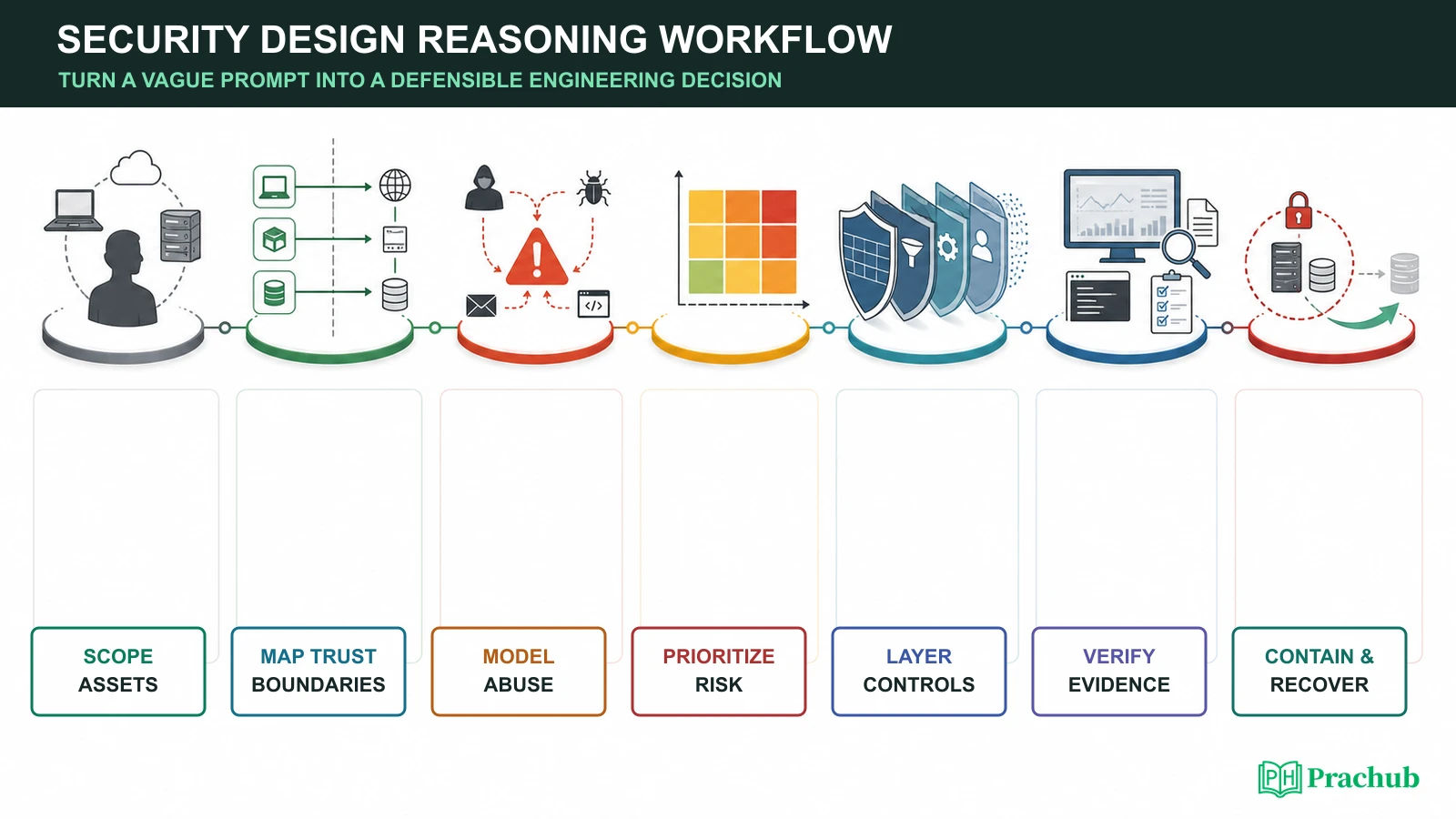
1. Scope the assets, actors, and business impact
Begin by clarifying what must be protected and from whom. Name sensitive data, credentials, money-moving actions, privileged tools, availability requirements, legal constraints, and the users or services that legitimately need access.
This prevents a common mistake: proposing expensive controls for low-impact paths while ignoring the system's most valuable asset. If the prompt is vague, state a reasonable assumption and explain which answer would change if that assumption is wrong.
2. Map data flows and trust boundaries
Draw the request from client to edge, service, queue, database, object store, third-party dependency, and administrative plane. Mark where identity changes, where data crosses tenants or regions, and where an untrusted input becomes a privileged action.
A clear flow diagram creates the surface for the rest of the interview. It also lets the interviewer challenge one boundary at a time instead of debating an abstract list of threats.
3. Model credible abuse, then prioritize it
STRIDE can help you prompt your thinking, but reciting six categories is not threat modeling. Describe an attacker, a prerequisite, a path through the system, the violated security property, and the consequence. Then rank the scenario using impact, likelihood, detectability, and exposure.
A useful sentence is: “The highest-risk path is a stolen support credential reaching cross-tenant documents because the blast radius is broad and the action currently has weak step-up verification.” That is more actionable than saying only “privilege escalation.”
4. Layer controls and make them verifiable
Choose preventive, detective, and recovery controls that map directly to the abuse case. Least privilege, short-lived credentials, tenant-aware authorization, schema validation, encryption, rate limits, approval gates, and isolation all solve different parts of the problem.
Then explain the evidence: unit and integration tests, negative authorization tests, audit events, alert thresholds, canary policies, access reviews, recovery drills, and ownership. A control that cannot be tested, monitored, or operated is only a design intention.
5. Contain failure and state residual risk
Assume at least one layer will fail. Describe revocation, key rotation, tenant isolation, kill switches, rollback, forensics, customer communication, and data recovery. Finish by naming what remains risky and who accepts or remediates it.
What to Expect in the Coding and Code-Review Round
Security coding interviews are not always LeetCode with a different job title. You may parse authentication logs, write a policy evaluator, normalize indicators, detect suspicious sequences, validate tokens, automate a response workflow, or add tests to an unfamiliar repository.
Correctness still matters, but so do boundaries. Validate untrusted input, avoid ambiguous parsing, keep secrets out of logs, use safe library primitives, distinguish authentication failures from authorization failures, and make fail-open versus fail-closed behavior explicit.
In a code review, prioritize findings instead of narrating every style issue. Start with exploitable trust-boundary failures, broken access control, unsafe deserialization or command construction, credential exposure, and missing integrity checks. For each important finding, explain the attack precondition, affected asset, practical remediation, and regression test.
How to Answer a Security Design Interview
Treat security design as system design with adversarial failure modes. Define functional requirements first, then security objectives and non-functional constraints. Only after that should you select components and controls.
Your design should cover identity lifecycle, authorization decisions, data classification, key and secret management, service-to-service trust, administrative access, auditability, abuse controls, dependency failure, and incident recovery. You do not need to mention every control; you need to show why the chosen controls protect the stated assets.
Senior-level answers add implementation realism. Explain how an existing product migrates to the new policy, how developers receive secure defaults, how emergency exceptions expire, what false positives cost, which team owns each control, and how you will know whether risk actually declined.
Worked Example: Design a Secure Document-Sharing Service
Suppose authenticated users can upload files and share them with colleagues. Begin with assets: document contents, metadata, access policies, encryption keys, audit records, and administrative capabilities. Actors include owners, recipients, tenant administrators, support staff, services, and malicious or compromised accounts.
Map the upload and download paths. The client requests an upload session, the application authorizes the action, object storage receives chunks, metadata records ownership, and a later download request evaluates the current policy. Trust boundaries exist at the public API, object-storage presigned URL, tenant boundary, asynchronous scanner, and support plane.
Prioritize credible abuse cases: an attacker changes an object key to read another tenant's file; a stolen link remains valid after access is revoked; an uploaded chunk is attached to the wrong document; a support role exports content without approval; or malware bypasses scanning.
Layer controls around those paths. Bind every upload session to tenant, user, file, size, content type, and expiry; enforce authorization again when finalizing; use short-lived download grants; isolate tenant metadata; encrypt with managed keys; scan asynchronously before release; log policy decisions; and require approval for high-risk support access.
Prove the design with cross-tenant negative tests, revoked-link tests, chunk-integrity tests, audit-log completeness checks, and a recovery drill for key compromise. Residual risks might include malicious content that evades detection and authorized users exfiltrating documents, which require product controls, telemetry, and explicit business acceptance.
Detection and Incident Questions Test Decision Quality
When given a suspicious event, do not jump directly to attribution. Validate the signal, define user and data impact, set an initial severity, preserve evidence, and choose the safest reversible containment action. State what evidence would make you escalate or de-escalate.
A strong response separates parallel workstreams. One owner contains the blast radius, another investigates identity and timeline, another maintains stakeholder communication, and a fourth prepares recovery. Afterward, convert the incident into preventive changes, detective coverage, owners, deadlines, and verification criteria.
Common Security Engineer Interview Questions
How would you threat-model a password-reset flow?
Map account discovery, token issuance, delivery, redemption, session invalidation, and support override. Discuss enumeration, token theft, replay, weak recovery factors, rate limits, audit events, and how a user regains control after compromise.
How would you secure a multi-tenant API?
Make tenant identity originate from trusted credentials, never a user-controlled request field. Recheck authorization at every downstream hop, isolate storage and caches, prevent cross-tenant observability leaks, test negative paths, and define a response for credential or signing-key compromise.
Tell me about a security risk you could not eliminate
Use a story where you quantified the risk, compared options, proposed guardrails, documented residual exposure, secured an accountable decision, and followed up with evidence. Avoid presenting “security said no” as the outcome; show how you helped the business make a safer choice.
How do you influence a team that disagrees with your finding?
Translate the finding into a concrete failure path and user or business impact. Offer proportional options, listen for delivery constraints, agree on a decision owner, document exceptions with expiry, and verify the final control rather than winning an argument.
Practice with PracHub Questions
Use these question-bank records to rehearse the same reasoning under different constraints. Each complete title in the first column opens the question and written solution.
| PracHub question | Practice focus | Why it helps |
|---|---|---|
| Design a Secure Document Vault | Threat boundaries, authorization, upload integrity | Turns a broad product prompt into concrete abuse cases, controls, and tests |
| Design an IAM System for Services and Users | Policies, temporary credentials, audit, revocation | Builds a complete identity lifecycle instead of a login-only design |
| Build an Auth0-Protected MCP Server | JWT validation, scopes, 401 versus 403 | Tests implementation details at the authentication and authorization boundary |
| Design a Secure Copilot API | Multi-tenancy, abuse prevention, token lifecycle | Exercises modern security design with untrusted model output and privileged tools |
| Design an Access Control System (RBAC + Resource-Based) | Policy evaluation, caching, ACLs, audit logs | Forces explicit trade-offs between permission models, latency, and consistency |
A Seven-Day Security Engineer Interview Plan
| Day | Focus | What to do |
|---|---|---|
| Day 1 | Role diagnosis | Map the job to AppSec, cloud, detection, or a hybrid; list likely interview rounds. |
| Day 2 | Threat modeling | Model one familiar product using assets, data flows, trust boundaries, abuse cases, and priorities. |
| Day 3 | Coding and review | Complete one implementation problem and review unfamiliar code for boundary failures and tests. |
| Day 4 | Security design | Answer a 45-minute IAM or secure document-sharing prompt and record the session. |
| Day 5 | Detection and response | Rehearse triage, containment, evidence preservation, recovery, and prevention for one incident. |
| Day 6 | Behavioral evidence | Prepare stories about influence, risk acceptance, a missed issue, and a control that improved outcomes. |
| Day 7 | Mock loop | Run one timed design question, one code review, and one behavioral round; fix only the largest gaps. |
Frequently Asked Questions
Do security engineer interviews include LeetCode?
Some do, especially at companies with standardized software-engineering loops. Others use practical coding, scripting, data parsing, debugging, or code review. Ask the recruiter about language choice, environment, and whether the round emphasizes algorithms, automation, or secure implementation.
Should I memorize STRIDE?
Know what STRIDE stands for, but use it as a prompt rather than the answer. Interviewers care more about whether you can model the actual system, identify credible abuse paths, prioritize them, and connect mitigations to evidence.
How much offensive security should I discuss?
Explain enough of the attack path to justify risk and controls, but keep the discussion defensive and scoped. The goal is not to demonstrate exploit theatrics; it is to show that you can anticipate abuse and build safer systems responsibly.
What separates a senior security engineer answer?
Senior candidates connect technical risk to product and operational reality. They address migration, ownership, usable defaults, exceptions, alert quality, incident recovery, and residual risk while keeping the recommendation proportionate to the threat.
Final Takeaway
The best security engineer interview answers follow a visible chain: asset, boundary, abuse case, priority, control, evidence, recovery. Practice that chain until you can apply it to code, architecture, incidents, and stakeholder decisions without sounding scripted.
PracHub can help you make that practice concrete. Choose a question, attempt it before opening the solution, explain your assumptions aloud, and score yourself on prioritization and verification as well as technical correctness.
Sources and Further Reading
- OWASP Threat Modeling Cheat Sheet
- NIST SP 800-218: Secure Software Development Framework
- Microsoft Security Development Lifecycle
- OWASP Application Security Verification Standard
- OWASP Code Review Guide
- CISA Principles and Approaches for Secure by Design and Default
Research note: Interview formats vary by company and security team. Confirm the current loop, permitted tools, and role-specific expectations with your recruiter.
Comments (0)