Cloud Security Interview Questions: IAM, Encryption, Networks, and Incident Response
Quick Overview
Practice 20 scenario-based cloud security interview questions covering shared responsibility, least-privilege IAM, temporary credentials, multi-account guardrails, envelope encryption, key management, private networking, container isolation, audit logs, containment, and safe recovery. Built for SRE, platform, backend, and security-minded engineering candidates.
Cloud security interview questions rarely reward a list of product names. A prompt about a leaked key, a public API, or a compromised container is usually testing whether you can trace identity, data, network paths, evidence, and recovery as one system.
This guide gives you 20 scenario-based questions across IAM, encryption, network isolation, containers, and incident response. Each answer shows the reasoning interviewers want, including the trade-offs and failure modes that separate a senior response from a checklist.
Use PracHub to practice real interview questions with written solutions, then narrow your preparation with company-specific interview prep. For every security scenario, state the asset, threat actor, trust boundary, control owner, and evidence before naming a cloud service.
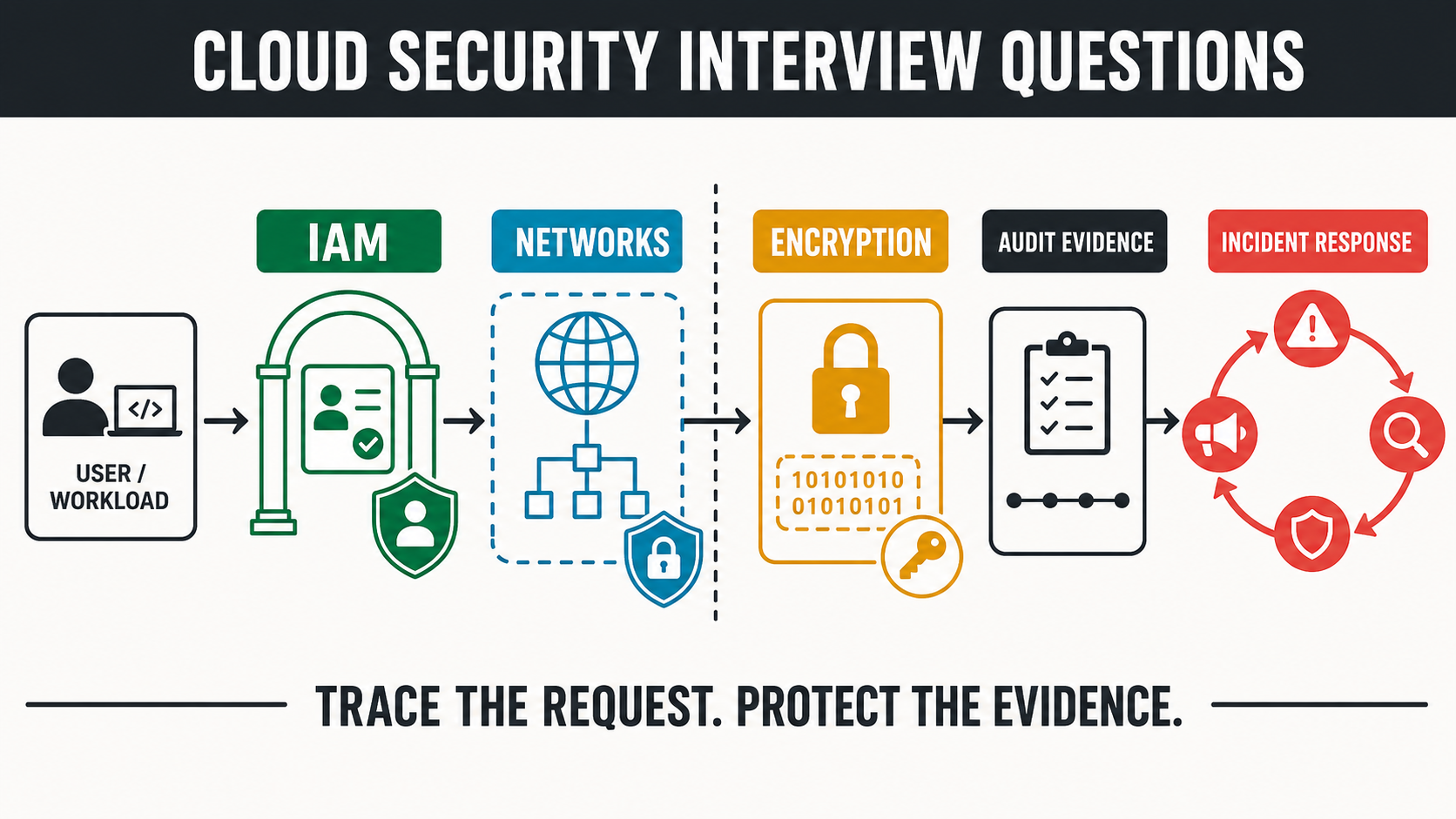
A strong cloud security answer connects preventive controls to detection and recovery. No single IAM rule, encryption key, or firewall is the whole design.
Quick Verdict: What Makes a Strong Cloud Security Answer?
Start with the workload and its risks, not a vendor diagram. Explain who can act, what data needs protection, which network paths are necessary, what will be logged, and how you will contain a failure without destroying evidence.
| # | Strong answer signal |
|---|---|
| 1 | Defines assets, actors, trust boundaries, and business impact before selecting controls. |
| 2 | Uses short-lived identity and least privilege instead of distributing permanent credentials. |
| 3 | Explains key ownership, network paths, and effective permissions rather than saying "encrypt everything." |
| 4 | Includes centralized audit evidence, alerts, and a tested containment path. |
| 5 | Names operational trade-offs such as availability, recovery access, logging cost, and blast radius. |
Cloud Security Foundations
1. What does the cloud shared responsibility model actually change?
The provider secures the physical facilities, underlying hardware, and managed service infrastructure. The customer still owns responsibilities such as identities, data classification, application behavior, access policies, and many network and logging configurations. The exact boundary changes with IaaS, containers, serverless, and fully managed services.
A good answer maps every important control to an owner. AWS describes this as security of the cloud versus security in the cloud; saying "the provider handles security" misses the customer configuration failures that cause many incidents.
2. How would you threat-model a new cloud workload?
Identify the sensitive assets, human and workload identities, external entry points, administrative plane, data flows, and trust boundaries. Then test abuse cases: stolen credentials, public storage, vulnerable dependencies, metadata access, malicious insiders, compromised containers, and unavailable dependencies.
Prioritize controls by likelihood and impact. The answer should connect each major threat to prevention, detection, containment, and recovery, while preserving the application's latency and availability requirements.
IAM and Multi-Account Boundaries
3. What is the difference between authentication and authorization in a cloud request?
Authentication establishes the principal; authorization decides whether that principal may perform an action on a resource under the current conditions. A useful policy model names the principal, action, resource, and conditions such as time, network origin, device posture, tags, or session attributes.
When debugging access, calculate effective permissions across identity policies, resource policies, boundaries, and organization guardrails. In AWS policy evaluation, an explicit deny overrides an allow, while boundaries and organization policies can further limit the result.
4. How do you implement least privilege without blocking engineering teams?
Begin with permissions tied to a job function or workload, scope them to specific resources, and use conditions where stable attributes exist. Provide time-bound elevation for exceptional work instead of leaving administrator access permanently attached.
Then review actual usage, remove dormant grants, and test policy changes before enforcement. AWS recommends federation, temporary credentials, MFA, access analysis, and regular removal of unused access in its IAM security best practices.
5. Why are temporary credentials better than long-lived access keys?
Federated sessions and workload identities expire automatically, can be scoped to a role, and reduce the value of a copied credential. They also make it easier to attach identity context and centralize revocation.
For humans, use an identity provider with MFA. For applications, bind a role or workload identity to the runtime rather than shipping a key in source code, an image, or a deployment variable. Google Cloud likewise advises avoiding service account keys when a safer alternative exists.
6. When would you use RBAC versus ABAC?
RBAC fits stable job functions such as reader, deployer, and database operator. ABAC can scale across many resources by matching controlled attributes such as environment, team, data class, or tenant.
ABAC is only safe when attribute creation and mutation are protected; otherwise a user may relabel a resource to gain access. A mature design often combines group-based roles with a small set of governed attributes, periodic access reviews, and just-in-time privilege. Azure recommends least privilege, group assignments, and time-bound access through Privileged Identity Management.
7. How would you design privileged access across multiple cloud accounts?
Separate production, non-production, security tooling, and log archives into accounts or projects so one credential does not own the whole estate. Centralize human federation, use audited cross-account roles, keep break-glass access independent, and send logs to a security boundary that workload administrators cannot alter.
Organization guardrails should block dangerous classes of action while account-level roles grant the needed work. AWS service control policies set maximum available permissions; they do not grant access by themselves.
Encryption, Keys, and Secrets
8. How do encryption at rest, in transit, and in use address different threats?
Encryption at rest protects stored media, snapshots, and backups from unauthorized reading. Encryption in transit protects data crossing a network and authenticates endpoints when certificates are validated correctly. Data in use is plaintext in a process unless a specialized confidential-computing design protects that execution boundary.
Do not stop at "AES plus TLS." Explain who can request decryption, where plaintext appears, how certificates and keys are rotated, and which logs prove that access occurred.
9. What is envelope encryption, and why do cloud systems use it?
A data encryption key encrypts the payload. A separate key encryption key in a key management system wraps that data key, so large data does not need to pass through the central key service for every operation.
This design limits key-service work while centralizing control over the smaller wrapping keys. Google describes storing data encryption keys near encrypted data while centrally protecting them with key encryption keys in its default encryption architecture.
10. Who should be allowed to administer and use an encryption key?
Separate key administration from key use. A platform security role may create, rotate, disable, and schedule deletion, while application roles receive only the encrypt or decrypt operations they need for specific keys and contexts.
Protect the recovery path as carefully as normal access. Key policy, IAM policy, grants, audit logging, replication, and break-glass procedures must agree; an encrypted backup is not recoverable if the only usable key is deleted or locked behind the failed environment.
11. Does rotating a key re-encrypt all existing data?
Usually not. Managed key rotation commonly changes the material used for future encryption while retaining older material so existing ciphertext can still be decrypted. Re-encryption is a separate migration with cost, availability, and rollback implications.
Rotation also does not repair a compromised application that can still call decrypt. First remove the unauthorized identity or code path, then decide whether the threat model or compliance requirement justifies re-encrypting historical data.
12. How should applications store and rotate secrets?
Prefer workload identity and short-lived credentials, so fewer secrets exist at all. Store unavoidable database passwords, API tokens, and signing material in a managed secret system, restrict retrieval, rotate them, and audit every administrative and read path.
Do not bake secrets into repositories or container images. AWS Secrets Manager recommends encryption, rotation, caching, private network access, monitoring, and least-privilege access to secrets; the same design principles apply across providers.
Networks and Workload Isolation
13. Does placing a service in a private subnet make it secure?
No. A private route removes one direct internet path, but the service can still be reached through load balancers, peering, VPNs, compromised internal workloads, overly broad firewall rules, or outbound callbacks. It also still needs patching, identity controls, and monitoring.
Trace every ingress and egress path, including DNS, management access, package downloads, metadata services, and third-party APIs. Then allow only the paths required by the workload and record the decisions in infrastructure as code.
14. What is the difference between a security group and a network ACL?
In AWS terms, a security group is a stateful firewall attached to a resource interface: return traffic for an allowed connection is automatically permitted. A network ACL evaluates traffic at the subnet boundary and is stateless, so both directions need explicit rules.
Use resource-level groups for primary workload policy and subnet ACLs for coarse defense-in-depth or explicit deny cases. The official VPC documentation explains both stateful security groups and stateless network ACLs.
15. When do private endpoints and egress controls matter?
A private endpoint lets a workload reach a managed service without traversing a public internet path. That reduces exposure, but identity policies and endpoint policies must still restrict which resources and actions are reachable.
Control outbound traffic through approved endpoints, proxies, DNS policy, domain or destination allowlists, and flow logs. AWS PrivateLink documents private access without an internet gateway, NAT device, or public IP, but private connectivity is not a substitute for authorization.
16. How would you secure a containerized workload in the cloud?
Use trusted and scanned images, run as non-root, drop unnecessary capabilities, restrict writable filesystems, and avoid privileged containers. Bind each workload to a narrowly scoped service identity, inject secrets at runtime, block metadata access where possible, and apply default-deny ingress and egress policies.
Separate control-plane access from application access and log both. The Kubernetes security checklist recommends Pod Security Standards, network policies, protected APIs, filtered metadata access, and limited service account permissions.
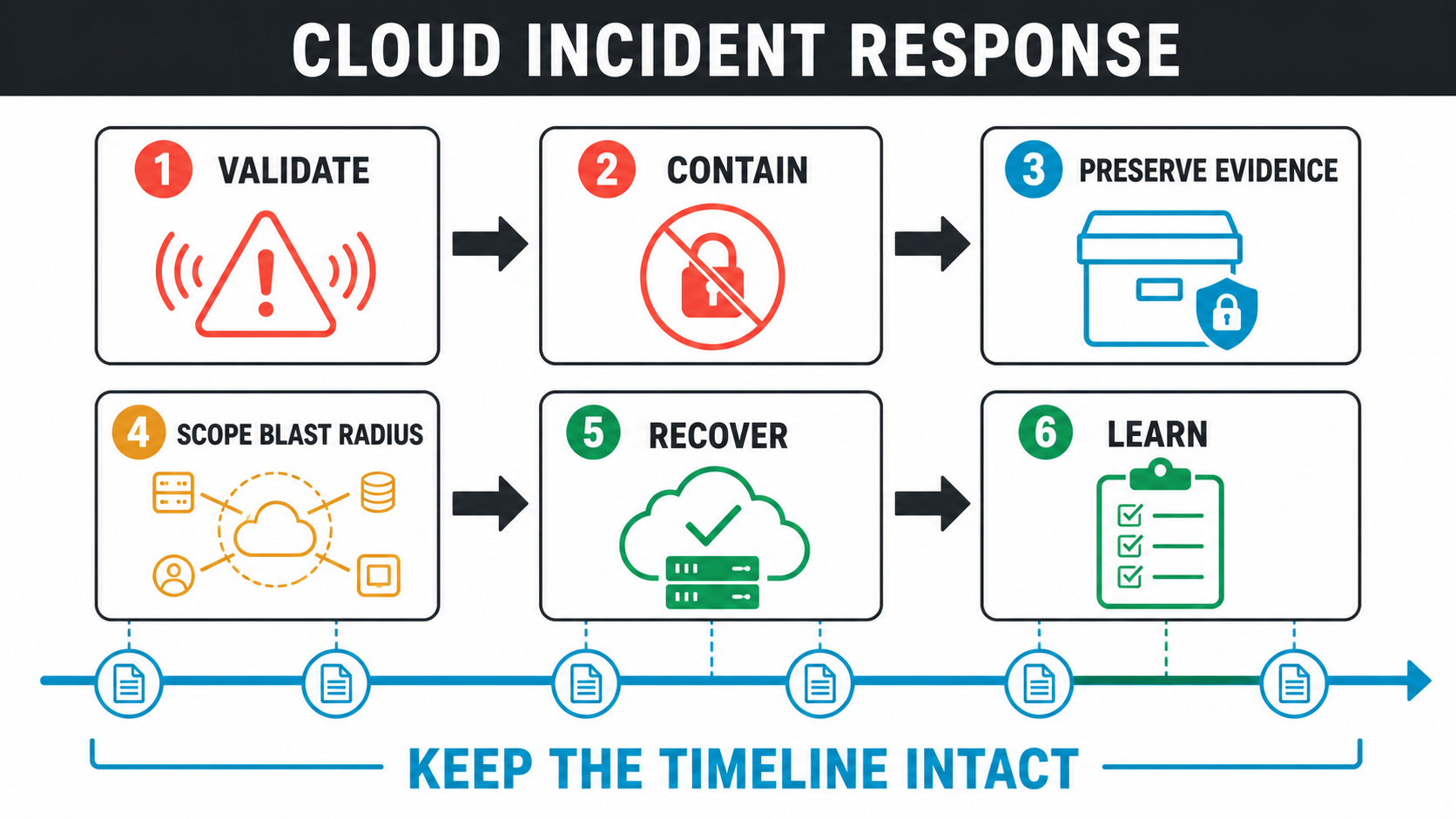
Interview shortcut: trace one request through identity, network, data access, audit evidence, and the containment control you would use if that request were malicious.
Cloud Incident Response
17. What should you do when a cloud access key is exposed?
Contain the credential first: replace it with a safe credential if continuity requires it, then disable or revoke the exposed key and invalidate related sessions. Preserve audit data before changing more state, identify the principal's effective permissions, and scope every action taken since the earliest possible exposure.
Look for new users, roles, keys, policies, compute, network paths, and data access that could preserve attacker control. Rotate dependent secrets, remove persistence, notify the required owners, and monitor for reuse. Simply deleting the key without scoping the blast radius is incomplete.
18. How do you isolate a compromised workload without destroying evidence?
Move the workload to a quarantine network policy or security group, remove it from serving paths, and restrict egress while preserving approved forensic access. Capture snapshots, metadata, orchestration events, and volatile evidence when the incident plan and tooling support it.
Do not rebuild or power off blindly before deciding what evidence is needed. Investigate a controlled copy, keep a timeline of responder actions, and use a separate clean environment for recovery.
19. Which logs matter most during a cloud security incident?
Collect identity and control-plane activity, resource-level data access, key usage, network flow, DNS, load balancer, WAF, container audit, host, and application logs. Centralize them in a separate account or project with restricted deletion, known retention, and synchronized time.
Coverage must match the threat. AWS CloudTrail, for example, distinguishes management, data, network activity, and Insights events, and notes that some high-volume event types are not logged by default.
20. How do you recover safely after containment?
Rebuild from known-good infrastructure code and images, rotate affected trust, validate dependencies, and restore traffic gradually with heightened monitoring. Define the security and business checks that must pass before each recovery step.
Afterward, document root cause, missed detection opportunities, control owners, and a test that proves the fix. NIST SP 800-61 Rev. 3 integrates incident response across risk management so organizations improve preparation, detection, response, and recovery rather than treating the event as a one-time cleanup.
A Five-Step Framework for Cloud Security Scenarios
- Frame the risk. State the asset, actor, entry point, trust boundary, and business impact.
- Trace identity. Show authentication, effective authorization, privilege elevation, and credential lifetime.
- Protect data. Cover classification, encryption boundaries, key ownership, secrets, backups, and recovery access.
- Constrain paths. Draw ingress, east-west traffic, egress, administrative access, and container or account boundaries.
- Prove and recover. Name logs, alerts, containment actions, evidence handling, and the safe recovery test.
This order works for both design questions and incidents. It also prevents a common failure: proposing ten preventive tools without explaining how the team will detect a bypass or recover from one.
What Interviewers Are Actually Scoring
Risk judgment: Can you prioritize the controls that materially reduce the stated risk? Systems reasoning: Can you trace effective permissions, network reachability, data access, and failure propagation?
Operational realism: Do you account for deployment, logging cost, on-call response, break-glass access, and recovery? Communication: Can another engineer understand what is allowed, what is denied, and what evidence will exist?
Practice the architecture side with system design questions. For deeper scenarios, use PracHub's networking interview guide, Kubernetes production scenarios, and incident response questions.
Frequently Asked Questions
Are cloud security interviews only for security engineers?
No. Backend, SRE, platform, data, and senior engineering interviews increasingly test identity boundaries, secrets, network exposure, auditability, and incident response. The expected depth changes by role, but every engineer who designs or operates cloud systems should be able to explain the request path and blast radius.
Do I need to memorize AWS, Azure, and Google Cloud service names?
Know the major service categories and one provider well enough to be concrete. Lead with vendor-neutral concepts, then map them to familiar services. Interviewers usually learn more from a correct authorization or containment model than from a long list of equivalent product names.
How should I answer "Design a secure VPC"?
Clarify the workloads and required flows first. Draw public entry points, private services, administrative access, managed-service endpoints, east-west traffic, and egress. Add identity-aware authorization, layered firewalls, encryption, centralized logs, and a quarantine path, then explain how availability and operational access are preserved.
What is the biggest IAM red flag in an interview answer?
Permanent broad credentials with no conditions, review, or revocation path. Replace them with federation or workload identity, narrowly scoped roles, short sessions, controlled elevation, organization guardrails, and audit logs. Also explain how effective permissions will be tested before a policy reaches production.
How can I practice cloud security interview questions effectively?
Take one architecture each day and answer the same five prompts: asset, identity, data, network, and response. Then inject one failure such as a leaked token, compromised container, or public bucket. Finish by comparing your answer with written solutions and practicing behavioral and leadership stories about real security trade-offs.
Final Takeaway
The best cloud security candidates do not claim that a private subnet, encryption checkbox, or zero-trust label solves the problem. They show who can do what, through which path, to which data, with what evidence, and how the team will recover.
Use PracHub to practice the real questions companies ask, compare your reasoning with written solutions, and build a repeatable answer across IAM, encryption, networking, containers, and incidents. Start with PracHub's interview question library and make every control traceable to a concrete risk.
Comments (0)