Data Engineering System Design Interview Guide: Pipelines, Trade-Offs, and Scoring
Quick Overview
Prepare for a data engineering system design interview with a seven-step framework for requirements, data contracts, batch and streaming pipelines, delivery semantics, late data, quality, observability, backfills, schema evolution, governance, and cost. Includes a practical scoring rubric, worked real-time analytics design, common prompts, failure modes, and a focused seven-day plan.
A data pipeline can look perfect on a whiteboard and still fail the interview in one sentence: "We stream everything into the warehouse." That answer skips the decisions the interviewer actually needs to hear: freshness, correctness, replay, schema change, cost, and who notices when yesterday's partition is wrong.
A strong data engineering system design answer does not begin with a fashionable stack. It begins with the consumer, data contract, service-level objective, and failure model, then chooses the simplest pipeline that can satisfy them.
Start with PracHub's real interview questions with written solutions, then use company-specific interview prep to map the data rounds in your target loop. This guide gives you a repeatable framework for designing those pipelines and making your trade-offs visible.
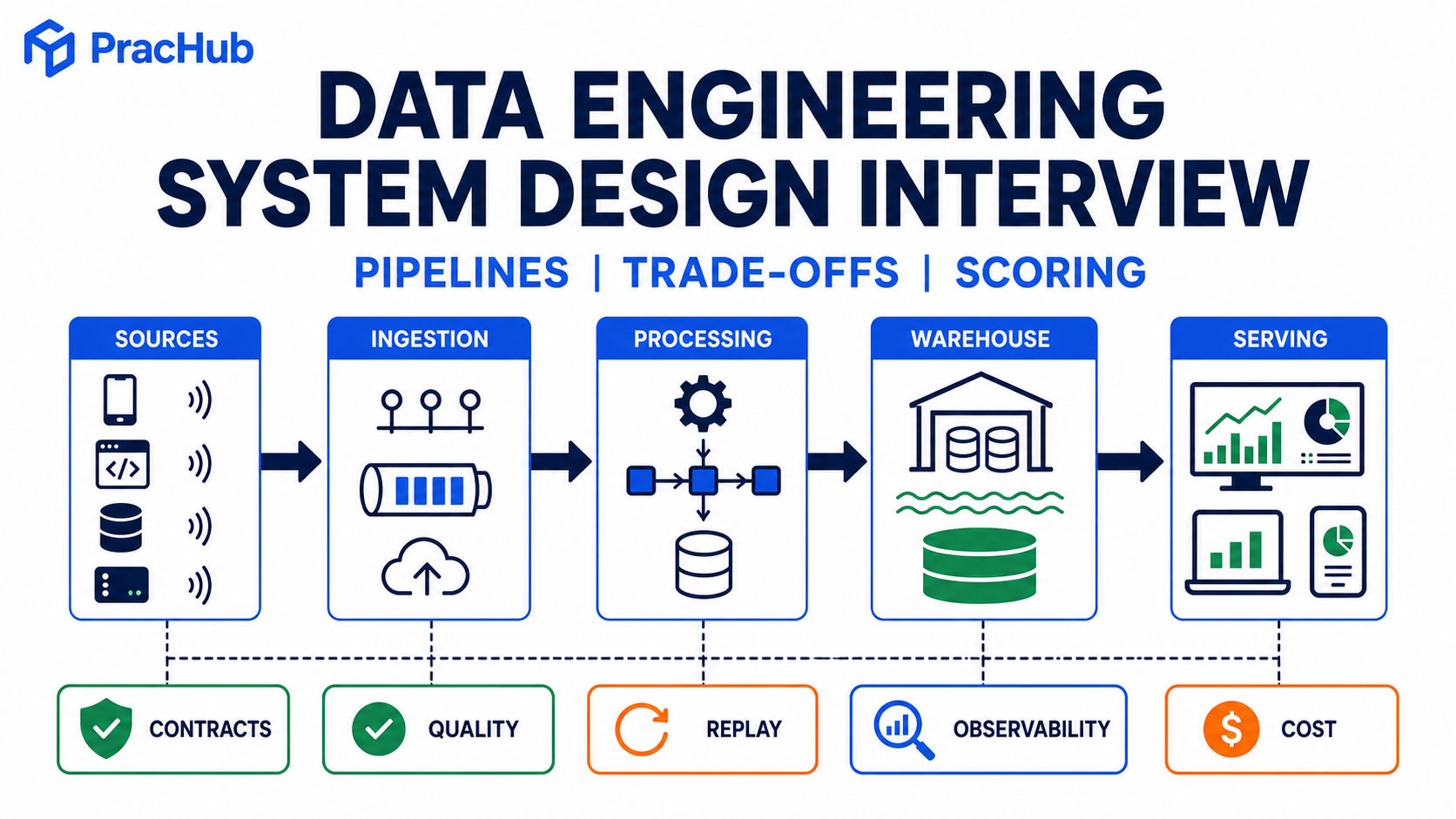
A complete answer connects producers, contracts, processing, storage, consumers, operations, and recovery.
Quick Answer: How Should You Approach a Data Engineering System Design Interview?
Use seven steps: define the outcome, quantify requirements, model the data contract, draw the end-to-end flow, design correctness and recovery, add operations and governance, then compare trade-offs. Keep one representative record moving through the design so every component has a reason to exist.
Before choosing batch or streaming, ask who consumes the output, how fresh it must be, how much error is acceptable, how much history must be replayable, and what the budget or operational constraints are. A one-hour dashboard SLA may not justify second-level streaming.
What Interviewers Evaluate and How Scoring Works
Companies do not share one universal data engineering rubric. Your interview brief and recruiter guidance remain the source of truth. The scorecard below is a PracHub practice rubric for making common signals observable, not a claim about any employer's private scoring sheet.
| Practice dimension | Weak signal | Strong signal |
|---|---|---|
| Requirements and SLOs | "It should be real time" | Names consumers, volume, latency, completeness, retention, and failure tolerance |
| Data contracts and modeling | Moves undefined JSON between boxes | Defines keys, schema ownership, event time, compatibility, and business grain |
| Correctness | Promises exactly-once everywhere | Scopes guarantees and explains idempotency, deduplication, late data, and reconciliation |
| Scale and reliability | Adds more workers without a bottleneck model | Discusses partitioning, skew, backpressure, replay, checkpoints, and capacity limits |
| Operations and quality | Monitors CPU only | Measures freshness, volume, failures, lag, lineage, cost, and data-quality assertions |
| Trade-offs and communication | Names tools without alternatives | Connects each choice to user impact, cost, complexity, and a rejected option |
A senior-level answer usually goes one step further: it identifies ownership boundaries and explains how the platform evolves when a producer changes schema, a consumer requests a tighter SLA, or a backfill competes with production traffic.
A Seven-Step Data Pipeline Design Framework
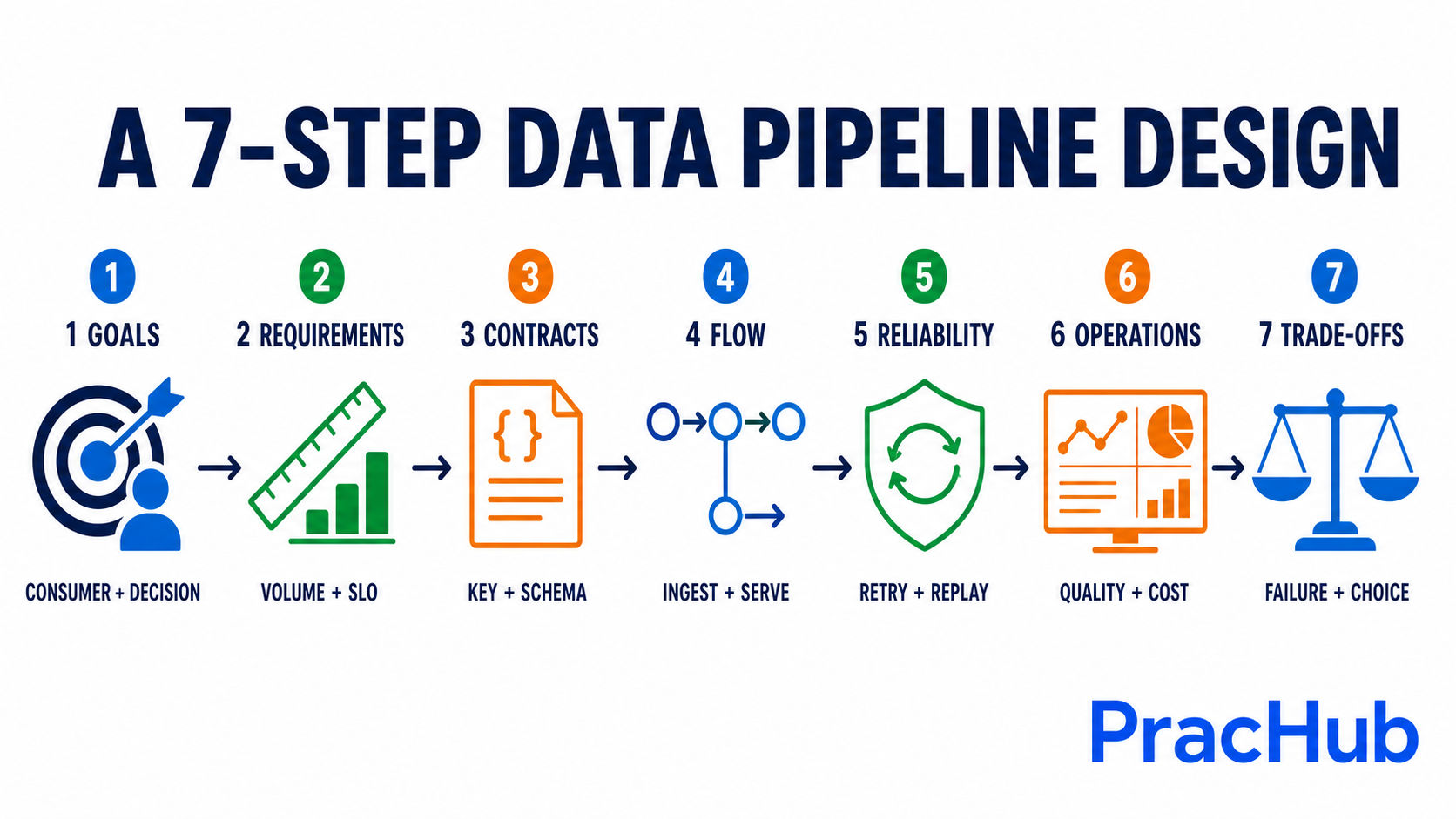
Move from business outcome to an operated and trade-off-tested pipeline.
1. Define the Consumer and Decision
Identify what the output enables: a finance report, fraud alert, experiment dashboard, customer feature, ML training set, or regulatory extract. The consumer determines the acceptable latency, correctness, retention, and serving model.
2. Quantify the Requirements
Estimate events per second, average and peak record size, daily volume, key cardinality, retention, query patterns, and growth. Name freshness and completeness targets separately; a dashboard can be fresh but incomplete.
3. Define the Data Contract and Grain
Specify the event key, business grain, required fields, event timestamp, schema version, ownership, and compatibility rule. Clarify whether an update is a fact, a snapshot, or a change-log record.
4. Draw the End-to-End Flow
Connect producers to ingestion, durable storage, processing, curated models, and serving. Mark where data is buffered, partitioned, transformed, validated, and exposed. Avoid adding a technology that does not satisfy a stated requirement.
5. Design Correctness and Recovery
Choose delivery semantics, checkpoint behavior, deduplication keys, retry boundaries, dead-letter handling, late-data policy, and replay source. Explain how the system recovers without silently duplicating or dropping business facts.
6. Add Operations, Security, and Governance
Define freshness, lag, volume, error, quality, and cost signals. Add ownership, lineage, access control, encryption, retention, and PII handling where relevant. State who is paged and what the first recovery action is.
7. Compare Trade-Offs and Stress the Design
Test peak traffic, a hot partition, source outage, schema-breaking change, warehouse slowdown, and a thirty-day backfill. Summarize why your design is sufficient now and what condition would justify the more complex alternative.
A Reference Pipeline and the Batch vs. Streaming Decision
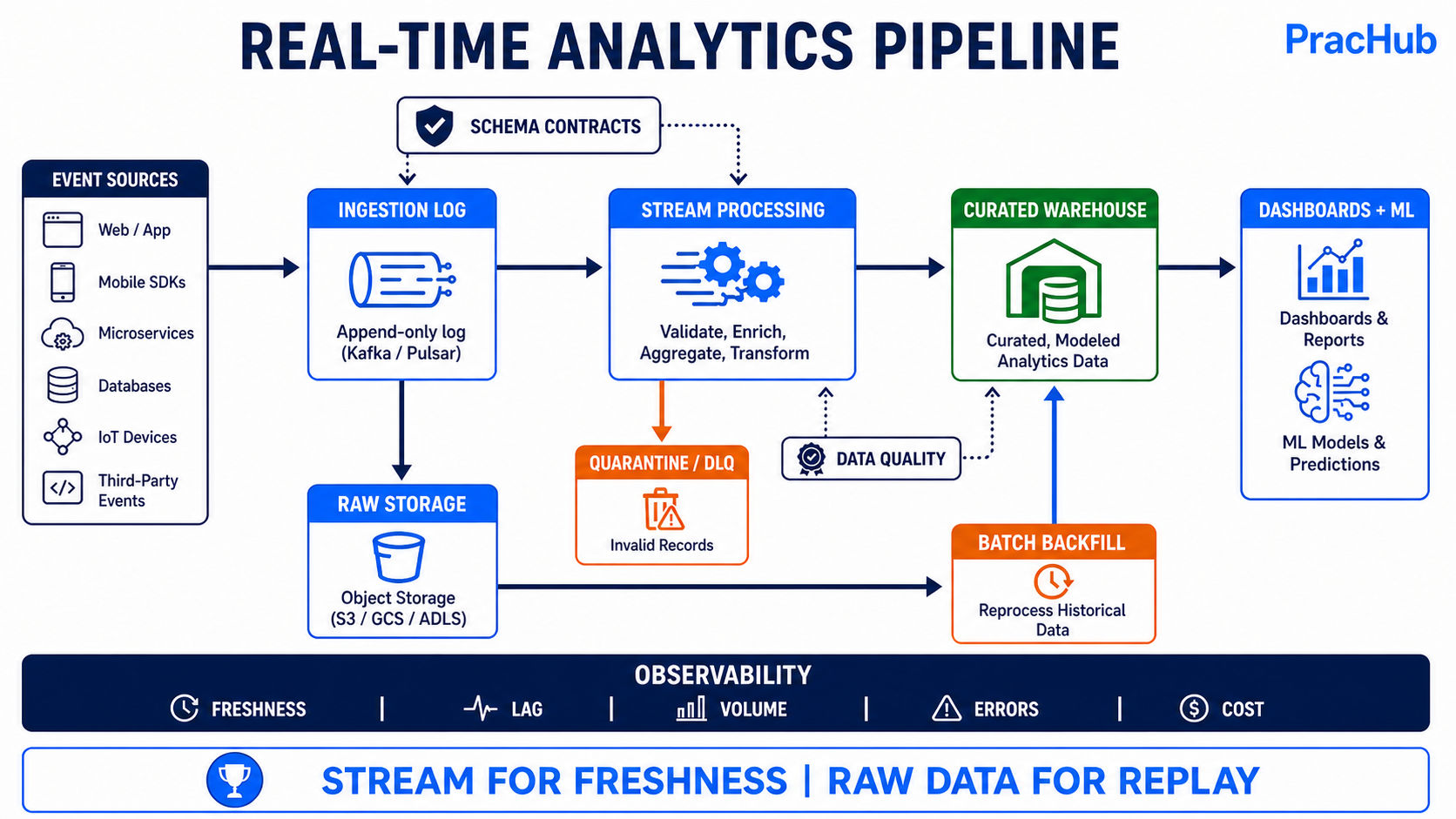
A durable raw layer and replay path keep the serving pipeline recoverable when code or data changes.
A practical reference design separates ingestion, durable raw data, transformation, curated storage, and serving. Streaming and batch paths can share contracts, quality rules, and sinks without pretending they have identical execution models.
| Approach | Best fit | Main cost |
|---|---|---|
| Batch | Bounded data, predictable schedules, relaxed freshness, efficient bulk work | Higher latency and larger recovery windows |
| Streaming | Continuous inputs and decisions that lose value when delayed | State, ordering, late data, backpressure, and operational complexity |
| Hybrid | Fresh incremental updates plus authoritative replay or reconciliation | Two execution paths can drift unless logic and contracts are shared |
Choose from the SLA backward. Streaming is not automatically more senior or more scalable. A well-partitioned hourly batch can be the better design when it meets the consumer's deadline at lower cost and with simpler recovery.
Reliability: Delivery Semantics, Late Data, and Replay
Scope the Delivery Guarantee
At-most-once can lose records; at-least-once can redeliver them. Transactional exactly-once support is usually bounded to specific systems and operations. Apache Kafka, for example, documents exactly-once processing between Kafka topics, while external destinations require cooperation from the sink or coordinated offset and output storage.
| Guarantee | What can happen | Practical response |
|---|---|---|
| At-most-once | A record may be lost but is not retried | Use only when occasional loss is acceptable |
| At-least-once | A record is retried and may appear more than once | Use stable keys, idempotent writes, or sink-side deduplication |
| Transactional scope | Exactly-once behavior holds only inside a supported boundary | Name the boundary and reconcile every external side effect |
Separate Event Time from Processing Time
Events can arrive late or out of order. Define whether a metric follows event time or arrival time, then choose windows, watermarks, allowed lateness, and correction behavior. Apache Beam treats a watermark as an estimate of event-time completeness, not proof that no earlier event will arrive.
Make Replay a First-Class Path
Keep an immutable or recoverable source, version transformations, and make sinks idempotent. A replay should be bounded, observable, and isolated enough that it does not starve current production traffic. State how duplicate outputs are prevented or reconciled.
Data Quality, Contracts, and Observability
Infrastructure health does not prove data health. Monitor source freshness, row or event volume, nulls, uniqueness, referential integrity, accepted values, distribution shifts, and business invariants. dbt's current documentation distinguishes model contracts, which protect output shape, from data tests, which assert properties of the built data.
Attach every alert to an owner, affected consumer, and response. A late partition that blocks payroll has a different severity from a delayed exploratory dashboard. Track pipeline lag and compute cost alongside data-quality signals so the team can see whether an SLA is being met efficiently.
Backfills, Schema Evolution, and Reprocessing
Assume a transformation bug will be discovered after data is published. Preserve raw inputs or reproducible snapshots, version code and contracts, and define how a historical date range is reprocessed. Apache Airflow's backfill model makes the core controls explicit: date range, reprocessing behavior, concurrency, run order, and dry run.
For schema changes, name the compatibility policy and rollout sequence. Additive nullable fields are often easier than renames or type changes. Use versioned contracts, dual-read or dual-write periods when needed, and a deprecation window for downstream consumers rather than silently breaking them.
Worked Example: Design a Real-Time Product Analytics Pipeline
Scope the system to product events from web and mobile clients, near-real-time dashboards within five minutes, daily finance reconciliation, seven years of aggregated retention, and replay for corrected logic. Raw payloads may contain identifiers, so access and retention rules matter.
Clients send versioned events through an ingestion API. A durable log partitions by a key that preserves needed ordering without creating hot partitions. Stream processing validates schemas, applies event-time windows, writes invalid records to a quarantined path, and stores both curated aggregates and raw events in object storage.
The warehouse receives idempotent upserts keyed by event ID and model grain. Dashboards read curated tables rather than the raw stream. Freshness, consumer lag, invalid-event rate, volume deviation, warehouse load failures, and cost per processed unit are observable.
Late events within the accepted window update provisional aggregates. Older arrivals enter the next reconciliation run. If transformation logic is wrong, a versioned batch backfill reads raw partitions, writes to shadow tables, validates counts and business totals, then swaps or merges only after comparison succeeds.
Common Data Engineering System Design Questions
Practice designing a clickstream analytics platform, CDC pipeline into a warehouse, IoT telemetry system, log-processing platform, fraud-feature pipeline, data lake ingestion service, experimentation metrics layer, and multi-tenant ETL platform.
Expect follow-ups about late and duplicate records, schema-breaking producers, hot keys, source deletion, GDPR or retention requests, a slow warehouse, failed partitions, backfills, regional outages, and cost spikes. Use the Databricks Domain Deep Dive guide for a company-specific version, and reinforce implementation skills with the correct SQL interview practice set.
Trade-Offs to Say Aloud and Mistakes to Avoid
Strong trade-off language is concrete: "An hourly batch meets the SLA at lower operational cost, but recovery can replay a larger window." "At-least-once ingestion protects against loss, so the sink must deduplicate by event ID." "Partitioning by customer preserves locality, but one enterprise tenant can create a hot key."
Common mistakes include choosing tools before requirements, treating storage as a single box, ignoring the business grain, claiming end-to-end exactly-once without a boundary, monitoring only jobs instead of data, forgetting replay, and designing a backfill that overwhelms production.
Do not spend the round reciting product names. Use generic capabilities first, then name a representative technology when it clarifies the mechanism. The architecture should survive a tool substitution because its contracts and guarantees are explicit.
A Focused Seven-Day Preparation Plan
Days 1-2: practice requirements, volume estimates, data grain, schemas, partitions, and batch-versus-streaming decisions on two prompts.
Days 3-4: trace at-most-once, at-least-once, deduplication, checkpoints, late data, windows, retries, and replay. Explain the exact boundary of every guarantee.
Days 5-6: add quality tests, freshness SLOs, lineage, security, cost, schema evolution, and a safe backfill to each design. Practice one relevant API design prompt for ingestion boundaries.
Day 7: run a 45-minute mock: five minutes on scope, twenty-five on architecture, ten on failures and trade-offs, and five on the final scorecard summary.
Frequently Asked Questions
Is a data engineering system design interview the same as backend system design?
They share distributed-systems fundamentals, but data engineering interviews emphasize data contracts, business grain, batch and streaming semantics, late data, schema evolution, lineage, quality, replay, and analytical serving. Backend design often focuses more heavily on request paths, service APIs, transactional state, and online availability.
Should I always choose streaming for a real-time requirement?
No. Clarify what "real time" means in measurable terms. If the consumer needs results within fifteen minutes, micro-batch or frequent batch processing may meet the goal with less state and operational complexity. Choose continuous streaming when the value of the decision materially decays before the batch can finish.
How should I discuss exactly-once processing?
Name the precise boundary where atomicity is supported. Across arbitrary sources and sinks, use idempotent writes, stable event IDs, deduplication, coordinated checkpoints, and reconciliation. Avoid claiming that a broker setting automatically makes every downstream database, notification, and external side effect exactly once.
How much SQL appears in a data engineering system design interview?
The design round may not require a full query, but SQL fluency helps you define grain, keys, joins, incremental models, deduplication, and validation. Separate SQL or coding rounds are also common in data engineering loops, so practice implementation alongside architecture and confirm the exact format with your recruiter.
Final Takeaway
A strong data engineering system design answer is an operated data product, not a row of vendor logos. It connects consumer needs to contracts, flow, correctness, quality, recovery, governance, and cost, then states what each trade-off buys and risks.
Use PracHub's real interview question library to practice that reasoning with current prompts and written solutions. Start from the SLA, make every guarantee scoped, and keep replay and data quality in the main design rather than adding them at the end.
Sources and Methodology
This guide uses the current Apache Beam Programming Guide for event time, watermarks, windows, triggers, and late-data behavior; Apache Kafka's design documentation for delivery semantics, idempotence, transactions, offsets, and external-sink limits; and Apache Airflow's backfill documentation for bounded reprocessing controls. The dbt data-test guidance, model-contract documentation, and source-freshness documentation anchor the quality discussion. AWS's Data Analytics Lens supports the reliability, security, performance, cost, and operational framing. The scorecard, seven-step framework, worked example, and preparation plan are PracHub recommendations, not a universal company rubric.
Comments (0)