Databricks Domain Deep Dive Interview: What Strong Candidates Show
Quick Overview
The Databricks Domain Deep Dive is an in-depth technical conversation about architectural and scaling challenges you have actually solved. This guide explains where the round fits in the backend and database engineering loop, what strong Senior and Staff candidates demonstrate, how to structure a project walkthrough, which follow-ups to expect, and how to use PracHub for company-specific system design and behavioral practice.
The hardest part of the Databricks Domain Deep Dive is not remembering every technical detail. It is proving that you understand why a real system became difficult, which decisions were yours, and what changed because of your judgment.
Many candidates prepare a polished project summary or another generic system design answer. Both miss the point. Databricks describes this round as an in-depth technical conversation about architectural and scaling challenges you have actually solved.
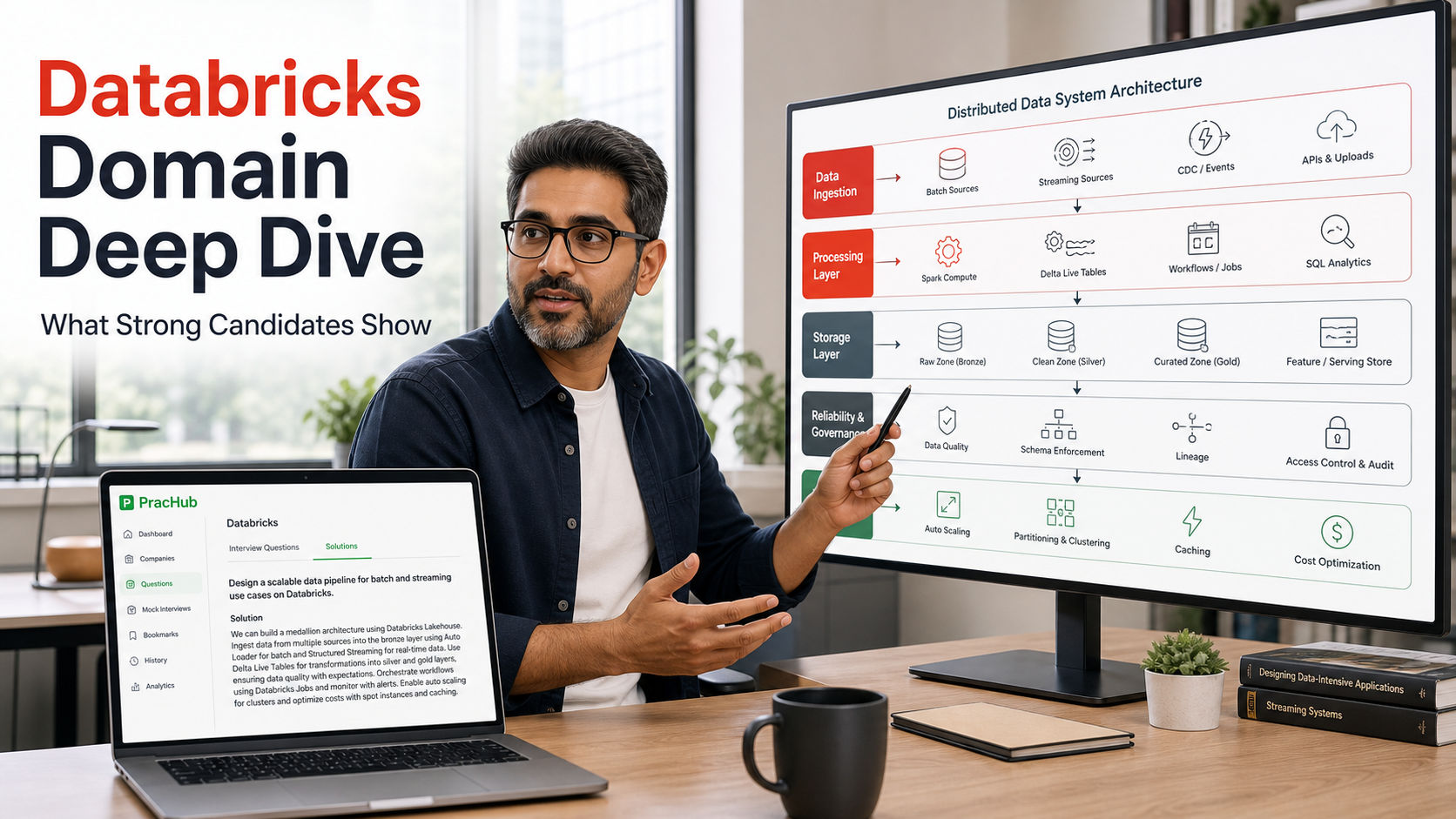
Start by reviewing real Databricks Software Engineer interview questions on PracHub. Use them to identify the systems, reliability, and leadership themes most relevant to your target team, then build your deep-dive stories around comparable evidence from your own work.
Quick Verdict
Strong candidates turn one project into a rigorous technical conversation. They explain the original constraints, draw a clear architecture, separate personal ownership from team output, compare credible alternatives, quantify results, and discuss what failed without becoming defensive.
Senior and Staff candidates go one step further. They show how their decisions changed the system or organization beyond one implementation: setting direction, aligning teams, reducing long-term risk, and revising the design as evidence changed.
What Is the Databricks Domain Deep Dive?
Databricks' official engineering interview guide calls the Domain Deep Dive a technical conversational interview that explores architectural and scaling challenges from your experience. It examines your problem-solving approach, technical decisions, and domain expertise.
You may also be asked to work through an architectural problem related to your background. The stated goal is a meaningful exchange in which both you and the interviewer gain a new perspective within your technical domain.
For backend candidates, the full panel is typically a combination of four to six one-hour interviews selected from Coding, Algorithms, System Programming, Architecture, Domain Deep Dive, and Cross-Functional. Database candidates may also see Storage, Stream Processing, or a Database Papers discussion.
Domain Deep Dive vs Architecture vs Hiring Manager
These rounds can all mention projects and tradeoffs, but they are not interchangeable.
| Round | Starting Point | Main Evidence |
|---|---|---|
| Domain Deep Dive | A system or problem from your experience | Depth, ownership, decisions, scaling lessons, and domain judgment |
| Architecture | A new open-ended design prompt | Requirements, end-to-end design, scalability, reliability, and tradeoffs |
| Cross-Functional / Hiring Manager | Your career, motivation, and major projects | Impact, collaboration, leadership, growth, and alignment with company goals |
The Domain Deep Dive asks what you know deeply because you built and operated it. Architecture asks how you would design something new. Prepare distinct evidence for each.
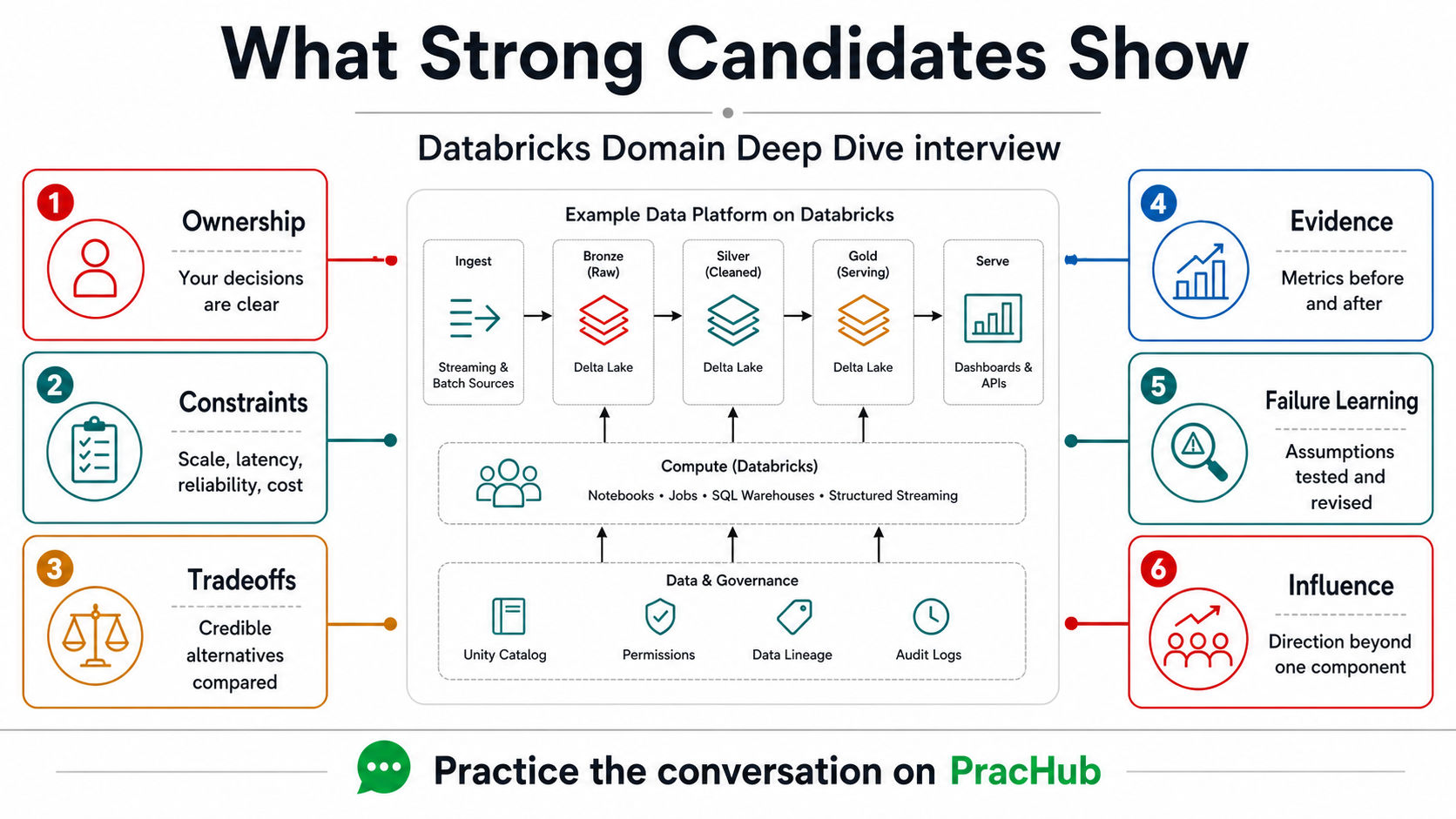
What Strong Candidates Show
Ownership Beyond Implementation
State your role precisely. "We migrated the pipeline" is too vague. Explain which requirement you clarified, which interface or component you designed, which decision you drove, and where another engineer owned the work.
Constraints Before Solutions
A strong answer explains why the obvious design was insufficient. Name the workload, latency target, data volume, consistency requirement, reliability goal, cost limit, migration risk, or organizational constraint that shaped the decision.
Numbers make the story testable. Use evidence such as requests per second, dataset size, p99 latency, failure rate, recovery time, or cloud cost instead of saying the system was "large scale."
Real Alternatives and Tradeoffs
Do not present the final architecture as inevitable. Compare at least two viable alternatives and explain what you optimized for. A useful tradeoff has a cost: lower latency may increase operational complexity; stronger consistency may reduce availability; faster delivery may create migration debt.
Failure, Learning, and Evolution
Discuss a bad assumption, bottleneck, incident, or rollout surprise, then show how evidence changed the design. Real judgment is more credible than a story in which every decision was correct.
Senior-Level Influence
For Senior and Staff roles, implementation depth is necessary but incomplete. Show how you aligned reviewers, resolved disagreement, sequenced a migration, set a technical standard, or helped other teams adopt the solution.
How to Choose the Right Project
Choose one primary project with enough complexity for repeated follow-ups. The best story has visible architecture, nontrivial constraints, at least one contested decision, measurable impact, and a lesson you would apply differently today.
Prepare a second project from a different failure mode. If your first story centers on high-throughput streaming, the backup might emphasize storage correctness, concurrency, or a platform migration.
Your project does not need to use Databricks, Spark, or Delta Lake. Domain depth matters more than forced product references. However, reviewing system design questions can help you practice explaining replication, caching, consistency, fault tolerance, and evolving requirements in interviewer-friendly language.
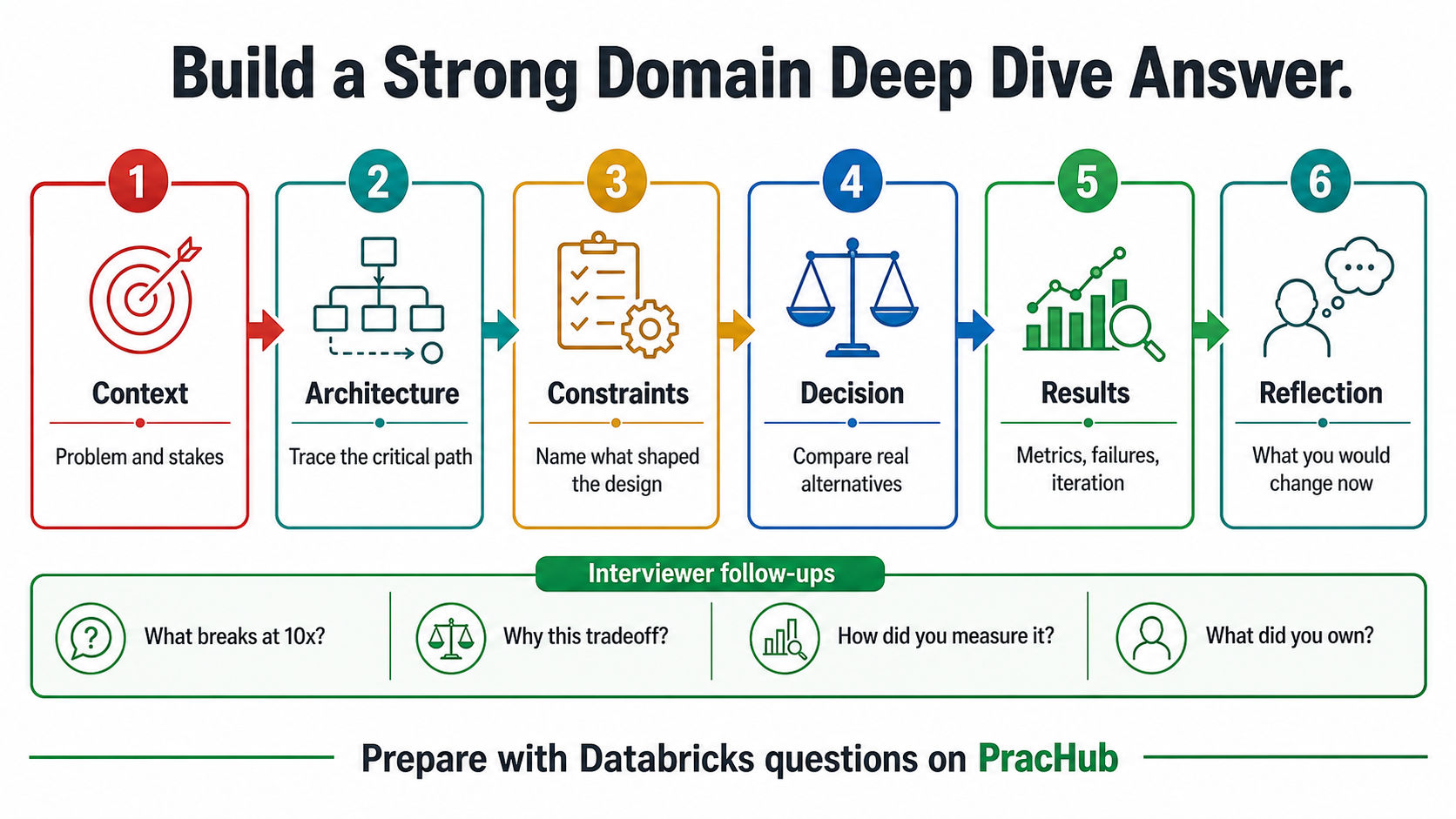
A Six-Part Deep Dive Answer
1. Context and Stakes
Open with the user or business problem, the previous system, and the consequence of failure. Keep this to about two minutes so the technical discussion can start quickly.
2. Architecture and Data Flow
Draw the major components and trace one request, event, or data record through the system. Define unfamiliar terms instead of relying on internal names.
3. Hard Constraints
Name the two or three constraints that eliminated easy options. Explain what was measured before the decision and which assumptions remained uncertain.
4. Decision and Alternatives
Compare the selected design with credible alternatives. State why the choice fit the constraints at that time, not why it is universally best.
5. Results and Failure Modes
Quantify the outcome and describe how the system behaved under stress. Include monitoring, rollout, rollback, recovery, and one issue that forced iteration.
6. Reflection
Close with what you would change now. A thoughtful revision shows growth; it does not weaken the original decision.
| Weak Answer | Strong Signal |
|---|---|
| "We needed to scale, so we added Kafka." | Defines throughput, ordering, replay, and failure requirements before choosing a log. |
| Lists every component in the diagram. | Traces the critical path and explains where correctness or latency is won. |
| Claims the team project as personal work. | Separates personal decisions, collaboration, and delegated ownership. |
| Says the migration was successful. | Provides before-and-after metrics, rollout evidence, and remaining limitations. |
| Avoids discussing mistakes. | Explains a failed assumption, the signal that exposed it, and the correction. |
Follow-Up Questions to Expect
Expect the interviewer to move away from your prepared narrative. They may ask what breaks at 10x load, how you handle partial failure, why you chose one consistency model, how you detect silent corruption, what happens during deployment, or how cost changes with usage.
They may also challenge ownership: Who disagreed? What did you personally decide? Which metric proved the change worked? What would you do with twice the time? Practice answering these aloud with behavioral and leadership questions, because technical judgment and influence often appear in the same story.
Adapt the Story to Your Domain
Backend candidates should be ready to discuss concurrency, caching, APIs, storage, and fault handling. Storage or database candidates should emphasize ambiguity, evolving requirements, performance, and correctness. Streaming candidates should cover ingestion, throughput, latency, fault tolerance, and future growth.
A 7-Day Preparation Plan
On Days 1 and 2, select two projects and reconstruct their architecture, timeline, metrics, and decision record. On Day 3, write the six-part narrative and remove company-specific jargon. On Day 4, drill scaling, reliability, consistency, and cost follow-ups.
On Day 5, use PracHub's Databricks interview guide to add company-specific practice. On Day 6, run a 45-minute mock in which the interviewer interrupts and changes constraints. On Day 7, tighten weak evidence and rehearse a clean five-minute opening.
Common Mistakes
The most common mistake is spending ten minutes on background before reaching the hard decision. Other weak patterns include hiding behind "we," using internal acronyms, describing tools instead of reasoning, inventing precision, and treating every interviewer challenge as something to defeat.
Do not memorize a speech. Build a map you can navigate, pause for questions, and let the interviewer choose where to go deeper.
Frequently Asked Questions
Is the Databricks Domain Deep Dive a system design interview?
It is related but distinct. The Architecture round starts from a new design problem. The Domain Deep Dive starts from your experience and tests whether your architectural knowledge, decisions, and lessons hold up under detailed questioning.
Do I need Databricks or Spark experience?
The official description focuses on your technical domain, not a required Databricks stack. Relevant distributed systems or data-platform knowledge can help, but a deeply understood project is stronger than superficial product vocabulary.
How many projects should I prepare?
Prepare one primary project in depth and one credible backup. For each, know the architecture, constraints, alternatives, metrics, failures, your exact ownership, and what you would change now.
How should Senior and Staff candidates answer differently?
Go beyond component design. Explain long-term direction, cross-team dependencies, migration strategy, risk management, organizational influence, and how you improved decisions for engineers beyond the immediate project.
Final Verdict
The strongest Databricks Domain Deep Dive answer is specific enough to audit and flexible enough to explore. It connects architecture to constraints, decisions to evidence, failures to learning, and technical work to wider impact.
Use PracHub's Databricks question bank to identify likely technical themes, practice related questions with written solutions, and pressure-test the stories you plan to tell. Your goal is not a perfect presentation. It is a technical conversation that proves how you think when real systems become difficult.
Sources and Further Reading
Databricks Engineering Interview Prep Guide | Databricks high-level architecture documentation | PracHub Databricks Software Engineer Interview Guide
Comments (0)