Databricks Solutions Architect Interview: Technical Discovery, DataFrame Tasks, and the Presentation
Quick Overview
Prepare for the Databricks Solutions Architect interview with dated process evidence, customer discovery, a verified DataFrame exercise, and a presentation storyboard that connects data correctness to pilot decisions.
Prepare for a Databricks Solutions Architect interview by connecting three skills: discovering what a customer needs, producing a trustworthy data result, and presenting a solution the customer can evaluate. Rehearse them together. A polished architecture pitch loses force if you cannot explain the metric or demonstrate that the transformation preserves it.
Start with the official Field Engineering preparation material, then confirm your current interview plan with the recruiter. The public guide is dated April 2025, while newer candidate accounts describe some different arrangements. For targeted practice, PracHub's Databricks Data Engineer questions include a customer data-quality scenario; the site's role label is Data Engineer, not a separate Solutions Architect bank.
Read the interview evidence by version and role
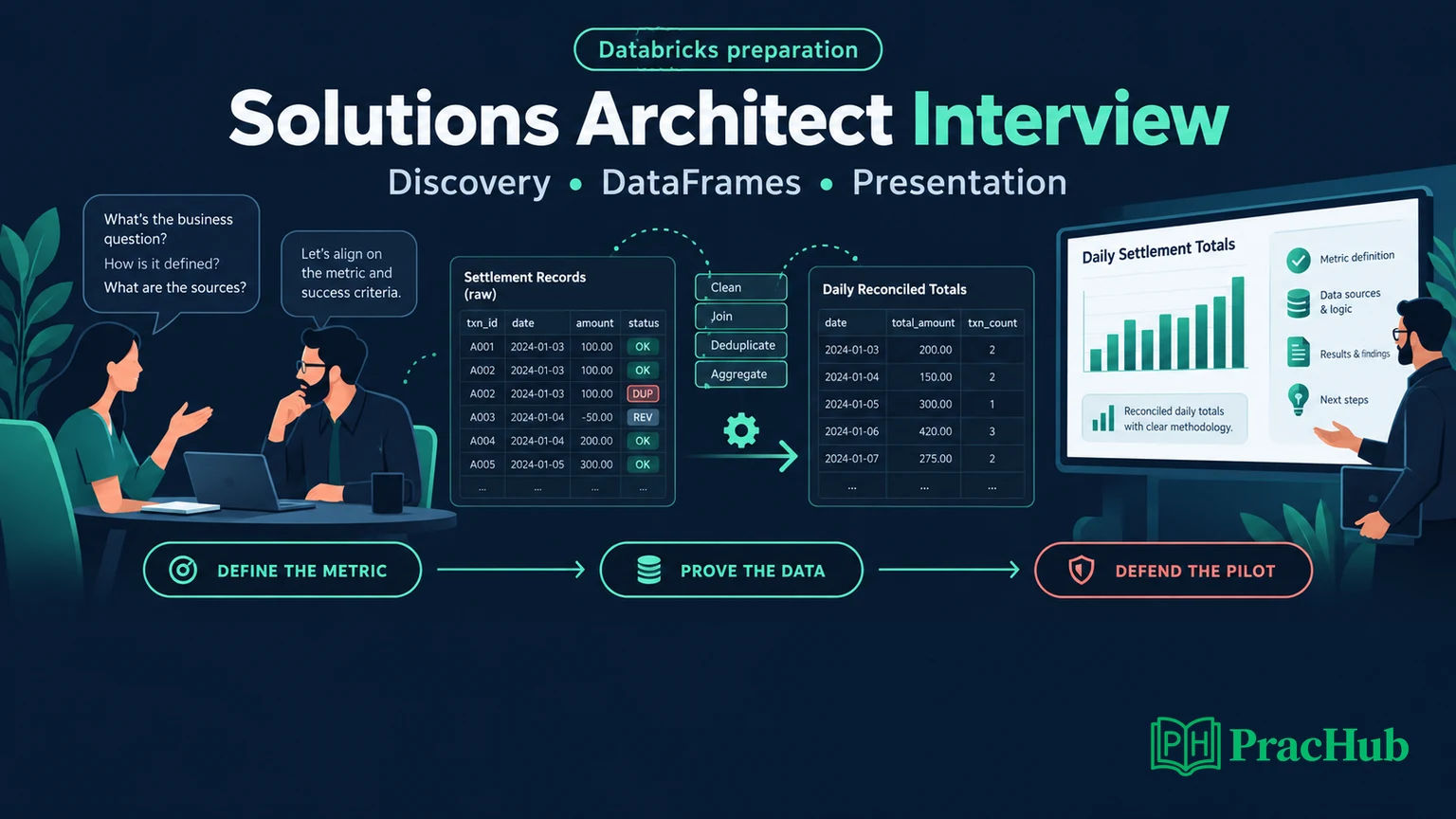
Official fact: Databricks' April 2025 Field Engineering guide outlines recruiter and hiring-manager conversations, a technical screen, a coding assignment, a panel, and a presentation before references and offer. The assignment covers problem-solving, feature implementation, and DataFrame operations in Python or Scala. Technical topics include data systems, cloud architecture, and working with customers. The presentation uses a hypothetical customer scenario to assess discovery and an appropriate Databricks solution pitch.
Candidate reports: A PracHub-curated July 2025 experience, published in August 2026, describes customer data-quality discussion and three CodeSignal questions involving Python/PySpark, with about a week to complete them. That is a reported submission window, not a week of continuous examination. It does not describe the final presentation.
A May 2026 Senior Solutions Architect candidate reported being told to expect architecture, live coding, and presentation rounds after the recruiter screen. This is an upcoming-round account, not a completed-loop report.
Preparation inference: Discovery, data work, and presentation deserve preparation, but their order, delivery format, and permitted tools need confirmation. We did not establish two independent completed accounts from the same current hiring cycle. This article therefore offers a preparation framework rather than a guaranteed 2026 loop.
Ask which technical specialization applies, whether coding is live or an assignment, which DataFrame library is expected, and what the presentation brief requires. Separately confirm the submission deadline, working-time limit, demo environment, audience, and AI-tool policy. Advice about using a tool is not permission to use it during an interview.
Practice discovery before proposing a platform
Original practice scenario, not a reported interview prompt: A retailer's finance team says its daily net-settlement dashboard disagrees with its transaction export. Engineering also reports slow refreshes. The customer asks whether moving the workload to Databricks would fix both problems.
First separate correctness from freshness. Ask which decision the dashboard supports, who owns the metric, when it must be ready, and how the discrepancy was measured. A faster incorrect total would still fail the customer.
Next trace the data: transaction source, delivery mechanism, transformations, customer lookup, aggregation, and dashboard query. Request a small disputed example and the expected answer. Establish whether deliveries repeat, refunds arrive separately, customer mappings change, or late events revise previous days.
Record answers as decisions and open questions. For this rehearsal, use the following hypothetical agreement:
| Topic | Exercise agreement | Effect on the design |
|---|---|---|
| Metric meaning | Net settlement includes negative refund events | Preserve signed amounts; do not filter out refunds |
| Duplicate meaning | Identical deliveries of one event count once | Deduplicate by stable event identity and payload |
| Missing customer region | Keep the amount in an UNKNOWN group | Use a left join and expose unmatched records |
| Success criterion | Totals reconcile with accepted source events | Show row counts, rejected rows, and sum reconciliation |
These assumptions are not facts about an actual retailer. In a mock interview, let your partner challenge one. If finance wants refunds attributed to the original purchase date, the proposed event-day aggregation must change. State that consequence before continuing.
Close discovery by summarizing the agreement: “The first goal is a reconciled daily total, including refunds and records without a region. We will measure refresh time separately. Before choosing an execution pattern, I still need the freshness requirement and the rules for corrections.” This gives the customer a chance to correct your understanding.
Solve a DataFrame task that tests the agreed metric
Use two small DataFrames for the same fictional customer. All events below belong to the already-normalized UTC business date 2026-08-01; all amounts use one currency and integer cents. The customer dimension contains only c1 → US, with one row per customer ID. A missing amount is invalid. Other fields in this fixture are well-formed. ID and Buyer below represent event_id and customer_id.
| ID | Buyer | Cents |
|---|---|---|
| e1 | c1 | 5000 |
| e1 | c1 | 5000 |
| e2 | c1 | 3000 |
| e3 | c1 | -1500 |
| e4 | c9 | 2000 |
| e5 | c1 | 1000 |
| e6 | c1 | -1000 |
| e7 | c1 | NULL |
The second e1 row is an exact retry. Events e3 and e6 are refunds; c9 has no customer-dimension entry; e7 has an invalid amount.
Your task is to return net settlement by date and region, plus rejection and duplicate counts. Keep valid zero or negative amounts. If the same event ID has conflicting valid payloads, stop and report the conflict instead of choosing a survivor arbitrarily. Reject a customer dimension with duplicate keys before joining.
Implement the transformation in stages. First isolate invalid rows, keeping enough diagnostic context to explain the rejection. Next remove exact repeated event payloads, then check that each surviving event ID identifies one payload. Left-join the customer dimension, label absent or null regions UNKNOWN, and aggregate signed amounts by business date and region.
Technical background: Spark's DataFrame.dropDuplicates documentation distinguishes whole-row deduplication from comparison on selected columns. Selecting only event_id does not encode your business decision about conflicting payloads. Project only the stable payload fields for exact-retry comparison; delivery timestamps should not turn one event into multiple settlements.
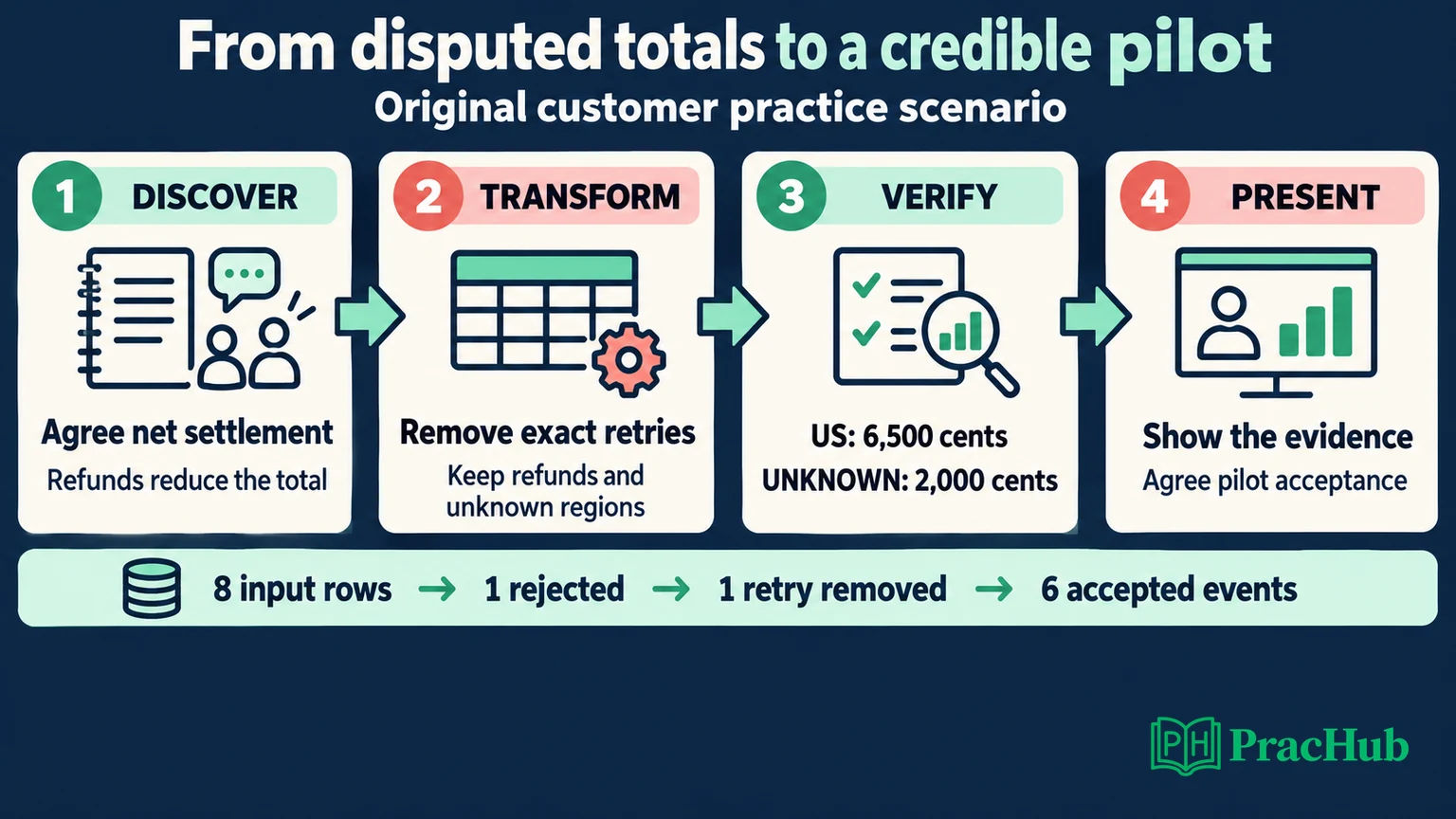
The expected result is US: 6,500 cents; UNKNOWN: 2,000 cents. Reconcile eight inputs into one rejected row, one extra retry, and six accepted events. The accepted signed sum and the grouped sum are both 8,500 cents. These are synthetic expected values, not a customer case study.
Now explain two deliberately wrong implementations. An inner join loses the unmatched customer's 2,000 cents. Filtering to positive amounts removes both refunds, overstating the accepted total by 2,500 cents. Showing these counterexamples makes your review more useful than saying that you “handled edge cases.”
Test reordered input, an empty batch, an all-refund batch, a null region, conflicting event payloads, and duplicate dimension keys. Repeat an already-present valid row and confirm that the aggregate stays unchanged while the duplicate count increases. In a real pipeline, also define how reruns update the output: batch deduplication alone does not make an append-only sink safe from duplicate writes.
Explain the architecture behind the notebook
The tiny fixture proves a metric contract. It does not establish distributed performance, access controls, or recovery behavior. Explain what additional evidence you need before recommending a production design.
Official technical guidance: Databricks describes medallion architecture as a pattern that progressively improves data quality through bronze, silver, and gold layers. It is a recommended pattern, not a mandatory design. For this practice scenario, raw deliveries can support replay, validated events can support reconciliation, and the regional aggregate can serve finance.
Defend each boundary. Who can access raw customer identifiers? Where are invalid records reviewed? Can finance trace an aggregate back to its accepted events? What happens when a customer mapping is corrected? A diagram labeled bronze, silver, and gold is incomplete until those questions have answers.
Official product capabilities: Lakeflow Jobs orchestrates tasks and exposes run status; Unity Catalog provides governance capabilities including access control and lineage. In your proposed pilot, connect those capabilities to a demonstration: show a failed validation task stopping publication, then show which user can query the approved aggregate. Confirm the required configuration in the demo environment. Product availability alone does not prove your workflow enforces the intended policy.
Compare a scheduled batch with a streaming approach against the customer's confirmed freshness requirement. Explain the cost of lower latency, the handling of late records, and the operational responsibility each option creates. Do not add a streaming system solely to make the diagram look more sophisticated.
For performance discussion, inspect the execution plan, join sizes, partition distribution, and slow stages before prescribing more compute. A small fixture cannot reveal skew or validate a broadcast decision. Propose a representative workload test with runtime, cost, and correctness checks. PracHub's Databricks questions for Data Engineers guide provides broader platform revision when you need it.
Build a presentation around a customer decision
Use the same reconciliation example to prepare a presentation. The following six-slide storyboard is an original rehearsal asset, not Databricks' prescribed slide count. Scale it to your actual brief and leave room for questions.
| Slide | Takeaway | Evidence |
|---|---|---|
| 1. Decision and impact | Why the disputed total matters | The finance decision blocked by unreliable settlement data |
| 2. Current flow | Where uncertainty enters the result | Source-to-dashboard map, including retry and lookup boundaries |
| 3. Agreed contract | What the metric includes and excludes | Refund treatment, event identity, UNKNOWN region policy |
| 4. Working result | How the proposed logic resolves the example | Eight input rows, reconciliation counts, and correct totals |
| 5. Proposed architecture | Why the design fits the confirmed needs | Processing boundaries, governance, alternatives, unresolved risks |
| 6. Pilot decision | What must be demonstrated before expansion | Acceptance tests, owners, cost measurement, and review checkpoint |
Open with the customer's decision and the evidence needed to support it. Then demonstrate one incorrect result and the correction. Explain the business implication in plain language: “The inner join excluded a valid settlement because its customer had no region mapping. This version retains the amount and makes that gap visible.”
Prepare both a technical explanation and an executive explanation of the same result. An engineer may ask about join cardinality; a finance leader may ask whether the number can be trusted. Answer each directly, then connect back to the shared acceptance criterion.
Keep measured results separate from estimates. If the customer has not supplied baseline effort, incident cost, or workload spend, present the measurement plan. A credible pilot proposal says what you will measure and which outcome would change your recommendation.
If a demo is required, rehearse the exact environment and have a clearly labeled backup artifact if the brief permits one. A saved screenshot shows an earlier run; it does not prove the live environment succeeded. Distinguish those states when presenting.
Handle objections without losing the thread
Ask a practice partner to interrupt with: “Our warehouse already does this. Why would we change?” A useful response acknowledges the existing capability and asks what gap remains. If the only problem is an incorrect join, fixing that logic may be the immediate action. A wider platform proposal needs evidence of additional requirements.
Another challenge is: “We need this in real time.” Clarify the decision deadline and acceptable delay. Then explain how that changes ingestion, state, monitoring, and cost. Record the revised assumption rather than quietly stretching the original batch design.
For a past-project discussion, use an experience you can defend: the customer's constraint, your contribution, the alternative considered, feedback received, and measured result. Keep a failed assumption ready to discuss. Showing how feedback changed your recommendation is more informative than claiming every stakeholder agreed immediately.
Five questions for targeted rehearsal
These records support specific skills; they are not a predicted Solutions Architect question set. Their role tags span Data Engineer, Data Scientist, and Software Engineer. The customer-diagnosis record is tied to the older Databricks experience discussed above, so it is not independent process corroboration.
| PracHub question | Focus for this preparation |
|---|---|
| Diagnose data quality and pipeline performance issues | Databricks: clarify the customer problem before selecting a fix |
| Clean and Aggregate Transactions for Finance Dashboard | Pinterest: rehearse DataFrame cleaning and aggregation |
| Reason About Duplicate Data and Scaling in Spark | Cognitiv: explain event identity, conflicting copies, and scaling |
| Present an end-to-end project and defend decisions | Snowflake: practice a presentation that survives technical follow-ups |
| Share background, conflicts, and proud project details | Databricks: connect personal decisions, collaboration, and results |
Begin with the customer scenario in Databricks Data Engineer questions. Record your discovery questions, implement the small data task, and present the result to a partner acting as the customer. Check that every recommendation traces back to an agreed requirement or an observed result.
Sources and Further Reading
- Databricks: April 2025 Field Engineering interview preparation — dated official process material.
- PracHub: July 2025 Solutions Architect candidate experience — curated account published August 25, 2026.
- May 2026 Senior Solutions Architect upcoming-round report — candidate-reported recruiter guidance, not a completed loop.
- Apache Spark: DataFrame.dropDuplicates — technical reference.
- Databricks: Medallion lakehouse architecture — technical reference.
- Databricks: Lakeflow Jobs — workflow orchestration and run monitoring.
- Databricks: Unity Catalog — governance capabilities.
Evidence checked September 8, 2026. Confirm your specialization, round format, deadlines, presentation instructions, and tool permissions with your recruiter.
Comments (0)