Datadog AI Coding Interview: Feature Building, Code Review, and Verification
Quick Overview
Prepare for an explicitly authorized Datadog AI coding interview with evidence-aware format advice, a log-counter feature, a defective review diff, tests, and targeted practice.
The Datadog AI coding interview is an explicitly announced, AI-permitted interview for certain roles. If your invitation offers feature building or code review, prepare to explain your decisions, inspect generated changes, and demonstrate correctness. Public evidence does not establish that every candidate gets this choice, a standard tool, or a fixed scoring rubric.
Datadog's official AI guidelines establish the permission boundary. A candidate's invitation report supplies the feature-versus-review distinction. The exercises below are original preparation material, not disclosed Datadog interview tasks.
Use Datadog Software Engineer questions on PracHub alongside this guide. Practice a small engineering change you can defend: what it should do, where an AI suggestion is wrong, and which test proves the difference.
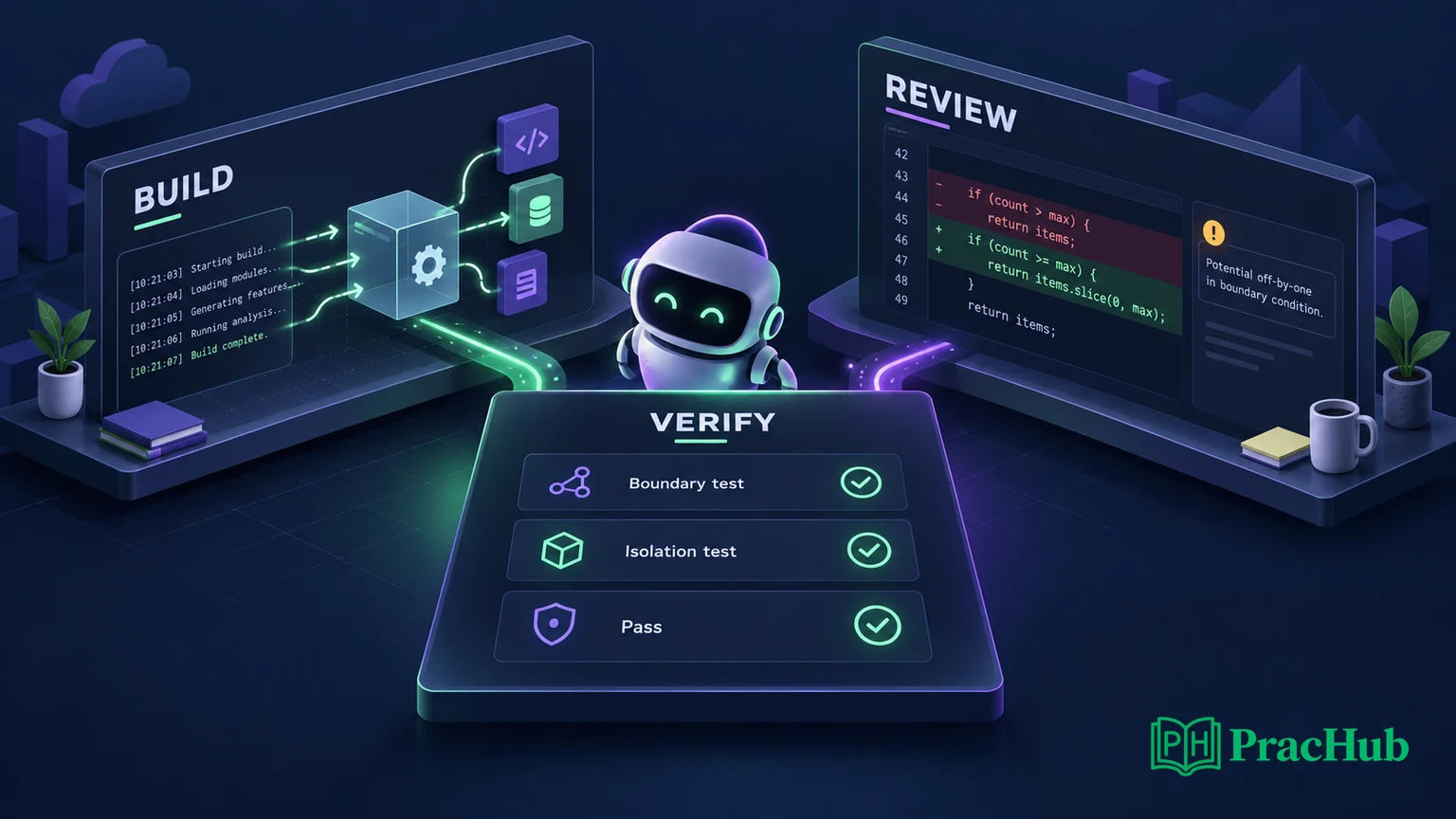
What Datadog officially confirms
Official fact: Datadog's policy, updated May 13, 2026, says selected roles include AI-assisted coding interviews. Candidates receive advance notice and should explain their approach and how they used AI. The stated evaluation concerns problem solving, reasoning, and engineering decisions with AI. Other live coding and technical assessments prohibit AI unless explicitly permitted. See the published policy.
An AI-assisted coding interview is a technical exercise in which the interview rules expressly permit an AI tool. The candidate remains responsible for understanding the task and evaluating the resulting implementation. Permission belongs to that interview; it does not automatically extend to other rounds.
Preparation inference: treat explanation and verification as part of the work from the beginning. A patch that runs is useful evidence, but it does not explain whether you understood the requirements. Explain one incorrect suggestion, what it would break, and how you corrected it. That gives the interviewer evidence of your judgment.
What candidate reports establish—and leave unknown
Candidate-reported: on May 27, 2026, one Reddit poster said their upcoming Datadog AI interview offered coding a feature or AI-assisted code review. This was a question about preparation, not a completed interview account. Their post establishes what they reported receiving, not a company-wide menu.
A separate August 2026 poster described an upcoming AI code-review interview for an engineering-manager role. That is adjacent-role evidence, not confirmation of a software-engineer exercise. Crossposts and repeated comments should not be counted as independent experiences.
We did not establish two independent, completed software-engineer accounts from the same recruiting cycle. Accordingly, this guide offers policy-grounded preparation rather than a reconstructed interview loop. Your invitation must resolve the allowed assistant, language, duration, repository access, and expected deliverable. Public anecdotes cannot tell you which format is easier to pass.
Feature building versus code review: choosing your preparation
If you are offered a choice, compare the work you can demonstrate reliably. Feature building requires turning a contract into a bounded implementation. Review requires finding consequential defects in unfamiliar code and supporting each finding. Both benefit from reading tests, tracing data, and explaining alternatives.
| Preparation decision | Feature building | Code review |
|---|---|---|
| Best evidence from a mock | A small working change with meaningful tests | A short list of reproduced, prioritized defects |
| Common trap | Asking AI for a broad rewrite before clarifying behavior | Repeating an AI warning without tracing the failing path |
| Useful self-check | Can I explain every changed function? | Can I show the input that makes this finding true? |
This comparison is our preparation advice, not Datadog's grading criteria. Try each format on the same small service. Choose based on your ability to reach a defensible result, rather than on how much code the assistant produces.
Before committing, confirm whether review means written comments, live discussion, runnable fixes, or a combination. Also confirm whether you receive starter code and which tools are available. Those details change the mock you should rehearse more than a generic claim that one format is easier.
Build a small observability feature
Original practice exercise: implement count_errors(events, tenant, start, end). Each valid event has tenant, id, ts, service, and level. Return ERROR counts by service for one tenant in the half-open interval [start, end): include the start, exclude the end. Count a repeated event ID once within that tenant's selected window. Sort output by service name.
Datadog's pipeline documentation describes filtering logs and applying processors. That product context makes log transformation a useful practice domain; it does not establish an interview question. Our tenant, deduplication, and time-window rules are deliberately chosen exercise constraints.
Start by resolving ambiguities. Here, an event ID identifies one immutable event within a tenant, and exact retries may repeat it. Different tenants can reuse an ID. Inputs are already schema-validated, timestamps are integer milliseconds, and reversed intervals raise an error. Conflicting payloads under one ID are outside this baseline contract and deserve an explicit follow-up.
Write examples before asking AI to implement anything. For tenant A and window [100, 200), an ERROR at 100 counts; one at 200 does not. Two copies of the same A event count once. A B event with the same ID must not hide the A event.
Now give the assistant a bounded request: implement one function, preserve input order and objects, add no dependencies, and explain the filtering and deduplication order. Review the answer against your examples before expanding scope.
A reference implementation you can explain
The baseline below favors inspection over indexing. It scans the supplied events, filters to the requested tenant and window, deduplicates eligible IDs, and counts errors. It returns a new dictionary with deterministic service ordering.
def count_errors(events, tenant, start, end):
    if start > end:
        raise ValueError("start must not exceed end")
    seen = set()
    counts = {}
    for event in events:
        if event["tenant"] != tenant:
            continue
        if not start <= event["ts"] < end:
            continue
        if event["id"] in seen:
            continue
        seen.add(event["id"])
        if event["level"] == "ERROR":
            service = event["service"]
            counts[service] = counts.get(service, 0) + 1
    return dict(sorted(counts.items()))
For n events and s counted services, expected runtime is O(n + s log s) with hash-based sets and dictionaries. Extra memory holds eligible distinct IDs and service counts. This is a finite-input practice function; it does not solve unbounded streaming retention, persistence, or concurrent mutation.
Explain why deduplication follows filtering. An unrelated tenant must never consume the requested tenant's ID. Explain why sorting happens at the end: the scan does not depend on input order, while deterministic output helps inspection. If repeated queries become the bottleneck, discuss an index only after establishing the correct baseline.
Review a tempting optimization against the same contract
Synthetic review exercise: imagine an assistant proposes this replacement for the loop's filtering logic. The code is intentionally defective. Your job is to identify what breaks, demonstrate it, and suggest the smallest repair.
 for event in events:
-    if event["tenant"] != tenant:
-        continue
-    if not start <= event["ts"] < end:
-        continue
     if event["id"] in seen:
         continue
     seen.add(event["id"])
+    if event["tenant"] != tenant:
+        continue
+    if not start <= event["ts"] <= end:
+        continue
The first finding is incorrect suppression across tenants. Put B's event with ID 7 before A's event with ID 7, both inside the window. The changed loop marks 7 as seen while reading B and discards A later. A's error count becomes zero when it should be one. This is a correctness defect; the example does not demonstrate disclosure of B's data.
The second finding is an upper-bound regression. An event at 200 enters the [100, 200) query because the comparison became inclusive. Adjacent windows can then count the same boundary event. Restore < end and keep a regression test at the exact boundary.
Prioritize these before naming or formatting suggestions. A useful review comment states the triggering input, observed result, required result, and repair. For example: “B/7 consumes the deduplication key before tenant filtering, so A/7 disappears. Filter first; retain the cross-tenant counterexample.” This is more actionable than “deduplication looks unsafe.”
Verify with counterexamples, not reassurance
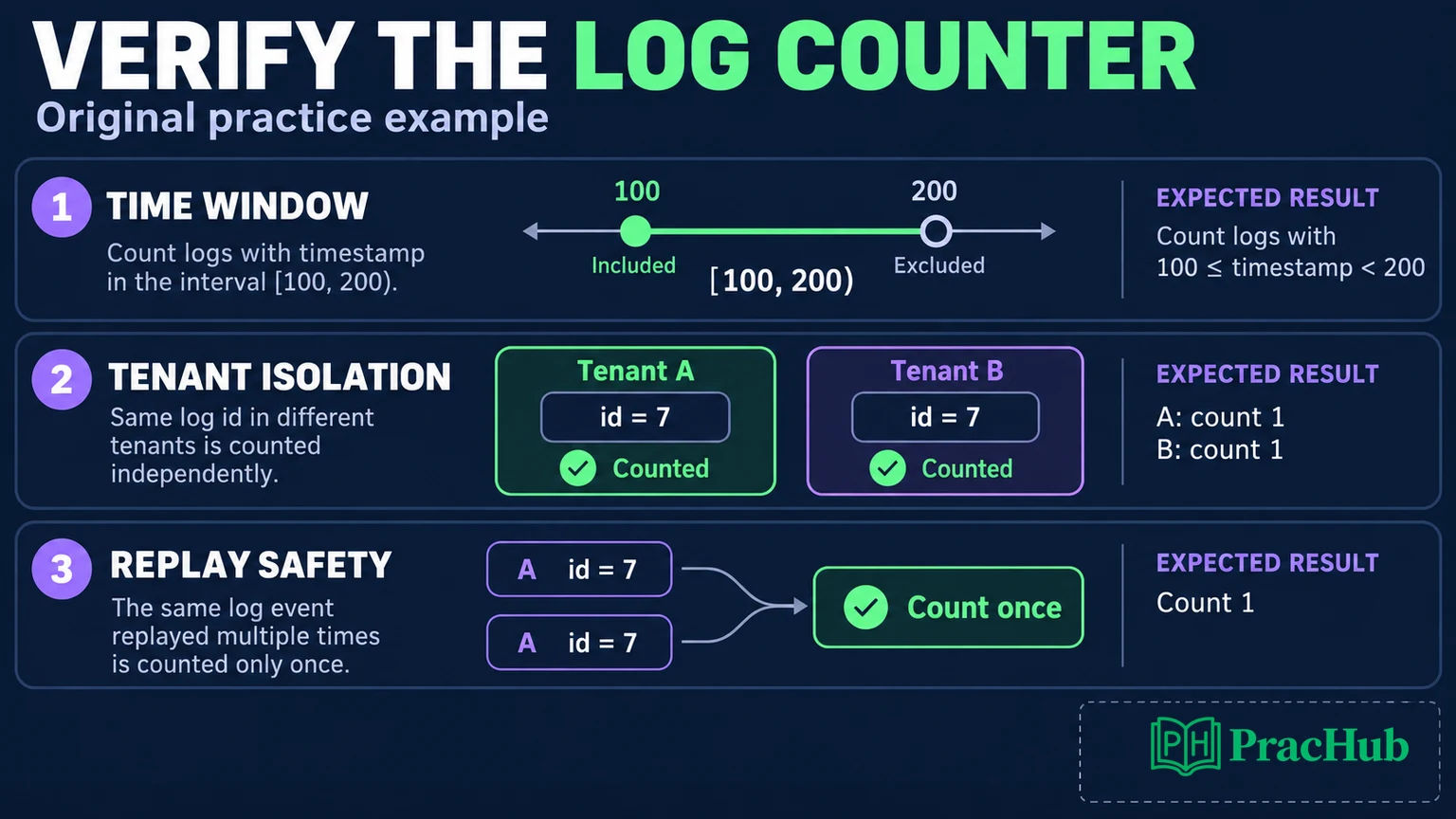
Use the following expected outcomes as a compact test specification. Each row challenges a different part of the contract; several ordinary ERROR events in the middle of the window would not provide the same coverage.
| Case for tenant A, window [100, 200) | Expected result |
|---|---|
| One A/api ERROR at 100 | {"api": 1} |
| One A/api ERROR at 200 | {} |
| Two identical A/api ERROR events with ID 7 | {"api": 1} |
| B/7 followed by A/7, both ERROR at 150 | {"api": 1} |
| Only A/api INFO at 150 | {} |
| Empty input or an empty [100, 100) window | {} |
We ran these behaviors locally against the reference implementation and checked that the defective version fails the cross-tenant and upper-bound examples. Those tests validate this synthetic exercise only; they are not evidence about Datadog's assessment or production systems.
Add two properties during a mock: permuting valid immutable events should preserve the result, and replaying the same event should not increase a count. Keep the expected answer independent of the implementation. If AI writes both the code and its tests from the same mistaken assumption, a green run can preserve the mistake.
When a test fails, read the assertion and isolate the smallest input before requesting another patch. Explain which assumption changed. After the fix, rerun the failed case and the existing suite so that a local repair does not quietly change another behavior.
Explain your AI decisions as you work
For an authorized practice session, ask the assistant to inspect one function or explain one failure path. A useful prompt is: “Compare this diff with the tenant and half-open-window contract. For each suspected defect, provide a minimal input and expected result. Separate confirmed bugs from questions that need more context.”
Then verify the response yourself. Reject warnings that depend on constraints the exercise excludes. For example, malformed timestamp handling is a follow-up if inputs are guaranteed valid; it should not displace a reproduced counting error. If the interviewer expands the contract, explicitly update the implementation and tests.
Finish with a short handoff: the behavior implemented, tests actually run, a suggestion you rejected, and remaining limitations. Say that large-input performance is unmeasured if you have not measured it. This practice keeps your explanation aligned with Datadog's published emphasis on reasoning without inventing an internal scorecard.
Practice with five Datadog questions on PracHub
These verified question-bank records provide related practice. They are not predictions of your exact AI interview, and their company tags do not establish a universal interview format.
| PracHub question | Deliberate practice action |
|---|---|
| Prioritize Critical Findings in a High-Load Batch Processor Review | Trace the caller-visible failure before ranking review comments. |
| Implement a Snowflake Query Client | Build a bounded API wrapper and test failed state transitions. |
| Match Registered Word Queries Against a Log Stream | State ordering rules before optimizing matching. |
| Implement log storage and querying | Defend time boundaries and query behavior with examples. |
| Implement DeleteTree With Limited Filesystem APIs | Reason from available APIs instead of assuming extra capabilities. |
For your next Datadog AI coding interview mock, choose one exercise from the Datadog Software Engineer question bank. Produce a working change or a reproduced review finding, then explain its evidence without the assistant. That is a concrete preparation target you can adapt once your invitation confirms the format.
Sources and Further Reading
- Datadog Careers: Interviewing at Datadog—AI Guidelines
- Candidate invitation report: feature building versus AI-assisted code review
- Engineering-manager invitation question: AI code-review preparation
- Datadog documentation: Log pipelines
- PracHub: How to Review AI-Generated Code in a Technical Interview
Research checked September 8, 2026. Official policy, candidate invitation reports, and original preparation advice are distinguished above. Role-specific instructions take precedence over public anecdotes.
Comments (0)