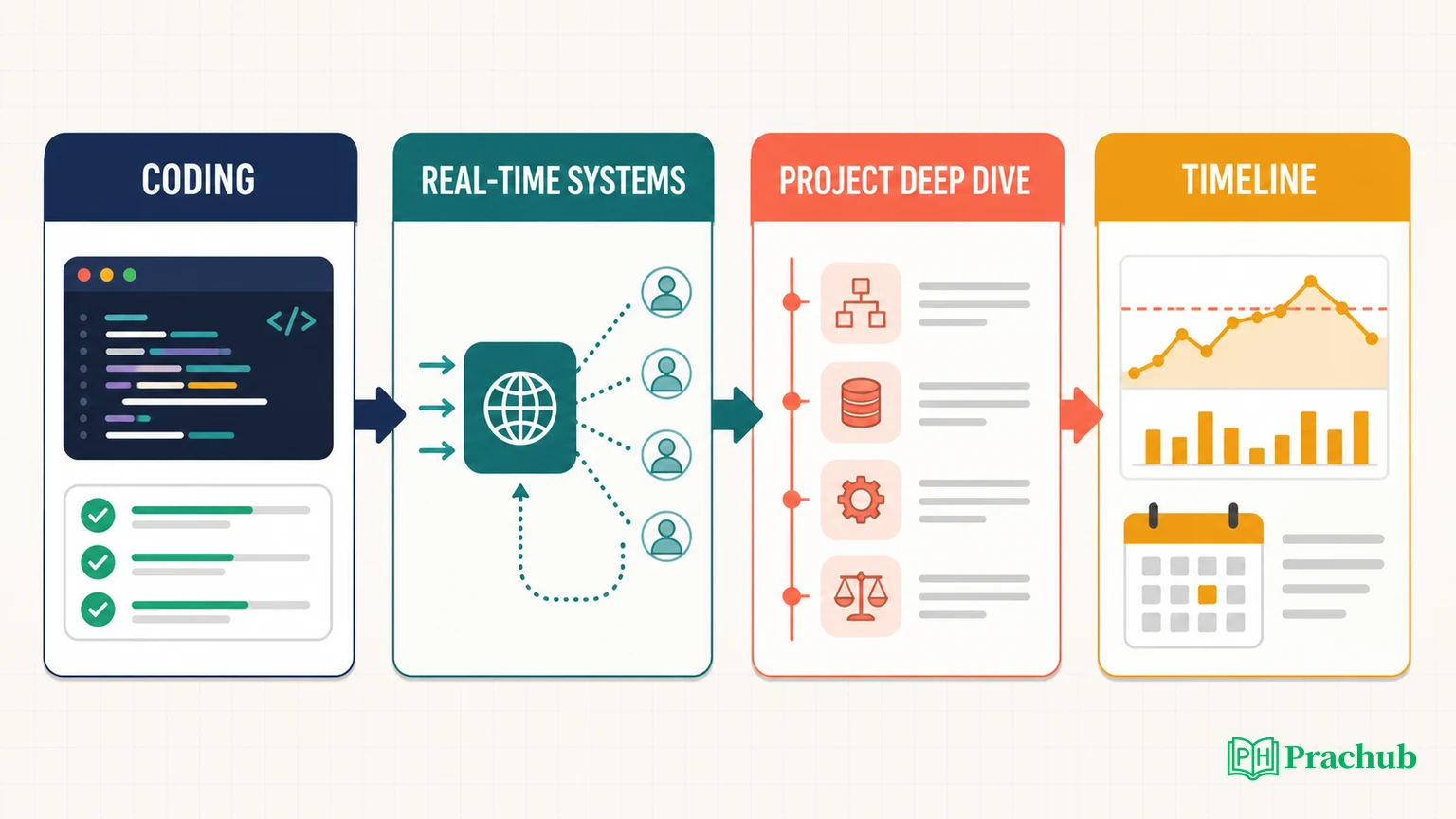
Discord Software Engineer Interview Guide 2026: Coding, Real-Time Systems, Project Deep Dive, and Timeline
Quick Overview
An evidence-based Discord Software Engineer interview guide for 2026, separating Discord's historical official process from current role signals and recent candidate-reported variations.
Discord Software Engineer Interview Guide 2026: Coding, Real-Time Systems, Project Deep Dive, and Timeline
The Discord software engineer interview in 2026 is best treated as a role- and level-specific process, not one fixed loop. Discord's detailed public engineering interview guide dates to 2020: it described recruiter and hiring-manager screens, a one-hour coding test, and a 5–6 hour panel with coding, values, and role-dependent architecture or specialty sessions. Current openings emphasize writing and reviewing scalable code, reliable systems, project ownership, and communication; these are role-context signals, not confirmed interview stages.
Start with the job description, then use Discord Software Engineer questions to rehearse the relevant skills. PracHub records are practice material, not a prediction of your exact interview.

Quick answer: what Discord confirms and what varies
Discord's published engineering interview guide is useful historical evidence. It says the company designed questions around work its engineers had done rather than trivia, and evaluated correct implementation, complexity, trade-offs, testability, resource use, and collaboration. It also described architecture interviews for mid- and senior-level candidates and specialty sessions for selected roles.
The limits matter. That guide was published on October 9, 2020. Discord's current Careers page does not publish a replacement universal loop, current assessment platform, time-to-offer promise, or generative-AI policy. Treat your recruiter email and interview invitation as authoritative.
Current job descriptions provide a better signal for emphasis. A Distributed Systems opening covers large-scale text-chat infrastructure, reliable update delivery to user sessions, monitoring, and tier-0 operations. A Developer Success opening emphasizes scalable code, APIs, real-time infrastructure, milestones, cross-functional work, and end-to-end ownership. Those signals support targeted preparation; they do not prove every applicant receives the same real-time design or project round.
Discord interview process at a glance
| Stage | Evidence and preparation |
|---|---|
| Application and recruiter screen | Historical official sequence; prepare a concise career narrative, motivation for Discord, logistics, and role fit. |
| Hiring-manager or technical screen | A hiring-manager screen was described in 2020; technical content is role-dependent and currently candidate-reported. |
| Coding skills test | The 2020 guide described one hour; current format may differ. Practice correct implementation, tests, complexity, and refactoring. |
| Panel or final loop | Historically 5–6 hours with a role-dependent mix. Follow the invitation for coding, values, architecture, debugging, or specialty prep. |
| Decision and follow-up | A few business days was the 2020 reference, not a current SLA. Confirm timing and follow up after the agreed date. |
This is an evidence map, not a guaranteed itinerary. For example, a Glassdoor account posted July 21, 2026, describes a March 2026 senior software engineer interview with a recruiter screen followed by an in-depth hiring-manager web-service design and coding round. That single senior-role account shows a possible variation, not company policy.
Prepare for practical coding, not a rumored question list
Discord's historical rubric rewards observable engineering judgment. Practice in a language you can debug fluently and use the same loop each time:
- Clarify inputs, outputs, constraints, failure behavior, and what “done” means.
- Propose the simplest workable design before writing code.
- Explain relevant complexity, then implement small, testable pieces with clear interfaces.
- Test normal, boundary, malformed, and concurrent cases.
- Refactor deliberately when a requirement changes instead of patching blindly.
Review core data structures, but do not assume the interview is only LeetCode-style algorithms. Candidate reports describe a chat server and a streaming data problem, while the 2020 guide describes feature implementation and staged follow-ups. Prepare to read requirements, explain library choices, and validate generated or handwritten code.
One PracHub-curated new-graduate candidate account labeled Jan 2026 says an AI-assisted chat-server option was provided and that the interviewer challenged prompts, library choices, testing, and follow-up changes. This is evidence for one reported loop, not proof that AI is allowed in every interview. Use generative AI only when the invitation explicitly permits it, and own every line it produces.
Real-time systems: prepare for Discord's domain without assuming “design Discord”
A real-time messaging system delivers state changes quickly enough for users to experience them as immediate while preserving acceptable ordering, reliability, and availability. At Discord scale, that can involve persistent connections, event fan-out, reconnects, presence, rate limits, backpressure, observability, and graceful degradation.
Current engineering work supplies practice contexts. The 2026 article Tracing Discord's Elixir Systems discusses message passing, fan-out, sampling, CPU overhead, and observability. A 2024 post explains how Discord reduced WebSocket traffic by 40% through compression and delta updates. These are public trade-off examples, not leaked questions.
Prioritize these problem families:
- Connection lifecycle: authenticate a session, send heartbeats, resume after disconnects, and avoid reconnect storms.
- Fan-out and ordering: distribute an event to many sessions, define the ordering scope, and handle duplicates or gaps.
- Hot communities: shard work, isolate noisy tenants, limit expensive actions, and protect shared dependencies.
- Voice and latency: route traffic near users while balancing packet loss, capacity, cost, and failover.
- Operations: choose service-level indicators, trace a request selectively, roll out safely, and mitigate before root-cause analysis is complete.
For protocol-specific follow-ups, use the WebSocket Interview Questions guide. Keep the Discord answer focused on requirements and trade-offs rather than reciting a generic architecture.
How to structure a Discord-shaped system-design answer
Begin with scope: text chat, voice, presence, notifications, or a combination. Ask about regions, connections, peak messages per second, delivery delay, retention, ordering, and availability. State assumptions before estimating ingress, fan-out, bandwidth, and storage.
Separate connection handling from durable storage and asynchronous delivery. Define APIs, choose a partitioning key, and explain ordering. Decide on delivery semantics, deduplication, and which state can be eventually consistent. Presence usually tolerates more staleness than authorization or billing.
Then test failure modes. What happens when a gateway dies, a shard becomes hot, consumers lag, a dependency times out, or a deployment causes mass reconnects? Discuss backpressure, bounded queues, load shedding, retry budgets, circuit breaking, and staged rollout. Discord's April 2026 voice-outage review is a public reminder that simultaneous session loss and cascading load are worth reasoning about.
Finish with observability and evolution. Name user-impact metrics, explain safe trace sampling, and show how the design changes at 2× and 10× load. Make assumptions and decisions inspectable instead of guessing Discord's internals.
Project deep dive: prove ownership, not architecture vocabulary
Discord's 2020 guide called its formal version a Project Retrospective and said it was generally used for management candidates and very senior engineers who might become technical leads. Therefore, do not assume every software engineer receives a named project-deep-dive round. Still, every candidate should prepare at least two project stories because recruiter, hiring-manager, behavioral, and technical conversations can probe ownership.
Open with a two-minute spine: user problem, constraints, your role, architecture, hardest decision, result, and lesson. Be ready to discuss alternatives, tests, rollout, incidents, disagreement, and measurable impact. Use “I” for your contribution and “we” for the team outcome.
A strong story survives counterfactual questions: Why not choose the other design? What broke in production? Which metric changed? What would you remove at one-tenth the scale? How would you migrate without downtime? For a reusable framework, see the Software Engineer Project Deep Dive Interview Guide.
Debugging and operational judgment
Discord's current Distributed Systems opening emphasizes monitoring, tier-0 operations, and complex distributed systems. Its Data Platform opening emphasizes clean tested code, debugging, deployment, and production support. Practice incidents as a sequence: establish impact, stop the bleeding, form hypotheses, request discriminating evidence, validate the cause, recover safely, and prevent recurrence.
PracHub-curated candidate accounts labeled Oct 2025 for senior backend and Dec 2025 for senior data platform describe, respectively, CPU-spike debugging plus project, behavioral, and design discussions, and an unbounded event-stream problem. Use them to create practice scenarios, not to predict your round mix.
Practice with Discord questions from PracHub
These verified question-bank records train skills relevant to the evidence above. They are practice material, not predictions of your exact Discord assessment or interview.
| PracHub question | Practice value |
|---|---|
| Implement an asyncio-based chat server | Trains concurrency, connection handling, tests, and evolving requirements. |
| Design a TCP Discord-like chat server | Builds an end-to-end narrative across protocols, sessions, and messaging. |
| Debug and mitigate a CPU spike incident | Practices triage, mitigation, evidence gathering, and prevention. |
| Walk through your background and proud project | Turns ownership and project depth into a measurable story. |
| Demonstrate effective AI-assisted coding workflow | Practices prompting, review, and validation when AI is explicitly allowed. |
A focused seven-day Discord interview plan
- Day 1 — Build the evidence map: mark every requirement in the job description and confirm the scheduled rounds, tools, and durations with the recruiter.
- Day 2 — Coding fundamentals: solve two timed problems, then review complexity, names, edge cases, and tests.
- Day 3 — Practical implementation: build a small networked or streaming component and complete one requirement change without losing correctness.
- Day 4 — Real-time design: design a chat, presence, or voice-routing slice with estimates, ordering choices, backpressure, and failure tests.
- Day 5 — Project deep dive: rehearse two projects, including a rejected alternative, a difficult incident, measurable results, and lessons.
- Day 6 — Debugging and values: run one production incident exercise and prepare six adaptable collaboration, ownership, and conflict stories.
- Day 7 — Full mock and repair: combine coding, system design, and project follow-ups, then fix the two weakest observable behaviors.
Do not spend the week memorizing rumored prompts. Record your practice, inspect where your reasoning becomes vague, and repeat the specific moment that failed.
Frequently asked questions
What is the Discord software engineer interview process in 2026?
Discord has not published a universal 2026 software engineer loop. Its 2020 engineering guide described resume review, recruiter and hiring-manager screens, a one-hour coding test, and a role-dependent panel. Current candidate reports show variations. Your recruiter and invitation are the source of truth for the stages, platform, and evaluation areas.
How long does the Discord software engineer interview process take?
No current official Discord source gives a universal application-to-offer timeline. The 2020 guide described a 5–6 hour final panel and said decisions often followed within a few business days, but those are historical reference points, not 2026 guarantees. Ask the recruiter for the expected schedule and follow up after the agreed date.
What coding questions does Discord ask software engineers?
Discord's historical guide emphasizes practical problems based on engineering work, correct implementation, complexity, trade-offs, testability, and follow-up changes. Recent candidate reports include chat-server, web-service, and event-stream tasks, but questions vary by team and level. Practice implementation and explanation rather than memorizing one rumored problem.
Does Discord allow AI during coding interviews?
Do not assume so. One PracHub-curated new-grad candidate account labeled Jan 2026 describes an optional AI-assisted format, but Discord has not published a universal interview AI policy. Use AI only when written instructions or the interviewer explicitly permit it. If allowed, expect to justify prompts, review generated code, test behavior, and correct mistakes yourself.
Is system design or a project deep dive guaranteed at Discord?
No. Discord's 2020 guide described architecture sessions for mid- and senior-level candidates and a Project Retrospective mainly for managers and very senior potential technical leads. Current role requirements and candidate reports make both valuable preparation, but neither is confirmed for every software engineer. Match your preparation to the role and scheduled loop.
Final takeaway
The best Discord software engineer interview preparation makes engineering judgment visible. Write correct, testable code; clarify requirements; explain trade-offs; reason about failures; and tell project stories that prove personal ownership. Add real-time systems depth when the role touches messaging, voice, infrastructure, APIs, or distributed data, but do not assume every candidate receives the same architecture round.
Use the current job description and recruiter instructions as the final authority. Then rehearse with PracHub interview questions, treating every prompt as a chance to communicate assumptions, verification, and learning—not as a forecast of the exact interview.
Sources and Further Reading
- Discord: How to prepare for your Discord interview
- Discord Careers
- Discord Software Engineer, Distributed Systems opening
- Discord Software Engineer, Developer Success opening
- Discord Software Engineer, Data Platform opening
- Discord Engineering: Tracing Discord's Elixir Systems
- Discord Engineering: How We Moved Discord Voice to the Edge
- Discord Engineering: Behind the Scenes of the March 25, 2026 Voice Outage
- Discord Engineering: How Discord Reduced WebSocket Traffic by 40%
- Glassdoor Discord interview reports
- PracHub Discord new-graduate interview report
- PracHub Discord senior backend interview report
Research note: This guide was checked on August 29, 2026. Hiring stages, technical emphasis, tooling, AI permissions, and timing can vary by team, level, location, and recruiting cycle.
Comments (0)