Embedded Electronics Review: C/C++ Q&A Sets and Practice Depth
Quick Overview
A bounded review of Embedded Electronics public interview sets, sampled C/C++ answer depth, and free-resource boundaries. Original C17 and C++20 examples distinguish pointer passing, const access paths, volatile assumptions and atomic increments. It includes seven host assertions, an expected compiler rejection and a practical map from recall to code evidence.
Embedded Electronics is useful as a public index for recalling embedded, C and C++ interview vocabulary. The sampled pages opened questions into short answers without an account. The inspected interface revealed reference text; it did not ask us to compile a program, explain a failing execution, or defend a follow-up answer. Use it to find a term you cannot explain, then create the missing code evidence before treating that topic as prepared.
PracHub publishes this review and owns the complementary practice links. The PracHub C++ const-pointer exercise offers a specific follow-up to the qualifier examples below. Our compiler checks are original local exercises, separate from Embedded Electronics. They do not measure its learners, paid training, or interview outcomes.

What the public interview hub contains
Direct observation, November 3, 2026: the supplied GitHub Pages interview address redirected to the Embedded Electronics interview hub. Its five categories were Embedded Systems, C Programming, C++ Programming, Data Structure, and Microcontroller. Each category linked three sets labeled “30 Q&A.” Those are catalog labels; we did not verify every answer, deduplicate the collection, or establish employer provenance.
We opened C Programming Sets 1, 2 and 3 and C++ Programming Set 1. Each inspected set presented question buttons and instructions to expand them. Opening selected buttons revealed text answers. We did not encounter a required sign-in, payment step, code editor, submission result, or personalized feedback in that route. This is a bounded interface observation, not a claim about every other part of the site.
Official access statement: the FAQ says free learning resources remain separate from its Professional Training Programme. Do not infer that a public Q&A page includes enrollment, live classes, a certificate, or an assessment entitlement. We did not register for or evaluate the training programme.
Choose the category that exposes a gap in your explanation. C and C++ overlap in spelling but differ in language mechanisms. A microcontroller prompt introduces target assumptions that a host-language explanation may leave out. Moving between these categories should change the questions you ask, rather than merely increase the number of answers you have opened.
A short answer can start the next question
In C Set 2, the inspected const answer describes preventing modification after initialization. Its volatile answer refers to values that may change unexpectedly and hardware registers. C Set 3 offers another concise volatile explanation focused on optimization. Use these definitions as starting points; the inspected answers leave the concurrent-program and peripheral-access contracts unresolved.
For example, ask what exactly is protected by const: the pointed-to value, the pointer object, or both? Ask whether another writable alias exists. For volatile, name whether the changing value comes from a peripheral, a signal-related mechanism, or another C++ thread. The answer determines which language and platform rules you need.
This review does not grade the whole collection from those samples. The narrower finding is that the opened answers leave room for follow-ups a learner should supply. A quick reveal checks recognition. Predicting a concrete operation and explaining a failed alternative require another exercise.
Before opening an answer, write your explanation and the smallest example that would disprove it. After opening, compare assumptions as well as wording. If your explanation says “safe,” specify safe from which failure and under which execution model. That step gives a short reference answer a useful role without assigning it capabilities we did not observe.
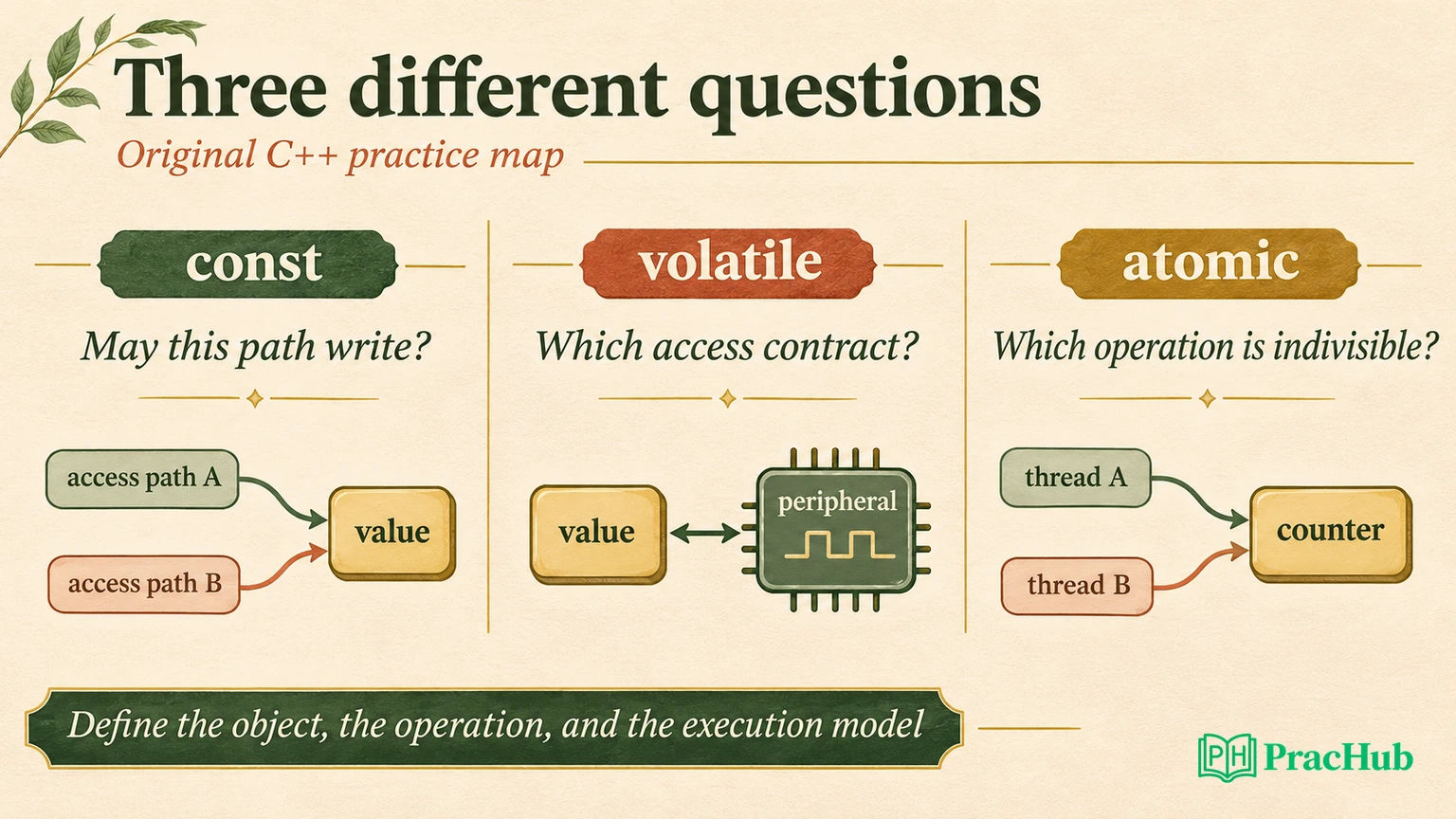
Const, volatile and atomic answer different questions
Our original comparison below is a routing aid for follow-up practice. It is not an Embedded Electronics answer or an implementation recommendation for an unidentified device.
| Mechanism | Question to resolve | Evidence still missing from a definition |
|---|---|---|
| const-qualified access | May this access path modify the value? | Object identity, other aliases, and the exact declaration |
| volatile-qualified access | What access semantics does this implementation provide? | Target documentation and the required ordering contract |
| Atomic operation | Which concurrent operation must be indivisible? | Memory order, related data, and the wider invariant |
The C++ working draft on cv-qualifiers distinguishes an object from a const-qualified path to it. A read-only view can refer to an ordinary mutable object. Its value may change through another permitted path. That does not authorize modifying an actually const object by casting away its qualifier.
Here is our original single-threaded example:
int reading = 7;
const int* view = &reading;
reading = 9;
// Reading *view now observes 9.

int* const fixed = &reading;
*fixed = 11;
// The pointer is fixed; its pointee is writable.
We compiled and ran assertions for those two results. A separate translation unit attempted to write through a pointer-to-const and was rejected by the compiler. Compare the diagnosed forbidden write with the permitted write through another access path. We did not execute an undefined attempt to alter an actually const object.
Changing an imagined sensor value into const volatile introduces another question: who supplies updates and which accesses are valid? A language declaration alone cannot identify a register's physical behavior. Consult the target's register and compiler documentation before claiming anything about access width, side effects, or ordering.
The exercise here is to make your explanation survive a declaration change. If const int* becomes int* const, predict the newly allowed and forbidden operations before compiling. If you cannot explain the difference without running it, the original definition has identified a useful gap.
Do not use volatile as a thread-safety answer
Consider two C++ threads updating one shared counter. Qualifying an ordinary counter volatile does not make a read-modify-write atomic or create the required inter-thread relationship. The working draft's data-race rules explain why conflicting non-atomic actions without the necessary ordering can produce undefined behavior. We did not run a deliberately racy version to manufacture a misleading “lost updates” measurement.
Our original safe counter used an atomic fetch-add. Two threads each performed 20,000 increments; after joining them, the observed total was 40,000. This is a small host-side result, not evidence about interrupt latency, device access, or the reviewed product's grading.
std::atomic<int> count{0};
auto add = [&] {
    for (int i = 0; i < 20000; ++i)
        count.fetch_add(1, std::memory_order_relaxed);
};
Why discuss the order at all? The atomic-ordering specification separates indivisibility from synchronization of other memory. This example only accumulates a counter and reads it after the worker threads have joined. It does not use a relaxed flag to publish a separate mutable payload.
If a follow-up asks a consumer to read data when a “ready” flag changes, that is a new contract. Identify the data, its writer, its reader, and the required publication relationship. Repeating “atomic” without those details is as incomplete as repeating “volatile.” Our counter result cannot validate a different publication protocol.
Keep C pointer passing distinct from C++ references
The opened C Set 1 uses passing an address to describe call by reference. That common teaching shorthand needs care in a technical answer. The GNU C manual describes C calls as passing copies of argument values, including pointer values.
Our original C17 check separated two actions. One function assigned a different address to its local pointer parameter; the caller's pointer still addressed the original integer. Another function wrote through the copied pointer; the original integer changed. Four assertions checked the caller pointer, the original value before the write, the value afterward, and the untouched second integer.
Draw two boxes before explaining this: one for the caller's pointer object and one for the integer it addresses. The callee receives another pointer object with a copied address. Reassigning that local pointer and writing to its pointee affect different objects. If the requirement is to replace the caller's pointer, the function signature must express that requirement.
The inspected C++ Set 1 describes a reference as an alias. Keep that language mechanism distinct from the C pointer example. State whether you are discussing C or C++, then identify the exact signature. Keep the parameter mechanism explicit even when learning materials use the same phrase.
Turn a Q&A page into a compile-and-debug session
This original practice map supplies evidence the inspected accordion interface did not collect. Choose a row based on the answer you could not defend, rather than completing every category in sequence.
| Starting point in the sampled material | Original follow-up | Useful result to retain |
|---|---|---|
| Const definition | Swap pointer constness and pointee constness | Prediction plus accepted or rejected write |
| Volatile definition | Identify a peripheral-access contract separately from thread synchronization | A precise statement of what remains unproved |
| C address-passing answer | Rebind a local pointer, then mutate its pointee | Caller-object diagram and observed values |
| C++ reference definition | Compare signatures for mutation and rebinding | Explanation tied to the language and parameter type |
| General debugging vocabulary | Reduce one incorrect assumption to a tiny program | Compiler diagnostic or bounded runtime assertion |
Our local checks used C17 and C++20 with warnings enabled and treated as errors. The runnable examples passed seven assertions in total, and the forbidden const write failed compilation as expected. These are original examples written for this review. No hardware board, debugger probe, automated site judge, course assessment, or cross-compiler comparison was involved.
Keep the source, compiler command, prediction, and actual result together. A successful run supports only the behavior that the example actually exercises. A concurrency claim still needs a language-level argument; a device claim still needs the relevant target contract. That discipline prevents a small successful program from becoming a larger unsupported conclusion.
An expected compilation failure needs a narrow interpretation too. In our const-write file, the attempted assignment was the only operation under investigation. Rejection supported the type-system boundary we intended to check. It did not show that a different program was race-free, that an object's lifetime remained valid, or that the compiler had understood a hardware protocol. Do not collect an error message without identifying the claim it supports.
For the pointer example, changing the input is useful only if it challenges the distinction. A second integer with a different value makes a mistaken rebind prediction visible. Merely choosing another value for the same integer would not expose which pointer object changed. That counterexample tests which object changes; rereading the definition alone leaves the distinction untested.
Use the short answer again after the experiment. Rewrite it to name the assumption that mattered, without turning it into a memorized transcript. A useful retained answer might explain which object changes and why, then point to the minimal counterexample that rules out your first interpretation.
Practice the gaps the product leaves open
These PracHub prompts add code reading, ownership and concurrency follow-ups to the sampled definition-level material. They are complementary exercises, not exports of the reviewed site or proof of its employer coverage.
| PracHub question | What to examine |
|---|---|
| C++ Fundamentals: const Pointers, and map vs unordered_map | Name which part of each declaration is const before predicting writes. |
| Reason About C Pointer and Array Declarations | Draw the pointer object separately from the memory it addresses. |
| Compare C++ Pointers and References | Keep C pointer passing distinct from C++ reference parameters. |
| C++ Atomics, Memory Ordering, and Safe Publication | Separate a counter operation from publication of other data. |
| Find and Fix C++ Ownership Bugs: Double Free, Shallow Copy, and Object Slicing | Explain object lifetime and repair the ownership path. |
We did not observe a learner history or an assessed readiness report in the sampled set pages. If you track progress yourself, record the unresolved assumption alongside the topic name. “Opened volatile answer” describes navigation. “Can explain why a thread counter needs synchronization and why a peripheral needs its own access contract” describes a more useful practice target. Neither entry should be presented as a verified prediction of interview performance.
Embedded Electronics fits a learner who wants an accessible recall list and is willing to supply the deeper checks. For practice that needs execution feedback, target diagnosis, or an assessed explanation, inspect whether the particular route provides those capabilities before relying on it. Start with one sampled definition and continue with the PracHub C++ const-pointer exercise. Leave with a prediction, a result and an explanation of its limits, rather than only a count of opened answers.
Sources and Further Reading
- Embedded Electronics public interview hub
- Embedded Electronics FAQ and free-resource distinction
- C Programming Set 1
- C Programming Set 2
- C Programming Set 3
- C++ Programming Set 1
- C++ working draft: cv-qualifiers
- C++ working draft: data races
- C++ working draft: atomic order and consistency
- GNU C Language Manual: function-call semantics
Comments (0)