EWskills Review: Embedded C/C++, Verilog, and Electronics Practice
Quick Overview
EWskills review based on current public catalogs and a UART bit-field task with a C11 editor, Quick Guide and visible cases. It separates readable content from authenticated execution and distinguishes value-level assertions, RTL evidence and physical hardware validation. An original eight-assertion C model and practice-evidence map explain the limits of each result.
EWskills is worth inspecting when your preparation crosses firmware code, RTL and electronics concepts. Its public catalogs separate Embedded C, C++, Verilog and circuit-oriented material instead of treating them as one interchangeable skill. Our review inspected those routes and a UART bit-field task with an editor and visible cases. Running that task required login, so we verified the public interface and built a separate host-side exercise rather than claiming a judge result.
PracHub publishes this review and owns the complementary practice destinations. The PracHub streaming-parser exercise offers another way to defend field boundaries and input assumptions. Our register-value example below is original educational code, not an EWskills submission, a hidden-test result, or physical UART validation.

What the public skill routes showed
Direct observation, November 3, 2026: the EWskills homepage linked Embedded C Programming, C++ for Embedded Systems, microcontrollers, component skills, Verilog, circuit protection and digital electronics. Its footer also linked ElectronicWings destinations. We report that visible association without inferring a legal ownership structure.
The Embedded C catalog grouped tasks, quizzes and Quick Guides by topics such as bit fields, pointers, buffers, strings and arithmetic edge cases. The C++ catalog included language mechanisms alongside ownership-oriented topics, including smart pointers, copy and move semantics, and RAII. Those observations establish navigable material, not an audit of every task or explanation.
The Verilog route listed tasks about gates, vectors, procedural constructs, handshakes and other logic concepts. The Circuit Protection route organized component-related tasks and quizzes. We did not execute an RTL simulation, perform a circuit experiment, inspect private grading, or measure learning outcomes.
The practical implication is to choose a route by the failure you need to explain. A wrong output integer, an incorrect signal sequence, and an unsuitable component choice call for different evidence. Use the catalog to find a topic, then seek evidence appropriate to that kind of exercise.
What the UART field task exposed before login
The inspected Set Baud Rate Field in Control Register task described a four-bit field occupying bits 8 through 11 of a 32-bit value. Its requirement was to update that field while preserving other bits. The page included a C11 editor, a Quick Guide, and visible input/expected-output cases.
The same page explicitly said login was needed to run code. We did not select Run, submit an implementation, open a private submission record, or create an account. Seeing sample expectations therefore did not establish that our implementation passed the site's evaluation.
The public contract asks which bits may change and which must stay identical. Before coding, predict a case where the old field already contains ones and the requested replacement contains zeros. That input distinguishes replacement from merely setting additional bits.
Keep the input domain explicit too. A four-bit value normally suggests a limited range, but an API parameter can represent more than that range. Decide whether an out-of-range input is rejected, masked, or excluded by a precondition. This review's original extension defines its own masking policy; we did not verify the provider's hidden expectations for that extension.
Original drill: replace the field and preserve its neighbors
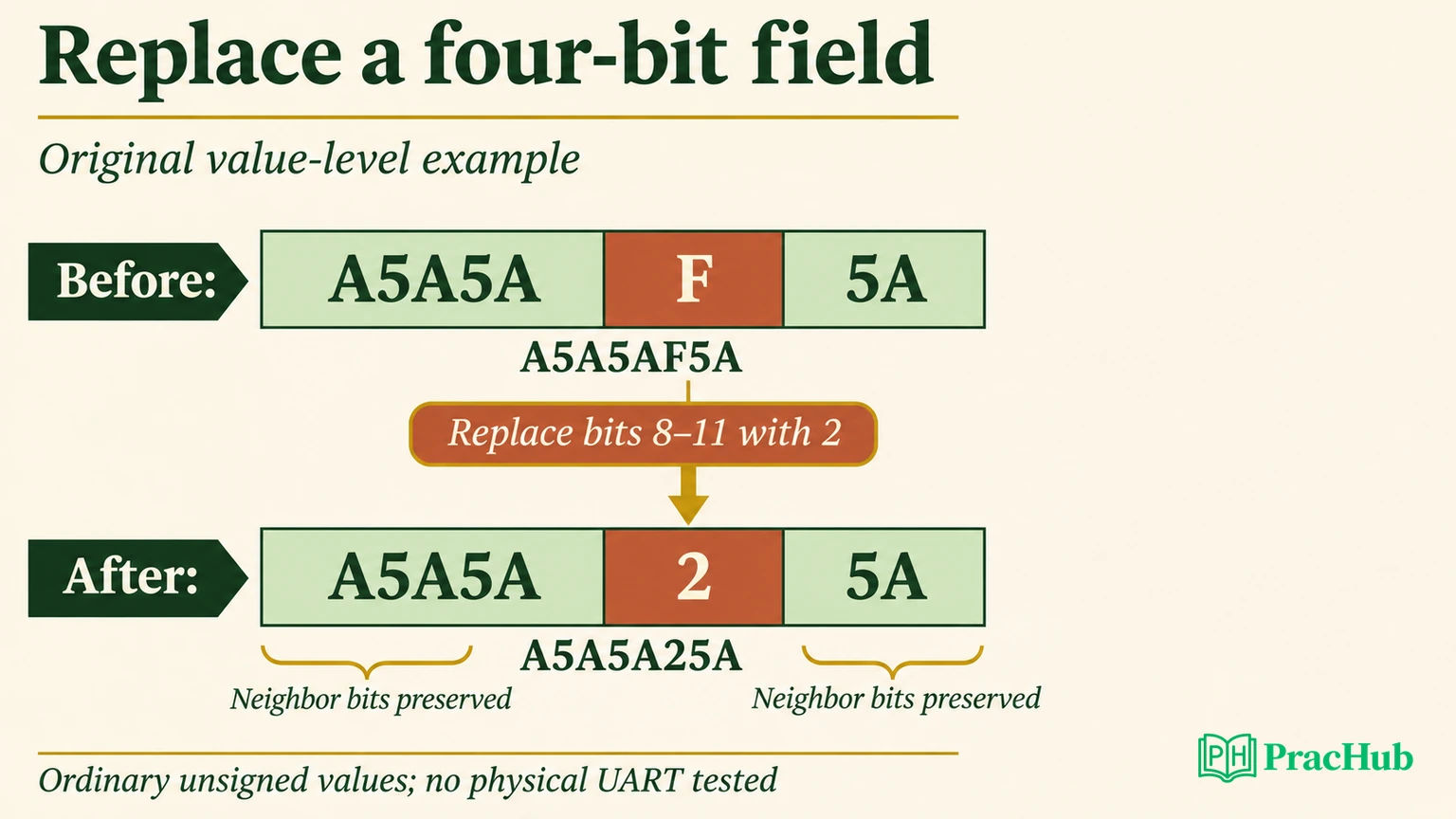
For our separate exercise, treat the register as an ordinary unsigned 32-bit value. The field mask is hexadecimal 00000F00. Start from A5A5AF5A and request field value two. The intended result is A5A5A25A: the selected nibble changes from F to 2 while the surrounding pattern stays intact.
The alternating surrounding bits matter. Starting only from zero would let an implementation accidentally erase unrelated state without revealing that failure. Starting with every target bit set makes the need to clear old ones visible. This input exposes an implementation that erases neighbors or leaves old field bits set.
uint32_t replace_field(uint32_t reg, uint8_t code) {
    const uint32_t mask = UINT32_C(0xF) << 8;
    return (reg & ~mask)
        | (((uint32_t)code & UINT32_C(0xF)) << 8);
}
The first part preserves the bits outside the field and clears the old field. The second part limits the supplied code to four bits before positioning it. Combining them fills the space that was deliberately cleared. This is our chosen ordinary-value contract, not a prescription for every hardware register.
SEI CERT C's guidance on unsigned bitwise operands is relevant to keeping representation and shift assumptions explicit. Our function uses unsigned fixed-width values and a fixed, valid shift distance. A reusable variable-width helper would need additional range checks; this small function does not establish that a general helper is safe.
Why OR alone does not replace a field
Consider combining the original value with the new field using only OR. An old one cannot become zero through that operation. With the selected nibble initially F, OR-ing in two leaves F in place. Preserving the surrounding bits does not fix the incorrect field value.
That reveals two independent obligations. The field must equal the requested low four bits, and every non-field bit must equal its original value. A check of only one obligation can accept a faulty solution. Add idempotence as another useful question: applying the same replacement twice should not change the second result under this value-level contract.
Our original C11 program compiled and ran eight assertions. They covered the worked result, preservation outside the mask, extraction of the requested field, an OR-only counterexample, the explicit low-four-bit policy, all-one and all-zero boundary inputs, and a repeated replacement. These host assertions cover the stated cases; EWskills evaluation and exhaustive verification remain untested.
A register-shaped integer is not a physical peripheral
The task provides a useful numerical exercise. Deploying a similar-looking expression to a device adds a different contract: whether reads have side effects, which fields are writable, how reserved bits behave, and which ordering or access width the device requires.
The CMSIS-SVD 5.8.0 register schema describes access and modified-write semantics for register descriptions. That is a reminder to identify the operation a register accepts before applying an ordinary-value transformation. Our local example neither reads nor writes a mapped peripheral address.
If a follow-up names a real UART, ask for the relevant register description and clock configuration. Updating a field value does not independently establish the resulting baud rate. Nor does passing a host assertion prove that a physical read-modify-write is legal or that a transmission completes correctly.
This boundary is useful when evaluating practice tools. A compiler can help check language behavior. A peripheral simulation can model additional state if its scope is known. A board measurement can establish a particular observed signal under stated conditions. Evidence grows only when the actual mechanism is exercised; changing the label on an integer does not add a hardware test.
A changed clock exposes a different unanswered question
Here is a synthetic follow-up, independent of the provider's task: suppose a teaching device defines its output rate as clock / (16 × (d + 1)). The four-bit field directly holds d in this invented model. With d = 2, a 48 MHz clock produces one million units per second; a 24 MHz clock produces half that rate. The field-replacement code can be identical in both cases.
This is not a claim about the divider encoding or clock tree of a real UART. It demonstrates why a correct field update and a correct output rate are separate obligations. For an actual part, the encoding, oversampling mode, clock source and allowed error would need to come from its documentation.
In an interview, name which obligation you have established before moving to the next. If the requirement changes from “preserve the other bits” to “meet this timing,” identify the new inputs and specification rather than describing the same assertion as a timing test.
Match the practice route to the evidence you need
The following original map connects the inspected catalog types to a sensible next check. It does not assert that EWskills implements every tool or feedback mechanism listed in the final column.
| Practice need | Public material we inspected | Evidence to seek next |
|---|---|---|
| C bit-field reasoning | UART field prompt, guide and visible cases | Predicted value plus field and preservation checks |
| C++ behavior and ownership | Language and RAII-related catalog topics | A concrete lifetime or state trace tied to the code |
| RTL logic reasoning | Verilog task and quiz listings | Defined inputs, expected signal behavior, and a bounded simulation result |
| Electronics selection | Circuit Protection task and quiz listings | A stated requirement and relevant component constraints |
| Terminology recall | Quick Guides and quiz routes | An explanation of why an alternative fails in context |
A C++ ownership answer, for instance, needs to identify which object owns a resource and when that ownership changes. A correct bit mask does not test that explanation. Likewise, a logic task may require reasoning across events rather than evaluating a single arithmetic expression.
For an electronics question, explain the requirement before choosing a component. Name the limits or operating conditions that would make the selection unsuitable. We did not validate real circuit safety or component performance, so a catalog label should not be read as a tested design recommendation from this review.
Use the route map to choose the next unresolved obligation. Completing more items is not the same as resolving the assumption that caused the last failure. Choose one missing obligation and seek evidence appropriate to it. That could mean a compiler diagnostic, a logical trace, or a request for a missing specification.
Evaluate the run and feedback boundary separately
We could read the task statement and visible cases without logging in; the inspected execution path required authentication. This review does not establish account allowances, grading reliability, hidden-case coverage, paid access, cross-device progress, or the quality of a completed feedback report.
If you later evaluate that route with an account, begin with an implementation whose behavior you already understand. Compare expected behavior with the returned result, then change one assumption at a time. A deliberately chosen counterexample is more informative than an unexplained pass or fail.
For the field exercise, an old field full of ones tests clearing. A patterned surrounding value tests preservation. A request outside the ordinary four-bit range tests the declared input policy, if such inputs belong to the contract. Those cases ask different questions, so retain which one produced the observation.
Retain the smallest useful record: the stated input contract, the input that challenged it, the expected observation, and the actual result. In the original OR-only counterexample, the error is specifically a failure to remove old field bits. A broad label such as “bitwise bug” would discard the reason that made the case useful.
If the tool returns a mismatch, first reduce the cause to input parsing, language behavior, or the transformation itself. A visible example does not reveal the entire grading contract, and a hidden failure does not identify its cause automatically. Keep the evidence narrower than the explanation until you have isolated the difference.
Practice the gaps the product leaves open
These complementary PracHub questions connect the review's software, verification and hardware-evidence gaps. They are not copies of EWskills tasks or authenticated results from its judge.
| PracHub question | What to examine |
|---|---|
| Design a Streaming TLV Message Reassembler in C | Preserve field boundaries while handling input that arrives in pieces. |
| Verification Plan for a FIFO, a Round-Robin Arbiter and a Valid/Ready Handshake | Choose assertions and sequences that expose handshake and ordering failures. |
| Explain thermal and signal fundamentals | Connect an electronics explanation to stated signal and thermal assumptions. |
| Implement memcpy with misaligned addresses | Make alignment and memory-access assumptions explicit before optimizing. |
| Explain C++ References, Pointers, Virtual Methods, and Overrides | Defend language behavior separately from hardware behavior. |
EWskills may fit a learner looking for separate firmware, RTL and electronics practice paths. Inspect a task's contract and current execution boundary, then judge the result by the mechanism it actually exercises. Continue with the PracHub streaming-parser exercise if you want another setting for preserving boundaries while inputs change. Retain the counterexample and state which target assumptions remain untested.
Comments (0)