GenAIForge Interview Prep Review: Offline SQL and JavaScript Practice
Quick Overview
GenAIForge Android offline SQL and JavaScript practice
GenAIForge Interview Prep is the Android app whose listing describes local SQL execution and JavaScript tests for supported problems. It can fit a study block where internet access is unreliable, provided the advertised features work on your device and the problem you choose includes the tests you need. For an independent correctness check, try the PracHub SQL question and predict its result rows before executing it.
This review covers the Google Play entry for Interview Prep by GEN AI FORGE, package com.genaiforge.interviewprep. I verified the storefront description and supported practice claims. I did not install the app, run a device experiment or verify all offline features on Android. Treat the resulting examples as ways to assess that fit yourself.
What the developer says runs on the phone
The official listing describes an on-device SQL query runner. It also says JavaScript tests execute on the device when the particular coding problem includes them. The developer lists Blind 75 questions with hints and references, behavioral prompts with STAR fields, system design outlines, a daily mix and spaced practice. Python, Java and C++ solutions are reading references under the listing’s description. The described version has no cloud account or server sync. GenAIForge Interview Prep on Google Play
| Practice surface | Listed behavior | Evidence to look for |
|---|---|---|
| SQL | On-device query runner | Inspect output against expected rows, nulls and duplicate keys. |
| JavaScript | Local tests where a problem includes them | Confirm which problem has tests and whether an edge case is covered. |
| Python, Java and C++ | Reference reading | Use the required language in an independent runtime. |
| Behavioral and system design | Outlines, self-rubric and sample answers | Speak a complete response and ask a practice partner for a changed condition. |
| Progress and stories | Local use and a user-exported JSON backup | Verify retained progress and restoration before changing phones. |
The listing says candidates can continue as guests. It describes the current version as free of ads and in-app purchases and says it can work offline after installation. The initial acquisition still depends on the store and device. The data-safety section says the app may collect personal information, while the description says account details can be local and nothing is uploaded. These are separate developer disclosures. If data handling affects your choice, read the current policy and use fictional practice content until you understand the behavior that applies to you.
A local runner and a remote assessment judge serve different needs. A runner can show the result on the data or test cases provided. A judge additionally defines accepted outputs and compares selected cases under an exam or platform contract. The listing distinguishes this app from a remote judge and a live AI interviewer. Use the run result for the scope you can observe.
Make a SQL session verifiable offline
Here is an original exercise for checking a SQL runner. Suppose a roster has customers A, B and C. Orders contains two paid rows for A and one canceled row for B. You want one row per customer with their count of paid orders. The expected result is A with two, B with zero, C with zero. Write the expected rows before running a query.
One useful query approach is starting with the customer roster, left joining orders on customer identity and paid status, then counting the joined order identifier. Filtering for paid status after the outer join can drop B and C. Counting all result rows can report one for a customer who has no qualifying match. Use a deliberately empty count and a customer with multiple matching orders to test both errors. SQLite’s reference material explains joined rows and filtering. Check the app’s supported dialect and table interface rather than assuming it exposes every SQLite feature. SQLite SELECT reference
An interview can change the problem. Ask whether repeated payment status events are orders or events, and whether output should be one row per buyer or per purchase. Add a duplicate event and a null join key to your test if the task permits. Inspect the selected population with a small query before summarizing. A readable intermediate result helps you explain why an unexpected count appears.
Use the mobile session to practice what you can actually inspect. Some problem environments supply a fixed data set, so you may need to create your extra fixture in a separate tool. If an answer can only be compared with a reference result, keep that distinction in your notes. During an actual screen, follow the permitted tools and use the engine named by the employer.
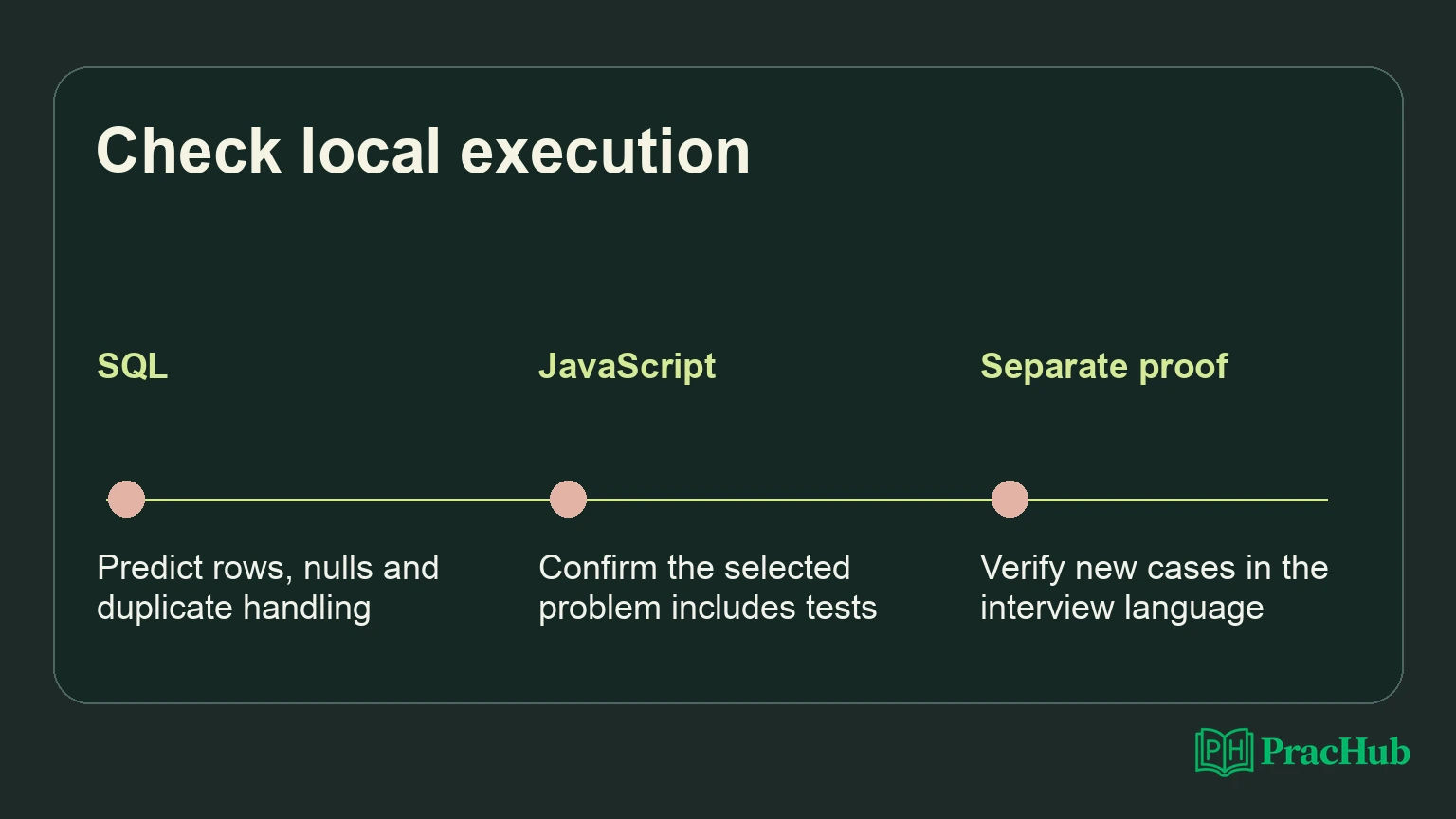
Use available JavaScript tests and add one missing case
Choose a coding problem that shows runnable tests. Before seeing them, state the interface and prepare a case that a plausible wrong answer would fail. For example, if a task sorts a list of scores, use 2 and 10 to distinguish numeric ordering from default string ordering, and add two equal scores if ordering among ties matters. JavaScript’s Array sort documentation explains default conversion for sorting and the use of a comparison function. The documentation supports the language behavior, while the app listing supplies the claim of on-device execution for some questions. JavaScript Array sort reference
A passing demonstration can conceal a gap. A general algorithm may need to handle an empty input, duplicates, negative indices, large input or a constraint on mutating the array. Check the contract before adding any test. Consider a problem that asks for two distinct indices. An input containing two equal numbers can expose whether the algorithm reuses a single element. Make the expected values explicit and track the case that first invalidates your approach.
If your preferred language is Python or Java, use the references for studying and write the solution in a separate editor in that language. Distinguish a reference solution you followed from a solution you can write independently. A useful practice log records which language ran and which tests were actually executed. This lets you revisit a problem without treating a successful local JavaScript run as proof of equivalent behavior in another language.
Check what you can do away from a connection
Before a trip or an offline practice block, choose one SQL exercise, one JavaScript problem with tests and one note you want to retain. While connectivity is available, open each and learn how the app shows results. Then verify actual availability while disconnected on your own device. Confirm whether loading, running, reviewing answers and saving progress behave as expected. This is a suggested test rather than a report of device performance.
Take the same care with backups. The developer describes a manually exported JSON file. Confirm whether the export covers practice progress, local preferences and personal stories you are allowed to retain. Check supported restoration steps with a small synthetic record before making it the only copy. A local workflow can be convenient if you choose what stays on your phone and where backup files go.
A separate practice track can fill the gaps. Use a coding environment for a problem whose cases you can extend. Practice a timed task in the language expected by a role. Ask someone to challenge the reasoning behind a query or a system design choice. Keep the phone app for a quick retrieval, query run or reference check when a larger environment would interrupt the session.
Test the output independently of the explanation
When you run the original SQL fixture, compare the full output with a tiny hand table. If the result looks like A with two and B with zero but C has vanished, inspect which table supplies the population. If B and C both appear with one, find the joined row that contains no order identifier. Point to the difference between a physical row and a qualifying order. This makes the reasoning explainable in a live interview after you have learned to produce the query on a phone.
Add a second scenario where the output order matters. An interview prompt may ask for descending count with a stable alphabetical tie-breaker. B and C both have zero in the fixture. Agree on the tie-breaker before treating an observed output as incorrect. If the app uses a fixed problem with an expected order, compare the requirements and the printed data. A local engine can give you a result that satisfies the query while a different judge also checks output format and ordering.
Turn a passing JavaScript check into a second task
Suppose a supplied example passes for [1, 3, 5] and the question asks for efficient lookup. Use a case involving duplicate values and a target index boundary to see which assumption the solution makes. If the result must keep the input array intact, check its contents after the call. A correct return value can hide mutation. A prompt could allow mutation, so say which observation the contract requires.
For timed practice, record which check you wrote yourself. A supplied test suite makes it easier to see immediate feedback. Building a small separate test is a different skill and helps you prepare for an exercise where the visible examples are sparse. If your work is for an SQL screen, add a join condition or window that can be inspected with a table. If it is for a JavaScript screen, add an edge case that targets the data structure or language behavior you are studying. Use one unexpected result to guide another retrieval rather than reading through all reference solutions.
Decide when the phone workflow is worth keeping
A portable study session is useful when the input method and available tools suit the work. Consider a commute where you can read a SQL prompt and sketch the expected rows. A short query run can validate that cost. A multi-file code assessment, design deep dive or long writing exercise might need a larger editor. The developer’s features justify considering a local session. Your observation of a representative workflow should decide how central it becomes.
If you verify offline continuity, record the exact content you used during the test. For example, note whether one selected problem reopened from a cold launch and whether its expected tests ran. Check one following session to see what was retained. Avoid assuming a note or profile field travels between devices. The advertised export being local makes a restoration check relevant when preserving your practice history matters.
Five questions for a separate correctness check
| PracHub question | What to rehearse |
|---|---|
| Explain Joins and Write Coupon SQL | Predict the preserved rows and exact join behavior before running SQL. |
| Understand SQL Aggregations and Joins: Key Differences Explained | Use a fixture to distinguish row counts from distinct entity counts. |
| Design tests to verify shuffle randomness | Record what the available test does and which evidence it does not provide. |
| Read the Final Value of an Array | Add an edge case and test your implementation in the intended language. |
| Survey Response Rate per Impression and per Unique User in SQL | Check how a shared user affects the denominator. |
After an app session, choose one question with a new edge case. Write its expected output before checking the solution. Record whether you recalled an approach, implemented it, or verified it in the intended language. Use that evidence to pick your next exercise.
Comments (0)