How to Run a Product Manager Mock Interview: Prompts, Follow-Ups, and Debrief
Quick Overview
Set up a two-person PM mock, try a fictional bike repair booking case, and use specific feedback to replay the decision with one constraint changed.
To run a useful product manager mock interview, give your partner one prompt, keep a few relevant facts for the follow-ups, and agree when feedback starts. After the answer, choose one moment where the candidate's decision became unclear. Replay that moment with one changed constraint. A practice session that ends with “you should be more structured” gives the candidate less to work on than a short replay where they can see exactly what improved.
The plan below is for two peers, not a reproduction of any company's interview. It includes a fictional bicycle repair appointment case and partner-only follow-ups. MIT Career Advising's interview primer is a general preparation resource. For a scoring framework, use the PracHub PM interview rubric. This guide focuses on running the conversation and making the debrief useful.

Agree what you are practicing before the clock starts
Choose one behavior to observe. It might be defining the user before proposing features, using evidence to choose between options, or explaining what would make a launch unsafe. This does not mean ignoring the rest of the answer. It tells the partner when to note a decision and gives both people something to compare on replay. If this is your first mock, pick a behavior you could recognize from a sentence someone says, not a broad trait such as confidence.
Assign roles. The candidate sees the opening prompt. The partner sees the hidden facts, asks follow-ups, and marks what they heard. Do not send the partner-only section to the candidate in advance if you want an unfamiliar case. Agree whether the candidate can take notes, whether the partner can interrupt, and whether the session is recorded. A written note is usually enough; record only if both people want it and agree how to use the recording.
A thirty-minute session is enough for this example. Use two minutes to set expectations, twelve for the initial answer, five for follow-ups, six to debrief, and five to replay one decision. The timings are a practice choice, not an industry standard. You can shorten the first answer if you are practicing communication. For a metrics case, you might give the candidate longer to define a denominator and ask for data. Protect the replay time even when the discussion runs long.
Keep your roles clear while the answer is happening. A partner who says, “Have you considered the no-show rate?” has already named a useful diagnostic. If the goal is to see whether the candidate finds that diagnostic, ask, “Which other outcome could move in the wrong direction?” Let them find the measure. If they are stuck and you give a hint, say that it was a hint in the debrief. Otherwise, the two of you cannot tell whether the reasoning came from the candidate or the interviewer.
Use this prompt and keep the branch card separate
Read the opening aloud: “A city runs low-cost bicycle repair appointments. Many people start booking online, but the service director says too few riders complete a repair. You have one month and one engineering team. What would you change first, and how would you know it helped?”
The prompt deliberately leaves the breakdown open. The candidate can ask who uses the service, whether repair slots are scarce, and where people drop out. The partner can answer from the card below. If a question asks for data you do not have, say so; ask what the candidate would do to get it. Avoid inventing precise facts to reward an answer you happen to like. The exercise lets you evaluate how the candidate uses a consistent set of constraints.
| What the candidate does | Partner-only fact or follow-up | What to listen for |
|---|---|---|
| Proposes adding reminders immediately | “Many people leave before choosing a slot. What could a reminder help after booking, and what would it leave unchanged?” | Separates booking friction from post-booking attendance. |
| Asks what users see when a shop is full | “The page says there are no slots, even when a nearby shop has one tomorrow. Which riders should see an alternative?” | Chooses a group and considers travel and accessibility. |
| Chooses completed reservations as success | “Would it still count as success if more people reserve, but fewer repairs are completed?” | Defines a completed repair outcome and appropriate denominator. |
| Proposes more appointments | “This month the shops cannot add staff hours. What useful change can you test without extra capacity?” | Works within a capacity constraint or explains why the team should wait. |
| Proposes redirecting riders to any available shop | “The available slot is at a shop twice as far away. What information would let someone choose?” | Preserves user choice and considers whether the option is usable. |
Choose one or two follow-ups based on the answer. Do not try to read the entire table. If the candidate has already distinguished booking from repair completion, use the capacity or distance branch. If they never ask a clarifying question, you can wait until they commit to an approach, then introduce a fact that would challenge it. Observe whether they update the choice or add another idea without resolving the trade-off.
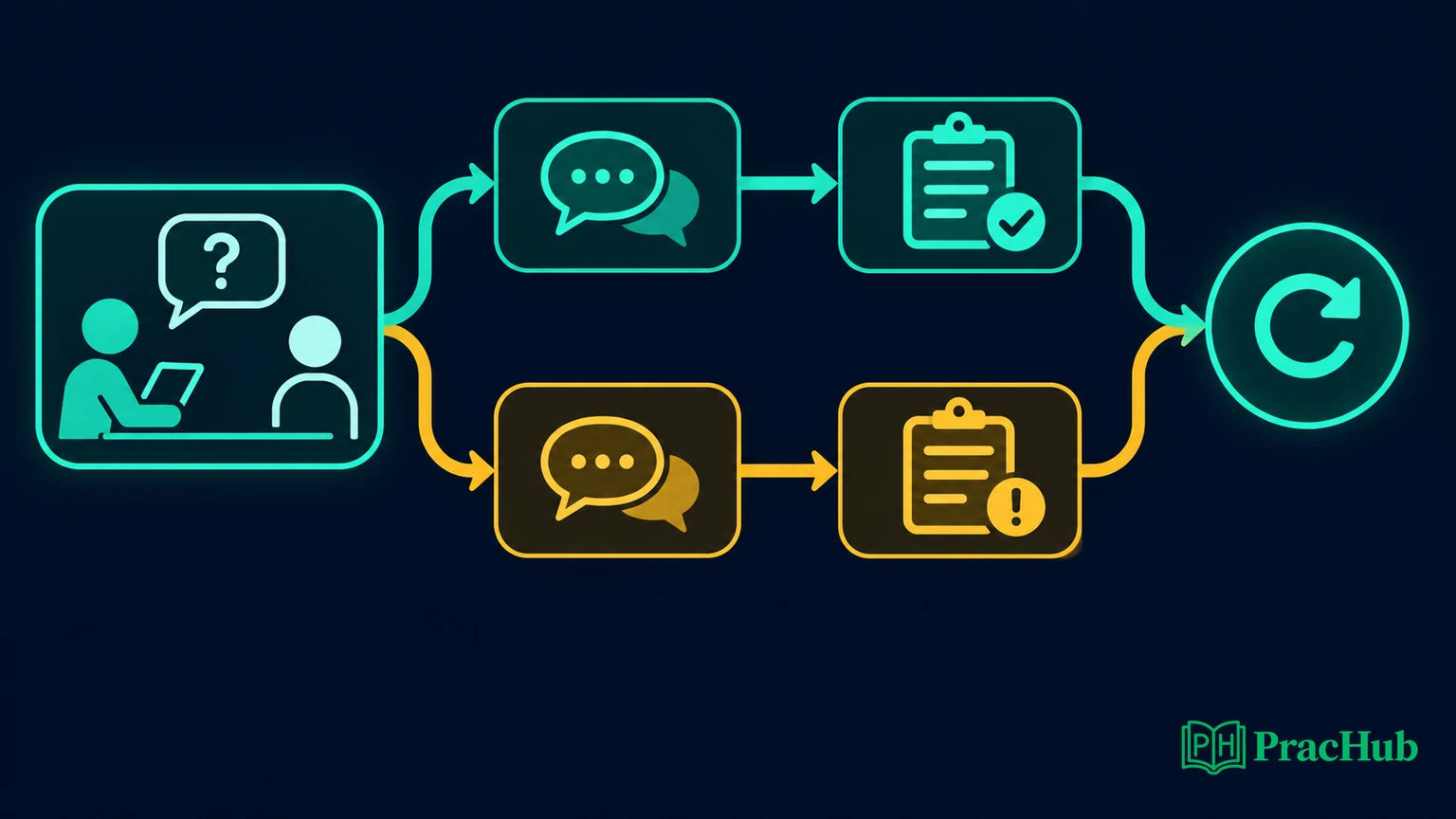
Turn feedback into something the candidate can change
Write down a sentence or decision before giving an opinion. “You chose reminders before establishing where riders dropped out” is more useful than “you are weak at product sense.” Tie it to the consequence: a reminder could help somebody who reserved a slot, but it does not help a rider who never saw an available option. Then ask for one change to the next answer: “Before picking an intervention, separate the two stages and say which one your idea addresses.”
Invite the candidate to go first. Ask what felt clear, when they changed their mind, and which question they would answer differently. Then share one strength to keep and one behavior to practice. If you want a score, use the linked PracHub rubric after you agree on the observations. A score can help compare attempts when the target behavior and difficulty are similar. It should not replace the evidence about what happened, and it is not a forecast of how a company would evaluate the candidate.
Use a simple debrief note:
| Debrief field | Example from the repair case |
|---|---|
| Observation | Candidate used completed bookings as the only success measure. |
| Consequence | A reservation counted even when the rider never received a repair. |
| Replay instruction | Define completed repairs per eligible booking visitor, then add one signal for whether the alternative is usable. |
| Evidence to listen for | Candidate keeps the denominator stable and distinguishes booking, attendance, and completion. |
During the replay, keep the rest of the prompt fixed. Change one fact: a nearby shop has openings, but most of those slots are early on weekday mornings. Give the candidate a minute to restate the decision. A stronger answer might keep the original measure and let riders see travel time and appointment hours before choosing. A weaker answer might treat every visible slot as equally usable. Compare the explanation, rather than requiring a particular feature.
If the candidate improved only after the partner restated the desired answer, note that distinction. The replay can still teach the behavior. In the next session, use a fresh case with the same measurement problem so the candidate has to recognize it without being prompted. For instance, a community workshop might gain signups while fewer people attend and finish an activity. The cases look different, but the practice target is the same: separate a step that is easy to count from the outcome the product exists to deliver.
Adapt the protocol for another type of PM round
For a product design case, change the audience or constraint and listen for which user need stays central. The partner can say that riders who are new to the city do not recognize neighborhood names and ask which directions would help. For an execution case, give the candidate a diagnostic result and ask what they would inspect next before moving the metric. For a behavioral case, use a real project the candidate is allowed to discuss. Replace the fictional branch with one follow-up about what they owned and another about what the evidence can support.
Keep your partner's feedback within what they observed. If neither of you has hired for the role, you can still assess whether a decision was stated, a number was explained, or a trade-off was ignored. You cannot reliably infer a company bar or tell the candidate a particular answer guarantees advancement. The Harvard Mignone Center's interview practice resource is general practice reading, not a source for the timings or case details here.
Decide how you will handle silence before starting. In a live practice round, a brief pause lets the candidate arrange their thoughts. If the pause lasts long enough to stall the exercise, ask what information they are looking for. That is less leading than proposing a solution. In the debrief, distinguish a pause that helped them organize a decision from a pause caused by missing data. The two call for different practice: a clearer opening in the first case, and a better clarifying question in the second case, before proposing a feature.
A good session does not need a long score sheet. Keep the exact opening prompt, the follow-up that changed the conversation, the observed weakness, and one replay instruction. If you swap roles on the same day, use a different prompt so the second candidate has not already heard all of its hidden facts. Schedule the next practice around the unresolved behavior rather than repeating every question because there is time left.
Pick one of five PracHub prompts for the next session
Use the same protocol with a new prompt. The partner should open the question first and decide which fact or assumption to hold back.
| PracHub interview question | What the partner should watch |
|---|---|
| Designing a Metrics Framework to Judge Whether a Product Is Working | Can the candidate tell a behavior metric from a user outcome? |
| Describe Your Method for Deciding What to Work On First When Everything Competes | Does new evidence change the priority or only add another item? |
| Handling an Underperforming Launch When Engineering Has No Spare Capacity | Does the answer respect the stated capacity limit? |
| Behavioral: Hindsight Review of Your Latest Project and What You Would Change | Does the candidate explain what they would do differently and why? |
| Choosing a Primary Metric, Funnel Metrics and Guardrails to Judge a Product Launch | Does the candidate explain what would stop the launch despite a better primary metric? |
Start with the PracHub launch metrics question if the repair case exposed a measurement gap. Give your partner one clear target for the debrief. Ask them to save the sentence that showed the gap and give you a different example for the replay. The aim is to be able to make the next decision without the same hint.
Comments (0)