Hudson Bay Capital Quantitative Developer Careers: What Is Verified and How to Prepare
Quick Overview
An evidence-bounded guide to Hudson Bay Capital quantitative developer careers, separating verified technology context from historical reports and original preparation exercises.
A quantitative developer career at Hudson Bay Capital is worth researching through the work a team needs done, rather than an assumed interview template. Start with concrete questions: who consumes the software, which decisions depend on it, and how would you know its output is correct?
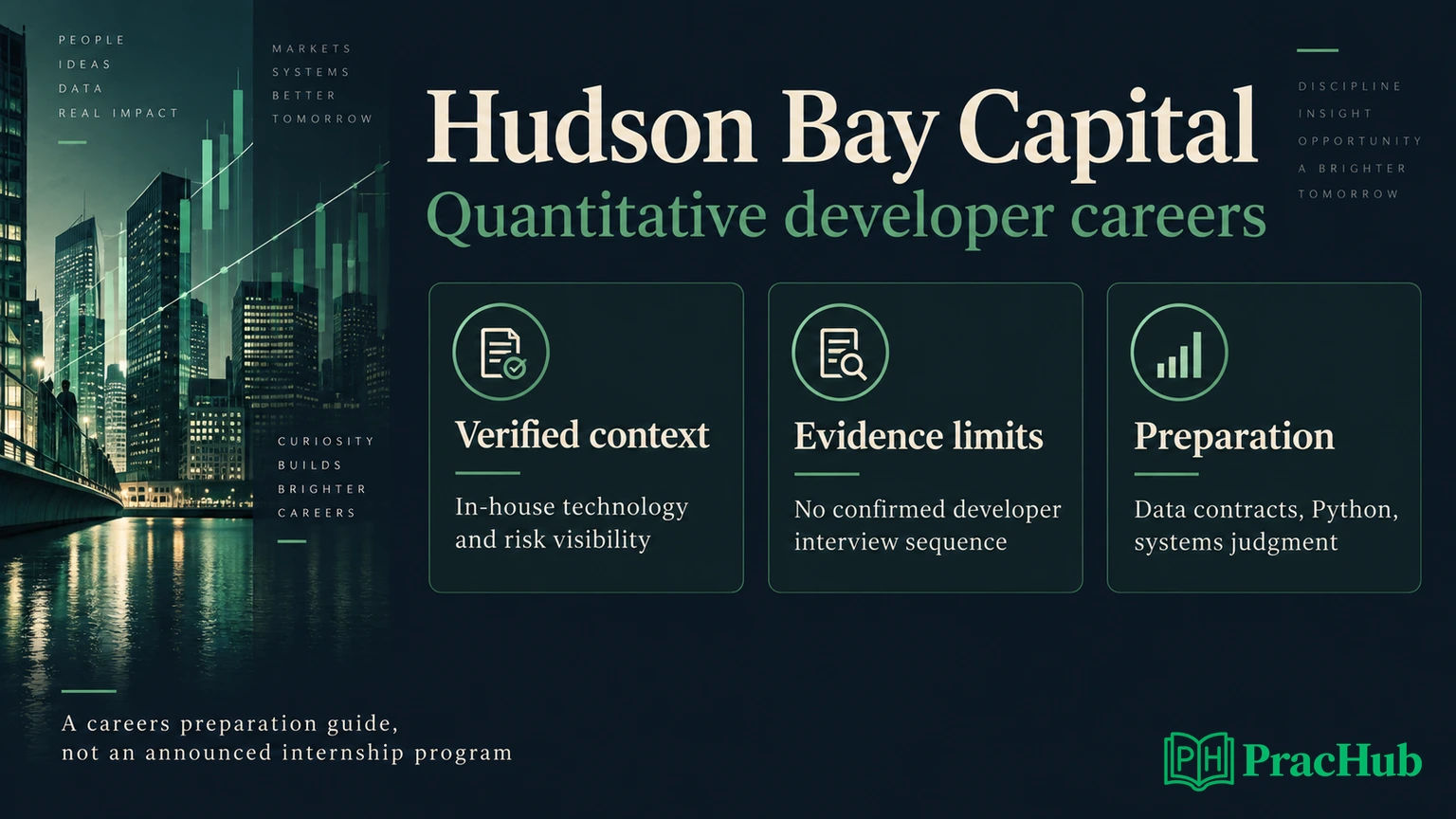
What is verified: Hudson Bay Capital publicly describes in-house technology and proprietary data architecture. What we could not verify, as of September 8, 2026, is a current quantitative developer internship program, required Python/C++ assessment, or fixed interview sequence. This guide separates employer facts, historical self-reports, and role-level preparation advice.
For an early practice exercise, use PracHub's Choose Between Python, Java, and C++ for a Service. It helps you justify a technology decision; it is not a reported Hudson Bay interview question.
Start with the right employer and the right evidence
Hudson Bay Capital Management is the firm discussed here. Hudson River Trading and Hudson Advisors are different employers. A search result containing “Hudson,” “quant,” and “Python” is not enough to transfer a job description or interview account between them.
The evidence also needs to match the role. A portfolio analyst's stock-pitch interview can be accurately reported and still tell you little about a developer's coding session. Check the employer name, position, date, and whether the author actually completed the stage being described.
| Source you encounter | How to use it |
|---|---|
| Hudson Bay's own careers page | Establish public hiring context and the official contact route |
| A specific, current developer posting | Confirm that role's responsibilities and eligibility, if available |
| A developer's personal account of past employment | Establish self-reported historical experience, not current openings |
| An analyst or generic summer-intern interview report | Keep its role and date attached; do not turn it into a developer process |
| Another “Hudson” employer's assessment guide | Exclude it from Hudson Bay-specific claims |
Research conclusion: the materials reviewed do not support a fixed quantitative developer interview guide. That limits what can be claimed publicly; it does not prove that the firm has no developer opportunities. A direct role description or recruiter clarification could resolve information that public pages leave open.
What Hudson Bay officially says about its technology
Official information: the careers page describes internally developed technology, proprietary data architecture, and integrated AI capabilities supporting decisions and execution. It emphasizes independent thinking, collaboration, and testing assumptions across areas of expertise. These are useful signals about the environment, not a published programming-language specification.
The firm's investment approach page adds more specific context. Its Deal Code System groups an investment thesis with core positions and related hedges. RMon provides visibility into exposures, diversification, and concentration across Deal Codes and strategies. The page also identifies the Gerber Statistic as part of its risk framework.
Preparation inference: software supporting shared risk visibility makes data identity, consistent calculations, and understandable failures useful subjects to study. This is a reasoned preparation direction, not evidence that a candidate will implement RMon or reproduce a proprietary statistical method.
You can discuss that distinction explicitly: “Your public materials describe risk visibility across investment groups. In my project, I focused on ensuring that every displayed aggregate can be traced to one consistent input version.” Then explain your own design. Avoid implying familiarity with internal systems you have never used.
Ask next about the team's actual work. A research-facing developer, a platform engineer, and a developer supporting a trading team can spend their time very differently. Ask which users and workflows the particular position serves before specializing your preparation.
What historical accounts can—and cannot—tell you
Historical self-report: Dejon Kurti's personal website describes a past quantitative developer internship at Hudson Bay Capital, involving proprietary trader technology and data science. The page does not provide a dated current vacancy or a selection process. It supports a narrow statement about one person's reported experience; it does not establish a recurring annual program.
Candidate reports for other roles: the Glassdoor employer interview page includes an analyst account published in July 2024 discussing sovereign debt, and a summer-intern account published in July 2021 mentioning a stock pitch. Neither is identified as a quantitative developer interview.
Those accounts are therefore excluded from any claim about developer rounds, coding difficulty, or assessment providers. Their publication dates should not be confused with confirmed interview dates, and the website's current-year heading does not make the underlying experiences current.
If someone shares a newer account, ask what position and team it concerned. A report of a live coding session becomes more useful when you know whether the candidate was applying for a senior platform role or a student internship. Preserve that scope when deciding how much preparation time to allocate.
Choose a project that demonstrates reliable decision support
Recommended preparation: bring one project you understand deeply enough to explain its inputs, outputs, users, and failure modes. A bounded position-summary service or research-data API can demonstrate more engineering judgment than a large trading dashboard whose calculations you cannot trace.
Start with a contract. What uniquely identifies an instrument? What groups positions into an investment idea? Which units and currencies are allowed? When is a calculation considered complete? Choose explicit answers for your exercise and explain which would require stakeholder input in an actual system.
Connect each design choice to a user consequence. If an exposure view mixes old positions with new market data, a user may receive a number that looks precise but cannot be reproduced. If a missing position silently becomes zero, an apparently clean report can conceal incomplete input.
A useful demonstration includes a valid run, a rejected run, and a recovery path. Show what the user sees when validation fails. Explain whether the service retains the last successful result, labels it stale, or withholds a decision-dependent output. These are product and operational decisions, not just exception-handling details.
Keep the project independent of Hudson Bay's proprietary implementations. Its public description of investment-level groupings motivates the exercise, but your identifiers, formulas, and architecture should be clearly your own. Do not name a toy application as though it were a replica of the firm's systems.
Worked exercise: equal totals can conceal wrong allocations
Original practice exercise, not a reported interview question: imagine two implementations of a grouped exposure calculation. One is a Python reference; the other is a candidate optimized implementation. Both should consume the same immutable snapshot, called S42, and return a value for each group.
The reference returns Group A = +100 and Group B = −80, totaling +20. The candidate returns Group A = +120 and Group B = −100, also totaling +20. A test that compares only portfolio totals passes, even though both group values are wrong.
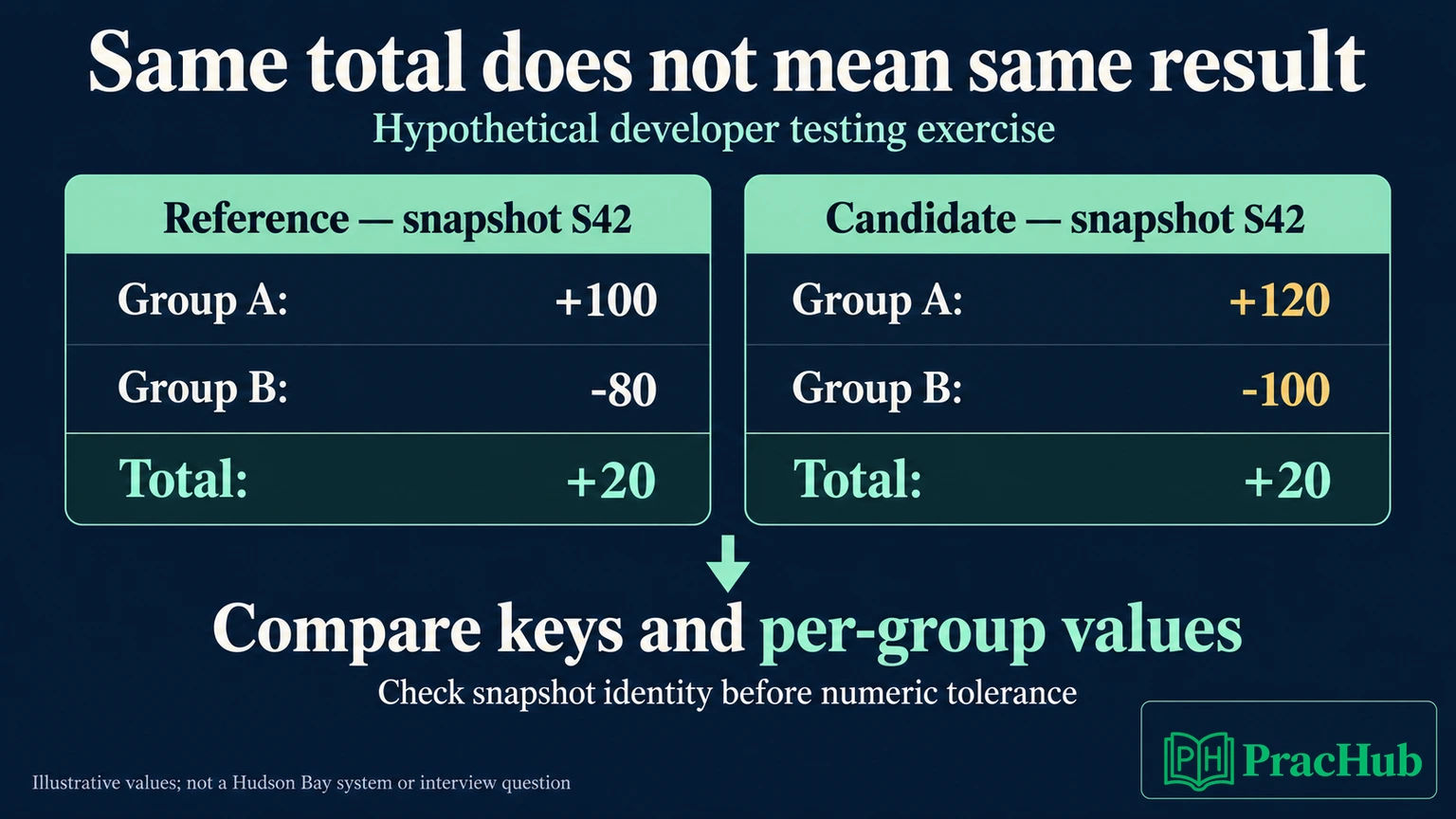
For this exercise, values share one defined exposure unit, and groups are simply labels. The numbers are invented. The example does not model Hudson Bay's Deal Codes or claim that aggregating real instruments is this simple.
Test three layers separately. First, confirm snapshot identity: an S42 result and an S43 result are not comparable merely because they contain the same group names. Second, compare key sets so that missing or additional groups cannot disappear during a join. Third, compare each numeric value under an explicitly chosen tolerance.
Also test a group reassignment. If an instrument moves from A to B, the overall total may stay unchanged while the allocation changes correctly. Your expected output should be tied to the mapping version used for that run. Otherwise a correct implementation can appear wrong because the test itself mixes versions.
The connection to Hudson Bay's public risk context is specific: investment-group visibility requires more than a matching grand total. Your demonstration should show that you can preserve meaningful distinctions throughout a calculation without asserting how the firm implements them.
Python and C++ preparation: prove equivalence before speed
Role-level recommendation: practice Python for clear reference implementations, data validation, and test harnesses. Study C++ where the actual position calls for it. No source reviewed establishes that both languages are mandatory for a Hudson Bay applicant.
A compact Python comparison contract for the exercise could look like this:
from math import isclose, isfinite

def equivalent(ref_version, ref, got_version, got):
    if ref_version != got_version or ref.keys() != got.keys():
        return False
    return all(
        isfinite(ref[k]) and isfinite(got[k])
        and isclose(ref[k], got[k], rel_tol=1e-9, abs_tol=1e-8)
        for k in ref
    )
Here both mappings contain numeric values already validated into a common unit. The tolerance is illustrative, not a financial accuracy standard. Python's math documentation explains relative and absolute tolerance, including behavior near zero. Identifiers, versions, and discrete counts should normally be compared exactly under their contracts.
Test the equal-total mismatch, a missing key, an extra key, a version mismatch, nonfinite values, and reordered keys. Define whether an empty result is valid. The function accepts two empty mappings with the same version; if your domain requires at least one group, add that rule at the validation boundary.
If you implement the calculation in C++, reuse the reference fixtures before benchmarking. Be prepared to explain ownership, object lifetime, container choice, and where copying occurs. A faster implementation is useful only if its output contract remains satisfied.
Measure the stage you intend to improve. Separate input loading, conversion, calculation, and serialization. Run comparable workloads and record the build configuration and dataset. If the bottleneck is repeated I/O, changing a small arithmetic loop may have little effect on end-to-end latency.
Explain a consistent read and a safe recovery
Recommended system-design exercise: describe how a reader obtains one coherent version of positions, mappings, and calculated outputs. A shared timestamp label is insufficient if the underlying components can change independently during the read.
One possible design builds and validates a new immutable result before changing an active-version pointer. Readers select a version and remain on it for the request. That makes rollback and reproducibility easier to explain, although storage, retention, and publication coordination still need decisions.
Database isolation is another relevant concept. The PostgreSQL transaction-isolation documentation explains that successive statements under Read Committed can see different committed data, while Repeatable Read provides a stable transaction snapshot. This is a technical example, not a claim that Hudson Bay uses PostgreSQL. A database transaction also does not automatically synchronize an external market-data service.
Rehearse a concrete failure: the new calculation finishes, but publication fails. Can the old version continue serving? How does an operator distinguish “built” from “active”? What prevents a retry from publishing an incomplete result? Answering these questions is more useful than naming a queue, cache, and database without defining their guarantees.
Five PracHub questions for focused practice
These are cross-company exercises, not Hudson Bay interview records. They were selected for language choice, runtime reasoning, consistency, and recovery. Some solution details may require access.
| PracHub question | What to explain after solving it |
|---|---|
| Choose Between Python, Java, and C++ for a Service | Which measured requirement changes your language choice? |
| Explain Python internals and practices | Which runtime behavior matters to your project's workload? |
| Optimize C++ Performance with Provided Concurrency | How do you protect correctness while changing performance? |
| Design a Snapshot-Driven Product Catalog | How do readers remain on one published version? |
| Design a persistent key-value store | What survives an interrupted write, and how is it recovered? |
Clarify the opportunity before assuming a hiring process
The official careers page provides a contact route for people interested in the firm. Practical recommendation: ask about the role and team you want to understand, then describe one relevant project and your availability. A concise inquiry is more useful than assuming that an unverified seasonal program is accepting applications.
If a position is available, confirm its level, location, eligibility, and core responsibilities. Once invited to interview, ask whether the session involves coding, a project discussion, systems design, or another format. Clarify language choice, permitted tools, and expected preparation from the actual instructions.
Prepare a collaboration example as carefully as the technical project. Explain a disagreement, the evidence each person brought, what changed your mind, and the outcome. This responds to the firm's stated emphasis on challenging assumptions through discussion without scripting a claim that a particular behavioral question will appear.
Finish by practicing Design a Snapshot-Driven Product Catalog, then adapt its consistency discussion to the S42 exercise. Your goal is to explain which version produced each value, why the comparison is meaningful, and how the system behaves when it cannot safely produce an answer.
Sources and Further Reading
- Hudson Bay Capital: careers and official contact route
- Hudson Bay Capital: investment approach and proprietary risk frameworks
- Dejon Kurti: personal account of past quantitative developer experience
- Glassdoor: historical Hudson Bay analyst and summer-intern reports
- Python: math.isclose and finite-value checks
- PostgreSQL: transaction isolation
Research checked September 8, 2026. General developer exercises are recommendations, not confirmed Hudson Bay assessments. No current internship timeline or fixed developer interview sequence is established here.
Comments (0)