Hyring AI Coding Interview: Practice Running Code and Explaining Your Decisions
Quick Overview
Prepare for a Hyring AI coding interview with an executed byte-budget task, Unicode tests, debugging evidence and a clear explanation of your decisions. Primary references, original examples and explicit evidence limits support focused preparation.
Prepare for a Hyring AI coding interview by practicing an executable task: clarify the input contract, run small tests, explain a failure and defend the correction. First confirm that your invitation names the employer's coding assessment. Hyring also advertises jobseeker mock interviews and other screening products, which should not be treated as interchangeable sessions.
Show the same reasoning in your code and spoken explanation. PracHub's debugging and explanation practice gives you an independent prompt for that rehearsal. The task below adds a specific byte-budget contract so correctness can be checked rather than judged by how confidently you describe it.

Official product statements are attributed below. The Python exercise, test results and rehearsal advice are original. We did not take a private Hyring assessment or verify two independent same-cycle coding-interview reports. No question count, cutoff or employer-specific timer is established here.
Confirm the product and the assessment contract
Official provider description: Hyring's AI Coding Interviewer page advertises an executable IDE, code-quality and problem-solving assessment, live and asynchronous modes, and monitored sessions. These describe the offered product, not the exact configuration or scoring formula in your invitation. Hyring AI Coding Interviewer
The official site separately lists video, phone and coding interview products. Its jobseeker page also promotes mock-interview preparation. A practice session, an employer assessment and a shared jobseeker screening profile can have different purposes. Confirm which one you are entering and who will receive the result. Hyring products · Hyring for jobseekers
Before starting, identify the available language and version, input/output convention, permitted libraries, time limit, submission step and assistance rules. An example written in Python does not establish that your assessment supports the same runtime. Adapt the rehearsal to the environment named in the invitation.
If a recruiter says “AI coding interview,” ask whether you must also explain your work aloud and which equipment is required. Do not infer that another candidate's video-screen setup applies to a coding IDE. Resolve uncertainty before the timed or assessed portion begins.
State a byte-budget problem before choosing an algorithm
Here is an original practice task, not a reported Hyring question: partition an ordered list of strings into consecutive batches. The UTF-8 encoded bytes in each batch must not exceed a positive integer budget. Preserve every input string, its order and its boundaries. A string larger than the budget is an error; this task does not split it.
The no-splitting rule determines the problem. “Send messages in batches” could permit splitting strings, reordering them or skipping oversized items. Each interpretation produces a different problem. State the contract before choosing a convenient implementation.
For this exercise, count only the strings' encoded payload bytes. Delimiters, JSON quoting, headers and network framing are excluded. In a real transport protocol, those additional bytes could change the result. Passing these tests does not establish that a serialized HTTP request fits the server’s full size limit.
Empty strings are valid and remain in their input position. An empty input produces no batches. A Boolean budget is rejected even though Python treats Boolean values as a kind of integer. Non-string items are also rejected; there is no implicit conversion that could conceal malformed input.
Predict outputs that separate characters from bytes
Use a small input whose expected output you can compute before running code. With budget three, ab, c, de become two batches: the first holds ab and c; the second holds de. The first batch uses the limit exactly, so a strict-less-than check would split too early.
Now change the first item to é and use é, a, b. In UTF-8, the first string occupies two bytes. The first batch holds é and a; b begins the second. Counting Python characters would incorrectly place all three together, producing four payload bytes under a three-byte limit.
| Input and budget | Expected result | Contract being checked |
|---|---|---|
| Empty list; 4 | No batches | No empty output batch |
ab, c, de; 3 | [ab, c], [de] | Exact fit and preserved order |
é, a, b; 3 | [é, a], [b] | Encoded bytes, not characters |
Empty string, a, empty string; 1 | One batch containing all three | Empty strings are retained |
🙂, a; 4 | [🙂], [a] | A multibyte item can fill a batch |
🙂; 3 | Error | An oversized item is not silently split |
These examples make the contract observable. They also give you something precise to say when a run fails: the mismatch concerns encoding, exact fit or preservation, rather than a vague claim that the algorithm “does not work.”
Implement the invariant with one open batch
Maintain one current batch and its used-byte count. Before appending an item, compute its encoded length and reject it if it cannot fit even in an empty batch. If a nonempty current batch would overflow, emit it and start a new batch. Then append the item exactly once.
def chunk_utf8(items, budget):
    if isinstance(budget, bool) or not isinstance(budget, int) or budget <= 0:
        raise ValueError("positive integer budget required")
    out, current, used = [], [], 0
    for item in items:
        if not isinstance(item, str):
            raise TypeError("strings required")
        size = len(item.encode("utf-8"))
        if size > budget:
            raise ValueError("item exceeds byte budget")
        if current and used + size > budget:
            out.append(current)
            current, used = [], 0
        current.append(item)
        used += size
    if current:
        out.append(current)
    return out
The batching invariant is that used equals the encoded size of exactly the strings in current, and never exceeds the budget after an append. Previously emitted batches are nonempty consecutive prefixes of the remaining input. That explanation ties the bookkeeping to the promised output.
The current guard prevents emitting an empty batch. It also works when the batch contains an empty string: a list containing "" is nonempty even though its byte count is zero. Testing the list's truth value and testing used > 0 would not mean the same thing.
The implementation returns only after processing the whole input. If an invalid item appears late, it raises instead of returning partial output. A streaming generator could have already yielded earlier batches; that would require a different error and side-effect contract.
Explain the greedy choice and its limits
For indivisible items in fixed order, filling the current batch as far as the budget permits minimizes the number of batches. Any valid first batch cannot end after the greedy first batch, because adding its next item would overflow. Moving an earlier cut to the greedy cut cannot require more later batches when item sizes are nonnegative.
Continue that reasoning on the remaining suffix. The argument depends on fixed order, nonnegative byte lengths and no extra per-batch rule. It is not a proof for arbitrary bin packing, where items may be reordered, or for a system that discounts compression differently depending on neighboring strings.
If total encoded input size is B across n strings, encoding and scanning takes time proportional to B plus n. The returned structure stores n string references across its batches; temporary encoded byte strings are created while measuring items. Avoid saying the algorithm is constant-space without separating output storage from the open-batch bookkeeping.
A useful follow-up changes one assumption. If the transport inserts a delimiter, include it only between items or according to the actual serialization rule. If each batch has a fixed header, reduce available payload capacity appropriately. Do not add a guessed overhead number and call the original test suite sufficient.
Use a failed run to make a controlled correction
Start rehearsal with the tempting mutation size = len(item). Run the accented-character example and compare its claimed batch with the actual UTF-8 size. The failure points to the unit of measurement; it does not require replacing the entire greedy algorithm.
Explain the correction aloud: “I counted characters, but the contract limits encoded bytes. I will change the size calculation, retain the batching invariant and rerun the exact-fit and oversized-item cases.” That tells a reviewer what changed and why the previous tests were insufficient.
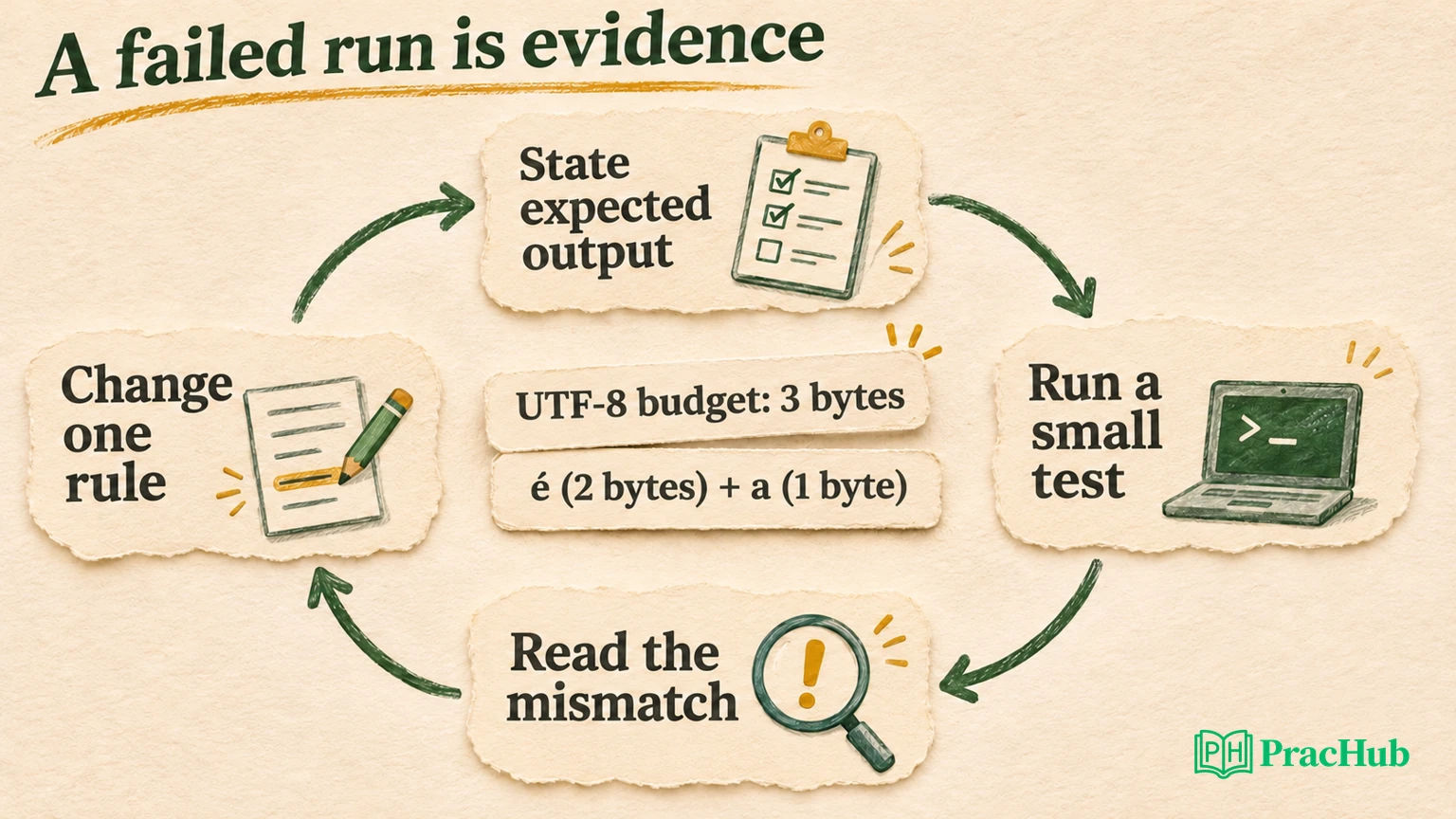
Our local Python run checked the five positive examples above, four invalid-input cases and 150 seeded small random inputs. For the random inputs, an independent exhaustive search enumerated all consecutive partitions and checked the minimum valid batch count. The byte-count mutation failed the intended Unicode counterexample.
Those results validate this bounded exercise. They do not establish Hyring compatibility, hidden-test coverage or a score. A different encoding, unpaired surrogate or streaming interface would need an explicit policy and additional tests. Say what you have verified before describing what you would investigate next.
Add a test that challenges a different assumption
After correcting the Unicode bug, do not spend every remaining test on another accented character. Challenge another invariant. Give the function several empty strings before and after a nonempty item, then check that flattening the returned batches reproduces the original list exactly. Byte totals alone would not detect a lost empty string.
Also test a budget that an item fills exactly, followed by another item. The next item must begin a new batch without duplicating the previous one. This catches a reset or append-order mistake that the encoding correction would not address.
A Python string containing an unpaired surrogate can fail UTF-8 encoding under the default error policy. The current function allows that encoding exception to propagate. If an assessment requires a different policy, make it explicit and test it; silently replacing invalid content changes the payload contract.
Finally, explain how the exercise would change if the caller requires a generator. Yielding batches can reduce retained output, but a later error cannot retract already yielded batches. Decide whether partial progress is acceptable before claiming that a streaming version has equivalent failure behavior. These are proposed interface extensions, not additional behavior covered by the 150-case run.
Make the final submission easy to assess
Before submitting an actual task, rerun the required entry point and remove debugging output that violates the expected output format. A function returning nested lists and a command-line program printing JSON are different interfaces, even when they use the same core algorithm.
Summarize one invariant, the main complexity and one meaningful limit. For this exercise, that limit is payload-only byte accounting. Mention an unfinished requirement plainly if time runs out; do not describe an unexecuted change as tested because it looks straightforward.
Follow the employer's assistance rules. The fact that an AI system conducts or grades the session does not authorize another AI tool to write your live answer. Use documentation, notes or external tools only when the actual instructions allow them.
Practice execution and explanation together
The following cross-company PracHub records exercise debugging, testing and implementation. They are practice material, not a Hyring question list. Java and concurrency records introduce additional language or synchronization requirements that the Python byte-packing exercise does not cover.
| PracHub question | Rehearsal focus |
|---|---|
| Debug and Explain Fixes | Explain the observed failure before proposing a correction. |
| Debug and test a Python function in venv | Rehearse a clean Python runtime and a testable function contract. |
| Debug and Fix Failing Unit Tests in Java | Transfer the regression-testing method; Java setup differs from this Python example. |
| Filter Logs by an Ordered Severity Threshold | State exact input rules and expected output before implementing a filter. |
| Implement concurrent structures and debug queue code | Keep execution, concurrency assumptions and debugging evidence separate. |
Use the debugging-and-explanation question for a complete rehearsal: state an expected result, run the program, diagnose one failed case and explain the smallest justified correction. Keep the test output beside your final claim so a practice partner can challenge both.
Sources and Further Reading
- Hyring: AI Coding Interviewer
- Hyring: official product overview
- Hyring for jobseekers: separate preparation and application features
Product sources checked November 3, 2026. The local exercise was executed independently; no private employer assessment was accessed.
Comments (0)