Intel Software Engineering Intern Interview 2027: C/C++, Operating Systems, and Hardware
Quick Overview
Intel’s 2027 software internship applications and historical candidate reports guide preparation in C/C++, OS coordination, and hardware debugging, with two original exercises.
For an Intel software engineering intern interview in 2027, prepare to explain what your code does at the boundary between software and the machine. That can mean decoding bytes correctly, coordinating threads, or tracing why a submitted operation never appears to finish. The relevant depth depends on the team; Intel’s current software internship applications cover several role families.
Official 2027 applications are available, but they do not establish one coding assessment, language requirement, or interview sequence for every candidate. This article separates verified role facts, historical candidate reports, and original preparation exercises.
Use PracHub’s Compare Multithreading and Multiprocessing to rehearse a concrete OS trade-off. This is cross-company practice, not evidence of Intel’s future questions.
Intel’s confirmed 2027 software internship applications
Official facts, checked September 7, 2026: Intel’s Software Engineering – Intern, Bachelor’s, JR0286834 and Graduate application, JR0286836 explicitly cover starts in Spring and Summer 2027. Both also mention consideration for year-long internships or co-ops.
The bachelor’s application requires current study toward a relevant bachelor’s degree; the graduate application specifies a master’s degree or PhD. Both require at least three months of relevant experience, which can come from coursework, projects, research, or other listed activities. A 3.0 GPA is preferred, rather than stated as the minimum.
These US applications list Hillsboro as the primary location and additional locations including Folsom, Santa Clara, Austin, and Phoenix. Confirm the actual team, location, and working arrangement during recruiting. Do not interpret a list of possible locations as permission to work from any of them.
Neither reviewed application supplies an exact interview calendar or application closing date. Spring and summer are start windows, not deadlines or promises of when a recruiter will reply.
The role family changes what preparation is useful
Official scope: the software applications include potential opportunities in firmware, system software, validation, GPU software, middleware, applications, cloud software, and AI frameworks. They describe development, debugging, automation, code review, and collaboration with hardware and systems teams. They are broader than a single driver or compiler opening.
Preparation inference: ask which layer the team owns before turning the title into a study checklist. Firmware preparation should emphasize representation, state, and device contracts. System software preparation should connect OS behavior to concurrency and resource ownership. Validation preparation should emphasize reproducible failures, test coverage, and evidence that distinguishes a regression from a setup problem.
If a recruiter identifies a compiler-focused opportunity, ask what part of the toolchain is involved before studying an entire compiler textbook. These branches are ways to allocate practice, not a claim that Intel has disclosed a separate interview format for each.
A useful clarification is: “Will this conversation focus on live implementation, reading existing code, my projects, or a particular hardware/software area?” Also confirm the language and environment. The answer can prevent several days of preparation for the wrong kind of round.
Historical reports show variation, not a universal loop
Candidate-reported evidence: an Intel Software Engineer Internship account posted April 3, 2026 describes an initial screen followed by a team panel, including hardware-level conceptual questions. A separate account posted April 24 describes three technical coding rounds and an HR conversation. Their visible entries do not separately identify the interview dates. Glassdoor’s Intel internship reports
The same page includes an account posted March 31 that explicitly describes a February 2026 interview in Gdańsk. It discusses presenting a project, explaining supplied code, and questions across Python, Linux, SQL, Git, and networking. This is useful evidence that a software internship conversation can differ substantially from a C++ hardware-focused interview.
These are historical accounts from different contexts. Two independent reports establishing a common 2027 cycle were not found. Prepare coding, code reading, and project explanation, but use your invitation to determine the actual round count, duration, and permitted tools.
C/C++ exercise: decode a contract, not a native struct
Original practice exercise: a test tool receives a six-byte header in ordinary memory. Bytes 0–1 encode a little-endian payload length; byte 2 contains flags, with only bits 0 and 1 allowed; byte 3 must be zero; bytes 4–5 encode a little-endian identifier. This is a fictional format, not an Intel device descriptor.
Little-endian representation places the least significant byte first. For the bytes 04 00 01 00 34 12, the decoder should produce length 4, flags 1, and identifier 0x1234. It should reject a header of any other size, nonzero reserved bytes, or unsupported flag bits. A failed parse must leave the output unchanged.
Here is a C17 implementation for a platform with eight-bit bytes and uint16_t:
#include <stdbool.h>
#include <stddef.h>
#include <stdint.h>
#include <limits.h>

_Static_assert(CHAR_BIT == 8, "Eight-bit bytes required");

struct Header {
    uint16_t length;
    unsigned char flags;
    uint16_t id;
};

bool decode_header(const unsigned char *p, size_t n,
                   struct Header *out) {
    if (!p || !out || n != 6) return false;
    if (p[3] != 0 || (p[2] & 0xFCu) != 0) return false;
    struct Header h = {
        (uint16_t)((unsigned)p[0] | ((unsigned)p[1] << 8)),
        p[2],
        (uint16_t)((unsigned)p[4] | ((unsigned)p[5] << 8))
    };
    *out = h;
    return true;
}
The caller must supply readable input storage and a valid writable output object. The byte loads avoid assuming that the input has the alignment, padding, or native representation of struct Header. Casting the input pointer to a struct pointer would not establish those guarantees.
The same decoding approach can be wrapped in a C++ API with an explicit success result. Changing the language does not remove the need to state the byte order, acceptable values, and output behavior on failure.
Follow the parser beyond its happy path
The header parser does not prove that the payload is present. A length field can be well formed while the surrounding message is truncated. Before consuming payload bytes, compare the decoded length with the remaining buffer size; before allocating memory, apply the application’s size limit.
For a complete message buffer of size n, first establish n >= 6, then compare the payload length with n - 6. Decide whether extra bytes represent another message or invalid trailing data. That framing decision belongs to the surrounding protocol, so the six-byte helper should not silently invent it.
Useful tests include every short header size, all-zero fields, the maximum sixteen-bit value, each unsupported flag bit, and each nonzero reserved-byte value. Place a valid header at an odd byte offset to check that the implementation did not accidentally depend on native word alignment. Verify output preservation after rejection, not only the returned Boolean.
For validation work, retain the exact failing bytes and expected interpretation. A report saying “the parser sometimes returns the wrong ID” is much less actionable than a six-byte reproducer that fails under a named build configuration.
OS exercise: why a notification can be missed
Original concurrency example: a consumer checks that no work is ready, then plans to wait. In the gap, a producer publishes work and sends a notification. The consumer subsequently starts waiting. If no later notification arrives, the consumer can remain blocked even though work exists.
Assume individual accesses to the readiness state are valid; the defect is the protocol around checking and waiting. Making a flag atomic does not by itself close that gap. Nor does changing the wait to a repeated sleep establish a correct coordination contract.
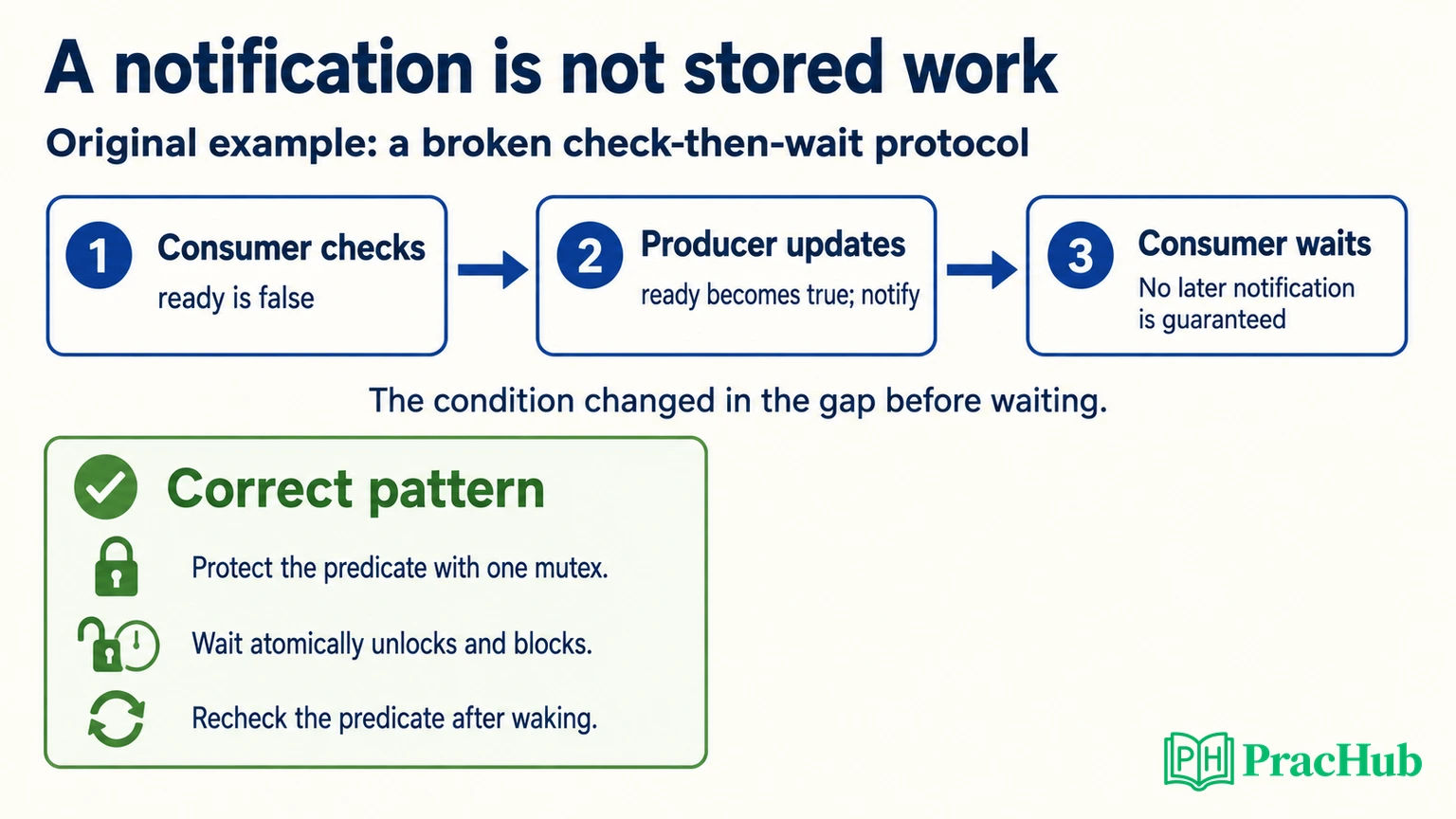
A standard condition-variable pattern protects the predicate with the same mutex used by the wait and the producer. The consumer checks the predicate while holding that mutex. Waiting atomically releases the mutex and blocks; after waking, the consumer reacquires the mutex and checks again. The producer updates the protected state and notifies. C++ condition-variable specification
The predicate is the statement that determines whether progress is possible, such as “the queue contains work or shutdown has been requested.” The notification prompts another check; it is not the stored work itself. Include shutdown in the design so an empty queue does not leave a worker waiting forever during teardown.
A useful follow-up is two consumers competing for one item. Even after a notification, another consumer may take the item first. Rechecking the predicate handles that situation as well as spurious wakeups. This example concerns user threads, not code to paste into an interrupt handler.
Hardware reasoning: distinguish submission from completion
For a system software or validation discussion, consider an original symptom: a test submits a device command and waits, but eventually times out. There are at least three different questions: was the command represented correctly, did the device finish it, and did software observe and publish that completion?
Start with the command bytes and the device’s documented contract. Then inspect evidence for acceptance or progress, completion status, and the software path that wakes the waiting task. If device status shows completion but the task stays blocked, investigate notification, interrupt handling, and shared-state coordination before blaming the hardware.
Primary technical guidance: Linux distinguishes memory-mapped device I/O from ordinary memory. Drivers use documented accessors with defined width and ordering behavior. A raw pointer store or an ordinary memory-copy routine is not automatically a valid replacement. Linux device-access documentation
Also distinguish ordering from completion. A correctly ordered write does not necessarily prove that the requested device operation has finished. Use the device-specific completion mechanism. Linux’s memory-barrier guide is useful background for reasoning about compiler, CPU, and device interactions; it is not permission to add barriers until a failure disappears.
For an intern-level explanation, identify the next observation that would separate hypotheses. You do not need to invent undocumented Intel register names or claim experience with hardware you have never used.
Turn a debugging story into evidence
Choose one project where you traced a failure across a boundary: malformed input, a blocked thread, incorrect resource ownership, or an unexpected interaction with a library or device. Explain what you could observe, what you initially suspected, and what evidence changed your mind.
A useful account distinguishes the test harness from the implementation. If a test failed only under load, explain how you controlled input and configuration, preserved logs, and reduced the reproducer. If logging made the failure disappear, acknowledge that instrumentation can change timing; do not treat the disappearance as a fix.
For a code-reading round, describe the input contract and state transitions before proposing changes. Identify one concrete defect, give a counterexample, and explain the smallest correction plus a regression test. This keeps the discussion assessable even when the codebase is unfamiliar.
If your strongest evidence comes from coursework, use it. The official applications explicitly accept relevant academic experience. Separate your own contribution from team work and avoid upgrading a simulated device into a claim of production hardware experience.
Application timing and the next useful action
Official but older guidance: Intel’s application-timeline support article, last reviewed January 27, 2022, says recruiting can take days to several months depending on available positions. It remains accessible, but it is not a current 2027 service-level promise. Intel application timeline guidance
Keep the requisition ID and application confirmation, and follow any recruiter-provided dates. If you need an update, identify the specific application rather than asking about Intel hiring in general. Continue other applications while waiting; silence does not identify which stage your application has reached.
For preparation, resolve the team and language questions first, then rehearse one implementation and one explanation of a failure. That produces a more useful next conversation than memorizing an unsupported company-wide sequence.
Practice the boundaries the role actually uses
These five PracHub records are cross-company practice, not predicted Intel questions. Choose the depth that matches your invitation; the full streaming-parser problem is an extension beyond the small header exercise.
| PracHub question | What to rehearse |
|---|---|
| Compare Multithreading and Multiprocessing | Shared state, isolation, workload, and shutdown trade-offs. |
| Design a Streaming TLV Message Reassembler in C | Byte layout, incomplete input, bounded state, and validation. |
| Identify and fix deadlock in locked code | Construct a failing interleaving and explain a consistent locking rule. |
| Explain virtual machines and concurrency basics | Separate execution, isolation, and synchronization mechanisms. |
| Detect memory leaks in C++ | Ownership evidence, diagnostic tools, and regression checks. |
For your Intel software engineering intern interview in 2027, make one explanation precise enough to test. Start with the C reassembly exercise: write the format contract, identify malformed inputs, and defend when a message is safe to publish.
Sources and Further Reading
- Intel: Software Engineering Intern, Bachelor’s, JR0286834
- Intel: Software Engineering Intern, Graduate, JR0286836
- Glassdoor: Intel Software Engineer Internship reports
- C++ standard draft: condition variables
- Linux kernel: bus-independent device access
- Linux kernel: memory barriers
- Intel: application process timing, reviewed January 2022
Comments (0)