Interview Prep Academy Review: Coding Problems, Zaheen Voice Practice, and Coaching Access
Quick Overview
Interview Prep Academy offers distinct recognition, coding and spoken-reasoning modes; its value depends on matching the mode and actual execution access to the skill you need to demonstrate. This review distinguishes current official descriptions, observed guest access and an original practice example.
Interview Prep Academy combines self-paced questions, timed mocks, coding problems, Zaheen voice interviews, and an AI Study Coach. Those modes exercise different skills. Recognizing the right multiple-choice option, editing a solution, executing tests, and defending the reasoning aloud should not be treated as interchangeable evidence of readiness.
Our verdict is that the public interface is useful for inspecting the learning material and trying a small question drill. Before relying on the coding or voice workflow, check the actual execution and account gates. Start with a Two Sum indices problem and decide whether you need help implementing it, testing it, or explaining why its lookup order is correct.
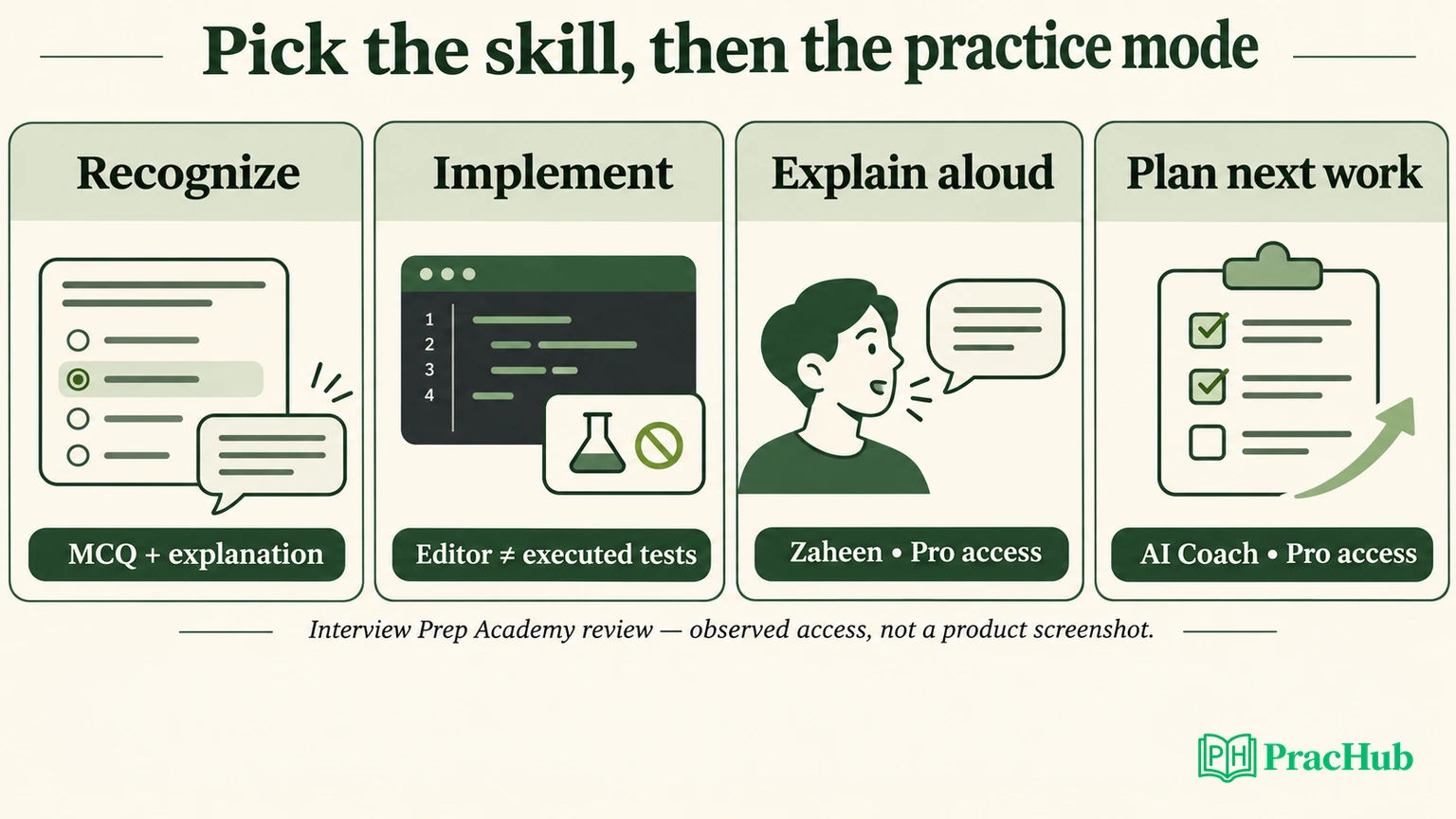
We checked the public product on November 28, 2026. One guest practice answer returned Correct with an explanation. The coding page explicitly said general code execution was switched off; AI Review required sign-in. A SQL run also requested sign-in. Zaheen and AI Coach displayed Pro gates. We did not create an account, complete a scored mock, enable microphone or camera access, upload a résumé, or purchase Pro. Our Python exercise below was tested locally, separately from the site.
What a visitor can actually try
The homepage describes a broad interview toolkit operated by QINTAR LLC. Its headline counts include more than 86,850 questions, thirty languages, and thirteen role categories. These are the vendor’s current display figures, not a count we independently verified.
In Practice mode, the guest interface showed a pool of ten questions under its initial filter. We answered a Selenium question about which wait polls until a condition is met. Choosing the explicit-wait option produced Correct and a short explanation. The page also said sign-in was needed to save progress, streaks, and bookmarks.
That establishes a real guest recognition exercise. It does not establish that we accessed the full bank, exhausted the free allowance, or evaluated the accuracy of every explanation. Nor does selecting the right option demonstrate that a candidate can write a reliable browser test under changing conditions.
The advertised Free allowance is thirty practice questions per calendar month, resetting on the first day in UTC. That account-level description is distinct from the ten questions visible in our initial guest filter. The site also describes timed mocks without a monthly limit; we did not complete one or inspect its final report.
Coding content and code execution are different
The coding interface opened Two Sum as the first of five free starter problems and linked to hundreds more with Pro. It exposed a statement, example, constraints, hints, an editorial tab, a reference-solution control, an editor, and labeled test cases.
The decisive message was “editor only”: the page explicitly stated that running code was switched off. Run Code and Submit Code were disabled in the observed Python view. Test labels and expected outputs remained visible, but we did not run those tests through the platform.
We entered a short original Python solution and selected AI Review. The interface responded that sign-in was required for a code review. We therefore did not obtain AI feedback about that solution. An available editor and a review button should not be described as a completed code assessment.
The SQL track had a separate query editor and an enabled Run Query button. We entered a simple LEFT JOIN for its person/address task. Clicking Run Query returned a sign-in requirement. This does not contradict the product’s description of an authenticated SQLite sandbox; it establishes where our guest test stopped.
| Activity | Observed visitor state | Evidence still missing from this review |
|---|---|---|
| Self-paced question | Answer selection and explanation worked | Full-bank accuracy and account allowance enforcement |
| General coding | Statement, editor and test labels visible; execution disabled | A platform-executed solution and test results |
| AI code review | Sign-in message after submitting synthetic code | Actual review quality and account-side limits |
| SQL execution | Run control available, then sign-in required | Query execution and comparison in an authenticated session |
| Zaheen voice | Pro feature notice | A completed spoken exchange and report |
| AI Study Coach | Paid-plan gate and idle tool panels | A generated plan or completed coaching intervention |
For a coding round, this access matrix matters more than the headline library size. Reading an editorial may teach an approach, but you still need an environment in which to execute it and an interviewer—or a deliberate self-check—to challenge the invariant.
An original Two Sum mistake worth explaining aloud
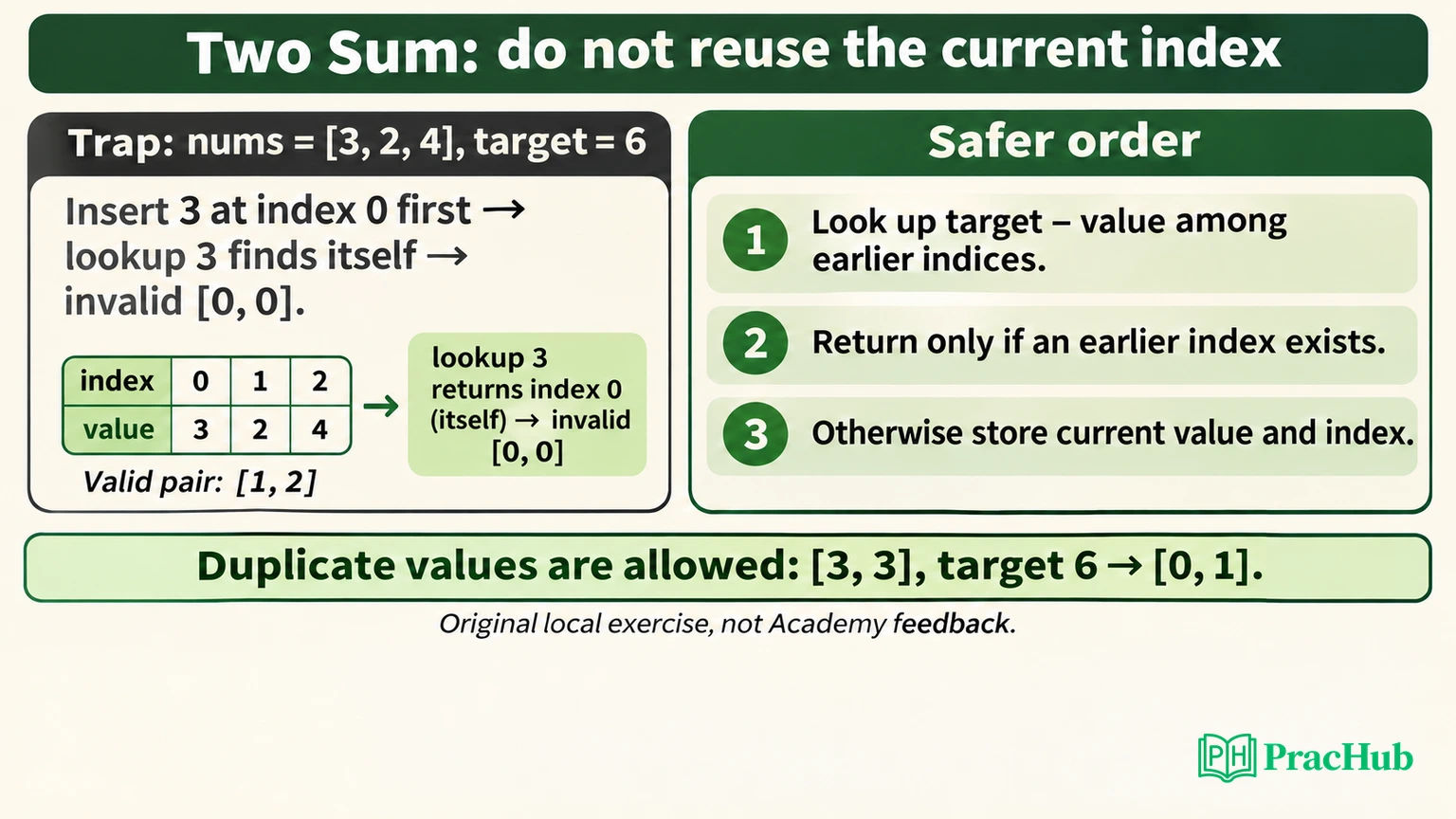
The visible problem asks for two distinct indices whose values sum to a target. A common hash-map approach looks for the complement among values already seen. The order of operations prevents the current element from matching itself.
Consider nums = [3, 2, 4] and target = 6. If you store the first 3 at index zero before looking for its complement, a careless implementation can immediately return [0, 0]. That reuses one element. The valid pair is the 2 and 4 at indices one and two.
Here is our original reference implementation, not a result produced by Academy’s AI Review:
def two_sum(nums, target):
    seen = {}
    for i, value in enumerate(nums):
        complement = target - value
        if complement in seen:
            return [seen[complement], i]
        seen[value] = i
    raise ValueError("No pair satisfies the target")
We ran it locally against ordinary, duplicate-value, negative-value, and self-reuse-trap cases. For [3, 3] with target six, it returns [0, 1]: equal values are allowed, while equal indices are not. For [3, 2, 4], it returns [1, 2]. The no-solution exception is a defensive extension; the stated practice problem promises a solution.
An oral explanation should make the invariant explicit: before each iteration’s lookup, the map contains only earlier indices. Finding a complement therefore supplies a distinct partner. After an unsuccessful lookup, storing the current value makes it available to later elements.
Under ordinary hash-table assumptions, the approach uses expected linear time and linear extra space. That is an algorithmic explanation, not a measured runtime result from the site. A useful follow-up asks what changes if there are several valid pairs, if all pairs must be returned, or if additional memory is restricted. Those are new specifications rather than reasons to silently alter the original answer.
What Zaheen’s voice workflow promises
The voice studio describes a structured interview with Zaheen, calibrated to role and experience, with five scoring dimensions. Its visible preparation path lists welcome, terms, brief, system check, identity, microphone test, and going live. The public page stopped at a Pro notice, so we did not proceed through those requirements.
The homepage describes a Planner, Interviewer, and Evaluator sequence, response-dependent follow-ups, speech analytics, and résumé-grounded questions. Those are vendor descriptions. We did not verify whether a follow-up catches the Two Sum self-reuse mistake, how transcription handles code terminology, or whether pacing measures remain consistent across devices.
For a useful trial, begin with a known reasoning target. Explain why lookup precedes insertion, then inspect whether the follow-up probes the invariant or merely asks for more detail. If a report rewards a fluent explanation that permits [0, 0], technical correctness has not been established. This is a proposed evaluation method, not an observed flaw in Zaheen.
Speech feedback and algorithm feedback should also remain separate. Fewer fillers can make an explanation easier to follow; it cannot repair an incorrect invariant. Conversely, a technically sound but hesitant answer may need delivery practice rather than another algorithm tutorial.
A readable rubric is useful, with limits
The methodology page describes a versioned scoring rubric and says scores from older versions are not directly comparable. It distinguishes technical, HR/behavioral, and mixed interview modes, with anchored dimension scores. Those descriptions provide a better basis for questions than an unexplained overall number.
It also describes an evidence pass separating directly observed statements, inference, insufficient evidence, and competencies not tested. That is a useful distinction for practice. If an interview never asks about concurrency, a report should not imply you demonstrated concurrency expertise.
We did not audit the implementation of that evidence pass or compare its outputs with human raters. The site’s hire/no-hire bands are explicitly advisory practice feedback. They are not employer decisions, validated hiring probabilities, or independent proof of readiness.
Question provenance needs similar care. The methodology page, dated as last measured on October 11, reports 86,750 questions and says most were generated in bulk, while ML/LLM banks were authored individually. The current homepage shows a different, slightly higher figure. We retain those dates and sources rather than choosing one as an independently verified live total. Neither count establishes that every question reflects a real employer interview.
Coach means AI planning here
The Coach page identifies itself as AI Study Coach. It displayed tools such as a profile analyzer, weak-spot finder, study planner, and mock generator, all idle in our visit. It said the coach belonged to a paid plan.
We found no basis in that interface for describing the Coach link as a booked human mentor. The expected value is an AI-generated preparation plan using practice context, not an observed appointment with an experienced interviewer.
Evaluate a plan by its connection to a demonstrated weakness. After the Two Sum exercise, “practice more arrays” is broad. Assigning a distinct-index explanation, a duplicate-value test, and a changed-specification follow-up would address the actual gap. We did not generate a plan to see whether the coach makes that connection.
Free and Pro access at review time
The pricing page showed Free at zero cost and Pro at $15 per month. Pro advertised unlimited practice, AI Study Coach, live voice interviews, résumé-grounded questions, scored evidence reports, and cross-session memory.
The usage FAQ narrowed the free coding offer to a fixed starter set. It also said paid accounts retained short-term safeguards against rapid bursts of requests, despite removing monthly practice and voice caps. “Unlimited” should therefore not be interpreted as immunity from every temporary request limit.
The page described Stripe monthly subscriptions and separate one-time payment options. We did not purchase a plan, test activation, or inspect cancellation and renewal behavior. For a candidate mainly seeking executed coding tests, verify the current authenticated runner behavior before buying Pro on the strength of the problem count alone.
Local video does not mean a wholly local interview
The Privacy Policy, updated October 2026, says webcam video and identity photos remain on the device. It separately describes stored interview text, scores, reports, and audit records linked to an account.
Voice processing depends on the selected engine. The policy describes browser Web Speech processing and an alternative Whisper path that uploads spoken answers for transcription through Groq. It also says answers and supplied résumé/JD material are sent to AI providers. Local video storage is therefore not a claim that all interview processing stays offline.
The policy says saved transcripts mask some personal details, while quoted answer excerpts may remain unmasked and code is saved as written. It also says deleting an account does not yet automatically remove saved interview records; a separate deletion request is needed. We did not test those controls or audit storage. Use permitted, sanitized material and confirm the applicable settings before a recorded or résumé-grounded session.
Five practice targets for choosing the right mode
These PracHub questions help distinguish implementation, reasoning, and experience evidence. They are not a claim about Academy’s inventory.
| PracHub question | What to practise |
|---|---|
| Two Sum — Indices Summing to a Target | Explain why complement lookup must happen before storing the current index. |
| Implement an LRU cache with follow-ups | Defend the data structures and invariants rather than just a reference solution. |
| Find the critical path and its total time in a service dependency DAG | Reason about dependency order and failure cases aloud. |
| Explain Your Engineering Ownership | Separate an observed implementation decision from an unsupported ownership claim. |
| Describe a failure and a success | Use a concrete correction to show what changed between attempts. |
Use the first question to trace the map invariant, the cache problem to defend data structures, and the dependency problem to explain ordering. For ownership and failure questions, retain actual contributions and corrections. An improved answer should not invent a production achievement to sound more senior.
Should you shortlist Interview Prep Academy?
The public guest drill is a practical way to inspect its question-and-explanation style. The broader toolkit may suit someone who needs several preparation modes, provided they verify the relevant account and plan access.
For coding preparation, distinguish reading and editing from executed tests. For Zaheen, judge a completed exchange against a known invariant before relying on its score. For Coach, look for a plan tied to observed weaknesses. Begin by explaining Two Sum’s distinct-index requirement, execute your solution in a suitable environment, and then rehearse the explanation without the reference in view.
Sources and further reading
- Interview Prep Academy current modes and usage FAQ
- Academy coding and SQL interfaces
- Academy self-paced guest practice
- Zaheen voice studio access page
- Academy AI Study Coach access page
- Academy scoring and source methodology,measuredOctober11,2026
- Academy Free andPropricing
- Academy Privacy Policy updatedOctober2026
Comments (0)