IpCisco Interview Simulator Review: Network Video Questions and Answer Comparison
Quick Overview
Review IpCisco’s public Junior and Senior simulator pages, video-answer comparison format and self-assessment rules. Includes an original next-hop resolution model and specific checks before relying on catalog or paid-access claims.
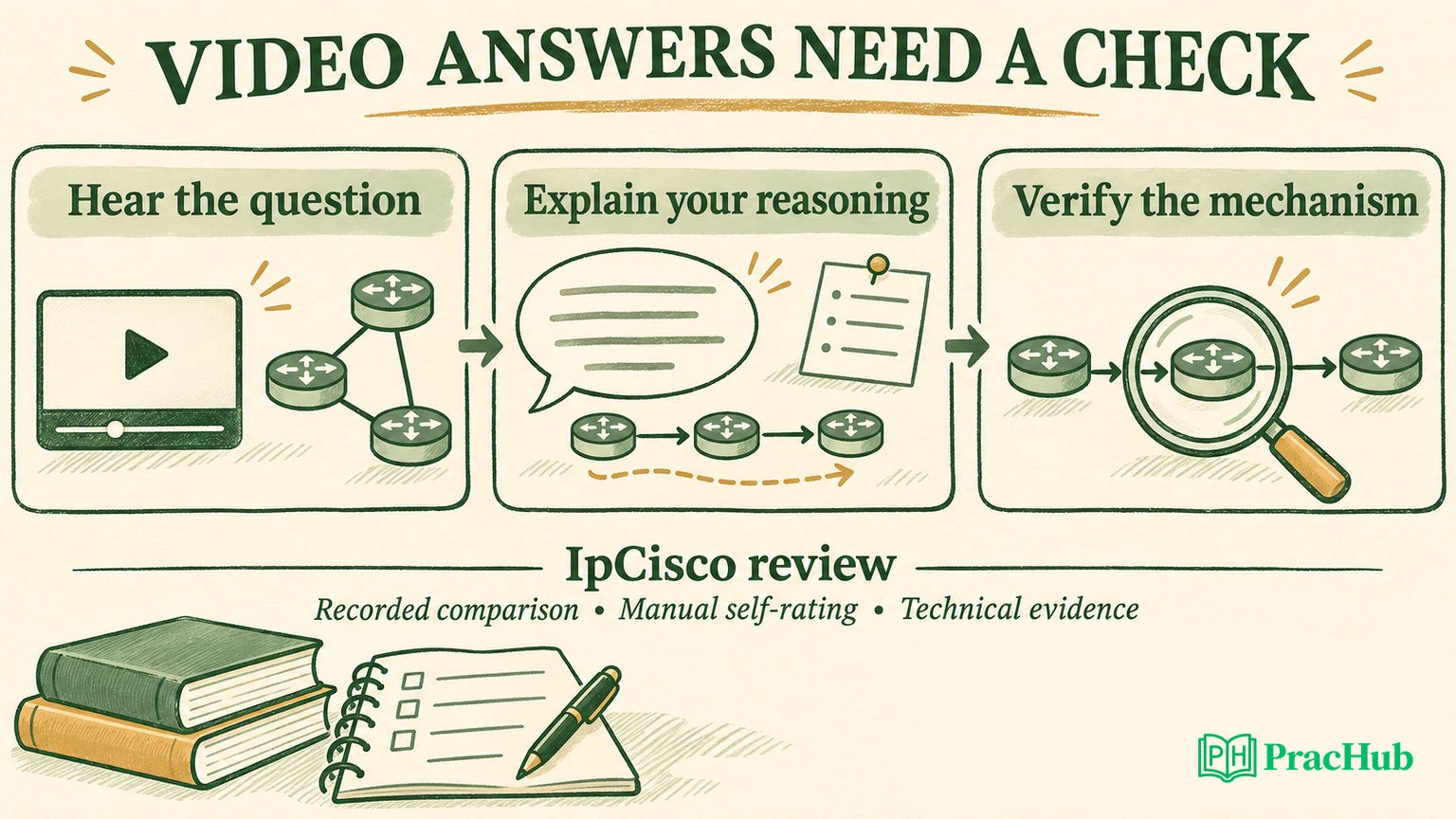
IpCisco Interview Simulator is presented as video-based rehearsal: hear a network interview question, prepare an answer and compare it with a recorded example. The format offers spoken rehearsal; our accessible samples did not establish the depth of the advertised collection. Treat its manual score as a study record and verify that a useful sample works before choosing a package.
PracHub publishes this review and owns the complementary practice links. Our BGP interview question offers an independent prompt for explaining session state, route exchange and path selection. The next-hop exercise below is our original educational example, not an IpCisco question, answer or test result.
What the simulator says it provides
Provider claims, checked November 3, 2026: the main simulator page describes Junior, Senior and Expert levels. The proposed workflow uses an interviewer video followed by a recorded candidate answer. You think through your own response, then compare the explanations. Practice Mode and Timed Challenge are presented as different ways to pace that rehearsal.
A recorded person answering a question is instructional material. It is not an independent report of a candidate’s actual hiring process. We found no basis in this review for presenting the videos as verified company questions, live interviews or adaptive AI follow-ups.
Choose the format according to the feedback you need. Video comparison can expose missing terminology, a weak sequence or an answer that takes too long. It cannot, by itself, establish that your explanation is correct. The reference answer still needs enough reasoning to support the conclusion.
We inspected public pages without creating an account, buying access or submitting personal material. We did not play the videos, measure timer behavior or complete a scored interview. Those limits apply throughout the review; the visible controls alone do not prove playback or the paid experience.
The sample-access map from our browser check
The main page advertised ten free samples for each level. We did not verify that allowance. The inline main-page panel showed controls but no populated question list and a 0/0 completion counter. The dedicated level pages showed different access states.
| Public surface checked | Direct observation | What remains unverified |
|---|---|---|
| Main simulator page | Empty question heading and 0/0 panel | A usable set of ten samples per level |
| Dedicated Junior page | Two listed items, labelled Soru 3 and Soru 2; Question 1 of 2 | Topic coverage or substantive video explanations |
| Junior Read Answer control | Expanded text read Answer 3 | A useful written solution for that item |
| Dedicated Senior page | Empty question list and 0/0 panel | A playable senior networking example |
These are dated observations of the public pages in one browser session. They do not establish that every visitor, account or paid package receives the same state. A loading, configuration or content issue would need further evidence before assigning a cause.
The Junior page and Senior page still describe substantial collections. Their promotional descriptions cannot fill the evidentiary gap left by a placeholder answer. We therefore cannot recommend the paid catalog on the basis of demonstrated sample depth.
For your own evaluation, require one complete chain: a clearly identified networking question, a playable prompt, your independent answer and a substantive reference explanation. If any link is missing, record the missing item before drawing a conclusion about the whole product.
Understand what the self-assessment score measures
Direct observation: the panel labels its assessment as self-assessment. Its rule awards ten points for Correct, five for Partial and zero for Incorrect; skipped and unrated items also receive zero. We did not select a rating or generate an interview report.
The learner supplies the judgment behind those points. A higher number can mean that you marked more answers correct. It does not independently demonstrate stronger routing knowledge, better troubleshooting or improved hiring performance. A zero on an empty or unrated session is equally unsuitable as an ability diagnosis.
Use the categories only after writing a correctness criterion. For a BGP explanation, “I mentioned next hop” is too loose. A better criterion asks whether you distinguished the BGP session from the route’s eligibility and explained how the advertised next hop becomes reachable.
A partial answer could correctly identify an unresolved next hop while omitting the evidence needed to verify it. Your correction would then name the route lookup and its limitation. That is a repeatable study decision even without claiming a calibrated score.
Before revealing an example, write a short answer with three parts: the observation you trust, the hypothesis it supports and the next check that could reject it. After comparison, underline the exact sentence you would change. If the reference merely states a conclusion, use a protocol or device reference to supply the missing condition.
For instance, “the peer is up” belongs in the observation column. “The next hop might be unreachable” belongs in the hypothesis column until a lookup supports it. Keeping those sentences separate prevents a confident presentation from converting an untested possibility into a fact.
Keep the answer, the reference and your reason for the rating together. Otherwise, reviewing a page of points may tell you less than rereading one precise omission.
Original exercise: Established does not prove a usable route
Consider an invented route to 198.51.100.0/24 whose advertised NEXT_HOP is 203.0.113.9. The addresses are documentation examples. Suppose a status display says the BGP session is Established. That statement does not prove the desired prefix was received, accepted, selected or installed for forwarding.
The protocol reference defines the next-hop condition to check. RFC 4271, section 9.1.2.1 describes next-hop resolvability, including recursive resolution and failures caused by absent or mutually recursive routes. Our recommendation is to use that mechanism to challenge an overly broad sample answer.
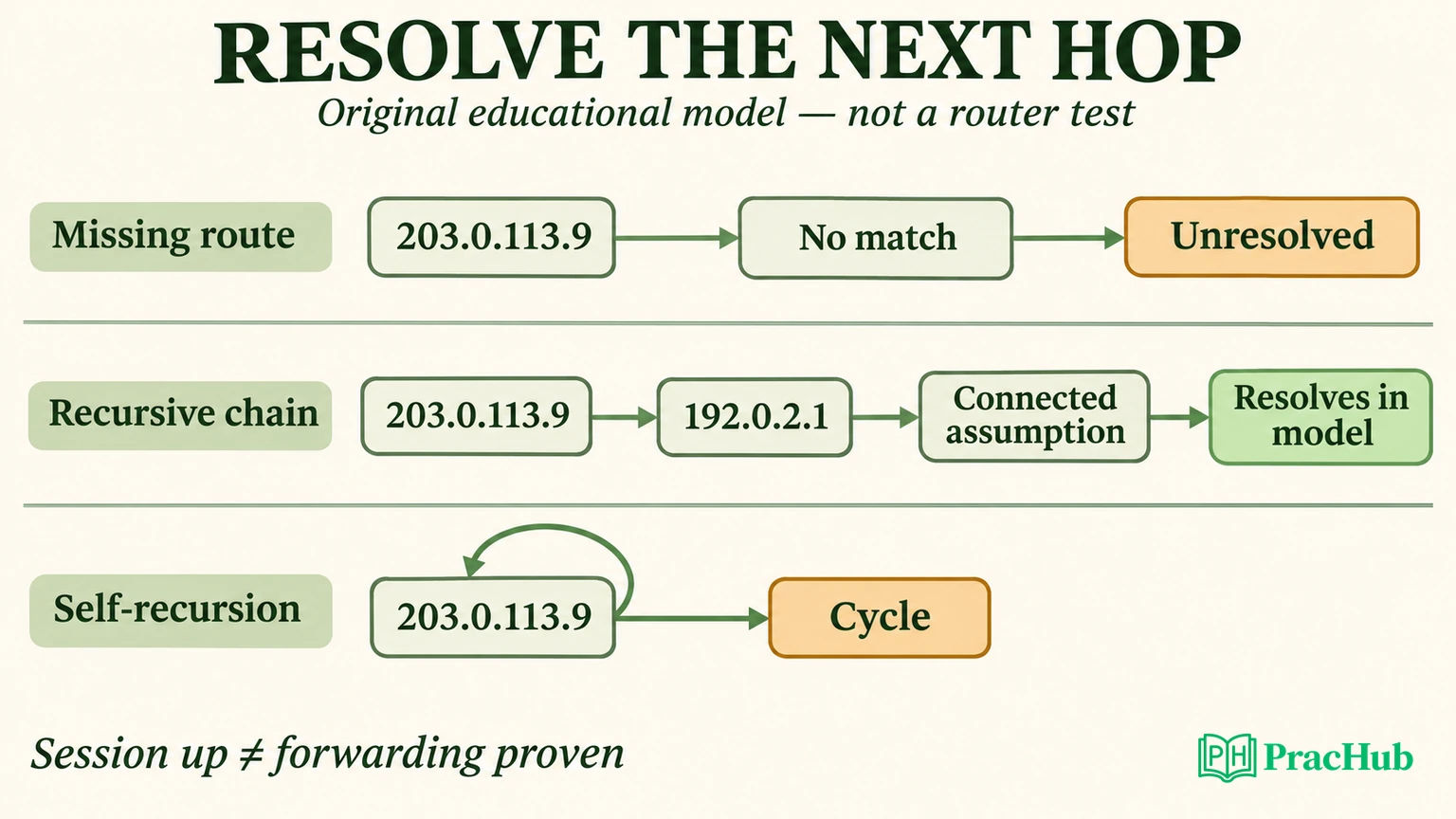
Start with three cases. If no route matches 203.0.113.9, the next-hop lookup cannot resolve. If 203.0.113.0/24 resolves through 192.0.2.1 and 192.0.2.0/24 is supplied as connected, the simplified chain reaches a connected route. If the route resolves back through itself, the chain forms a cycle.
Our offline Python model uses longest-prefix matching and detects repeated route prefixes. A connected marker is an input assumption. It does not inspect an interface, a neighbor cache or a real router. The model exists to make the distinction visible in an interview answer.
# Supplied educational route table, not a device configuration.
routes = [
    ("203.0.113.0/24", "192.0.2.1"),
    ("192.0.2.0/24", None),  # assumed connected in the model
]
# resolve("203.0.113.9", routes) -> "connected_in_model"
The local checks covered a missing route, the connected chain, self-recursion, mutual recursion and a more-specific route overriding a default. All five assertions passed. The last case deliberately cycles after recursive lookup; an available default does not justify ignoring the more-specific matching route.
These checks establish the behavior of this small function. They do not validate BGP policy, best-path selection, interface availability, FIB programming, access controls or a return path. Reaching a connected marker is a narrower result than demonstrating successful traffic.
Compare answers by their next evidence request
A weak response to “The BGP session is up, but the service is unreachable” might immediately change route preferences or reset the peer. That action assumes the failure is already localized. It also risks disrupting a session without explaining which observation supports the change.
First ask what is unreachable, from which source, and what changed. It then distinguishes the desired prefix’s presence, applicable policy, next-hop resolution, selected route and forwarding state. Each stage needs its own evidence; none follows automatically from Established.
For the invented route, a useful first branch is whether 203.0.113.9 has a resolvable route. If it does not, investigate the missing reachability and its intended source. If it does, continue to route selection and forwarding evidence instead of declaring the service healthy.
When comparing a recorded answer, listen for that branch. Does the speaker request evidence that could disprove the current hypothesis? Do they say what a successful check establishes? Do they preserve a separate check for the reverse direction and the application? This comparison is more informative than matching the order of memorized commands.
Command names vary across devices. The reasoning should survive that variation: identify the relevant table, explain the lookup and describe the observation that would change your next step. Do not claim that our offline fixture executed vendor CLI commands.
The same method scales down for Junior practice. Explain the packet path using a small topology and distinguish a routing lookup from an address-resolution step. For Senior practice, add policy, multiple paths and change safety only when you can explain their effect on this particular failure.
Check collection size and purchase scope separately
The public copy lists one hundred video questions per level and three hundred in the complete package. Another main-page passage refers to two hundred fifty. We did not reconcile those counts by inspecting a complete catalog, so neither number is an independently verified inventory in this review.
The displayed offers were $25 for a single level, $59 for the complete simulator and $139 for Gold Membership, with higher crossed-out prices on some cards. These are dated public prices, not a checkout verification or a commitment about future terms.
Before purchasing, confirm the selected level, access duration, included answers, playback requirements and applicable refund terms. Gold’s broader course and lab description does not establish the quality of this simulator’s particular samples. Conversely, a public sample problem does not prove that the broader membership is unusable.
If your immediate goal is spoken rehearsal, one functioning question and explanation can help you judge the format. If your goal is validated troubleshooting practice, require a substantive technical answer and enough evidence to test its claims. A catalog count cannot demonstrate either spoken feedback or technical validation.
Practice the gaps the product leaves open
These independent PracHub prompts turn a recorded answer into a mechanism discussion. They are complementary exercises, separate from IpCisco’s videos and self-assessment points.
| PracHub question | What to examine |
|---|---|
| Explain BGP: Sessions, Route Exchange, and Best-Path Selection | Separate session establishment, route exchange, next-hop reachability and path choice. |
| Explain how TCP/IP delivers data between internet-connected devices | Trace the packet after a route is selected; identify what the routing evidence does not prove. |
| Contrast TCP vs UDP; detect loss | Explain loss and transport behavior without treating every failure as a routing problem. |
| Design a device configuration system | Connect configuration intent, validation and a safe change process. |
| Register Data Centers and Route to the Nearest Healthy Region | Distinguish route proximity from service health and actual request success. |
Who should consider the simulator next
IpCisco’s proposed format suits a learner who wants to answer aloud and compare with a recorded explanation. Our access check leaves the usefulness of the available samples unresolved, so verify a complete example before relying on the advertised level collections or purchase offers.
For the next practice attempt, answer the BGP prompt without watching a solution. State what Established proves, identify one missing route observation and trace the next hop in a small topology. Then compare explanations and save one correction with its supporting evidence. That gives a self-rating a specific meaning without treating it as independent assessment.
Comments (0)