Jane Street INSIGHT Program 2027: Application, Interviews, and What to Expect
Quick Overview
A source-checked INSIGHT guide to NYC January 2027, three track choices, current application fields, limited assessment evidence and practical preparation.
Checked September 7, 2026. Jane Street's NYC INSIGHT application currently asks applicants to confirm availability for January 4–9, 2027. The form offers Software Engineering, Trading and Research, and Strategy and Product. That confirms a specific upcoming session; it does not establish a universal interview sequence or application deadline for every INSIGHT location.
The most useful way to prepare is to choose a track for a reason you can explain, make your application accurate, and distinguish selection from the activities taught during the program. For optional practice, explore Jane Street interview questions on PracHub. These are broader hiring records, not a predicted INSIGHT question set.

Start with the NYC 2027 application, not an old deadline
The current NYC form requests contact and education information, a PDF resume, your track interest, and availability for January 4–9. It also asks when you expect to start full-time employment. A school email may be used to verify enrollment, with an option to explain its absence. A cover letter is not required; an optional text field can provide useful context, including your interest in the program.
The reviewed form does not publish a closing date or a numerical GPA cutoff. Nor should its broad school and education fields be treated as proof that every possible applicant is eligible. Read the session description and clarify an unusual situation with the organizer. A dropdown's available values are an input mechanism, not an admissions policy.
Save the specific session page you are using and record three separate things: the event dates, any stated application deadline, and any dates in subsequent recruiting emails. January 4–9 is the availability window, not a deadline to submit. Likewise, a summer 2026 acceptance announcement cannot tell you when the January 2027 cohort will hear back.
Check your academic calendar before confirming availability. A winter session can overlap exams, a term beginning, or travel home. If your schedule is uncertain, resolve it instead of assuming that partial attendance will be accepted. The application is asking about your actual availability, not whether you would like the dates to work.
Who INSIGHT is for—and why the track matters
The official INSIGHT overview describes a multi-day program for women, transgender, and/or gender-expansive individuals. It says prior finance knowledge is unnecessary and asks applicants to choose the nearest location. Confirm session-specific qualifications; do not import another program's academic-year or work-authorization rules.
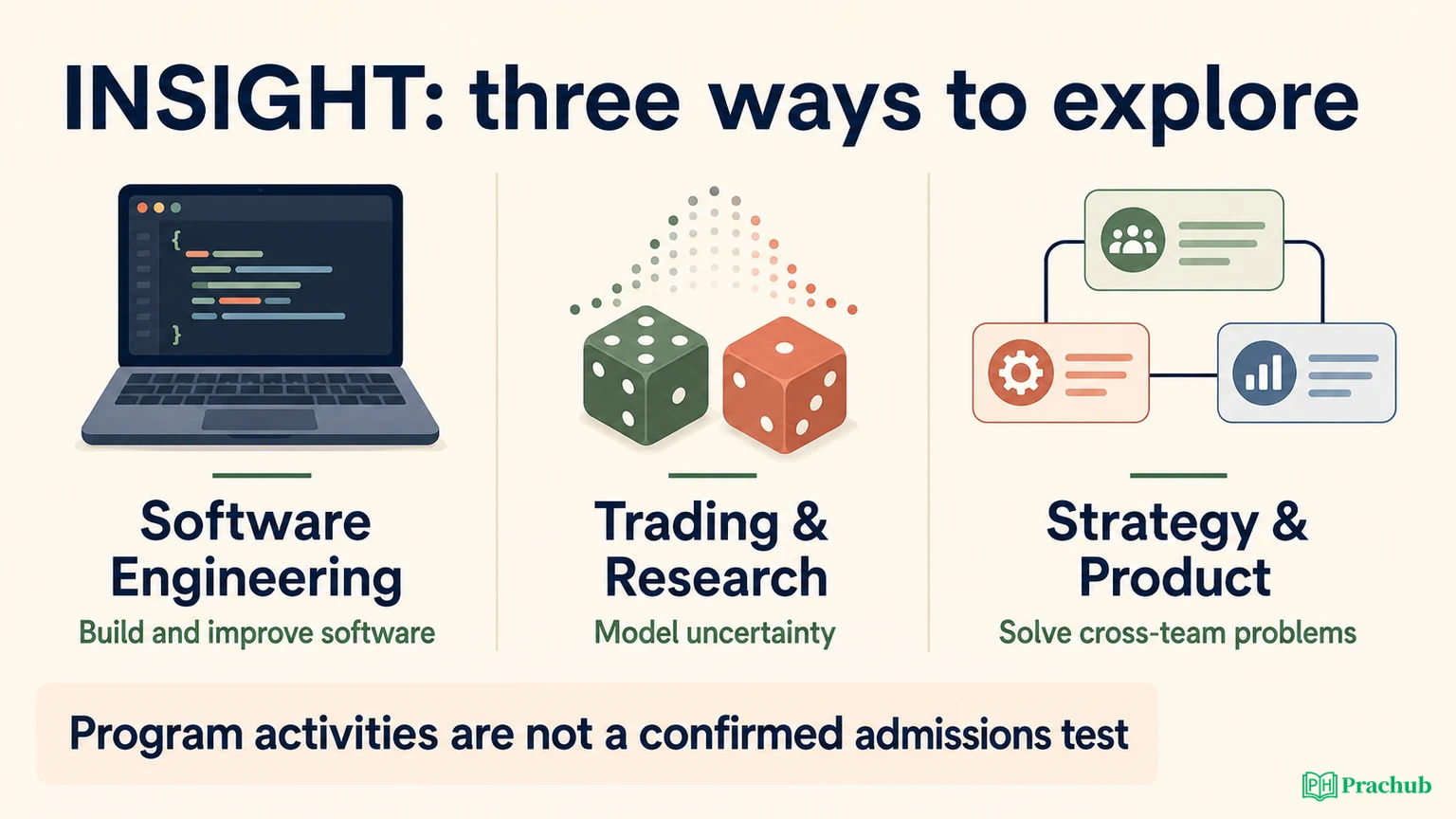
The three tracks share a learning purpose but emphasize different activities. The following comparison summarizes the official overview; the last column is preparation advice, not an assessment specification.
| INSIGHT track | Published learning emphasis | A useful question to ask yourself |
|---|---|---|
| Software Engineering | Programming, software design, and development practices through talks and hands-on work with developers | Do I enjoy making a program correct, understandable, and easier to extend? |
| Trading and Research | Probability, market structure, arbitrage, modeling, and learning through games and mock trading | Do I enjoy revising a decision when evidence changes? |
| Strategy and Product | Cross-departmental case studies involving the firm's business mechanics | Do I enjoy finding constraints and coordinating a solution across teams? |
Choosing a track is not a claim that you already know your entire career path. It is a choice about which problems you want to investigate now. A convincing reason can come from coursework, a personal project, a student organization, or a question you have kept returning to. It need not come from a previous finance internship.
Avoid selecting a track solely because someone online calls it easier to enter. A report may refer to a different location, year, or applicant background. Even an authentic acceptance story cannot reveal the counterfactual: whether the same person would have been accepted into another track.
INSIGHT, JSIP, and internships are different applications
The names are easy to confuse. Jane Street's JSIP page describes a multi-week summer software program for early undergraduates who have experienced barriers to opportunity in computer science. Its current page still gives a February 8, 2026 application deadline. That is neither the INSIGHT deadline nor a confirmed JSIP 2027 deadline.
If your goal is sustained programming immersion, read the separate Jane Street Immersion Program guide and then verify the current official requirements. If you are applying for a trading internship, the quant trader internship guide addresses a different recruiting process. A short educational event should not be described on a resume as an internship you did not hold.
This distinction also protects your preparation time. A multi-week software curriculum may justify sustained coding preparation; an exploratory track choice first calls for understanding the work. You can pursue both kinds of opportunity, but keep their forms, dates, invitations, and eligibility evidence separate.
What is known about assessments and interviews?
There is no verified universal INSIGHT 2027 sequence in the official pages reviewed here. Do not assume either that every applicant receives an OA or that admission never involves further evaluation. Your invitation is the useful operational source: it should identify the program, track, task, deadline, and permitted tools.
Historical candidate evidence suggests that additional stages can occur. In a 2026 INSIGHT OA discussion, one commenter reports receiving an OA and asks about Trading and Research preparation. The detailed preparation reply comes from someone promoting a question bank, not a clearly established account of that person's own INSIGHT assessment. It is not sufficient evidence for a timer, syllabus, provider, or cutoff.
A July 2026 New York acceptance discussion identifies the author's track as SWE, while other commenters ask whether interviews were required. Those unanswered questions do not prove an interview format. The author's parallel post in another subreddit is also not a second independent candidate account.
This review did not find two complete, independent 2027 INSIGHT selection reports. Accordingly, the advice below prepares useful skills without presenting a reconstructed admissions loop as fact. A report about a full-time engineer, quant intern, or JSIP fellow is not substituted for missing INSIGHT evidence.
If an invitation arrives, read it before changing your study plan. Check whether you are preparing for asynchronous work, a live conversation, or simply an administrative step. If technical expectations are unclear, ask the recruiting contact what format to expect. That is more reliable than assembling a fictional process from unrelated posts.
Make the application tell one coherent story
Start with the relationship between your interests and your chosen track. For SWE, a modest project can show how you handled a bug or changed a design. For Trading and Research, an investigation can show how you tested an assumption. For Strategy and Product, an activity can show how you clarified a goal when different people wanted different things. These are suggested ways to organize genuine experience, not a published scoring rubric.
Choose detail that another person could follow up on. “Built a scheduling tool” leaves several useful questions open: who needed it, what constraints mattered, and what did you personally implement? Answering those questions accurately communicates more than attaching several impressive-sounding technologies to the same bullet.
If you use the optional information field, add context the resume does not already convey. Explain a particular learning interest or a relevant circumstance plainly. Do not turn an optional field into a long cover letter merely because empty space feels risky. Repetition can obscure the one thing you actually want the reviewer to understand.
Check the exported PDF rather than only the editable document. Confirm that text remains selectable, links open, dates agree with the form, and project descriptions do not overstate team contributions. An application should remain understandable to a reader who has never seen your class syllabus or club's internal terminology.
Prepare by track with one problem you can extend
Jane Street's general interviewing guidance emphasizes collaborative problem solving and says formats vary by discipline. Its SWE guidance allows your strongest programming language rather than requiring new OCaml knowledge. These are broader hiring principles, not confirmation of INSIGHT rounds. Use them to practise explaining and revising your reasoning.
Software Engineering: make changing requirements manageable
As a self-designed exercise, write a small reservation function for a study room. Begin with non-overlapping time intervals. Specify whether an end time equal to another booking's start counts as a conflict. Then add cancellation and decide how a booking is identified.
The interesting part is how the change affects your representation. A list of intervals may be adequate at small scale; adding stable identifiers can make cancellation clearer. State the invariant, test adjacent bookings, and explain the tradeoff before reaching for a more complicated data structure. This rehearses design conversation without claiming the exercise appears in INSIGHT.
Trading and Research: update the model, not just the answer
Try this original probability exercise. A bag contains three green tokens and one orange token. A green draw pays 4 points; orange pays zero. For one uniform draw, the expected payoff is 3 points. Now draw twice without replacement and receive the sum: the expected total is 6 points by linearity.
After the first token is revealed as green, however, the expected second payoff is 8/3 points because two green tokens remain among three. Explain why the unconditional two-draw expectation and the conditional second-draw expectation answer different questions. If your first answer was wrong, identify the assumption you missed instead of disguising the correction.
Strategy and Product: locate the constraint before recommending a fix
Imagine a student event where registrations are rising but check-in queues are getting longer. Before proposing a new app, separate arrival patterns, verification time, staffing, and the consequences of admitting someone incorrectly. Define the outcome you want to improve and what must remain reliable.
A useful recommendation might start with measuring the bottleneck during the busiest period. Then compare a simple staffing change with a software change, including implementation time and failure cases. The aim is structured judgment under incomplete information. This is a practice scenario, not a reported INSIGHT case or a claim that the track is conventional product management.
Five optional questions for deeper practice
The following Jane Street records cover broader hiring contexts. They are practice material, not predictions of INSIGHT admission questions. Several are more advanced than an introductory event requires; use their reasoning goals rather than treating completion as an eligibility test.
| PracHub question | What to practise |
|---|---|
| Estimate the Number of Florists in Sydney and Make a Market | Make assumptions explicit and explain uncertainty around an estimate |
| Turning Interview Code into a Reusable Library or API | Separate an implementation from the interface another developer will use |
| Validate order book data across multiple databases | Define consistency checks and investigate discrepancies methodically |
| Design exchange–trading system message flow | Clarify ownership, state changes, and what happens after a failed message |
| Design a Real-vs-Fake DNA Classifier | Distinguish a plausible model from evidence that it generalizes |
Pick one aligned with your interests, attempt it, and explain one extension to a friend. Keep a note of what changed your reasoning. That produces a more useful learning record than a checklist of titles you only skimmed.
What to expect if you attend
The official overview says Jane Street covers travel, housing, meals, social events, and a daily allowance for other program-related expenses. Confirm your own arrangements before booking. Expense coverage is not a published salary or a guaranteed payment for every discretionary purchase.
Go in with a question about the work, not only about getting the next offer. During an activity, notice what you enjoy: debugging a shared implementation, revising a model, or reconciling different operational needs. Afterward, distinguish an interesting speaker from a problem type you would enjoy working on repeatedly.
The reviewed INSIGHT materials do not promise an internship offer or a universal recruiting fast track. Preserve useful notes, identify one skill to develop, and follow the instructions for any later opportunity separately. A worthwhile outcome is a clearer understanding of which track fits you and why—even if that understanding changes your original plan.
Sources and Further Reading
- Jane Street INSIGHT: audience, tracks, and program coverage
- NYC INSIGHT application: January 4–9, 2027 availability
- Jane Street JSIP: a separate summer immersion program
- Jane Street interviewing: general role guidance, not an INSIGHT sequence
- 2026 INSIGHT OA discussion: limited candidate evidence
- July 2026 NYC INSIGHT acceptance discussion
Comments (0)