Jane Street Quant Trader Internship 2027: Probability, Trading Interviews, and Timeline
Quick Overview
A current guide to Jane Street's 2027 quantitative trader internship, including official interview stages, probability and trading questions, timelines, and preparation.
Preparing for a Jane Street trading interview can feel strangely ambiguous. The firm publishes unusually helpful guidance, yet candidates still encounter different numbers of phone rounds, different problem styles, and different timelines depending on office and recruiting needs.
The clearest answer is this: Jane Street officially emphasizes collaborative problem solving, probability, statistics, and trading judgment, not prior finance knowledge or advanced mathematics. Recent candidates describe dice and card problems, expected-value follow-ups, strategy games, and a final stage that becomes more interactive than a conventional quiz.
Start with Jane Street interview questions to practice company-specific probability, game-theory, and quantitative reasoning problems. This guide explains what is official, what recent candidates have reported, and how to prepare without treating one anonymous interview story as a guaranteed 2027 format.
Quick answer: what should you expect?
| Question | Best current answer | Preparation implication |
|---|---|---|
| Is there a finance test? | Jane Street says quantitative trading interviews do not require prior finance or economics knowledge. | Learn expected value and market-making intuition, not finance trivia. |
| What does the process include? | Officially, the process starts with phone interviews and ends with an in-person final stage. | Prepare for several conversations, not one pass-or-fail puzzle. |
| What question types can appear? | Probability, statistics, problem solving, coding, data analysis, and general interests may appear. | Build breadth, then practice explaining one problem through multiple follow-ups. |
| Is there one fixed number of rounds? | Jane Street does not publish a universal count. Recent reports vary by office and candidate. | Treat your recruiter’s instructions as the source of truth. |
| When should you apply? | Applications are reviewed on a rolling basis and usually have no fixed deadline. | Apply when the role is open rather than waiting for a rumored cutoff date. |
The central evaluation is not whether you instantly recall a trick. Interviewers want to see whether you define the problem, make useful assumptions, update when new information appears, and communicate like someone they could solve problems with every day.
What Jane Street officially confirms for 2027
Jane Street’s current New York Quantitative Trader Internship listing describes an internship that combines trading, research, and technology. Interns work with experienced traders on market signals, strategy execution, quantitative models, statistical analysis, simulations, production tools, and team-based mock trading sessions.
The role does not require a specific major. Jane Street asks for strong quantitative thinking, clear communication, collaboration, curiosity, and a willingness to admit mistakes and learn. General programming experience is helpful, but no particular language is required.
The company’s official interview guide is equally direct. Quantitative trading candidates are not tested on finance or economics knowledge. The process begins with phone interviews and moves to an in-person final stage, where questions may cover problem solving, probability and statistics, coding in a language of the candidate’s choice, data analysis, and general interests.
Jane Street also says its applications are reviewed on a rolling basis and typically do not have one deadline. Its internships usually run for 10 to 12 weeks between May and September, though office-specific and off-cycle opportunities can differ.
A realistic Jane Street interview timeline
There is no public promise that every applicant receives the same number of calls or waits the same number of days. A useful timeline should therefore describe decision stages, not pretend there is a universal calendar.
Application and resume review
The 2027 role is open during the current recruiting season, and Jane Street recommends applying as soon as possible. Because applications are reviewed on a rolling basis, waiting for an imagined deadline can reduce flexibility without improving readiness.
The resume screen is selective. Show evidence of quantitative reasoning, difficult coursework or projects, competition experience, programming, research, or another signal that you enjoy solving unfamiliar problems. Finance clubs can help, but they are not a substitute for demonstrated analytical depth.
Phone interviews
Jane Street officially uses phone interviews at the start. Recent candidates commonly describe 30- to 45-minute conversations with a trader, though the exact duration and number of rounds vary. Early questions often begin with a compact probability or expected-value setup and then evolve through changed assumptions.
Some candidates report several phone or video rounds before the final stage. That should be treated as a current pattern, not a guaranteed count. Your invitation and recruiter are more reliable than a historical forum post.
Final stage and decision
The official final stage is in person and may combine several question styles. Recent reports mention strategy games, market-making decisions, probability, data interpretation, coding, and conversations about interests. Jane Street says candidates should normally hear back within a week after interviews and should follow up with the recruiter if they do not.
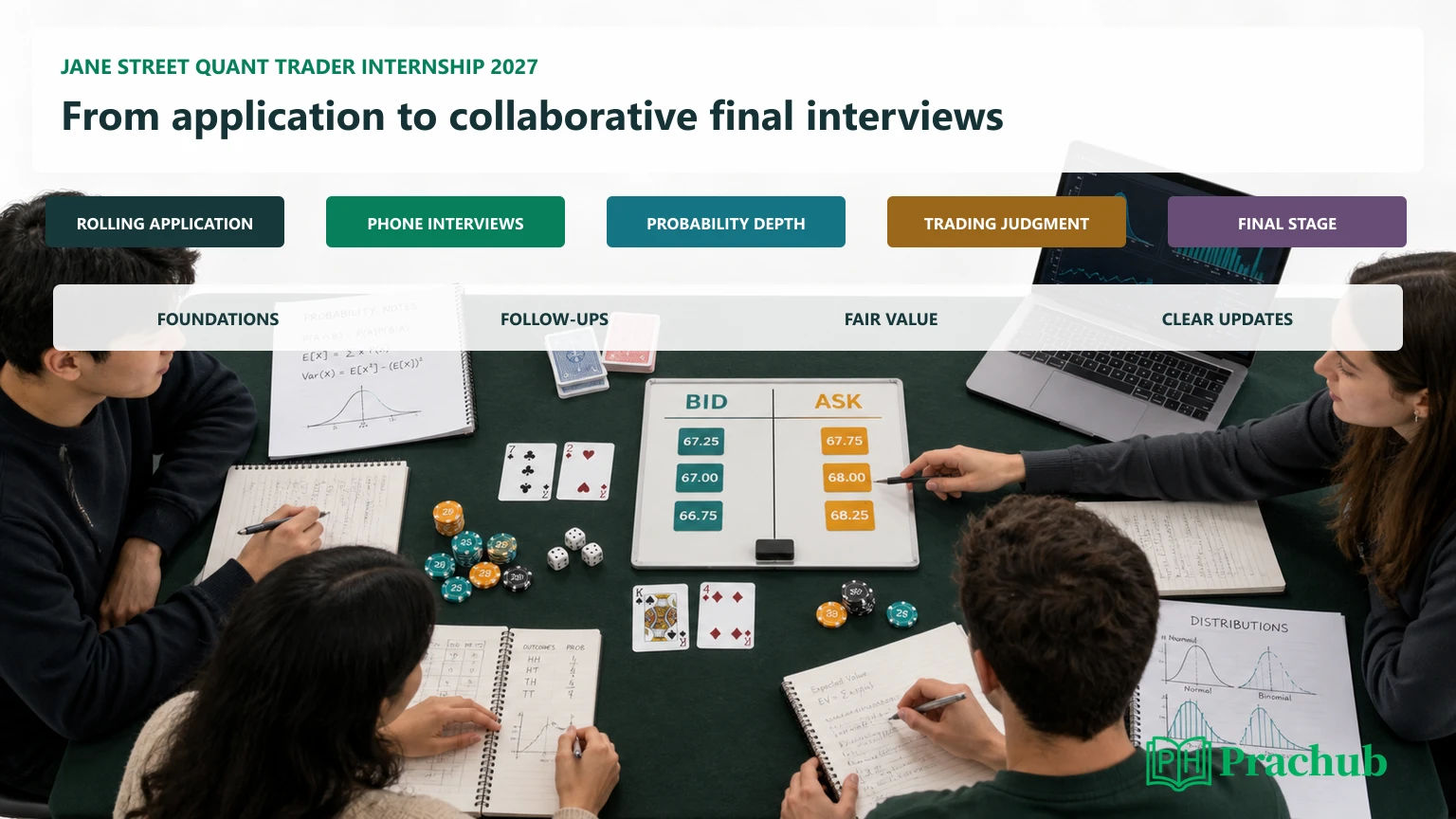
Probability questions: model first, calculate second
Recent 2026 candidate reports mention dice, cards, conditional probability, expected value, and recursive games. The surface story changes; the underlying test is whether you can turn uncertainty into a clean model.
Before calculating, identify the random variable, information available to each player, independence assumptions, and objective. A question about paying to play a dice game might ask for expected value at first, then introduce a stopping rule, an informed opponent, or a different payoff. Reusing the original calculation after the objective changes is a common failure.
Good preparation covers conditional probability, Bayes’ rule, combinations, linearity of expectation, variance, recursion, dynamic programming, and optimal stopping. Practice exact arithmetic, but also learn to produce bounds and sanity checks. If an expected payoff must lie between $20 and $30, an answer of $3.2 should stop you before you defend it.
Follow-ups matter more than the opening puzzle
A candidate may solve the first version correctly and still struggle when a parameter changes. After every practice problem, ask: What if the die is biased? What if the opponent has private information? What if maximizing the probability of winning replaces maximizing expected dollars?
This is closer to the real interview signal than memorizing dozens of isolated brainteasers. Jane Street’s own mock interview shows a problem expanding through several parts while the candidate asks questions and develops a strategy aloud.
Trading interviews: fair value, information, and adaptation
Trading questions often begin with a probability distribution and then ask you to make a market or choose a price. A strong answer connects the expected value to uncertainty: your midpoint reflects current fair value, your spread reflects risk and information, and your position should change when new evidence arrives.
Suppose an interviewer asks you to bid for a box whose payout depends on coin flips. The expected payout is only the starting point. If another bidder has more information, winning the auction can itself be bad news. The important insight is not a memorized bid; it is recognizing adverse selection and conditioning on the event that you win.
During a game, state your estimate, confidence range, and reason for trading. Track inventory instead of treating each decision independently. If the interviewer changes a rule, pause long enough to update the model rather than anchoring on your first price.
Communication is part of the quantitative score
Jane Street describes interviews as collaborative conversations. Silence makes it difficult to distinguish productive thinking from being stuck, while nonstop narration can hide the structure of the solution. Use short checkpoints: define the state, propose an approach, calculate, and verify.
When you notice an error, correct it plainly. The official guidance explicitly values candidates who are open to feedback and able to correct mistakes. Trying to protect an incorrect answer usually sends a worse signal than revising it carefully.
Ask clarifying questions when they affect the model. Do not ask questions merely to delay. “Are the draws independent and with replacement?” is useful; “Can you give me another hint?” before attempting the setup is not.
Coding and data analysis: prepare, but keep them role-relevant
The official trading interview page says final rounds may include coding and data analysis. It does not say every trading candidate receives a LeetCode-style round, nor does it prescribe one language. If coding appears, Jane Street allows a language of your choice.
For a trading internship, focus on clean implementation of simulations, state transitions, simple dynamic programs, aggregation, and numerical checks. Explain complexity and edge cases, but do not over-engineer a short quantitative task into a production framework.
For data analysis, practice interpreting noisy evidence, comparing strategies, and explaining what a statistic does not prove. A trader should be able to separate signal from randomness and change confidence without pretending uncertainty has disappeared.
A seven-day preparation plan
| Day | Focus | What to do |
|---|---|---|
| Day 1 | Probability diagnosis | Solve five mixed coin, dice, and card problems without notes; classify every miss. |
| Day 2 | Expected value and recursion | Practice repeated games, stopping rules, and value equations; explain each state transition aloud. |
| Day 3 | Conditional reasoning | Drill Bayes, private information, auctions, and adverse selection. |
| Day 4 | Trading judgment | Make markets on uncertain payoffs; update fair value, spread, and inventory after each clue. |
| Day 5 | Follow-up depth | Take three solved problems and create four rule changes for each. |
| Day 6 | Mock interviews | Run two 40-minute conversational mocks with no solution lookup and immediate feedback. |
| Day 7 | Final review | Revisit error patterns, prepare role motivation, and stop learning new topic areas. |
Track errors by cause: wrong model, missed conditioning, arithmetic, weak explanation, or failure to update. A smaller set studied deeply is more valuable than racing through hundreds of answers without understanding why they work.
Practice with Jane Street questions from PracHub
These question-bank records train relevant skills; they are not predictions of your exact 2027 interview. Every complete title in the first column opens the question and written solution.
| PracHub question | Practice focus | Why it helps |
|---|---|---|
| Solve Probability and Game-Theory Puzzles | Bayesian updating, stopping, and strategic games | Builds the multi-part reasoning and verbal structure used across trading interviews. |
| Alternating Die-Roll Game: Optimal Accept/Reject Strategy | Recursion, thresholds, and zero-sum decisions | Forces you to define a state value and compare accepting with passing control. |
| Sealed-Bid Auction for a Box of 200 Coin Flips (and an Informed Opponent) | Expected value, auctions, and adverse selection | Connects probability to pricing when another player has better information. |
| Four Fair Coins: Expected Payoff and Pricing Two Magic Wands | Linearity, invariants, and optimal action | Trains compact reasoning followed by a more difficult adaptive extension. |
| Optimal Stopping with Square-Number Ruin | Bellman equations and state-dependent policies | Practices careful transition logic when one outcome ends the game. |
Frequently asked questions
Does Jane Street require a finance background?
No. Jane Street explicitly says quantitative trading interviews do not test finance or economics knowledge. Understanding expected value, uncertainty, and market-making intuition is useful, but candidates are evaluated on quantitative reasoning and collaboration rather than memorized finance terminology.
Is there an online assessment for the 2027 quant trader internship?
Jane Street’s public trading-interview guide describes phone interviews followed by an in-person final stage. It does not publish one universal 2027 online-assessment format for every office and applicant. Follow the instructions in your own application email.
How many Jane Street quant trading interviews are there?
Jane Street does not publish a universal number. Recent candidates report multiple phone or video interviews before a final stage, but office, role, and recruiting needs can change the sequence.
Are Jane Street probability questions advanced?
The company says interviews do not require complicated higher-level mathematics. The difficulty usually comes from modeling, follow-ups, and communication rather than obscure formulas. Strong fundamentals applied flexibly matter more than advanced coursework alone.
Do I need to code in OCaml?
No. Jane Street says candidates can interview in the language they know best and should not try OCaml for the first time during an interview. Programming is a possible component, not a reason to abandon your strongest language.
How long does Jane Street take to respond after an interview?
Jane Street’s FAQ says candidates should hear back within a week after interviews. If a week passes without an update, the company recommends following up with the recruiter. Scheduling before the final decision can still vary.
Final takeaway
The best preparation for the Jane Street Quant Trader Internship is not finance trivia and not a list of remembered brainteasers. Build reliable probability fundamentals, practice turning expected value into decisions, and learn to update your model while another person follows your reasoning.
Use Jane Street interview questions on PracHub for structured company practice, then simulate full conversations in which each problem changes several times. That combination prepares you for the part Jane Street emphasizes most: solving an unfamiliar problem clearly with another person.
Sources and Further Reading
- Jane Street Quantitative Trader Internship
- Jane Street: What to Expect When Interviewing
- Jane Street Trading Interviews
- Jane Street Probability and Markets Guide
- Jane Street Internships
- Recent Candidate Discussion: Jane Street Quant Trading Interviews
Research note: This guide was checked on August 23, 2026. Interview sequences can vary by office, role, candidate, and recruiting cycle; your recruiter and invitation remain the source of truth.
Comments (0)