Jane Street Production Engineer Interview: Incident Reasoning and Support Tooling
Quick Overview
Prepare for Jane Street Production Engineer interviews with official role context, a bounded historical candidate report, and original incident and support-tool exercises. Diagnose a stalled partition despite a healthy heartbeat, test an alert-state reducer under retries and missing telemetry, and explain recovery, durable delivery, and escalation.
For a Jane Street Production Engineer interview, prepare to reason about live systems from incomplete evidence and explain how you would make recurring support work easier. Connect the symptom you observe, the test that would narrow its cause, and the improvement that would prevent the same confusion.
Our preparation thesis: practise the whole path from diagnosis to improvement. The fictional incident and alert-state exercise below develop that skill; neither is a reported Jane Street question or a description of its trading infrastructure.
For the broader coordination framework, see PracHub's incident-response interview questions. Here, the focus is a specific production-support problem and the engineering work it suggests.

Understand the role without inventing an interview loop
Official role facts: Jane Street describes Production Engineers as combining live support rotations with project work that improves production reliability and supportability. Examples include alerting, logging, incident follow-through, and tools that reduce repeated work. The page distinguishes this role from Linux platform tuning and data-center work, and says prior OCaml knowledge is not expected. Jane Street's Production Engineering overview.
Official practitioner perspective: a 2024 Signals and Threads episode discusses combining incomplete evidence, coordinating support, and improving the systems people operate. It also discusses training exercises. Those are insights into the work, not confirmation that applicants receive the same exercises. Solving Puzzles in Production.
Historical candidate report: one June 2024 New York account describes technical and behavioral calls followed by onsite coding and a hiring-manager conversation. Its brief question description does not reveal a reusable technical prompt. It is one older account, not a verified 2026 sequence or a basis for a pass-rate estimate. The candidate account.
We did not establish two independent current, role-matched reports. Our inference: rehearse practical debugging, coding, and clear coordination, while confirming your actual format with the recruiter.
Start the incident with impact and a system boundary
Consider a fictional service that consumes market-data updates and refreshes an internal quote cache. Updates are partitioned by a stable instrument group. This exercise does not submit, cancel, or replay orders.
At 09:30 UTC, an operator reports stale quotes for instruments in partition B. Partition A appears current. Your first task is to establish which consumers depend on the affected cache and what the runbook requires when freshness is uncertain.
Ask whether stale data is merely displayed or drives a downstream decision. Identify the responsible application owner and operator. If the agreed procedure requires suspending use of affected data, coordinate that scoped action rather than improvising a broad restart.
Keep mitigation and diagnosis separate. You can protect a consumer from uncertain data before proving the parser is responsible. Record what you changed and what would justify restoring normal use.
Read the evidence without trusting the green dashboard
All observations below are invented for the exercise. Assume their UTC timestamps are comparable and received sequence numbers are contiguous within each partition. In a real incident, verify clock and sequence semantics before subtracting values.
| Observation | What it establishes |
|---|---|
| 09:25:00 — strict parser configuration enabled | A relevant change occurred; causality is not yet established |
| 09:30:00 — global heartbeat healthy; global latest update current | Some monitored work is alive, not necessarily every partition |
| 09:30:03 — A's applied watermark advances | A is making progress |
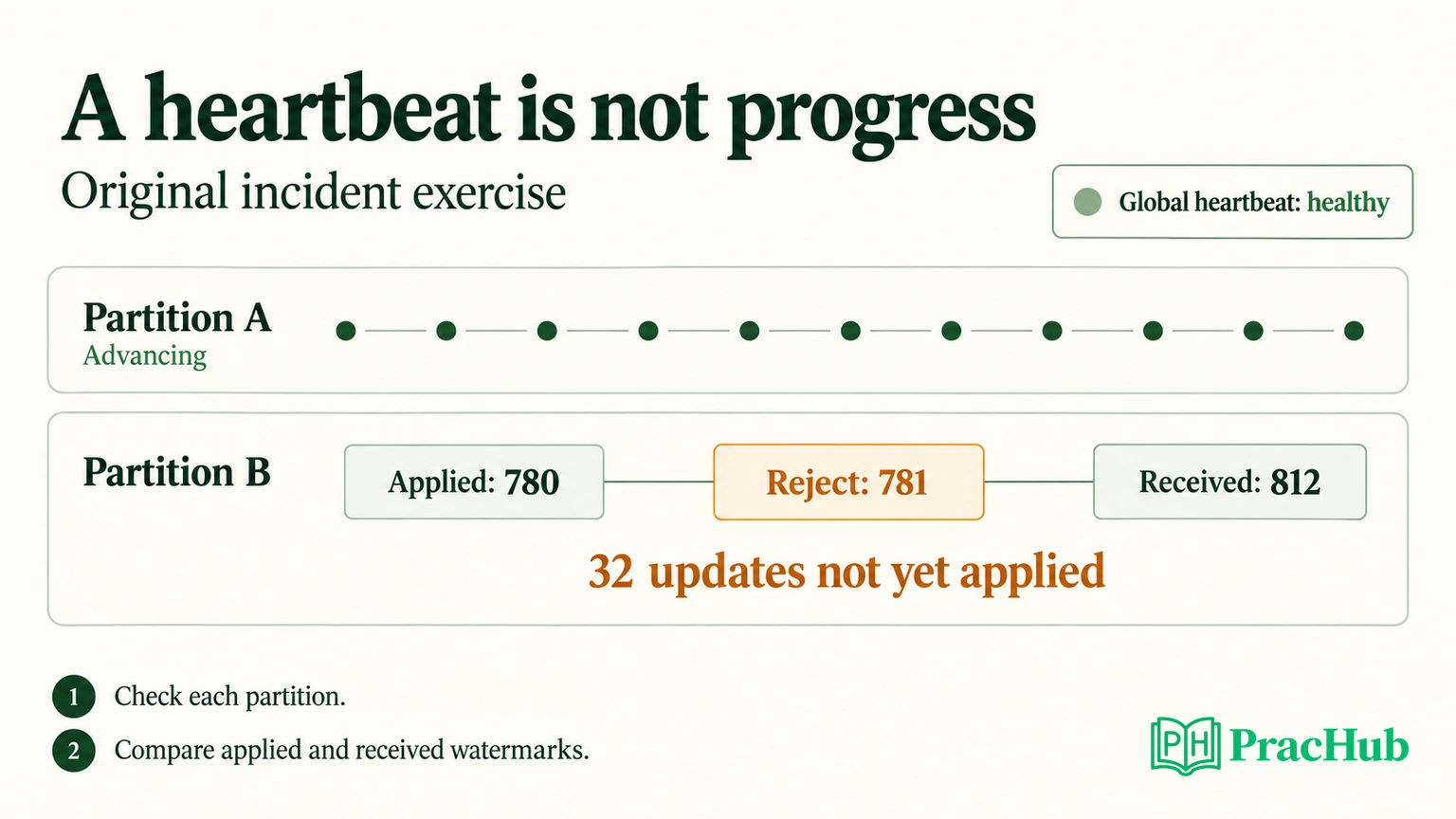
| 09:30:04 — B received through sequence 812; applied through 780 | B has 32 received updates not yet applied |
| 09:30:05 — B repeatedly rejects sequence 781 for an unexpected field | A specific record blocks progress in this fixture |
| 09:30:06 — CPU 18%; host responds to ping | Neither observation establishes application correctness |
The apparent contradiction is useful. A global “latest update” can stay fresh because A advances while B is stuck. Host reachability can remain normal while a consumer repeatedly fails on one record.
The sequence gap locates a boundary: data reached the service but has not been applied. It does not, by itself, distinguish parsing, a blocked write, or a commit failure. The repeated rejection adds evidence for the parser hypothesis.
The next discriminating test is to inspect a preserved copy of record 781 and compare its processing under the old and new configurations in an isolated fixture. Check the expected schema with the application owner. An unexpected field could be valid evolution or invalid input; silently accepting everything is not a justified fix.
Eliminate hypotheses with specific tests
For an upstream outage hypothesis, compare source and service receive watermarks for B. Continued receipt weakens the claim that the source stopped entirely, although upstream content can still be malformed.
For a capacity hypothesis, inspect the affected worker's progress and resource waits rather than relying on average CPU. Low CPU is compatible with blocking, waiting, or repeated low-cost failures. It is not a general proof that capacity is adequate.
For a configuration regression, run the same preserved input through both configurations. If only the new configuration rejects a field the agreed contract permits, you have a reproducible mechanism connecting the change to the stall.
Suppose that comparison supports the regression. A bounded response could restore a known-compatible configuration under the service's change procedure, then process the retained updates according to its replay contract. Do not skip record 781 merely to make the dashboard green; ordering and completeness may matter downstream.
Recovery requires more than a healthy heartbeat. Verify B's applied watermark advances, its backlog drains, affected values become fresh, and downstream reconciliation agrees. Confirm whether replay can duplicate effects and whether the consumer's application step is idempotent before authorizing it.
An effective status update is short: “Partition B has received updates but is not applying them. We are protecting affected consumers under the runbook. The parser change is the leading hypothesis; the owner is testing record 781 against both configurations.” State the next update time without inventing a recovery estimate.
Turn the support lesson into a small tool
The incident suggests two improvements: show per-partition progress, and manage alerts without repeatedly paging for the same condition. Start with a readable report containing partition, observed-at time, received and applied watermarks, configuration version, and a link to the first failure.
Missing telemetry must be visible as unknown. A disappeared series should not silently become a zero-lag, healthy partition. Freshness rules also need the source's expected activity schedule; an intentionally quiet feed is different from a stalled consumer with received updates waiting.
Technical reference: Alertmanager separates grouping, deduplication, routing, silencing, and inhibition. These solve different operational problems; grouping related notifications does not prove that a condition recovered. Prometheus Alertmanager documentation.
For original coding practice, implement a pure alert transition function. An upstream evaluator has already classified a condition as FIRING, OK, or UNKNOWN. Keep separate state for each key, such as environment, service, partition, and condition type.
The contract requires a nonnegative integer revision that increases for each new evaluation of that key and remains stable on retries. It must not reset after a producer restart. This is an explicit exercise assumption, not something wall-clock timestamps provide automatically.
def transition(old, revision, status):
    if type(revision) is not int or revision < 0:
        raise ValueError("revision must be a nonnegative integer")
    if status not in ("FIRING", "OK", "UNKNOWN"):
        raise ValueError("invalid status")
    if old is not None and revision <= old["revision"]:
        if revision == old["revision"] and status != old["status"]:
            raise ValueError("conflicting retry")
        return old, None

    is_open = old["open"] if old is not None else False
    action = None
    if status == "FIRING" and not is_open:
        is_open, action = True, "OPEN"
    elif status == "OK" and is_open:
        is_open, action = False, "RESOLVE"
    elif status == "UNKNOWN" and (
        old is None or old["status"] != "UNKNOWN"
    ):
        action = "CHECK_TELEMETRY"

    new = {"revision": revision, "status": status, "open": is_open}
    command = (revision, action) if action is not None else None
    return new, command
UNKNOWN preserves an open incident. A later fresh OK can resolve it; losing the measurements cannot. Repeated firing evaluations update state without generating another opening command. A newer firing evaluation after recovery opens a new incident.
The function returns a command proposal, not a delivered notification. It assumes previously stored state is valid and does not mutate it. Keeping side effects outside the function makes its transition behavior easier to test.
Verify retries, missing data, and recovery
Walk through this sequence for one scoped key:
| Input sequence | Expected behavior |
|---|---|
| Revision 1, FIRING | Open the incident |
| Retry revision 1, FIRING | No additional command |
| Revision 0, OK, arriving late | Ignore the stale evaluation |
| Revision 2, FIRING | Keep the incident open without reopening |
| Revision 3, UNKNOWN | Request telemetry investigation; retain open state |
| Revision 4, UNKNOWN | No repeated telemetry command |
| Revision 5, OK | Resolve the open incident |
| Revision 6, FIRING | Open a new incident with a different command identity |
Also test an equal-revision retry with a different status: the function rejects that contradiction. Invalid revisions and statuses must fail before producing a state change. Two partitions must not share one state record.
Our tests execute the article's function and check these transitions, invalid inputs, and input-state immutability. The tests verify a small state machine. They do not prove that a distributed notification service delivers exactly once.
For persistence, store the accepted state and an outgoing command in one transaction. This durable queue of pending commands is an outbox. Give each command a unique identity derived from the scoped key, revision, and action. Concurrent workers need serialization or a conditional update so they cannot both advance the same prior state.
A delivery worker can retry the durable command. If the provider accepted it but the worker crashed before recording success, duplicate delivery remains possible unless the receiver honors that identity. Explain this crash window instead of calling an in-memory set “exactly once.”
Add escalation without turning silence into recovery
Deduplication should reduce redundant notifications, not conceal an unresolved incident. Track acknowledgement separately from condition state. An acknowledged alert is still open until the recovery condition is satisfied.
Define reminders and escalation deadlines from the support policy. A repeated firing sample should not continuously reset the deadline and postpone escalation. Route a new severity or a newly affected partition according to explicit rules rather than suppressing it as “more of the same.”
The example function does not implement timers, severity changes, or acknowledgement. Treat those as deliberate follow-ups. Preserve the simple transition contract while deciding which additional state each requirement needs.
Finally, monitor the monitor. Stale evaluator revisions, an undelivered outbox, or a broken notification provider need a separate operational signal. The incident taught that a global green indicator can hide local failure; the support tool must not recreate that mistake.
Prepare explanations grounded in your own work
Choose an incident or support improvement you actually contributed to. Explain the initial symptom, a hypothesis you rejected, the evidence that changed your view, your personal action, and how you verified the outcome.
Then describe the follow-through: which repeated question, manual step, or missing signal you eliminated. If you did not implement the fix, distinguish your diagnosis and coordination from another engineer's code. Be precise about what improved and what remained unresolved.
Useful recruiter questions include which applications the team supports, how project work follows recurring incidents, and what the interview expects you to implement versus discuss. Those answers help calibrate preparation without assuming another office's older experience matches yours.
Five questions for incident and tooling practice
These other-company prompts are adjacent exercises, not Jane Street PE predictions. Focus on the support skill named in the second column, rather than importing each prompt's entire system into this incident.
| PracHub question | Practice focus |
|---|---|
| Debug a cache incident end-to-end | Connect a symptom to a test and a bounded mitigation. |
| Design Global Metrics Monitoring and Real-Time Alerting | Make missing and stale telemetry visible. |
| Design an alert notification system | Separate condition state, delivery retries, and escalation. |
| Design and Debug a Point-in-Time Backtest Data Pipeline | Preserve input and configuration evidence for reproduction. |
| Describe Past Project And Debugging Approach | Explain your contribution and how you checked the result. |
Browse PracHub's Jane Street questions with the listed role in mind. For this preparation, rehearse one incident from first observation through a tested support improvement.
Comments (0)