LeetCode vs HackerRank for Interview Preparation: Practice Plans, SQL, and OA Readiness
Quick Overview
Compare LeetCode and HackerRank for interview preparation using current official practice plans, logged-out interface checks, SQL preparation criteria, and a shared pair-sum exercise. Learn how input/output contracts and employer-specific assessment settings change your preparation, with three practical study allocations and clear verification limits.
You can recognize a two-sum problem, write a correct hash-map algorithm, and still submit the wrong answer because the assessment expects one-based indices. That small mismatch captures the real decision in LeetCode vs HackerRank for interview preparation: which practice route develops your skills, and how will you check that those skills transfer into your next interview?
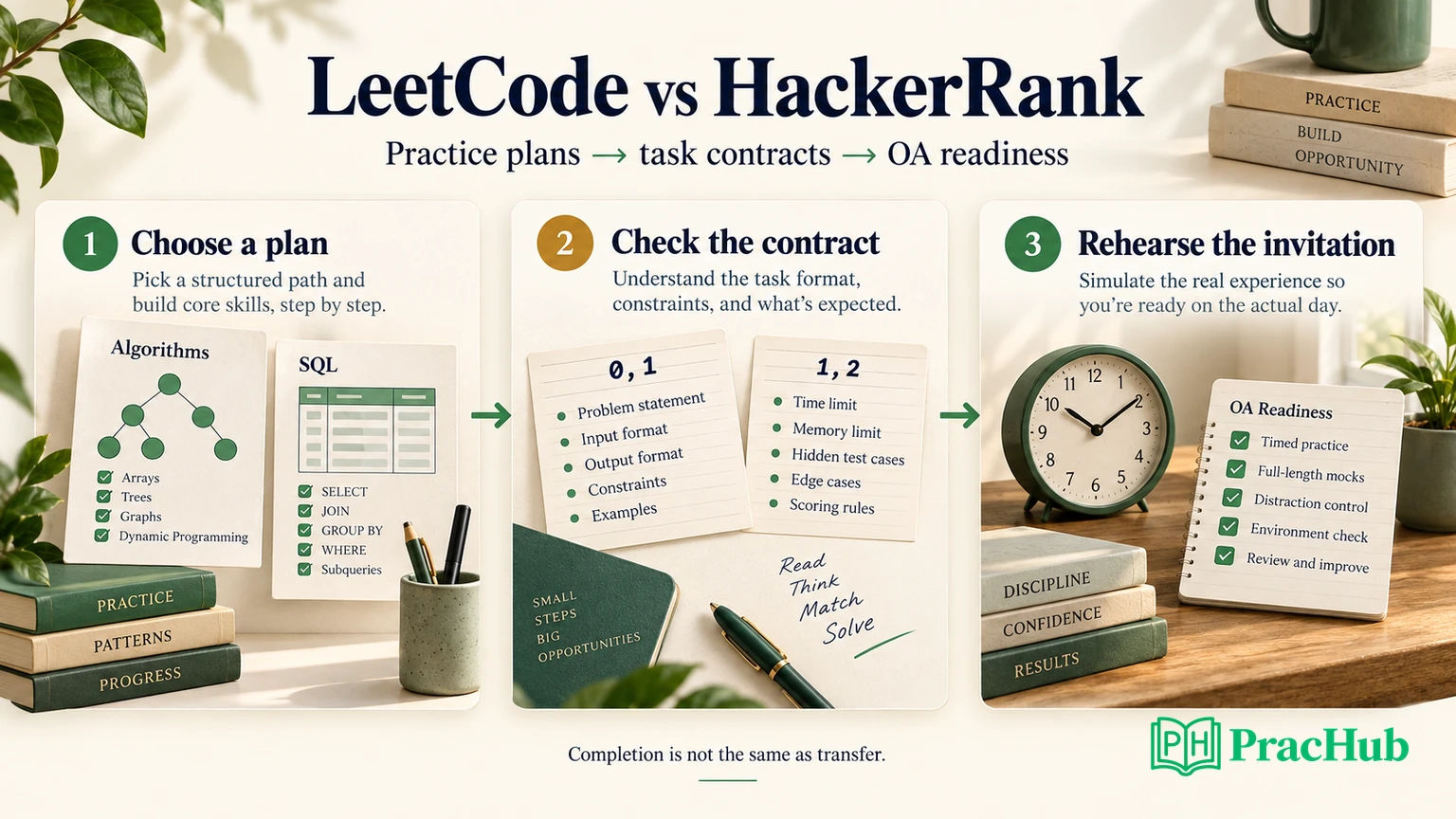
Our recommendation is to choose one primary learning plan, then rehearse the actual assessment contract separately. Both platforms offer structured practice. Neither a completed list nor familiarity with a public editor establishes readiness for a particular employer’s online assessment (OA).
Disclosure and evidence: This comparison is published by PracHub, which also offers interview preparation. Official facts below come from the platforms and HackerRank’s candidate documentation. Hands-on observations refer to logged-out browser checks on September 8, 2026. Both code-run attempts required login, so we did not benchmark authenticated judges or complete an employer assessment. Recommendations are editorial judgments; no candidate reports are used.
Which platform should you use first?
Start with the next task you must perform, rather than choosing a permanent winner.
| Your immediate need | Suggested starting point | What to verify before moving on |
|---|---|---|
| Build recurring algorithm skills | LeetCode Top Interview 150, or a HackerRank kit you can sustain | Solve an unfamiliar variation and explain complexity without recalling an editorial |
| Build SQL fundamentals | LeetCode SQL 50 or HackerRank’s SQL domain | Produce correct results for duplicates, missing matches, ties, and NULLs |
| Prepare for an invited HackerRank OA | Continue your learning plan, then use the invitation’s preparation information | Allowed language, duration, question types, input contract, and any available sample test |
| Decide whether to pay | Identify a specific missing feature first | Confirm the current offering and whether you will use it during your preparation window |
These are preparation choices, not claims that an employer prefers one practice site. If your interview is tomorrow, changing platforms to chase a larger problem count is unlikely to address a concrete weakness as efficiently as reviewing your mistakes and checking the invitation.
Both platforms have practice plans
Official facts: LeetCode’s Top Interview 150 organizes a 150-question preparation collection. Its SQL 50 targets basic-to-intermediate SQL. HackerRank’s interview preparation kits offer one-week, one-month, and three-month tracks, displaying 21, 54, and 104 challenges respectively.
Hands-on observation: LeetCode’s plan grouped problems under topics such as two pointers, hash maps, graphs, and dynamic programming. HackerRank’s three kit cards each displayed “Mock Tests: 0” during our check, despite introductory copy mentioning mock tests. That observation applies to those cards on that date; it does not establish the absence of mock features elsewhere.
Recommendation: Treat a plan as a sequence, not a deadline promise. A named one-week kit does not tell you how many hours you need. Record whether you solved independently, required a hint, or copied a solution. Revisit the latter two categories with a changed input or constraint. Completion counts become useful only when they reflect retained reasoning.
For a beginner, either route can provide structure. Choose the one whose first few tasks you can understand well enough to explain. Switching every time a problem becomes uncomfortable can conceal the exact concept you need to learn.
Try a two-session selection test before committing to a long plan. In the first session, attempt a problem and write down where progress stopped: understanding the prompt, finding an approach, implementing it, or checking the result. In the second, revisit that concept with a different problem and no saved solution visible.
If you can explain the approach but repeatedly misread inputs, spend your next block on contract checks. If you understand the inputs but cannot form an approach, stay with a focused topic sequence. If your SQL produces extra rows, inspect table grain and join cardinality before memorizing another window function.
Use this evidence to choose a route you can follow consistently. A platform change is useful when it supplies the practice you are missing. It is less useful when it merely resets your completion counter and lets the same mistakes go unexamined.
The same algorithm can require a different submission
We inspected LeetCode’s Two Sum and HackerRank’s Ice Cream Parlor. Both involve finding two distinct entries that meet a target sum, but their published contracts differ.
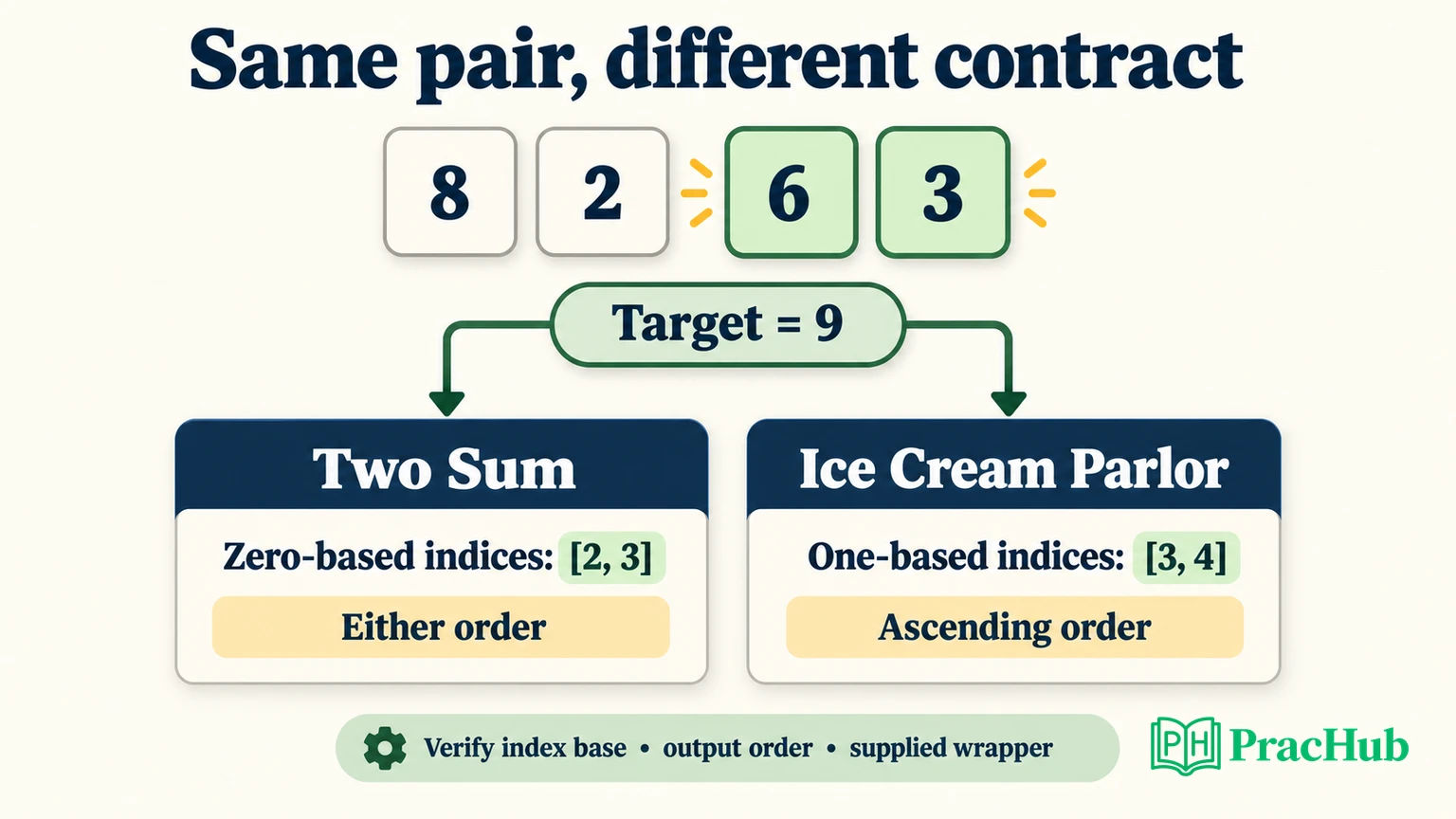
Official problem facts: Two Sum asks for zero-based indices and accepts either order. Ice Cream Parlor asks for one-based indices in ascending order. In the inspected C++ interfaces, LeetCode presented a method stub; HackerRank presented a function plus generated input/output scaffolding for multiple trips. HackerRank’s example is therefore not evidence that every task requires you to write a complete parser yourself.
Use this original fixture to separate algorithm correctness from contract correctness:
| Check | Two Sum-style contract | Ice Cream Parlor-style contract |
|---|---|---|
| Values and target | [8, 2, 6, 3], target 9 | Same values and target |
| Matching positions in the array | Third and fourth entries | Third and fourth entries |
| Required index representation | [2, 3], either order accepted | [3, 4], ascending |
| Duplicate-value check | [4, 4, 9], target 8 returns [0, 1] | Same case returns [1, 2] |
| What must remain true | Two distinct elements | Two distinct elements |
A reusable core can return zero-based positions; a small conversion function can adjust them. Here is an illustrative Python core, not a pasted submission for either platform:
def pair_positions(values, target):
    seen = {}
    for j, value in enumerate(values):
        needed = target - value
        if needed in seen:
            return [seen[needed], j]
        seen[value] = j
    raise ValueError("No pair exists")
Checking before storing prevents reuse of the current element. The earlier index is returned first, so adding one to each index produces the second contract’s ordering. Expected time and additional space are both O(n), assuming ordinary hash-map behavior.
Hands-on limitation: We inspected the visible testcase controls and clicked Run on both sites. LeetCode required login or signup; HackerRank opened a login prompt. The fixture and adapters were checked locally, not accepted by either platform’s judge. We cannot infer judge speed, hidden-test coverage, or paid editor behavior from this inspection.
Your transfer drill is to solve once, then rewrite only the interface assumptions from a fresh prompt. If you cannot identify the return type, index base, ordering, and supplied wrapper, another algorithm solution is not the only practice you need.
For SQL, compare the reasoning you practice
Official facts and observed navigation: LeetCode SQL 50 groups work around selection, joins, aggregation, grouping, subqueries, and other SQL topics. HackerRank’s SQL practice domain offers skill and difficulty filters, with subdomains including selection, aggregation, joins, and alternative queries. We inspected both navigation structures, not SQL judge execution.
Recommendation: Compare your error patterns against the exercises, rather than assuming one SQL list automatically prepares you for a business case. A query can run successfully while answering the wrong question because its population or time window is wrong.
Try this original review prompt: “Count registered users with no completed orders during June.” Before coding, write down four decisions:
- The population includes every registered user, including users with no order records.
- The event filter means completed orders, not all order attempts.
- The window has an inclusive start and exclusive end, in an agreed timezone.
- The result counts users, not joined order rows.
Now test users with zero orders, one failed order, several completed orders, and an order exactly at the boundary. Explain why a filter in WHERE can accidentally remove unmatched rows after a left join. An anti-join or NOT EXISTS formulation may express the intended exclusion more directly, depending on the schema.
Official OA distinction: HackerRank’s database-question guidance describes selecting an available database environment and matching the requested output. Do not assume the dialect you practiced will be enabled in your test. Check date arithmetic, division, rounding, aliases, and result ordering against the selected engine and prompt.
For a deeper SQL-only comparison, see LeetCode SQL vs DataLemur. The decision here is broader: learning SQL and becoming comfortable with an assessment interface require separate checks.
OA readiness depends on the invitation
Official guidance: HackerRank’s test familiarization documentation directs candidates to review test details and describes sample-test preparation. Availability and configuration depend on the assessment. Its during-test FAQ explains that the hiring company controls available programming languages.
Public practice does not tell you the employer’s exact mix of coding, database, or other question types. Nor does success on one practice task establish your employer’s scoring or pass threshold. For assessment-format comparisons, use our separate CodeSignal vs HackerRank guide.
Build your rehearsal from the invitation: note the permitted environment, time limit, required setup, and any sample option. Follow the stated rules for external resources and assistance. If instructions are ambiguous, resolve them with the recruiter before starting the real assessment.
Then rehearse a small unfamiliar task with a time limit. Reserve time to read constraints and test edge cases instead of spending every minute typing. If a wrapper is supplied, preserve its required interface. If the task uses standard input and output, practice that exact format; HackerRank documents that distinction in its STDIN/STDOUT guide.
Three practice allocations with measurable exit checks
The following allocations are editorial examples for ten focused hours, not guaranteed preparation timelines or employer requirements. Increase the total when the exit check fails.
| Candidate situation | Ten-hour allocation | Exit check |
|---|---|---|
| Early-career software candidate, no OA scheduled | Six hours on one algorithm plan; two revisiting mistakes; two on unfamiliar timed tasks | Explain the invariant, complexity, and a failing edge case before running |
| Data candidate expecting SQL | Six hours on joins, grouping, and windows; two on business definitions; two in the expected dialect/interface | Validate grain, missing users, ties, NULLs, and output schema on a tiny dataset |
| HackerRank invitation already received | Four hours on role-relevant weaknesses; three reviewing failures; three on invitation setup and timed rehearsal | Finish a representative task under the stated rules and verify the submission contract |
Keep one error log with three columns: mistaken assumption, smallest counterexample, and corrected rule. “Used zero-based indices” is actionable. “Need more practice” is not. If the same error recurs, shorten the next session and target that error before adding new topics.
When does paying make sense?
Official offering: LeetCode’s Premium page advertises features including company-specific material and interview simulations. We did not purchase or test them, and we are not quoting a price because a stable current price was not verified in this review.
Recommendation: Pay for a specific constraint you have identified: access to a needed collection, a workflow feature you will use, or structured practice that saves meaningful time. Confirm current terms directly before purchasing. A login requirement is not by itself proof that a feature requires payment.
Avoid buying a subscription to compensate for an undefined plan. First complete a small available sequence and review the mistakes. That gives you evidence about whether the missing resource is content, feedback, or simply uninterrupted practice time.
Apply the comparison to five practice tasks
These PracHub selections support the transfer checks above; they are not evidence of either platform’s employer-question frequency.
| Practice question | What to verify |
|---|---|
| Solve Algorithmic Challenges in Online Coding Assessments | Pair-sum indices, distinct elements, and output ordering |
| Parse and Format Arbitrarily Nested Tasks from CSV | Quoted input, hierarchy, and formatting contracts |
| Implement basic calculator with four operations | Operator precedence and integer-division edge cases |
| Explain Window Functions and Joins in SQL and Python | Join behavior and ranking distinctions |
| Compute Ride Metrics in SQL | Inactive users, time windows, and NULL-aware aggregation |
Choose one weak area from PracHub’s software engineer questions or the SQL question collection. Solve it, explain the contract, and test a counterexample. That exercise gives you a clearer next step than deciding which platform to use forever.
Comments (0)