Market Making Interview Questions: Explain Your Quotes, Risk, and Revisions
Quick Overview
Explain bid, ask, size, inventory and information updates through an original two-state market-making exercise and checked profit-and-loss calculations.
Market making interview questions become easier to explain when you keep four things separate: what the contract is worth, the prices you offer, the position you hold, and what new information changes. State your bid, ask, and size clearly. After a trade, update cash and inventory before deciding whether to change the quote.
Official context: Jane Street names probability, expected value, and making markets among the concepts in its interview preparation guide. Its trading interview page emphasizes collaborative reasoning, clear communication, and correcting mistakes. That supports practicing your explanation; it does not establish a universal game, timer, or scoring rule across firms. Probability and Markets, Trading Interviews
The examples below are original preparation exercises, not candidate transcripts or investment recommendations. Start with PracHub's market-making and expected-value trading game, then use this article to rehearse the decisions between calculations.
What does “make me a market” require you to say?
A two-sided quote states the price at which you will buy and the price at which you will sell. From the market maker's perspective, the bid is your buying price and the ask is your selling price. Quantity matters: willingness to buy one unit does not imply willingness to buy one hundred.
Official explanation: Optiver describes market making as providing bids and offers, with prices reflecting theoretical value and compensation for risk. Its explainer also connects better pricing and competition with tighter spreads. These are useful foundations, not a formula that determines your interview answer. Optiver market-making explainer
Before calculating, clarify the settlement definition, contract multiplier, permitted size, position limits, and whether you may revise or cancel quotes. Ask whether remaining orders stay active after a partial fill. Establish whether the counterparty sees information you do not, and whether it must trade or can choose to pass.
Those details change the problem. A fixed-width quoting game, a confidence-interval scoring exercise, and a voluntary trading game reward different decisions. Do not silently apply the rules from one to another.
Start with a value model you can defend
Original exercise: A contract settles at 40 points in a low-demand state and 70 points in a high-demand state. The stated probability of high demand is 40%. Each point is worth one unit of game money per contract. There are no fees, financing costs, or other cash flows.
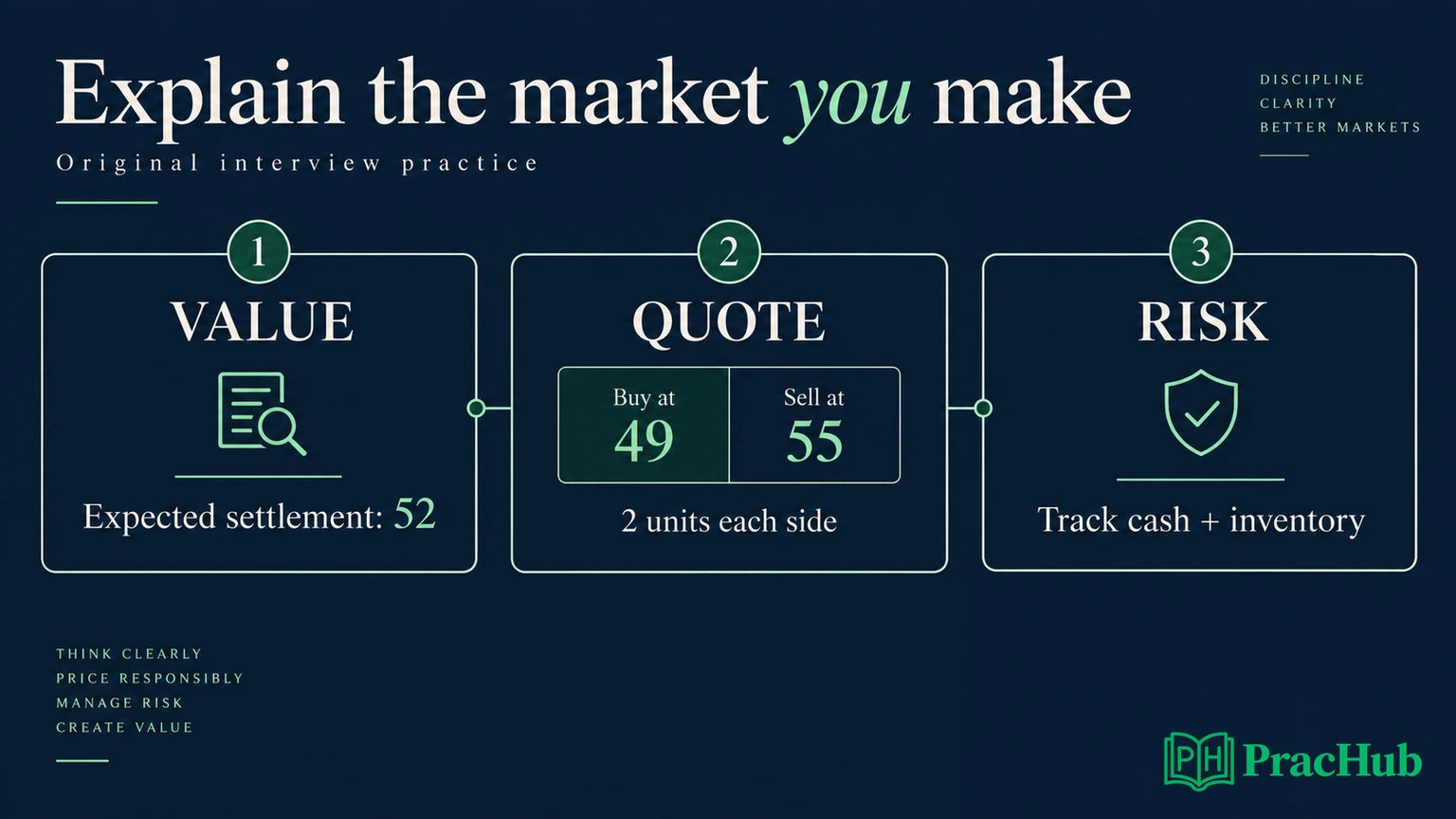
The expected settlement is 0.60 × 40 + 0.40 × 70 = 52. This is a probability-weighted average; it is not a prediction that the contract will settle at 52. In this exercise, 52 is not even a possible final settlement.
Say: “Given the supplied probabilities, my expected settlement is 52. Before choosing a spread, I want to know the size, information rules, and position limit.” This gives the interviewer both a number and the assumptions supporting it.
If the probabilities are estimates you supplied, explain their origin and test sensitivity. Moving the high-state probability from 40% to 50% moves expected settlement from 52 to 55. A ten-percentage-point belief change therefore matters more than arguing over a fractional point in the quote.
How wide should the initial spread be?
For a practice round, suppose you may quote two units on each side and revise after each completed interaction. Start flat, with no cash flows from earlier trades. An illustrative quote is 49 bid, 55 ask, two units each side.
Relative to an unchanged expected settlement of 52, buying at 49 has expected profit of three per unit; selling at 55 also has expected profit of three. The full spread is six. Neither side alone earns that entire spread, and neither trade guarantees a profit.
This is an illustrative policy to discuss, not an optimal solution. Optimal pricing would require more information about which quotes attract trades, counterparty information, risk preferences, and the objective. Saying “I always use a ten-percent spread” hides those missing assumptions.
A wider spread increases the margin on a trade at a given value estimate, but it can reduce the chance of trading. A narrower spread can improve competitiveness while increasing exposure to estimation errors. Explain the trade-off before changing the number merely because the interviewer asks for a tighter market.
Record the fill before changing your mind
Suppose the counterparty sells two units to your bid of 49. You bought two, paid 98, and now hold a long position of two contracts. Restate the direction aloud if the wording is fast: “You sell two to me at 49; I am now long two.”
Use a small ledger throughout the game. Here, cash means cumulative trading cash flow from the exercise's zero starting point, not the size of an external bankroll. Marked profit and loss uses your current valuation, while settlement profit uses the eventual realized value.
| Stage and value | Cash / units held | Profit or loss |
|---|---|---|
| Start; value 52 | 0 / 0 | 0 |
| Buy two at 49; mark 52 | -98 / +2 | +6 |
| Settle at 40 | -98 / +2 | -18 |
| Settle at 70 | -98 / +2 | +42 |
The last two rows are alternative outcomes, not consecutive events. Their weighted average is 0.60 × (-18) + 0.40 × 42 = six, matching the initial marked result under the unchanged beliefs.
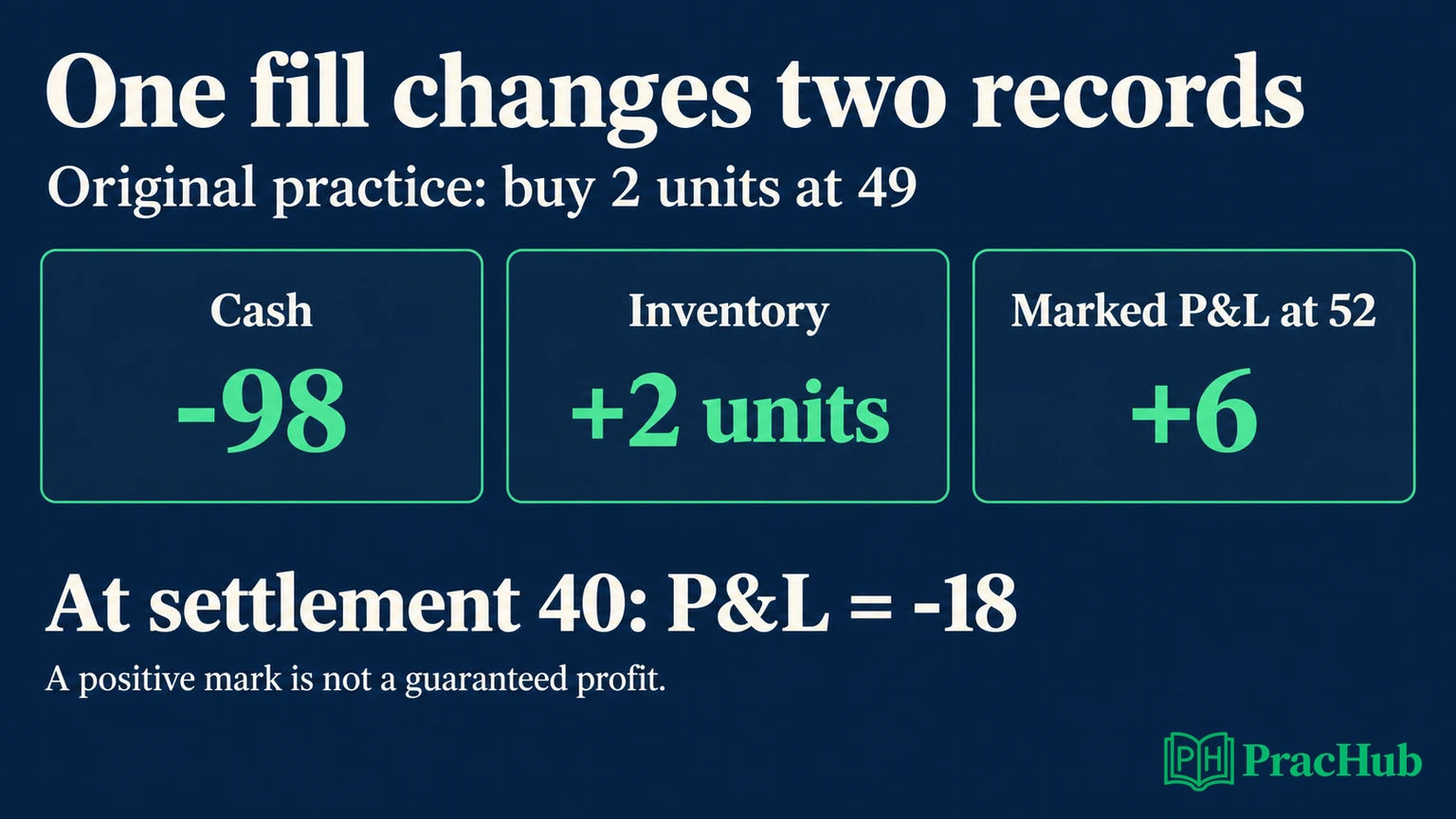
A profitable mark does not prove that your quote was safe. You still bear settlement risk, and your valuation may change. Keep that distinction visible whenever you describe performance.
Separate inventory adjustment from a value update
After buying two contracts, you may want to make another purchase less attractive and a sale more attractive. One illustrative inventory adjustment is to move the quote from 49/55 to 48/54, with the same width, if the rules permit it.
The lower bid pays less for additional inventory; the lower ask offers a better price to a buyer who would reduce your position. Your expected settlement can remain 52 while your quoting midpoint moves to 51. Inventory preference and estimated value are different objects.
Explain the limitation: changing prices encourages a different flow; it does not guarantee that someone will buy from you. Reducing bid size or withdrawing that side may control exposure more directly, but only when allowed. Check resting orders as well as the position already filled.
If you are short instead, the inventory incentive reverses: buying helps reduce the short position, while selling increases it. Do not memorize “move down after a trade.” Identify which side filled, what you now own or owe, and which next trade would increase the risk.
Update for information without double counting it
Now consider a separate branch of the original exercise. Begin again with the prior probabilities of 60% low and 40% high. A report arrives with a positive signal. The stated signal model is P(positive | high) = 75% and P(positive | low) = 25%.
The probability of a positive signal is 0.40 × 0.75 + 0.60 × 0.25 = 0.45. Conditional on that signal, the probability of high demand is 0.30 / 0.45 = two-thirds. The updated expected settlement is one-third × 40 + two-thirds × 70 = 60.
An illustrative neutral-inventory quote with the earlier three-point half-spread would become 57/63. The important answer is why the value moved from 52 to 60, not a claim that 57/63 is uniquely correct. Reconsider width and size separately if the information changes their justification.
Say: “The report updates my probability model. Inventory would create an additional quoting adjustment; it would not change the posterior probability itself.” If your counterparty already acted on this same signal, do not count the report and the trade as independent evidence unless your model supports that independence.
Why can an apparently favorable fill be bad news?
Official concept: Jane Street's guide explains adverse selection through the information contained in another person's willingness to trade against you. The relevant question is the contract's expected value conditional on getting filled, not only its value before anyone chooses a side. Probability & Markets guide
Here is another original branch. Keep the 40/70 settlements and the 40% prior high-state probability, but suppose the counterparty knows the final state perfectly and trades one unit only when profitable. At your 49/55 quote, it sells to you at 49 in the low state and buys from you at 55 in the high state.
You lose nine in the first case and fifteen in the second. Expected profit is 0.60 × (-9) + 0.40 × (-15) = -11.4 per interaction. The apparent three-point edge calculated before conditioning on the trade has disappeared.
This deliberately extreme model demonstrates selection, not a claim that interviewers always know the answer. If a counterparty is required to trade for an unrelated reason, a fill may carry little information. Ask what its behavior tells you rather than automatically treating every buyer as proof that fair value increased.
Explain size with a loss calculation
A sound value estimate does not determine how much risk you should take. In the original no-information purchase at 49, the worst settlement loss is nine per contract. If a rehearsal rule permits at most 27 of settlement loss on this position and contracts are whole units, three contracts is the maximum under that isolated calculation.
Already holding two leaves room for only one more at that price. A new bid for two would exceed the limit if fully filled. The calculation must include live orders that could fill before you cancel them, not just your preferred next trade.
Selling at 55 has a different worst-case loss: 70 minus 55 equals fifteen per contract. The same 27 loss budget supports only one such short contract from flat. Equal expected edges therefore do not imply equal permissible sizes.
These are exercise-specific loss limits, not recommended trading allocations. If there are several contracts, determine whether their bad outcomes can occur together. Positions tied to the same demand state cannot be treated as independent simply because you entered them in separate rounds.
Respond to pressure with a reasoned revision
An interviewer may challenge a number or ask you to change a decision. A useful practice response identifies what changed before giving the revised quote. Did you discover an arithmetic mistake, receive evidence, acquire inventory, or learn a new rule?
If asked to quote more tightly, explain the cost: “I can reduce my margin, but I want to keep the size small while the counterparty information is unclear.” If given a binding width, work within it and use only the other controls the exercise allows. Do not invent permission to pass.
If you notice a mistake, correct the calculation and identify any affected orders or positions. Repricing does not undo a completed trade. “My earlier value used 50% instead of 40%; the corrected value is 52, and my existing position is still long two” is a complete recovery statement.
Jane Street's published advice encourages correcting mistakes and communicating clearly. That is a reason to practice this recovery, not evidence that any particular error is harmless or that profit never matters in evaluation.
Review the decision, then the result
After a mock round, ask your partner to reconstruct your assumptions from your explanation. Could they identify the contract, quote size, inventory, and reason for each revision without guessing? If not, repair the missing statement before adding speed.
Then check the ledger and compare the outcome with the information available at the time. Buying at 49 and settling at 40 can be a losing outcome under a positive-expectation model. Repeating that quote against the perfectly informed counterparty is a model failure. The same loss needs different feedback in those two situations.
For your next rehearsal, change only one feature: settlement probabilities, counterparty information, allowable size, or quote persistence. This makes it possible to see whether you understood the mechanism rather than remembered the original numbers.
Practice related questions with the right rules
These are PracHub question records for targeted practice, not verified same-cycle reports of a universal interview. Some involve taking prices or scoring intervals rather than posting executable quotes. Read each problem's objective before borrowing a strategy.
| PracHub question | What to explain aloud |
|---|---|
| Quant Trading Game: Expected-Value Betting and Market Making on Coins, Dice, and Cards | Separate valuation, trade direction, and size as information changes. |
| Trading Game: Expected-Value Betting, Kelly Sizing, and Arbitrage Under Time Pressure | Identify the stated objective before choosing a sizing rule. |
| Estimate the Number of Florists in Sydney and Make a Market | Defend estimation assumptions before offering a two-sided price. |
| Market-Making Estimation Game: Optimal Confidence-Interval Strategy Over 5 Rounds | Distinguish interval scoring from cash-and-inventory accounting. |
| Optimize interval-scoring strategy | Derive the decision from the scoring function rather than a familiar label. |
Choose one market-making practice question, keep a ledger, and have a partner interrupt with one new fact. Your task is to explain which number changes, which position remains, and why.
Sources and Further Reading
- Jane Street: Probability and Markets preparation overview
- Jane Street: Probability & Markets guide
- Jane Street: Trading Interviews
- Optiver: Market Making explainer
Sources checked September 8, 2026. All numerical scenarios and suggested quotes are original preparation material; no current employer-specific timer, cutoff, or scoring formula is asserted.
Comments (0)