Monzo Machine Learning Interview: ML Modelling and Product Solution Design
Quick Overview
Prepare for Monzo machine learning interviews with separate approaches to ML Modelling and Product & ML. Distinguish official process details from historical candidate reports, work through an original fraud-review threshold exercise and a customer-support pilot, and prepare a project deep dive that explains your decisions.
A strong Monzo machine learning interview answer connects a prediction to a decision a bank can actually use. You need to explain what the model learns, but also which customer problem deserves attention, what happens when the prediction is wrong, and how the team will know the intervention helped.
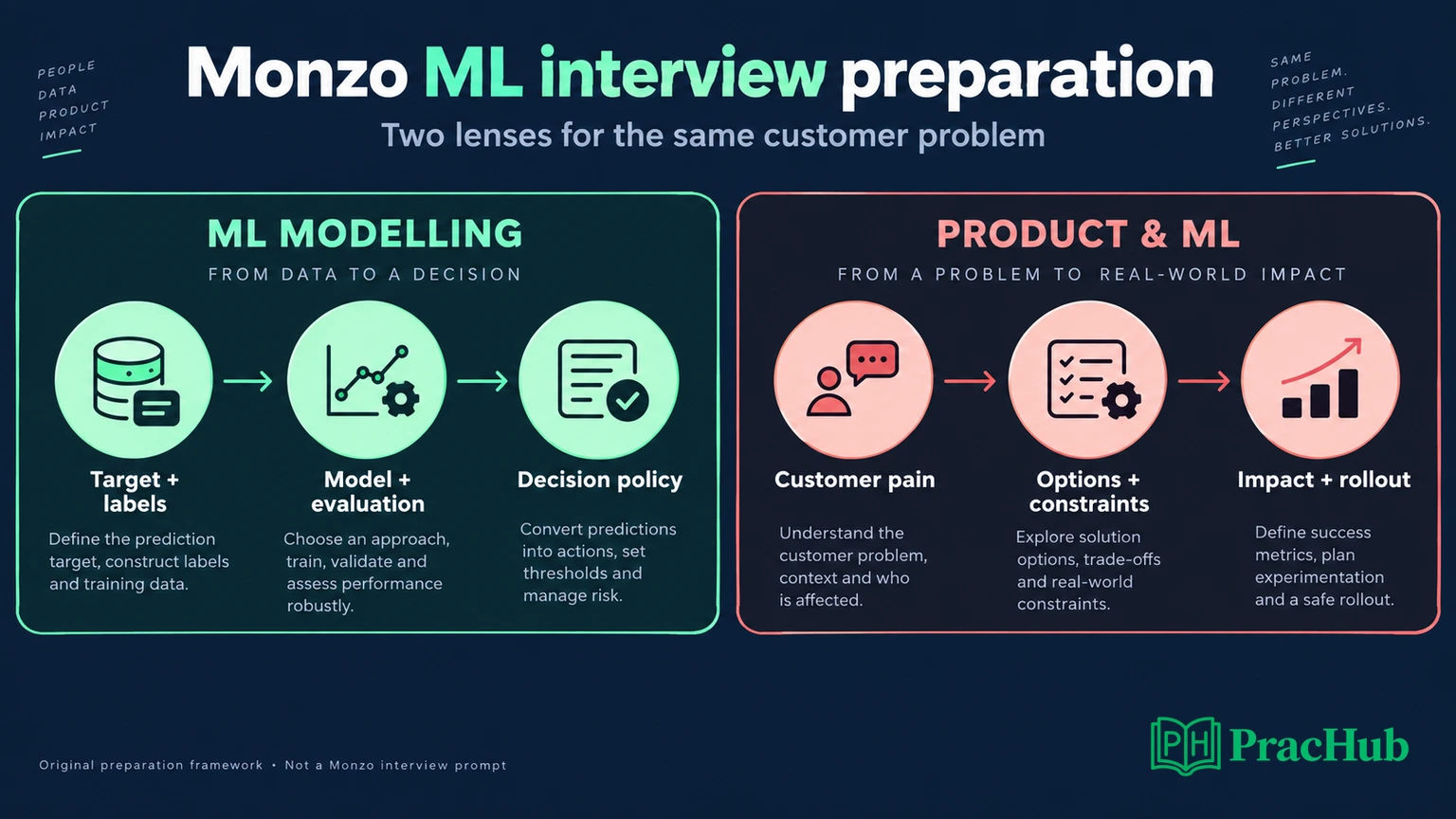
Official facts: Monzo's June 2026 hiring guide separates ML solution design from product-focused solution design. Our preparation recommendation: practise both perspectives explicitly, rather than preparing one architecture speech for every discussion. The exercises below are original practice material, not reported Monzo questions.
Use PracHub's Machine Learning Engineer interview questions to rehearse the technical explanations, then test whether you can translate each answer into a customer-facing decision.
What Monzo officially says about the interviews
Official process, published June 30, 2026: the general sequence includes a 30-minute recruiter call, a 45–60-minute initial call, two 60-minute solution design interviews, and a 60-minute behavioural interview. The modelling discussion uses a realistic scenario without live coding; the product discussion is collaborative, with the interviewer acting as a partner from another discipline. Staff-level candidates, typically L60+, also have a 60-minute project deep dive. Slides are optional there, with a maximum of five. Monzo's ML interview guide.
Role-specific official detail: the current Lead Machine Learning Scientist, Customer Operations listing names modelling, Product & ML, behavioural, and leadership interviews. Confirm your own invitation's stages and level; a general guide and a particular requisition need not use identical labels. Monzo's Customer Operations role.
Candidate report, historical: an anonymous Financial Crime ML manager applicant describing a March 2025 interview reported product-oriented cases involving support and complaints. That is one senior-role account, not evidence of a universal 2026 question set. We could not substantiate two independent same-cycle ML accounts, so this article relies on official process information and clearly identified preparation exercises. Glassdoor candidate report.
The practical implication is narrow: prepare to discuss modelling without a keyboard in that named round. It does not establish that every Monzo ML hiring process excludes coding elsewhere.
ML Modelling: define the intervention before the algorithm
Official business context: Monzo describes fraud prevention, credit, customer operations, personalisation, and its ML platform as investment areas. Its operations work includes intent classification and matching customer-service work to available agents. These are business examples, not an interview question list. Machine Learning at Monzo in 2025.
Original modelling exercise: design a risk score that prioritises suspicious outgoing payments for a limited review team. Assume the fictional system can allow a payment, send it for review, or request additional customer confirmation. All numbers below are invented for practice.
Open with the action: “Are we choosing which payments to review, or automatically stopping payments? Those decisions have different costs and evidence requirements.” Then establish when the score is needed, which payment types are in scope, and who owns the intervention policy.
A workable first target is the probability that a payment will receive a confirmed scam-related outcome within an agreed observation window. That definition still needs negotiation: a customer report, an investigator's conclusion, and a recovered loss are different labels. Avoid treating every alert as confirmed fraud or every unreported payment as unquestionably legitimate.
Build a dataset that could have existed at decision time
For this exercise, propose a 30-day label window, then ask how much confirmation actually arrives later. Train on sufficiently mature cohorts and inspect longer follow-up periods before treating that window as adequate. A recent payment with no report is still awaiting observation.
Candidate features might include payment amount relative to the customer's history, recent payment velocity, beneficiary age, and device changes. State the timestamp rule: each value must have been available when the payment was scored. An investigation result recorded next week cannot become today's feature.
Separate training, validation, and a later untouched test period. Fit preprocessing only on training data; scikit-learn's documentation explains how information from evaluation data can leak into a model through preprocessing. Data leakage guidance.
For this case, also examine repeated customers and shared beneficiaries across splits. Time separation answers a deployment question, while a grouped diagnostic can reveal dependence on memorised entities. Neither removes the need to inspect how labels were collected.
Start with the existing rules as a baseline, then compare logistic regression with a boosted-tree candidate. Explain what would justify more complexity: meaningful improvement at the review capacity the team can support, stable performance across relevant segments, and acceptable scoring latency. Naming a sophisticated architecture is less useful than stating the evidence that would earn it a place.
Make the threshold discussion numerical
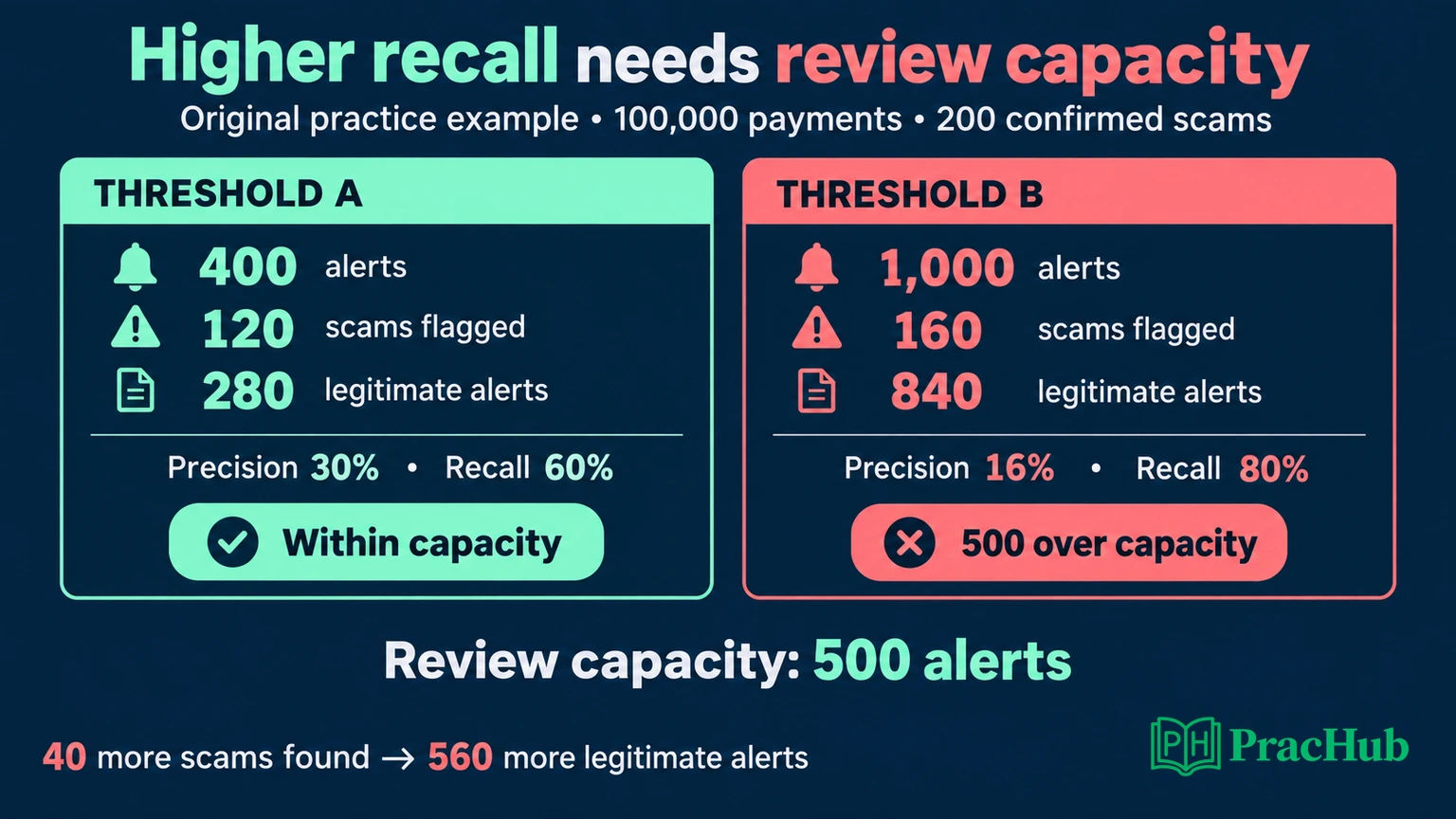
Suppose a mature test cohort contains 100,000 payments, including 200 confirmed scam payments. The review team can handle 500 alerts over the corresponding period.
| Proposed threshold | Alerts | Confirmed scams flagged | Legitimate payments flagged | Precision | Recall |
|---|---|---|---|---|---|
| A: stricter | 400 | 120 | 280 | 30% | 60% |
| B: looser | 1,000 | 160 | 840 | 16% | 80% |
Precision measures the share of flagged cases that are positive; recall measures the share of positives captured. Here, A gives 120/400 precision and 120/200 recall. These definitions follow standard classification metrics. Scikit-learn metric reference.
B finds 40 additional scams but adds 560 legitimate alerts and exceeds capacity by 500. You cannot recommend it solely because recall is higher. Nor can you assume selecting its top 500 alerts produces a particular recall: calculate that result from the ranked scores.
If each additional genuine alert could prevent £200 of loss, the 40 extra cases represent an illustrative £8,000 ceiling before accounting for intervention effectiveness. If each extra legitimate alert costs £10 in handling and customer friction, that contributes £5,600. The apparent £2,400 difference excludes the cost of reviewing additional genuine alerts, staffing limits, delayed service, and uncertainty. Use this arithmetic to expose missing assumptions, not to declare profitability.
Explain what changes after the model launches
Our proposed answer for the exercise: deploy the score in shadow mode first, logging its recommendations without changing customer treatment. Check feature availability, latency, missing values, and score distributions before drawing conclusions about impact.
Then propose a constrained rollout with the risk and operations owners. Define the fallback when a feature service fails, the queue limit that triggers intervention, and who can roll back the policy. A model that silently fills an unstaffed review queue has not solved the problem.
Keep model monitoring separate from policy monitoring. Scores may remain statistically stable while the team changes its review rules. Track confirmed outcomes on mature cohorts, customer interruption rates, time awaiting review, and differences across relevant customer segments.
There is also a feedback problem: stopping a payment can prevent the outcome you were trying to observe. A blocked payment with no subsequent loss is not automatically a negative training example. Discuss investigator evidence, intervention logs, and evaluation approved by the risk and operations owners. Do not suggest exposing customers to known high-risk payments merely to obtain cleaner labels.
If asked why offline performance improved while losses did not, walk through the chain: label maturity, feature timing, ranking at the actual capacity, policy execution, intervention effectiveness, and changing attack patterns. That diagnosis is more useful than immediately retraining a larger model.
Product & ML: choose which customer problem to solve
Original product exercise: customers contacting support about an unfamiliar payment are transferred between teams and repeat their explanation. Your product partner asks for an AI assistant. You have one small engineering team for a six-week pilot.
Ask what “better” means before accepting the proposed solution. Is the main pain waiting for a first response, reaching the wrong specialist, repeating information, or failing to resolve the issue? Request a sample of journeys and the current breakdown of contact reasons. An average handling time can hide very different problems.
Compare three concrete options:
- Improve the initial support form and routing rules. This can test whether missing information causes transfers without requiring a new model.
- Predict the appropriate queue and show an editable summary to the agent. This targets handoffs while preserving human ownership of the response.
- Let an assistant answer selected requests directly. This may reduce workload, but introduces additional evaluation and escalation requirements.
For the fictional pilot, recommend the second option only if the journey evidence shows misrouting is a major cause of delay. Restrict it to a well-defined contact type, keep an agent correction path, and explain why autonomous resolution can wait.
Official role context: Monzo's Customer Operations posting describes human-in-the-loop systems and collaboration with product squads. That makes customer support a relevant practice setting; it does not prove Monzo will use this prompt. Customer Operations ML role.
Connect the pilot to an observable outcome
Use time to meaningful resolution as the primary outcome for this exercise, with repeat contact and inappropriate routing as guardrails. Define resolution with the operations partner: closing a ticket may simply move the problem elsewhere.
Measure whether summaries omit critical facts, whether agents correct the assigned queue, and whether customers must repeat information. Track outcomes separately for sensitive or urgent contacts so aggregate speed does not conceal worse service where the consequences are largest.
A naive customer-level experiment could also affect the shared queue serving the control group. Explain that capacity changes create interference: faster routing for one group may free agents for everyone. Discuss a queue-level or time-blocked design with the experimentation partner, including differences in demand and staffing. The interview answer need not contain a complete statistical protocol, but it should recognise why ordinary randomisation may answer the wrong question.
If the interviewer removes half the engineering capacity, narrow the pilot before dropping the feedback path. If the partner insists on an LLM, ask which failure of the simpler approach it addresses and what evidence would justify the additional cost. Your goal is a recommendation that can change when the facts change.
Prepare a project story that survives follow-up questions
For your own project, prepare a short account of the customer problem, your responsibility, the alternatives, the decisive evidence, and the result. Keep a second layer ready: label construction, failed experiments, deployment constraints, and the decision you would now change.
For a senior deep dive, a useful five-slide preparation structure is problem, evidence, design decision, rollout, and outcome. This is our suggested structure, not Monzo's prescribed deck. Put the rejected alternative beside the chosen approach so the discussion naturally reaches trade-offs.
Separate “the team delivered” from “I decided.” Explain disagreements without casting stakeholders as obstacles. A convincing story might show that an operations partner changed your metric because your original definition rewarded closing cases too early.
Targeted questions to rehearse aloud
These verified PracHub questions come from other company-labelled collections. They offer adjacent practice, not a Monzo question bank. Use the fraud exercises for different decisions rather than repeating the same answer three times.
| PracHub question | Specific rehearsal goal |
|---|---|
| Design a Fraud Detection System | Define the decision point and available actions. |
| Design a traditional fraud detection system | Explain delayed labels and capacity-aware thresholds. |
| Design Real-Time Fraud Detection with XGBoost Model | Defend a tabular baseline and its evaluation. |
| Assess LLMs for fraud detection | Separate useful language tasks from automatic risk decisions. |
| Present a project deep dive | Explain your ownership and rejected alternatives. |
Choose one prompt from PracHub's Machine Learning Engineer practice collection, answer it aloud, and have a partner change one constraint halfway through. Finish with the decision you recommend, the uncertainty you would investigate first, and the result that would make you reconsider.
Sources and Further Reading
- Monzo: Interviewing for Machine Learning, June 2026
- Monzo: Lead Machine Learning Scientist, Customer Operations
- Monzo: Machine Learning at Monzo in 2025
- Glassdoor: Financial Crime ML manager candidate account, March 2025
- Scikit-learn: Classification metrics
- Scikit-learn: Data leakage and common pitfalls
Comments (0)