My Quant Journey Review: Mental Math, Market Making, and Beta Practice
Quick Overview
Review My Quant Journey’s guest arithmetic feedback, visible persistence, market-making setup and free/AI/sync boundaries. A constructed three-fill ledger and explanation checklist connect mental calculation to cash, inventory, information and settlement without claiming a completed game.
My Quant Journey lets a guest practice arithmetic with a named shortcut, inspect a market-making setup and retain visible session statistics after a reload. You can inspect those surfaces without registering. Evaluate each mode by the evidence it produces: one correct multiple-choice answer is narrow, and a profitable-looking spread still needs a cash-and-inventory explanation.
PracHub publishes this review and owns the complementary practice links. Our quant trading-game question offers a separate explanation task. The three-fill ledger and settlement cases below are original educational examples, not results generated by My Quant Journey.
What the training desk exposes to a guest
Provider description, checked November 3, 2026: My Quant Journey groups practice into arithmetic, probability, puzzles, estimation and simulated markets. Its desk overview also links to analytics, firm-oriented plans and an interview simulator.
We inspected the guest interface, answered one arithmetic item and opened the first market-making round. We did not use an account, paid feature, AI examiner, leaderboard or complete mock. Firm-style labels and achievement names are provider descriptions, not verified employer-process requirements or hiring predictions.
The site identifies itself as an evolving individual project and labels its Feedback control beta. That is a reason to document the tested surface precisely. It does not establish that every module has the same maturity or that an untested function is unavailable.
One arithmetic answer included a usable method
The Mental Math page describes five modes, including untimed work, timed runs and differently scored sprints. We selected Shortcut trainer, which described itself as untimed practice with an explanation after each answer.
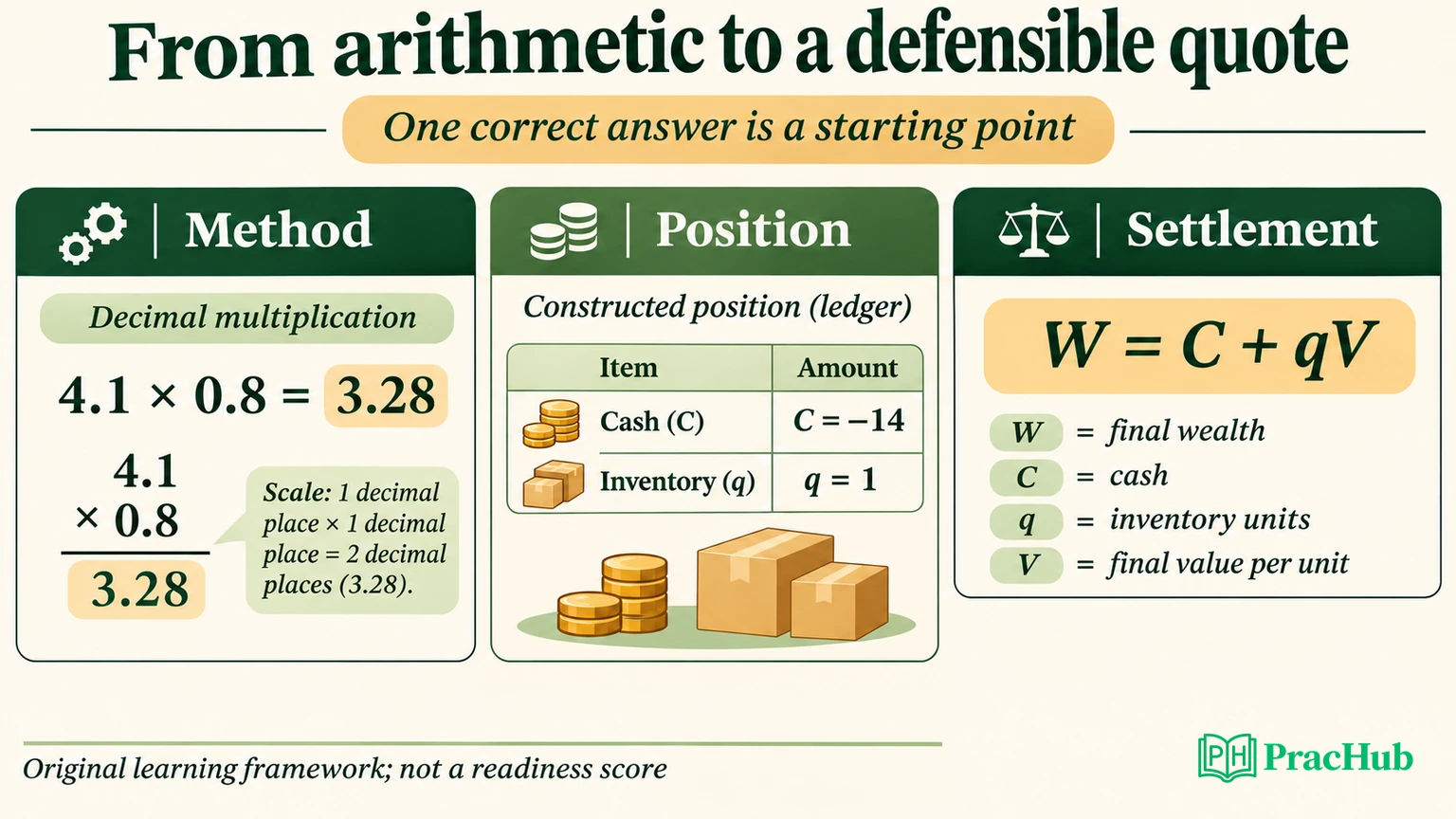
Direct observation: the first sampled item asked for 4.1 multiplied by 0.8. We selected 3.28. The interface marked that answer correct, added two edge points and explained decimal placement. We then explicitly ended the session after one answered item.
The summary displayed one correct answer out of one and one hundred percent accuracy. A reload of the desk overview retained that session, two edge points and the one-answer total. We observed visible persistence in the same browser; we did not inspect storage internals or test cross-device sync.
The result establishes the feedback returned for this item. It does not establish readiness, difficulty coverage or retention. The one-item denominator matters more than the impressive-looking percentage. Timing labels recorded during browser automation are not a calibrated measure of a person’s mental-arithmetic speed.
A method-focused follow-up is to change the scale. Multiplying 0.41 by 0.08 uses the same integer product but moves the decimal result to 0.0328. The arithmetic can be checked independently. That is a transfer question we propose, not another platform item we answered.
Choose a mode for the weakness you want to inspect
A shortcut trainer can help identify a mechanical error: the wrong decimal scale, an unnoticed sign or an arithmetic operation performed on the wrong quantity. A timed session asks whether you can apply the method while managing a clock. Those are related but different questions.
The public sprint descriptions use employer-style names and different penalty rules. We did not execute either sprint or verify that it matches a particular employer’s current assessment. Read the instructions supplied with an actual invitation before treating a practice mode as an exam specification.
For your own review, separate errors in method from errors in execution. If you know that 41 times 8 is 328 but choose 32.8 for the sampled decimal product, the useful correction concerns scale. Repeating more unrelated questions may not expose that mechanism as clearly.
Likewise, a fast correct answer may be recognition of a familiar form. Ask for an explanation or change the input before concluding that the method transfers. Our observed one-answer session cannot answer that longer-term question.
The market interface distinguishes a quote from a position
The Market Maker Arena describes simulated hidden-value products with informed and random counterparties. Its setup listed dice, coins, cards and other toy scenarios, with product-specific rounds and spread limits. These are practice rules, not real financial instruments.
Direct observation: opening the default dice market showed round one of five, cash zero and inventory zero. The bid and ask were separate inputs, with labels explaining that the learner buys at the bid and sells at the ask. A blotter awaited the first submitted quote.
We did not send a quote, receive a fill or complete settlement. The game description’s promises about counterparties, news and profit attribution therefore remain provider claims in this review. An opened market screen does not establish the accuracy of its execution or accounting.
For a future trial, ask whether you can reconcile the position after each fill. A quoted spread is a pair of proposed prices. Cash and inventory are consequences of actual executions. They should not be treated as interchangeable measures of success.
Original ledger: a spread of two does not guarantee a profit
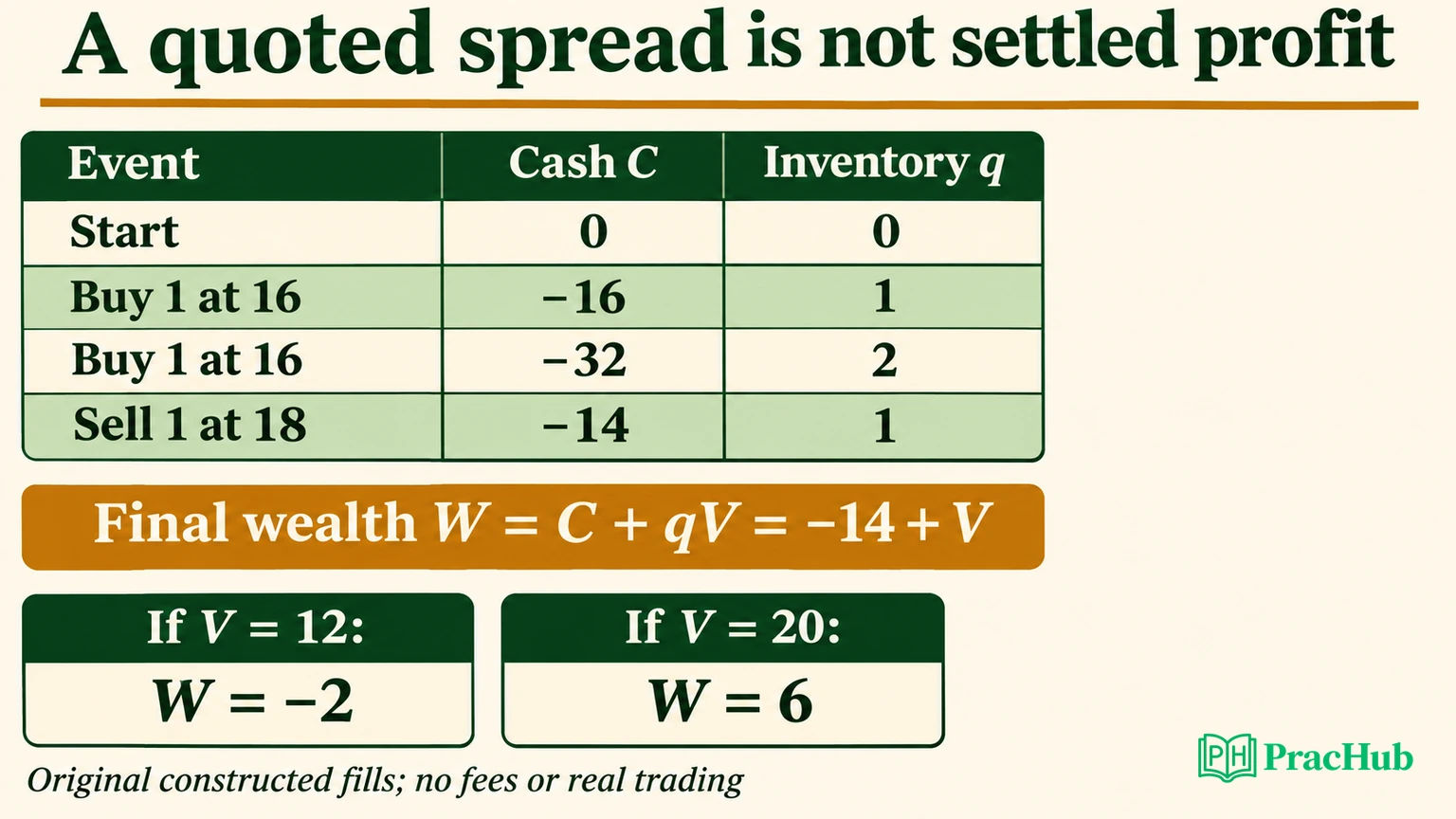
Our constructed exercise starts with zero cash and zero inventory. Assume one unit is bought at sixteen, another at sixteen, then one is sold at eighteen. There are no fees, financing, constraints or real trades. We supplied these fills ourselves; they did not occur in My Quant Journey.
Buying a unit reduces cash by its price and increases inventory by one. Selling does the reverse. After the three fills, cash is negative fourteen and inventory is positive one. The difference between the buy and sell prices leaves the remaining unit exposed.
| Constructed event | Cash C | Inventory q |
|---|---|---|
| Start | 0 | 0 |
| Buy one at 16 | −16 | 1 |
| Buy another at 16 | −32 | 2 |
| Sell one at 18 | −14 | 1 |
If the remaining unit settles at value V, final wealth is C plus q times V, or negative fourteen plus V. At V equal to twelve, wealth is negative two. At V equal to twenty, wealth is six. These are two specified settlement cases, not expected returns.
We executed exact-fraction Python calculations for the ledger and both settlements. The cash and inventory after every fill matched the table. No random market, counterparty model or platform score was involved. The checks establish arithmetic for these constructed events only.
This gives a concrete question for a future game trial: does the displayed settlement reconcile with the fills, remaining position and final value? A positive number by itself is less informative than an accounting trace you can reproduce.
Revalue the open position when information changes
The same ledger supports another distinction. Before settlement, you may mark the remaining inventory at a current estimate rather than its eventual payoff. If your estimate changes, marked wealth changes even without another trade. That is separate from cash moving after an execution.
In an invented five-fair-dice setup, the initial expected sum is 17.5. If a revealed die is six and the other four remain independent fair dice, the conditional expected total becomes twenty. The revealed six replaces an expected contribution of 3.5; it is not added on top of the original five-dice expectation.
This calculation assumes the reveal rule supplies no further information about the hidden dice. If the rule changes, the conditioning may change too. We did not observe a reveal in the platform game or verify its random-generation policy.
For an interview, state what changed in the information set, then recompute the estimate. Next, identify the existing inventory that is exposed to it. Repeating the original midpoint after new information or confusing marked wealth with realized cash obscures the decision.
This is an educational accounting exercise. It does not prescribe a real trading strategy, suitable spread or investment position. The value of the example is that the assumptions and resulting arithmetic can be inspected independently.
Audit a game with an explanation ledger
Use this original checklist if you later run a complete practice market. It is not My Quant Journey’s scoring rubric. It separates what you decided from what the simulator happened to do.
| Record | Why it changes the explanation |
|---|---|
| Information before quoting | Defines the estimate available at the decision time |
| Bid, ask and permitted size | Defines the proposed transaction terms |
| Actual fill and side | Determines cash and inventory updates |
| New observation | May change the conditional estimate |
| Final value and remaining inventory | Determines settlement wealth |
A profitable run can contain weak reasoning and a losing run can contain a defensible decision under uncertainty. You need the rules and counterparty behavior before interpreting the result. We did not estimate either property from the unsubmitted first-round screen.
After each fill, say the position aloud: how much cash changed, how many units remain and which direction of final value helps or hurts. This connects the spoken answer to the position numbers. It is more specific than saying that you would manage risk.
To inspect learning, repeat the explanation with a different fill sequence. Do not claim improvement merely because one later outcome is larger. A changed result can reflect different random events, different sizing or a different terminal value.
Free practice, sync and AI are separate access questions
The public About section promises free practice and describes a potential later paid layer for costly AI features. That is the provider’s stated direction, not a future pricing guarantee we can independently enforce. We did not activate an AI feature or test its allowance.
The Privacy section says guest progress stays in browser storage, while a free account adds sync and public leaderboard information. It separately says AI requests send submitted text through the service to model providers. Our visible reload result verifies local continuity only, not those storage, security or transmission claims.
We did not create a profile, submit a free-text AI answer, change account settings or test deletion and export. The presence of a privacy statement is not evidence that every related control has been exercised. A beta-feedback label also does not specify a complete access policy.
| Intended use | What this review establishes | What to verify separately |
|---|---|---|
| Try arithmetic as a guest | One answer and shortcut returned | More categories and sustained practice |
| Retain a guest record | One session survived reload | Backup and another browser or device |
| Practice market accounting | First-round inputs and position visible | Fills, reveals and settlement |
| Use AI or sync | Public descriptions available | Actual access, usage and saved data |
Keep the denominator beside the badge
The desk’s retained one hundred percent accuracy represented one correct response. It did not cover probability, estimation or market-making. Use the one-answer denominator when interpreting this aggregate statistic.
A useful personal record combines the category, format, number attempted and error mechanism. Distinguish an untimed multiple-choice shortcut from a typed sprint or a spoken derivation. Combining them into one readiness label would discard the conditions that make the result interpretable.
We did not measure a trend, multi-day streak or hiring outcome. The observed interface gives a place to accumulate practice evidence; the interpretation still depends on sample size and what each task required you to do.
Practice the gaps the product leaves open
These independent PracHub prompts extend quote reasoning and estimation. They are not My Quant Journey questions, scoring rules, firm plans or evidence of current employer assessments.
| PracHub question | What to examine |
|---|---|
| Quant Trading Game: Expected-Value Betting and Market Making on Coins, Dice, and Cards | Explain a quote through information, position and settlement. |
| Market-Making Estimation Game: Optimal Confidence-Interval Strategy Over 5 Rounds | Separate the rule being optimized from a displayed game score. |
| Estimate the Number of Florists in Sydney and Make a Market | State a range and its assumptions before presenting a two-sided quote. |
| Analyze distribution of a 3-dice product | Derive the distribution instead of substituting an arithmetic average. |
| Fermi Estimation with Confidence Intervals: How Many Houses Does One Year of US Netflix Spending Buy? | Explain uncertainty and the meaning of an estimation interval. |
Who should try My Quant Journey next
My Quant Journey is worth a bounded guest trial if you want arithmetic explanations and a route toward simulated quote and inventory reasoning. The sampled shortcut worked, and visible statistics survived a reload. Full market execution, AI quality and account sync remain untested here.
Use the quant trading-game prompt to explain the original ledger without a screen: two buys, one sale and one remaining unit. Reconcile cash, inventory and settlement, then change the final value. That is a concrete progression from calculating a number to defending what the number means.
Comments (0)