Node.js Stream Interview Questions: Backpressure, Errors, and Partial Writes
Quick Overview
Prepare for Node.js stream interviews with backpressure traces, pipeline failures, cancellation, short-write offsets, partial output, and chunk-boundary tests.
A Node.js export can accept every chunk and still fail halfway through. It can also finish writing a file without proving that a remote consumer processed it. In a stream interview, the strongest answer identifies three boundaries: accepting data, completing the local transfer, and committing the result the product promised.
This guide uses original controlled examples for backpressure, pipeline failure, and low-level short writes. Official facts are linked to Node.js documentation. Exercise observations come from Node.js 24.19.0 tests; architecture recommendations are our reasoning. No candidate reports are used, and these examples are not attributed to a company's interview process.
Start with Implement buffered file writer with concurrency support. Explain what the producer may do after each write result before discussing throughput optimizations.

Does write returning false mean the chunk failed?
No. For a healthy Writable, the current chunk has been accepted into its processing path. The boolean tells the producer whether it should keep submitting more data at that moment. Treating false as “retry this same chunk” can duplicate output.
Official fact: Node's backpressure guide explains the write-and-drain contract: stop producing more chunks when write() returns false, and resume when the destination signals that it can accept more. Backpressure coordinates rates; it is not a delivery acknowledgment from the final business consumer.
Here is an original observation. We created a Writable with highWaterMark: 4, held its write callback, and submitted the eight-byte Buffer ABCDEFGH. The call returned false, writableLength was eight, and the sink received the payload exactly once. After we released the callback, the drain wait completed.
This fixture answers two interview questions at once. The oversized chunk was admitted, so the threshold was not a hard eight-byte rejection rule. And the producer had no reason to submit that same chunk again. Its next action concerned the next chunk.
If you write a manual producer, explain how it also observes errors, cancellation, and premature closure while waiting. A destination that fails may never emit the drain event you expected. For a connected chain, prefer letting pipeline() coordinate those cases rather than building a partial lifecycle around one event.
Why does a small highWaterMark not guarantee low memory?
A stream threshold describes one queue's pressure signal. The application may also retain input arrays, in-flight requests, transform output, and destination buffers. In object mode, counting objects does not tell you the byte size of each object.
Consider an original capacity estimate: a producer launches 50 requests before yielding their results, and each response retains about two MiB. That is roughly 100 MiB of response data before accounting for stream queues. Lowering a downstream threshold cannot retroactively remove those outstanding requests.
My design recommendation is to place the bound where work is admitted. Generate or fetch the next item on demand, or maintain an explicit concurrency limit. Watch the number of active operations as well as the Writable queue length. Otherwise, the code can obey stream backpressure while an unrelated promise queue grows without restraint.
A transform that greatly expands its input needs the same analysis. One compressed chunk can generate much more output; the number of bytes entering the stage is not a memory budget for everything leaving it. State maximum record size and expansion assumptions before promising bounded memory.
The Node stream API documents buffering and object-mode behavior. Defaults can vary by version and stream implementation, so inspect the actual configured thresholds instead of quoting one remembered number as universal.
What does pipeline solve, and what does it leave behind?
For an ordinary file transform using Node's gzip implementation, the promise-based shape is straightforward:
import { createReadStream, createWriteStream } from 'node:fs';
import { createGzip } from 'node:zlib';
import { pipeline } from 'node:stream/promises';

await pipeline(
  createReadStream('input.txt'),
  createGzip(),
  createWriteStream('output.txt.gz'),
  { signal: controller.signal }
);
This fragment assumes the caller owns an AbortController named controller and handles promise rejection. Input and output names are illustrative; do not run a file-writing example against valuable files.
Official fact: Node's stream usage guide describes pipeline composition and coordinated error handling. It helps connect flow control with completion instead of leaving a chain of individually managed streams.
Our failure fixture sends the chunks A, B, and C to a Writable. The sink records A, then calls its write callback with an injected error while handling B. The pipeline rejects, and the participating streams are destroyed. The recorded output is still A.
That last observation is the important boundary. Destroying the chain does not erase already-written bytes or undo a remote side effect. A rejected promise tells the caller that the transfer did not complete successfully; it does not make the destination empty.
My application-level recommendation is to define what partial output means before choosing retries. For a disposable export, cleanup may be appropriate. For an append-only audit log, deleting the prefix could destroy valid records. For a remote API that acted on A, replaying from the beginning may duplicate an operation.
How should cancellation affect an export?
Our cancellation fixture aborts a running pipeline and checks an AbortError rejection plus destruction of its source and destination. That proves the controlled chain stops through this mechanism. It does not prove a separate database request, background promise, or remote system has undone its work.
Official fact: the stream API supports abort signals for pipelines. Any application work outside the chain still needs a compatible cancellation contract. An async stage that waits forever on a non-cancelable operation can defeat the lifecycle you intended.
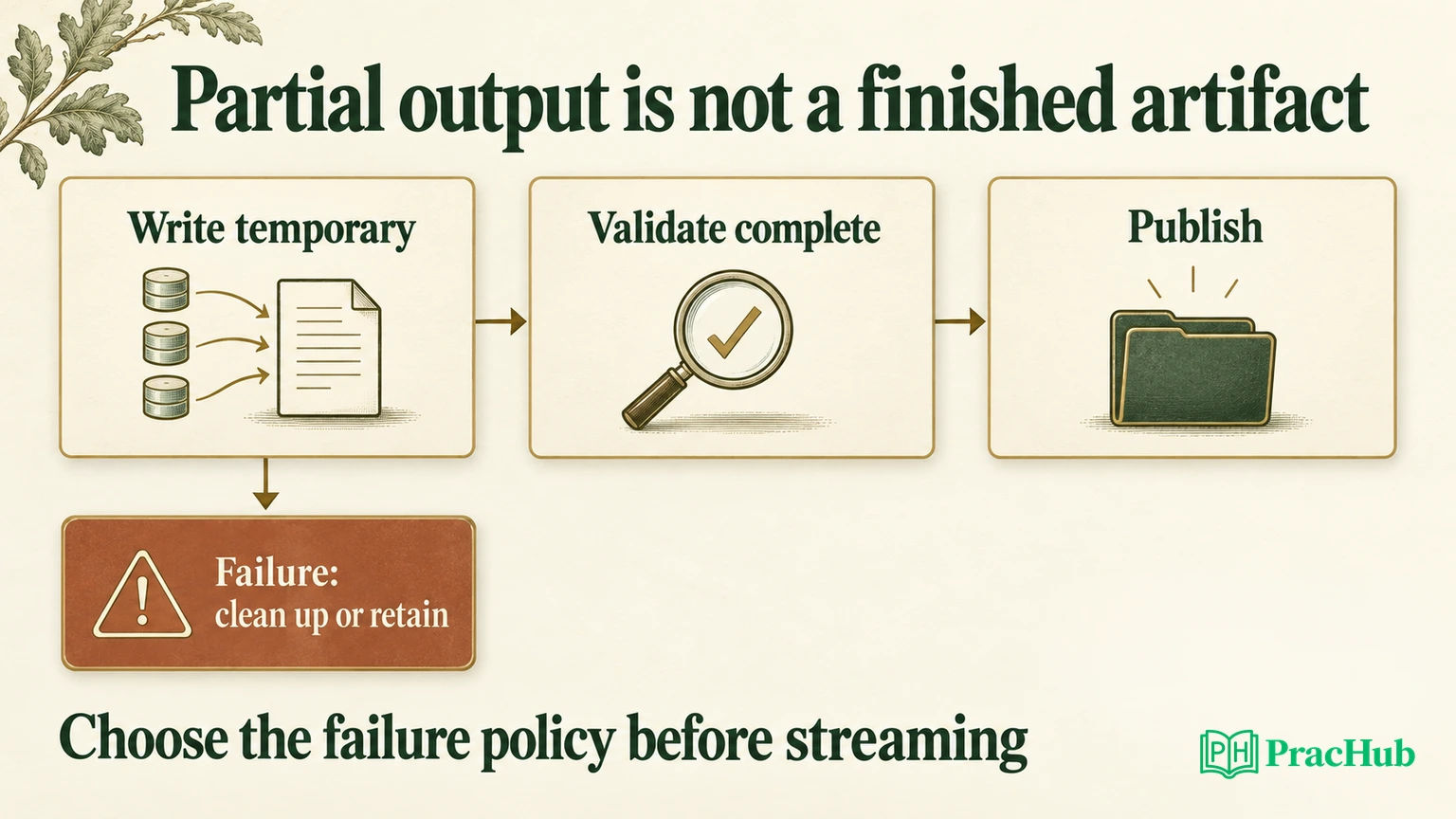
For an original export design, give one owner responsibility for the temporary artifact, cancellation signal, and final publication step. On failure, that owner records the error and applies the chosen cleanup policy. On success, it validates the complete result before making the artifact discoverable.
Be precise about the race between cancellation and publication. If the product requires “a canceled job is never published,” checking a boolean once at the beginning is insufficient. Serialize the final state transition or use a conditional update on the job record. That is a workflow guarantee above the stream abstraction.
How are low-level partial writes different?
A Writable's boolean return value is not a byte count. Lower-level file APIs expose a different contract: a write operation reports how many bytes it wrote. Official fact: the file-system API provides bytesWritten for file-handle writes and warns against overlapping writes without waiting for completion.
For a seekable file opened without append mode, this original helper advances both the buffer offset and the explicit file position:
async function writeAll(handle, buffer, position = 0) {
  let offset = 0;
  while (offset < buffer.length) {
    const { bytesWritten } = await handle.write(
      buffer,
      offset,
      buffer.length - offset,
      position + offset
    );
    if (!Number.isInteger(bytesWritten) ||
        bytesWritten <= 0 ||
        bytesWritten > buffer.length - offset) {
      throw new Error('invalid write progress');
    }
    offset += bytesWritten;
  }
}
The helper assumes exclusive ownership of that file region and a Buffer payload. The caller owns opening, closing, and error policy. It is not a generic socket writer or an append-mode concurrency solution.
Our fake file handle deliberately returns counts of two, one, and two for ABCDE, starting at file position 100:
| Call | Buffer offset | File position |
|---|---|---|
| 1 | 0 | 100 |
| 2 | 2 | 102 |
| 3 | 3 | 103 |
The reconstructed output is exactly ABCDE. A separate zero-progress fixture verifies that the helper throws instead of looping forever. These tests exercise offset accounting; they do not claim that the operating system produced a short write or a full-disk failure in this run.
A common broken version advances the source offset but keeps writing at position 100, overwriting earlier bytes. Another resubmits the whole buffer after every short write, duplicating its prefix. Trace the remaining range after each result rather than assuming one call means one complete payload.
When is a finished stream not a committed result?
There are several meanings of “done.” The source can have no more data, the destination can have processed its queued writes, and the application can have published the finished artifact. Those events belong to different contracts.
Official fact: the stream API distinguishes readable end, writable finish, and resource close. None is a generic acknowledgment that another application accepted the business operation. In HTTP, Node's response documentation likewise distinguishes handing response data to the operating system from proving that the client received it.
Consider a report endpoint that already sent a CSV header and 500 rows before its database cursor fails. A clean JSON error response is no longer interchangeable with the partially sent CSV. My recommendation is to decide up front whether this endpoint offers best-effort streaming or a complete downloadable artifact.
For the latter, write to a unique temporary file, await transfer completion, validate the expected format or checksum, and then publish through a controlled finalization step. A same-filesystem rename can be part of that design, but collision handling, platform behavior, and crash durability need explicit treatment. finish alone is not a disk-durability promise; the file-system documentation describes synchronization operations separately.
For a resumable transfer, track committed offsets or record identifiers and validate that the source version has not changed. Retrying from an arbitrary byte offset is unsafe if it splits a record, repeats an accepted operation, or resumes against different source contents.
Can a chunk be treated as one complete record?
No. Chunk boundaries are transport and buffering boundaries, not automatic message boundaries. A delimiter may span chunks, and one chunk may contain several records. That matters even when the bytes themselves arrive in the correct order.
Official fact: Node's StringDecoder preserves incomplete multibyte sequences between writes. Our UTF-8 fixture splits the three-byte euro character after its first byte: a decoder reconstructs the character, while decoding the two fragments independently does not.
Character decoding still does not solve framing. For an original newline-delimited parser, keep the unfinished trailing record between chunks, emit only complete records, and enforce a maximum retained record length. Otherwise, an input with no delimiter can grow the carry buffer indefinitely.
For a stop-token processor, retain only the suffix that could become a token prefix in the next chunk, subject to the chosen matching rules. Test the token split at every boundary, a near-match, and end-of-input with an unfinished match. The right algorithm follows the record contract, not the size of a network read.
What evidence makes a strong interview answer?
Name the failure you reproduced and the boundary your fix protects. In our six local tests, an eight-byte write exceeded a four-byte threshold without being duplicated; pipeline failure preserved prefix A; abort rejected and destroyed the controlled chain; short writes advanced correctly; zero progress failed; and split UTF-8 decoded correctly.
The fixtures are correctness checks, not throughput benchmarks or production durability tests. A realistic load test should add slow consumers, large records, transform expansion, and representative cancellation timing. Measure retained memory and active work alongside throughput, and confirm that partial artifacts follow the documented policy.
Use these verified PracHub questions to rehearse the corresponding decisions:
| PracHub question | Practice focus |
|---|---|
| Implement buffered file writer with concurrency support | Track accepted and committed bytes |
| Design a Large-File Upload and Analysis Flow | Own cancellation and publication |
| Design a Logger with Independent Handlers | Isolate slow destination policies |
| Extract stream prefix before stop token | Preserve cross-chunk matching state |
| Design log-query stream processor | Bound parsing and downstream work |
Finish with Design a Large-File Upload and Analysis Flow. Describe exactly when the user may trust the result, and what remains visible if the last chunk fails.
Comments (0)