Python Interview Questions for Software Engineers: Data Model, Iterators, Asyncio, and Performance
Quick Overview
Prepare for Python software engineering interviews with practical questions on the data model, identity and hashing, descriptors, iterators and generators, asyncio ownership and cancellation, the GIL, profiling, and performance trade-offs.
Python interview questions for software engineers test whether you can reason from language contracts, not whether you remember isolated syntax. Strong candidates explain how Python dispatches an operation, identify what is lazy or scheduled, separate portable behavior from CPython details, and measure performance before optimizing.
A reliable answer pattern is: state the protocol, trace one concrete example, name the edge case, then choose a verification method. This guide uses Python 3.14.7, the stable release at publication, while labeling version- and implementation-specific behavior. If an interviewer names PyPy, an older Python release, or a free-threaded CPython build, adjust the assumptions explicitly.
Use these Software Engineer fundamentals questions on PracHub to practice explaining those decisions aloud. PracHub question-bank records are practice material, not predictions of your exact interview.

What Python interviewers are actually testing
The Python data model is the set of object protocols that connects syntax and built-ins to behavior. For example, x == y, iter(x), and with x can invoke special methods such as __eq__, __iter__, and __enter__. Interviewers use these protocols to see whether you can predict behavior rather than recite method names.
| Area | Baseline knowledge | Strong interview signal |
|---|---|---|
| Data model | Identity, equality, hashing, attributes, context managers | Separates language rules from CPython implementation details |
| Iteration | Iterable, iterator, generator, laziness, exhaustion | Explains state, one-shot behavior, memory, and cleanup |
| Asyncio | Coroutine, Task, event loop, cancellation, backpressure | Defines ownership and failure behavior, not just async syntax |
| Performance | Complexity, allocation, profiling, benchmarking | Measures a representative workload before changing code |
Python data model interview questions
What is the difference between identity, equality, and hashing?
Identity asks whether two references point to the same object; is performs that test and cannot be overloaded. Equality asks whether values should compare the same and usually dispatches to __eq__. Hashing maps an object to an integer for hashed collections.
The key contract is: if x == y, then hash(x) == hash(y) must hold. Overriding __eq__ without a compatible __hash__ makes instances unhashable. A mutable value object should normally remain unhashable because changing equality-relevant state after insertion could leave a key in the wrong dictionary or set bucket. Use is for None, not for equal strings or numbers; object reuse and interning are not portable reasoning tools.
How does Python find a special method?
The language data model gives every object an identity, type, and value. Implicit operations generally look up special methods on that type. Assigning obj.__len__ = lambda: 5 does not reliably change len(obj) because special-method lookup may bypass the instance dictionary and instance __getattribute__.
Attribute access has a separate descriptor precedence. A data descriptor, such as a property, can override an instance-dictionary entry; a non-data descriptor can be shadowed. Functions are non-data descriptors, which is how retrieving a function through an instance creates a bound method. A strong answer connects the rule to property, methods, ORMs, validation fields, or cached attributes.
When should you use __new__, __init__, __slots__, or __del__?
__new__ creates the instance; __init__ initializes it. __new__ matters most for immutable subclasses or controlled construction. If it returns another type, Python does not call the requested class's __init__.
__slots__ can omit the normal instance dictionary and may reduce memory, but it restricts arbitrary attributes and weak references unless configured. Do not rely on __del__ for timely file or socket cleanup: finalization timing is not portable. Use a context manager for explicit ownership.
How does a context manager handle exceptions?
After __enter__ succeeds, __exit__ runs when the with block leaves, including during an exception. A truthy return from __exit__ suppresses the active exception; a falsey return lets it propagate. If __enter__ itself fails, __exit__ is not called. Multiple managers unwind in reverse order.
In an interview, name the invariant: acquire a resource, expose it only after successful setup, and release it exactly once. Async context managers apply the same ownership idea through awaitable __aenter__ and __aexit__ methods.
Iterable, iterator, and generator interview questions
What is the exact difference between an iterable and an iterator?
An iterable can produce an iterator through __iter__. An iterator represents a stream: it implements __next__, returns itself from __iter__, and keeps raising StopIteration after exhaustion. A list is reusable because each iter(list) call can create a fresh iterator; a file object or generator is usually consumed as it advances.
Python also retains an older fallback that repeatedly calls integer __getitem__ values until IndexError. That means isinstance(x, collections.abc.Iterable) can miss a valid legacy iterable. Calling iter(x) is the practical runtime test.
What happens when a generator function is called?
Calling it creates a generator object; the body does not run until iteration begins. Each yield suspends execution while preserving locals, instruction position, evaluation stack, and exception state. Resumption continues from that point. Python automatically supplies __iter__ and __next__, while send, throw, and close support two-way control and cleanup.
A generator is an iterator, but not every iterator is a generator. It is also one-shot. If two consumers need independent traversal, create two generators or materialize the values deliberately. Do not say generators are always faster: they often reduce eager allocation and peak memory, but per-item suspension and dispatch have a cost.
How would you implement a lazy transformation safely?
Start with the consumption contract. Decide whether the input may be infinite, whether results can be replayed, what happens on an upstream exception, and who closes the underlying resource. Then yield one result at a time without reading ahead unnecessarily.
For a lazy tee, the harder requirement is not producing values; it is buffering values consumed by the faster branch until every slower branch advances. Memory can grow with that lag. State that bound, define thread-safety expectations, and test interleaved consumption, exhaustion, early abandonment, and exceptions.
Asyncio interview questions
Coroutine, Task, or Future?
Calling an async def function creates a coroutine object. It does not run merely because it exists, and the same coroutine object cannot be awaited twice. Awaiting it drives its execution as part of the current task. An asyncio.Task schedules and owns a coroutine on the event loop; a Future is a lower-level awaitable representing a result that will arrive later.
Tasks are cooperatively scheduled: one task runs on an event-loop thread until it suspends. An await does not guarantee a useful yield if the awaited operation completes immediately. CPU-heavy work or blocking I/O on that thread can stall unrelated requests.
Why prefer TaskGroup for related work?
asyncio.TaskGroup gives child tasks a clear lifetime. Exiting its async with waits for all children. If one child fails with a non-cancellation exception, it cancels the remaining children and later raises failures as an exception group. That failure containment is stronger than default gather, which propagates the first exception without automatically cancelling every other awaitable.
The design question is ownership: which scope waits, which failure cancels siblings, and where exceptions are observed? Keep strong references to fire-and-forget tasks created outside a TaskGroup; the event loop holds only weak references.
How should cancellation and cleanup work?
Cancellation is a cooperative request, not a hard kill. Task.cancel() arranges for CancelledError to be raised at a later suspension point. Cleanup belongs in try/finally; if cancellation is caught, it should normally be re-raised after cleanup. Swallowing it can break TaskGroup and timeout behavior because both use cancellation internally.
For a server, also discuss backpressure and shutdown. After writing to a stream, await writer.drain() cooperates with transport high- and low-water marks. Bound queues, reject or shed excess work deliberately, stop accepting new work, cancel or drain owned tasks, and close transports with wait_closed().
Do Python threads run in parallel?
That question needs a runtime qualifier. In default GIL-enabled CPython, ordinarily only one thread executes Python bytecode at a time, although blocking I/O and many native extensions release the GIL. Threads can still fit I/O; processes or native code may fit CPU-bound work.
Python 3.14 officially supports an optional free-threaded CPython build, but it is not the default and extensions can re-enable the GIL. Free-threaded does not mean race-free. Protect shared mutable state explicitly; built-in-container locking is not a language-level atomicity guarantee.
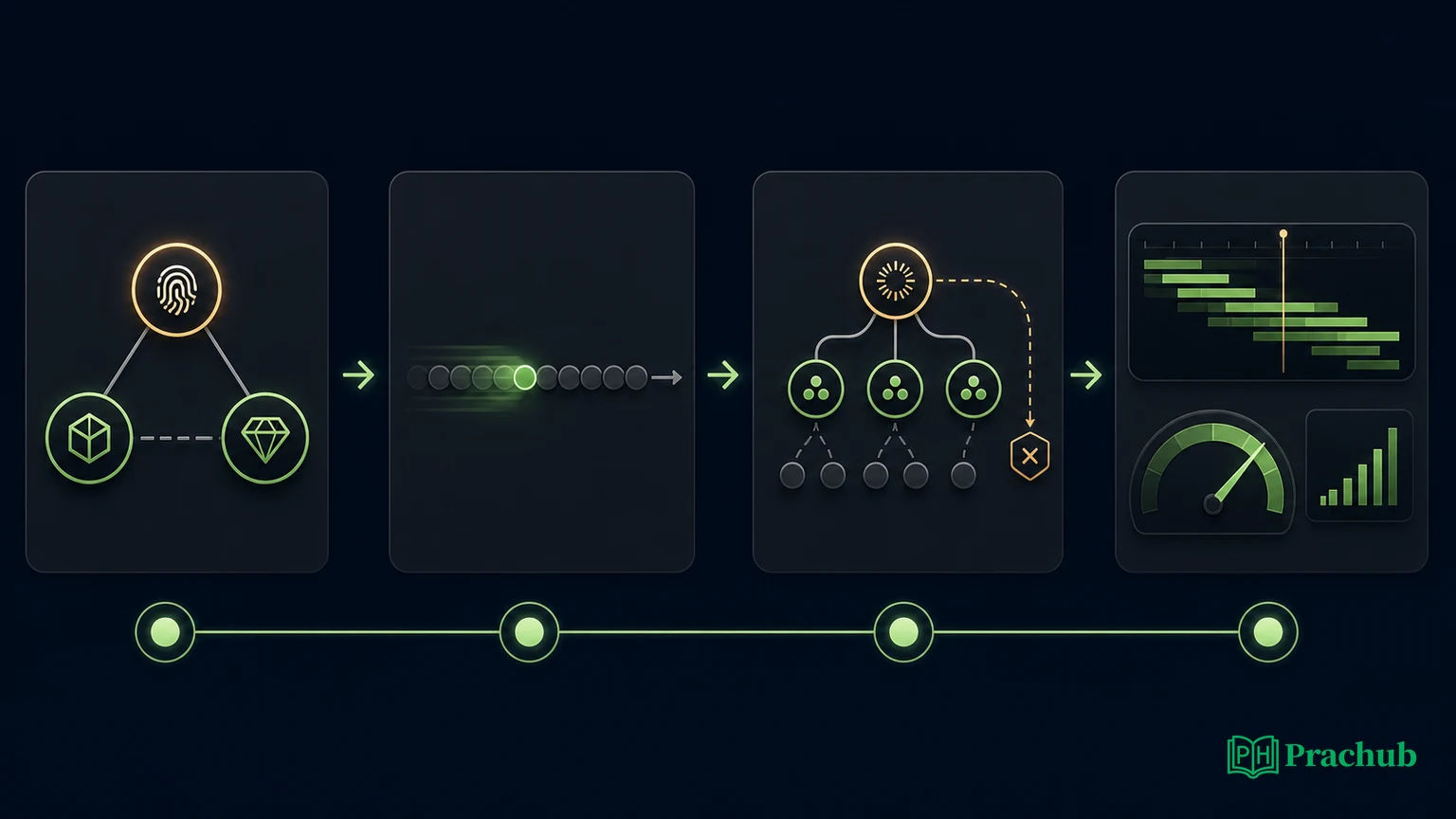
Python performance interview questions
How do you improve a slow Python service?
Confirm the symptom and representative workload. Check algorithmic complexity and data structures, then measure the real path. Use cProfile for function-level execution-time hotspots, tracemalloc for Python allocation tracebacks, and production traces for end-to-end latency.
After finding a hotspot, form one hypothesis and benchmark the smallest meaningful change. Consider batching, reducing allocation, streaming, caching with correct invalidation, or moving a measured kernel to an optimized library. Re-run correctness tests and the representative benchmark.
When should you use timeit?
timeit is for small controlled snippets. It uses a high-resolution timer and disables garbage collection by default, which can make repeats comparable but can also hide a material workload cost. Include realistic setup, repeat measurements, inspect noise, and re-enable GC when the code's allocation behavior matters.
cProfile answers “where does call time accumulate?”; timeit answers “under controlled conditions, how long does this small operation take?” Profiling perturbs execution, so do not turn profiler output into benchmark claims.
Which performance claims should you qualify?
Avoid absolutes such as “dictionary lookup is always O(1),” “generators are faster,” or “__slots__ improves speed.” Complexity depends on assumptions; collisions, allocation, data shape, interpreter, build, and platform all matter.
A strong Python interview answer framework
| Step | What to say | Example |
|---|---|---|
| Contract | State the portable rule | “Equal objects must have equal hashes.” |
| Execution | Trace one concrete path | “iter(x) returns an iterator; next() advances it.” |
| Boundary | Name version, runtime, or failure assumptions | “This GIL statement is about default CPython.” |
| Evidence | Explain how you would verify | “Profile the service, then benchmark the measured hotspot.” |
Use a tiny example when the question is abstract. Then cover exhaustion, exceptions, cancellation, shared mutation, or cleanup as appropriate. This shows judgment without burying the answer in trivia.
Practice these Python questions on PracHub
| Practice question | What to focus on |
|---|---|
| Python Language and Runtime Fundamentals | Hashing, generators, context managers, and resource ownership |
| Implement a Lazy Tee Iterator in Python | Iterator contracts, buffering, lag, exhaustion, and cleanup |
| Implement an asyncio-based chat server | Tasks, backpressure, cancellation, and graceful shutdown |
| Explain CPU-Bound vs I/O-Bound Work | Threads, processes, async I/O, the GIL, and workload shape |
| Explain Python internals and practices | Internals, generators, context managers, profiling, and trade-offs |
A seven-day preparation plan
- Day 1: Explain identity, equality, hashing, mutability, and
NotImplemented. - Day 2: Trace descriptors, bound methods, construction, and context managers.
- Day 3: Implement an iterator and generator; test exhaustion and early close.
- Day 4: Build a small asyncio service with bounded work and graceful shutdown.
- Day 5: Compare threads, processes, async I/O, and free-threaded CPython.
- Day 6: Profile one program and benchmark one evidence-backed change.
- Day 7: Run a mock using the contract, trace, boundary, evidence pattern.
Common mistakes to avoid
- Explaining
iswith small-integer caching instead of the identity contract. - Claiming an average dictionary operation or generator memory benefit is unconditional.
- Creating coroutine objects without awaiting or scheduling them.
- Catching
CancelledErrorand continuing as though cancellation never happened. - Blocking the event-loop thread with CPU work or synchronous I/O.
- Assuming the GIL protects multi-step invariants or that free-threading removes races.
- Optimizing bytecode tricks before measuring algorithms, I/O, allocation, and data shape.
Frequently asked questions
How deep should Python data model knowledge go for a software engineer interview?
Know the protocols that explain everyday behavior: identity, equality and hashing, attribute access and descriptors, iteration, context managers, object construction, and resource lifetime. Go deeper into metaclasses or bytecode only when the role or interviewer asks for runtime internals.
Are generators always more memory-efficient than lists?
Generators often lower peak memory when values can be consumed incrementally, but retained upstream state, buffering such as tee, or eventual materialization can erase that advantage. Define the consumption pattern and measure the actual workload.
Is asyncio multithreading?
No. Asyncio normally multiplexes cooperatively scheduled tasks on an event-loop thread. It can delegate work to threads or processes, but async/await itself does not imply multiple OS threads or parallel CPU execution.
Should I discuss the GIL in every Python concurrency answer?
Only when it affects the workload. State the runtime and build first. For default CPython, explain bytecode serialization, I/O releases, and native-extension behavior. Also mention that optional free-threaded builds change the parallelism model but do not remove synchronization requirements.
What is the best way to answer a Python performance question?
Define the metric and representative workload, analyze complexity, profile to find the real bottleneck, change one thing, benchmark it, and recheck correctness plus end-to-end behavior. That sequence is more credible than listing micro-optimizations.
Final takeaway
The strongest Python interview answers connect syntax to protocols and protocols to engineering consequences. Explain the portable contract first, label CPython or version-specific behavior, make task and resource ownership explicit, and support performance claims with evidence. Practice that reasoning aloud until data model, iterator, asyncio, and performance questions become variations of the same method.
Sources and Further Reading
- Python 3.14.7 release
- Python data model
- Python expressions: identity, comparisons, generators, and await
- Python iterator types
- Python collection abstract base classes
- Python
withstatement - Asyncio coroutines, Tasks, cancellation, and TaskGroup
- Asyncio streams and flow control
- Python free-threading HOWTO
- Python threading documentation
- Python profilers
- Python
timeit - Python
tracemalloc
Comments (0)