Quant Practice Review: Arithmetic, Market Making, and Probability Drills
Quick Overview
Review the specific Quant Practice app, its accepted guest warm-up, public grid-path hint and login-gated suite. An original six-path enumeration distinguishes uniform complete paths from equal legal moves, while a three-mode matrix defines untested market and tracking checks.
Quant Practice provides a working guest arithmetic warm-up and publicly readable probability statements and hints. Its full practice-suite entry required Google sign-in in our check. Sample the public surfaces, then verify timed drills, market execution and tracked submissions separately.
PracHub publishes this review and owns the complementary practice links. Our constrained grid-path question supplies an independent task. The six-path sampling comparison below is original educational work, separate from Quant Practice’s question bank, solutions or judge.
Confirm the exact product before comparing features
Provider description, checked November 3, 2026: Quant Practice describes three areas: mental arithmetic, market-making and probability/statistics. Its homepage links to the public Starkl7 repository and an author portfolio. This review concerns that specific hosted app, rather than the broad category of quant practice tools.
The page positions the material as preparation for quantitative-trading interviews and refers to published preparation material. We did not verify a current employer’s assessment against the drills or establish question-level interview provenance. No independent candidate-outcome evidence supports an effectiveness claim here.
Our observations cover the guest warm-up, the practice-suite login boundary and one public probability item with a revealed hint. We did not create an account, purchase access or complete a tracked assessment.
The homepage warm-up accepted one arithmetic answer
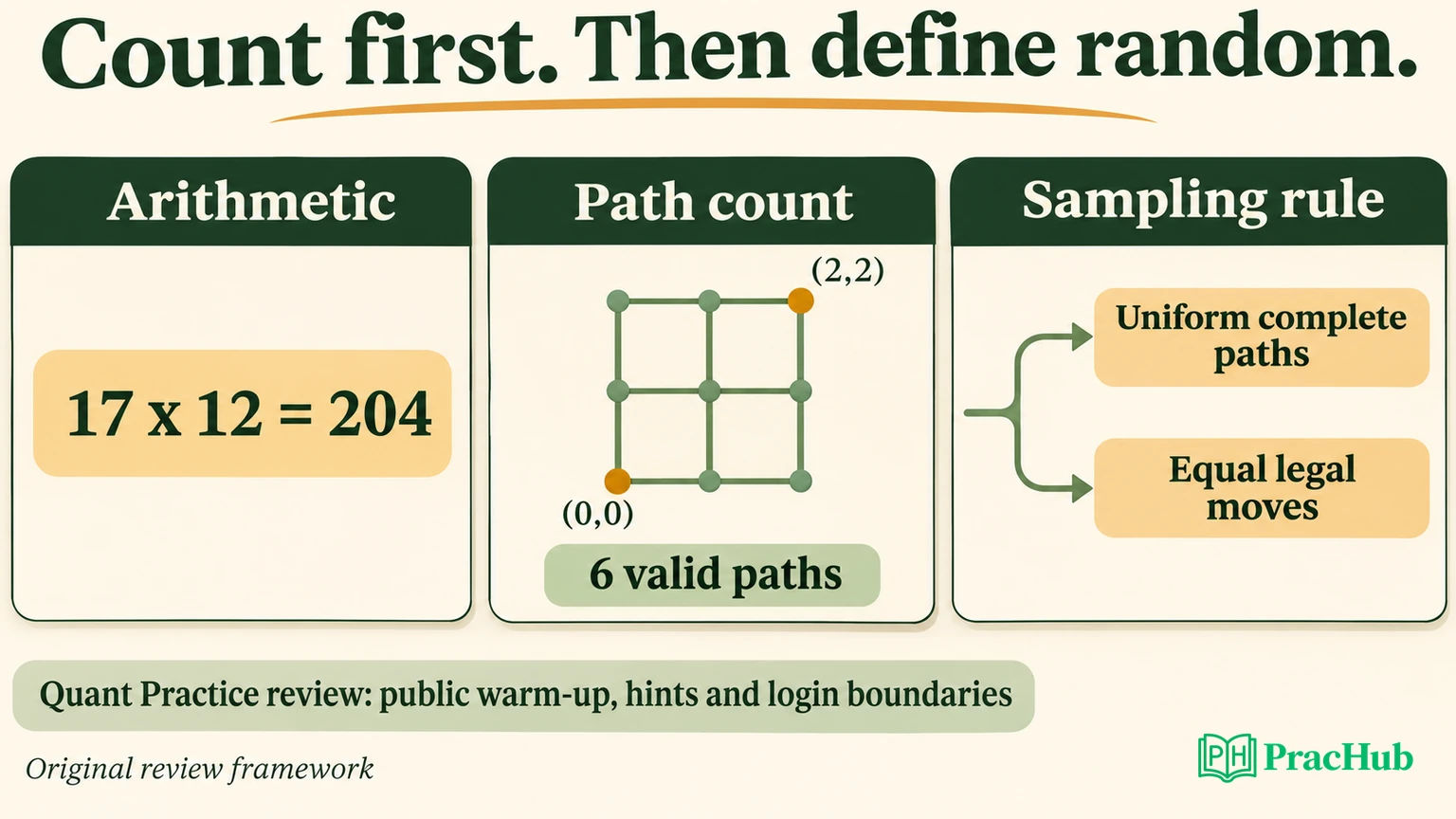
Direct observation: the homepage displayed seventeen multiplied by twelve in a warm-up input. We entered 204. The interface advanced to another expression and increased its current and best streak to one. We did not answer the next item or run a timed arithmetic session.
The changed problem and streak establish acceptance of this guest answer. It does not establish the full generator’s difficulty, arithmetic coverage or scoring accuracy. The visible auto-advance instruction is consistent with the change we saw, but one accepted answer is still one case.
A useful independent method is seventeen times ten plus seventeen times two, giving 170 plus 34. That explanation can be checked without a calculator. The warm-up’s acceptance does not itself reveal whether the learner used that method, guessed or read an external answer.
In a trial, explain how you produced the number. If the target interview requires typed arithmetic under a clock, the visible homepage warm-up is an incomplete test of that environment. If it requires verbal reasoning, a streak alone supplies even less evidence.
The main suite and public bank have different permissions
Selecting Start Practicing led to a login page offering Google sign-in. We stopped before authentication. We did not execute the full mental-math drill, a market-making round or account-side score tracking.
The public Problems page remained readable. It displayed a count of 486 worked problems and categorized entries. We did not audit that total or open the complete bank. The listing said sign-in was needed for submissions and progress.
We opened the first grid-path item. Its statement and source label were visible without an account. Selecting Show Hint exposed a short hint about the number of moves. The page still directed us to sign in to submit and track an answer.
We did not see or grade a full solution in that check. Do not expand the presence of a hint or a worked-problem count into a claim that we tested every solution or the answer parser.
| Surface | What worked in our guest session | What remains untested |
|---|---|---|
| Homepage warm-up | One correct input advanced the problem and streak | Full generated set and timing |
| Probability list | Titles, categories and source context visible | Complete catalog audit |
| Sample detail | Statement and one hint opened | Graded submission and full solution |
| Main practice suite | Entry led to Google sign-in | Arithmetic and market execution |
| Saved statistics | Persistence described publicly | Account history and percentile calculation |
Read coordinates before relying on a board label
The sampled problem’s coordinates ran from zero to six on each axis. That defines six moves in each permitted direction, rather than a route across six points with only five intervals. The hint referred to twelve total moves.
The explicit coordinates resolve how to read the board dimensions. Board dimensions can describe cells, points or coordinate limits. Use the explicit start, destination and move rules to determine the displacement before selecting a formula.
We did not submit a solution to that item. The smaller example below changes the coordinates and adds a probability question. It illustrates how counting and random generation can diverge even after the legal paths are fully specified.
Original example: six valid routes from zero to two
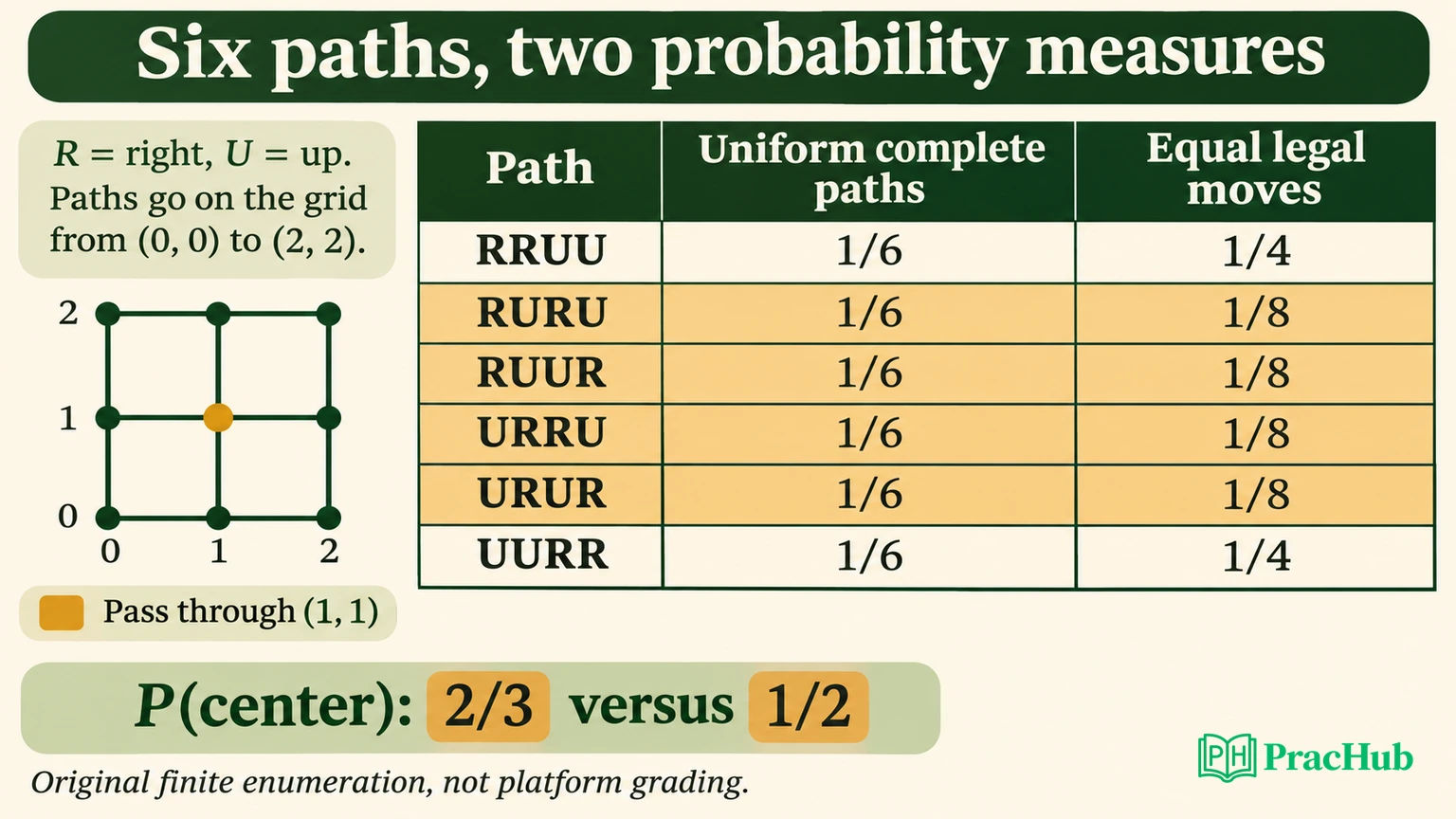
Our invented grid starts at (0, 0), ends at (2, 2) and allows only right or up moves. Each complete path has exactly two R moves and two U moves. There are six distinct sequences, found by choosing the two positions occupied by R in a four-move sequence.
Four paths pass through the center point (1, 1): RURU, RUUR, URRU and URUR. RRUU and UURR avoid it. If a complete path is chosen uniformly from the six sequences, the probability of visiting the center is four out of six, or two thirds.
Now define another generator. At each point, choose equally among the legal next moves. When only one direction remains legal, take that forced move. This generator reaches the same destination using the same six possible paths, but the probabilities are different.
RRUU has probability one quarter: choose R twice, then both U moves are forced. Each center-visiting path has probability one eighth because it requires three non-forced choices. UURR also has probability one quarter. The probabilities sum to one.
| Path | Uniform complete-path probability | Equal-legal-move probability |
|---|---|---|
| RRUU | 1/6 | 1/4 |
| RURU | 1/6 | 1/8 |
| RUUR | 1/6 | 1/8 |
| URRU | 1/6 | 1/8 |
| URUR | 1/6 | 1/8 |
| UURR | 1/6 | 1/4 |
Under the second generator, the center probability is four times one eighth, or one half. Both generators allow the same six paths. What changed was the probability assigned to each path.
We enumerated the paths and multiplied the local choice probabilities with exact-fraction Python arithmetic. Checks confirmed six paths, normalized distributions and the two center probabilities. No Quant Practice submission, random simulation or platform scoring was involved.
Why equally likely moves do not imply equally likely paths
A complete path’s probability is the product of its conditional move probabilities. Paths encounter different numbers of two-choice states before reaching a boundary. Forced moves contribute a factor of one, while a two-way choice contributes one half.
The edge-following RRUU path has fewer uncertain choices than a route that alternates through the center. Giving every local choice equal weight therefore favors some complete paths. A count divided by six is valid only after establishing that the six paths themselves are equally likely.
This is a common point where a correct combinatorial count can be attached to an incorrect probability model. The numerator may count the desired paths correctly and the denominator may count all paths correctly, while the ratio still answers the wrong sampling question.
Name the random object before calculating its probability. Are we sampling a complete sequence uniformly, choosing a direction at each legal step or using another rule? The answer determines how paths should be weighted.
The distinction also helps you evaluate a worked solution. Ask which sampling measure its argument uses and whether the statement supplies it. We did not identify a probability-model error in the sampled Quant Practice counting item; our added probability question is original.
Change the model before changing the arithmetic
Suppose a new rule chooses right with probability three quarters whenever both directions remain legal. The path set is unchanged, but the local probabilities change again. Counting alone cannot establish the new center probability; each route needs its corresponding weight.
Or suppose a random complete sequence with two R and two U moves is generated before the walk starts. That can implement the uniform complete-path model if the generator samples those sequences uniformly. It is a different mechanism from choosing each legal direction independently along the way.
A small enumeration is useful because it exposes these distinctions without a large formula. Write out the paths, mark the decision points and check that their probabilities sum to one. If they do not, inspect missing routes, double counting or incorrectly treated forced moves.
For a future probability-bank trial, use this as an answer-review method. A final number that matches an answer key is useful, but an explanation of the sampling measure tells you whether the method transfers when the rule changes.
The public repository explains intent, not live verification
The linked repository README describes an inventory-aware simulator, configurable drills and a probability bank with submission checking and statistics. It also describes the bank as curated, with original wording and numerical verification. We treated those as maintainer statements, not an independent audit.
The README distinguishes the code license from problem content stored outside the repository. Public code availability does not establish permission to repackage the bank. We did not copy the bank, install the app, run vendor code or inspect private data.
Nor did we establish that the repository’s current revision exactly matches the deployed app. Its descriptions help identify questions for a trial; they do not replace an observed live result. We did not validate server-side answer checking, supported expressions, saved history or security controls.
This boundary matters when a product is small and evolving. A roadmap or implementation note can be useful context while remaining distinct from current account-side behavior. Use the reached route to distinguish observed behavior from README descriptions.
An independent three-mode acceptance check
Use this original matrix to choose a bounded trial. It is not Quant Practice’s internal rubric. Each row asks for evidence relevant to a different task, rather than a shared score across unlike modes.
| Mode | Small trial task | Evidence to inspect |
|---|---|---|
| Mental arithmetic | Explain a product, then change its scale or sign | Correct result and method, under the intended timing |
| Probability | Count paths, then change their sampling rule | Normalized weights and a revised probability |
| Market-making | Identify the buy/sell convention before quoting | Input rules, actual fills and reconcilable position |
We tested only the guest arithmetic item and the public probability reading/hint path. We did not run the market-making row. Its presence in the matrix defines a future test, not a claim about a completed game.
Saved scores introduce another requirement: confirm what a completed attempt counts, what the profile retains and which users form a percentile comparison. We did not authenticate or inspect that account-side evidence. A public streak on the homepage is not a verified longitudinal record.
When reviewing progress, preserve the original error alongside the correction. In the path example, confusing a point count with a displacement calls for a reading check. Confusing uniform paths with uniform moves calls for a model check. More rapid arithmetic alone does not repair either issue.
Practice the gaps the product leaves open
These independent PracHub questions extend counting and sampling. They are not Quant Practice bank entries, judge rules or verified employer assessments.
| PracHub question | What to examine |
|---|---|
| Count Grid Paths with No Three Equal Moves | Define the legal move sequences before counting them. |
| Solve Grid Path and Graph Sampling | Separate a graph-sampling rule from the set of valid paths. |
| Prove Equal Probability Impossible with Relabeled Dice Faces | Check whether the proposed outcomes can actually have equal probabilities. |
| Compute bus-on-time and dice-sum probabilities | Specify the sampling process and denominator before computing. |
| Analyze distribution of a 3-dice product | Derive the distribution rather than assuming equally likely products. |
Who should inspect Quant Practice next
Quant Practice is worth sampling if you want a small, publicly inspectable quant-preparation app with a working arithmetic warm-up and readable probability material. The observed login boundary separates those surfaces from full drills and tracked submissions. Market execution, parser quality and account statistics remain untested here.
Try the constrained path prompt, define the legal sequences and explain whether you are counting or sampling. Then change the random-generation rule. That gives you a concrete test of reasoning transfer before relying on a streak, accepted answer or advertised catalog size.
Comments (0)