Quantm Review: Mental Math Progression, Desk Drills, and Practice Limits
Quick Overview
Review Quantm’s guest warm-up, fixed trading preview, observed missed-premium explanation and pass-versus-monthly access. An original expiry-only call matrix checks payoff, premium, direction and units without claiming a full simulation, paid curriculum or hiring result.
Quantm offers an observable progression from a free arithmetic warm-up to a fixed sample of trading questions. In our guest trial, its review correctly distinguished a call’s expiry payoff from profit after the premium. The feedback identifies the omission in this deliberately incomplete answer. It does not establish the depth of all paid categories or the validity of a readiness label.
PracHub publishes this review and owns the complementary practice links. Our options-and-pricing question offers an independent explanation task. The unit-and-sign matrix below is original educational work, not a Quantm result or a recommendation to trade.
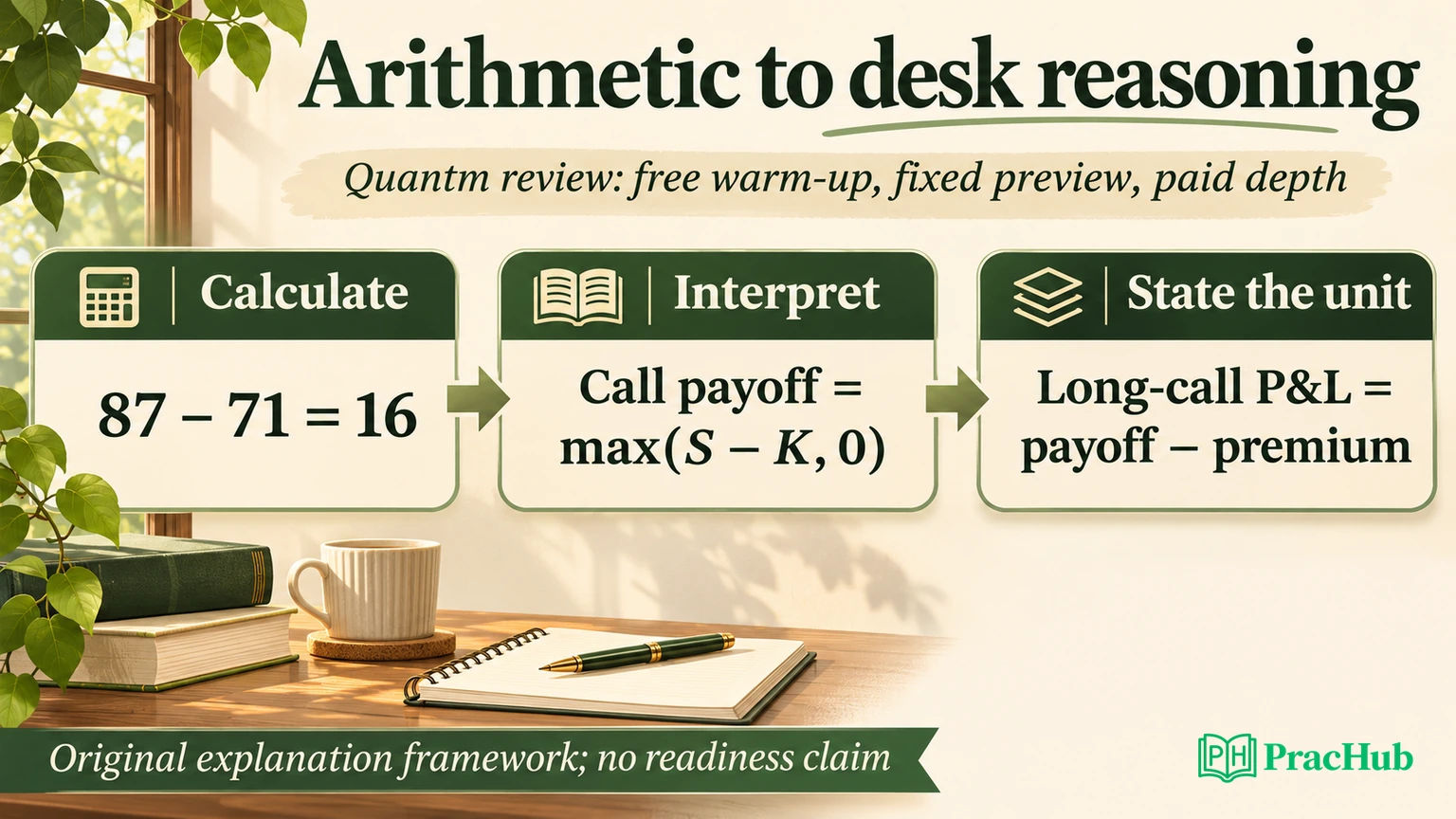
What the advertised progression includes
Provider description, checked November 3, 2026: Quantm positions itself as mental arithmetic followed by reasoning and trading-desk preparation. It advertises thirty-one categories and generated questions, including probability and options. We did not audit that category count or the generated collection.
The Drills directory provides an ordered path, individual categories, practice formats and assessment simulations. Free links and PAID labels appear within that directory. Its eight-step arrangement is a provider study path, not a verified sequence of rounds at every trading employer.
We inspected public routes, answered one homepage arithmetic item and deliberately submitted one wrong answer in the free trading preview. We did not create an account, buy access, complete a simulation or test cross-session analytics. No independent candidate-outcome evidence supports a hiring-success claim here.
The homepage warm-up accepted a guest answer
Direct observation: the homepage showed eighty-seven minus seventy-one. We entered sixteen and submitted. The display advanced, counted one correct answer and added one point. The warm-up described one minute with no wrong-answer penalty.
We did not complete that minute or measure a person’s speed. Browser-automation timing is not a calibrated mental-math result. The observation establishes that this guest input was accepted and the next item appeared, rather than a full performance assessment.
A simple method is to subtract seventy, then one. That gives seventeen minus one, or sixteen. Explaining the operation is different from producing the accepted number. Carry the same habit into the next stage: identify what the calculation means.
The directory listed six free categories, including integer and decimal arithmetic, fractions, percentages and squares/roots. We did not execute each category or test every free allowance. The homepage’s broad thirty-one-category description should not be read as thirty-one categories verified free in our session.
The fixed trading preview exposed a specific error
The free trading preview described six fixed questions, no timer, no wrong-answer penalty and permitted skipping. We started it and answered only the first item before ending early. A fixed sample is different from the advertised generated paid collection.
The first item described paying a premium of 5.36 for a call with strike 110, with the underlying at 125 at expiry. It asked for P&L per unit. We deliberately entered fifteen, which is the positive expiry payoff before subtracting the premium.
The interface counted the answer wrong and showed 9.64 as the expected answer. After ending early and selecting Review them, we could inspect our answer beside the explanation: expiry value was fifteen, then the premium reduced P&L to 9.64.
The observed review identified the missing premium. It identifies the omitted cash flow, not just a mismatch with an answer key. We did not answer the remaining five questions, complete the preview or compare feedback across multiple attempts. The recorded timing and zero score are not measures of a candidate’s ability.
The result also has a narrow scope. It tests one basic expiry calculation, not dynamic option pricing, exercise mechanics or a live trading decision. We made no actual financial transaction and submitted no account or portfolio information.
Original unit-and-sign check: the same call, opposite positions
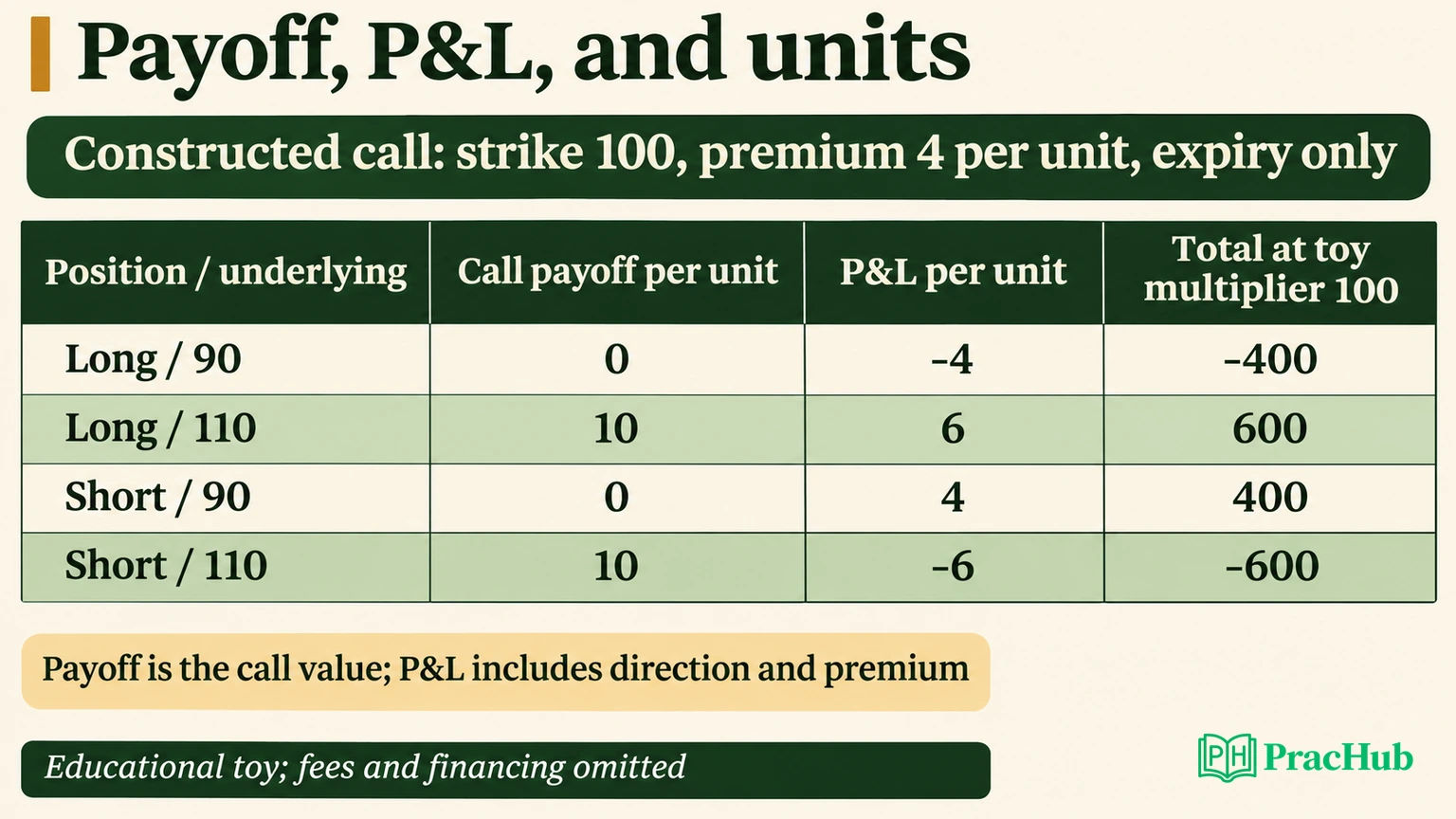
To test whether that correction transfers, use our invented call contract with strike one hundred and premium four per unit. Assume expiry values only, ignore fees and financing, and use a toy multiplier of one hundred units per contract. The multiplier is supplied for this exercise, not a universal exchange specification.
The long call’s expiry payoff per unit is the larger of the underlying value minus the strike and zero. Its P&L subtracts the premium paid. For the corresponding short position under these simplified assumptions, the premium is received and the payoff is owed, reversing the P&L sign.
The Options Industry Council’s long-call reference explains the premium-based loss and expiry breakeven. We use that primary reference for the basic distinction, not as a recommendation or a validation of Quantm’s full curriculum.
| Constructed position and expiry value | Call payoff per unit | P&L per unit | P&L with toy multiplier 100 |
|---|---|---|---|
| Long, underlying 90 | 0 | −4 | −400 |
| Long, underlying 110 | 10 | 6 | 600 |
| Short, underlying 90 | 0 | 4 | 400 |
| Short, underlying 110 | 10 | −6 | −600 |
The payoff column describes the call’s nonnegative expiry value. It is not the short position’s signed payment or either side’s profit. The P&L columns incorporate direction and premium. Name the quantity before interpreting a positive payoff as profit.
We checked the four rows with exact-fraction Python calculations, including the multiplier and the opposite signs. We also checked the sampled preview’s arithmetic independently. No model of market prices, Greeks, exercise, margin or execution was run.
A changed number should trigger a changed explanation
If the premium in our toy rises from four to six while the expiry value remains 110, the long position’s P&L per unit falls from six to four. The payoff remains ten. This isolates the difference between changing the instrument’s expiry value and changing what was paid for it.
If the multiplier changes instead, per-unit payoff and P&L stay the same while the total changes. If the position changes from long to short, the signed cash flows change. Changing premium, multiplier or position has a distinct consequence.
Before expiry, the simple intrinsic-value calculation is not a complete option valuation. State the time at which a question asks for value or P&L. A correct expiry formula does not automatically answer a mark-to-market question while time remains.
These are educational interpretation checks, not position-sizing or investment guidance. The original matrix intentionally leaves real-world fees, financing and product-specific procedures outside its scope. Its purpose is to make a candidate’s unit, sign and time assumptions explicit.
Use the path to diagnose what needs to change
A progression from arithmetic to desk questions is useful when each step adds a distinct reasoning requirement. Our observed subtraction asks for a number. The sampled call question requires interpreting that number as payoff or P&L. The original matrix adds direction and units.
Use the following independent map to review an answer. It is our practice framework, not Quantm’s internal grading rubric or evidence that every listed skill has been tested in the product.
| Stage | Error to look for | Evidence of repair |
|---|---|---|
| Arithmetic | Incorrect operation or decimal placement | Recomputed result with a clear method |
| Quantity | Reporting payoff when asked for P&L | Premium included exactly once |
| Direction | Treating long and short identically | Cash-flow signs stated and reconciled |
| Units | Mixing per-unit and contract totals | Explicit multiplier with consistent totals |
| Timing | Using expiry value before expiry | Stated valuation time and relevant assumptions |
Use the corrected explanation to identify which row improved. Preserve the original answer and the missed condition. Then change one input and explain the consequence without reusing a memorized result. We did not test retention or compare Quantm against a controlled alternative.
The free review we saw supports one part of this map: it exposed the missing premium. It does not establish that the platform diagnoses every unit, direction or timing error. Those are concrete questions for a broader trial.
Practice formats and simulation labels need separate evidence
The Drills page distinguishes its own practice formats from assessment simulations. Some simulation cards used reported or corroborated labels. We did not inspect the underlying candidate accounts or verify that any format matches the owner’s current invitation.
The directory also used a pass-line and readiness claim for a full run. We did not complete it, inspect calibration or establish that crossing a threshold eliminates preparation gaps. Treat that language as provider positioning, not a validated hiring prediction.
Different penalty rules change what a score means. The sampled warm-up had no penalty, while the directory described negative marking in other modes. We did not execute those modes or test skipping and backtracking rules. Read the actual instructions for the drill you choose.
For an employer assessment, the invitation remains the source for timing, tools, navigation and scoring rules. A practice product can approximate a format without establishing the current rules for every employer, location or role.
Passes and monthly access are different commitments
The current pricing page displayed a fourteen-day Interview Pass for $12 and a ninety-day Recruiting Season pass for $29. It described these as one-time payments with access ending after the stated window. We did not buy or test expiration.
A separate $15 monthly option described ongoing billing and cancellation. Do not transfer the fixed-pass nonrenewal description to that subscription. The page identified Polar as merchant of record; we did not inspect checkout taxes, payment details, cancellation or refunds.
Pro descriptions included advanced categories, simulations, inline methods and analytics. The guest review exposed one missed-answer explanation, while the paid offer described broader method access. We did not activate those entitlements or compare their enforcement with the marketing descriptions.
| Displayed option | Described window or billing | Check before choosing |
|---|---|---|
| Free | Guest arithmetic and visible samples | Whether the relevant skill is reachable |
| Interview Pass | $12 for fourteen days | Exact start and expiry of access |
| Recruiting Season | $29 for ninety days | Needed preparation window |
| Monthly | $15 with ongoing billing | Renewal and cancellation terms |
The review screen offered free sign-in to save the result and compare later sessions. We did not sign in or test saved history. A visible score on one device is not evidence that account analytics or longitudinal comparisons work as described.
Practice the gaps the product leaves open
These independent PracHub questions extend the interpretation and unit checks. They are not Quantm preview questions, simulation rules or evidence of a current employer assessment.
| PracHub question | What to examine |
|---|---|
| Explain Option Greeks and Futures Pricing | Separate expiry payoff, premium, sensitivity and the time being measured. |
| Estimate Greeks and hedging PnL | Keep units and sign conventions explicit before discussing a P&L number. |
| Explain derivatives, YTM, and core statistics | Connect a financial definition to the quantity the question asks for. |
| Quant Trading Game: Expected-Value Betting and Market Making on Coins, Dice, and Cards | State the contract, information and objective before choosing an action. |
| Four Fair Coins: Expected Payoff and Pricing Two Magic Wands | Derive the payoff distribution before describing a fair value. |
Who should try Quantm next
Quantm is worth a bounded guest trial if you want arithmetic followed by desk-oriented interpretation. We observed a correct arithmetic acceptance and a specific premium correction in a single fixed-preview item. Paid category depth, simulation fidelity and progress analytics remain unverified.
Try the options-and-pricing prompt and state the time, position, premium and unit before computing. Rebuild the original matrix after changing one input. Inspect the free explanation style, then compare a paid window with the capability and access you have verified.
Comments (0)