Qube Research & Technologies Quantitative Research Internship 2027: Coding, Statistics, and Timeline
Quick Overview
Prepare for the Qube Research & Technologies Quantitative Research Internship 2027 with evidence-aware coding, statistics, research, interview, and timeline guidance.
If you are preparing for the Qube Research & Technologies (QRT) Quantitative Research Internship 2027, the current public listing gives you a useful role blueprint but not a fixed online assessment script. The official 2027 Internship/Graduate - Quantitative Research/Trading listing covers a 3-6 month programme starting in 2027 in Hong Kong, Singapore, Shanghai, and Beijing. It is aimed at penultimate- and final-year Bachelor's, Master's, and PhD students, with applications reviewed on a rolling basis. QRT says shortlisted candidates may interview on-site or through Microsoft Teams.
That means your preparation should connect coding, statistics, research judgment, and a clear project story. A HackerRank test, a question count, a score cutoff, and a universal round sequence are not confirmed by the listing. Start with PracHub's quantitative interview questions, then use the evidence map below to decide which skills need the most work.

Quick answer: what is confirmed for 2027?
The strongest source is QRT's live Greenhouse listing. It describes the role, candidate profile, location choices, and a high-level interview step. It does not publish a vendor, timer, cutoff, or guaranteed response time.
| Evidence level | What it tells you | How to use it |
|---|---|---|
| Official 2027 listing | 3-6 months starting in 2027; Hong Kong, Singapore, Shanghai, and Beijing; penultimate or final-year Bachelor's, Master's, or PhD candidates. | Check location, eligibility, start date, and availability before you optimise interview drills. |
| Official role scope | Research interns develop predictive signals from large datasets; trading interns monitor signal behaviour, performance, execution efficiency, and risk. | Prepare a complete research loop: hypothesis, data, model, validation, and production decision. |
| Official skills | Quantitative degree; Python plus C++ or C#; statistics, ML, NLP, or AI are helpful; large-dataset experience and communication matter. | Make your CV and answers prove these skills with one or two defensible projects. |
| Official process | Applications are reviewed on a rolling basis; interviews are on-site or via Microsoft Teams and assess technical expertise plus culture and values. | Apply early, keep your calendar flexible, and ask the recruiter what the next stage will test. |
| Not publicly fixed | OA provider, question count, timer, cutoff, proctoring, round count, and exact decision SLA. | Treat your invitation as the source of truth rather than copying a different QRT report. |
One location nuance matters. QRT's own London Students and New Grads page currently says there are no jobs in the Research area, while the Greenhouse 2027 listing names four Asia-Pacific locations. Do not assume that a listing for one office applies to every QRT office or team.
What the internship may involve
QRT describes itself as a global quantitative and systematic investment manager combining data, research, technology, and trading. Its public About page says research teams include engineers, physicists, mathematicians, data scientists, and analysts. The 2027 listing separates the intern contribution into two complementary areas.
| Track in the official listing | Work described by QRT | Interview implication |
|---|---|---|
| Research | Use large, diverse datasets to find statistical patterns, refine methods with researchers, and move from idea to implementation. | Explain why a signal might work, how you tested it, and what would make you stop trusting it. |
| Trading | Monitor signal behaviour and performance, improve execution efficiency, and help manage risk on the systematic platform. | Connect model output to live constraints, monitoring, costs, and failure responses. |
The overlap is the point: show both mathematical reasoning and reliable implementation. A model that cannot be explained, tested, or challenged is not finished research.
Timeline: rolling applications do not mean instant decisions
The form and listing provide a sequence, but not a public calendar. Replace each unknown with the instruction in your invitation.
| Step | Public evidence | Your action | Still unknown |
|---|---|---|---|
| 1. Location and track | The 2027 listing names Hong Kong, Singapore, Shanghai, and Beijing and asks for a preferred location. | Decide whether your story fits research, trading, or both; prepare a work-authorisation answer. | Local eligibility, sponsorship, and team capacity. |
| 2. Apply online | Applications are reviewed on a rolling basis. The form asks for an 80-100 word asset-class or strategy answer. | Link an asset class to a research question, data source, and validation plan. | Review time and screening rubric. |
| 3. Interview | Shortlisted candidates interview on-site or through Microsoft Teams for technical expertise and culture fit. | Prepare statistics, coding, projects, and Why QRT. | Number, order, length, and interviewer roles. |
| 4. Decision | No official response-time promise is published. | Keep your application record and follow up once the invitation window passes. | Whether a team exercise or take-home is added. |
A February 2026 London Wall Street Oasis report described three Zoom rounds and a 1-2 month process. Use that as calendar context, not a service-level agreement.
Coding: practise research-quality implementation
The official listing requires coding in Python and C++ or C#. It does not say every applicant receives a coding OA. Some reports mention HackerRank, while other 2026 accounts describe technical interviews without a separate assessment. Prepare for a timed coding session followed by code review.
Use this routine:
- State the contract. Write the input shape, missing-value rule, ordering, and output before choosing a data structure.
- Make the statistic safe. For a rolling mean or z-score, maintain a window, sum, and sum of squares; define the short-window and zero-variance cases.
- Protect time order. Never use a future value in a feature or normalization step; split by time before tuning.
- Explain the production edge. Cover complexity, memory, precision, and monitoring.
Rehearse a streaming signal check: compute a rolling mean and standard deviation from timestamped returns, emit a score only when the window is full, and flag missing or duplicated timestamps. Explain O(n) time, division-by-zero handling, and an out-of-order test. Also review arrays, hash maps, sorting, binary search, recursion, and the language-specific containers on your CV.
Statistics and mathematics: derive, diagnose, communicate
QRT's listing calls out statistics, machine learning, NLP, and AI as useful knowledge. Candidate reports add regression, Ridge, Lasso, random walks, probability, and linear algebra. Treat these as a preparation surface, not a leaked syllabus.
Review:
- OLS intuition and derivation; multicollinearity; regularization.
- Ridge versus Lasso, scaling, bias-variance, and leakage-safe penalty selection.
- Conditional probability, expectation, variance, covariance, and random walks.
- Hypothesis tests, p-values, multiple comparisons, and economic usefulness.
- Time-series pitfalls: non-stationarity, autocorrelation, heteroskedasticity, look-ahead and survivorship bias.
- Time-aware validation, realistic baselines, costs, and post-launch monitoring.
Suppose a signal has positive next-day correlation in one sample. Check timestamp alignment, compare a baseline, use a time-ordered holdout, and report uncertainty. If performance disappears out of sample, revise the hypothesis. Explain OLS assumptions for prediction versus inference and mention a stable factorization when coding it.
What recent candidates report
The reports span locations and adjacent QRT roles, so they disagree in useful ways.
| Report and date | Candidate description | Safe preparation use |
|---|---|---|
| Wall Street Oasis, London, February 2026 | Three Zoom rounds, all technical; deep project and data-retrieval questions; 1-2 months. | Prepare data provenance, creative choices, failed ideas, and validation. |
| Glassdoor, Paris, April 2026 (posted June 8) | Fit, project presentation, linear regression, Lasso, Ridge, and a random-walk exercise. | Review derivations and explain method choice. |
| Glassdoor, August 30 2026 | Three to six rounds; no separate assessment or HR call in that account; ML, linear algebra, Python, firm and motivation questions. | Expect breadth and a clear Why QRT, not the same count. |
| Glassdoor, Singapore, October 2025 (posted May 2026) | HackerRank plus technical and behavioral stages; probability, statistics, ML, and finance. | Run one timed coding simulation; label it older and location-specific. |
The narrow inference is that QRT may test technical reasoning through an OA, a live conversation, or both, and may spend substantial time on projects. Prepare recurring capabilities rather than one platform configuration.
Build a research story for the 80-100 word application answer
The official application asks which asset classes or strategies interest you and why. Build the answer as a chain: name an area you can discuss honestly; state a research question and needed data; name a method or baseline; explain a robustness test and a reason to reject the idea; connect it to QRT's research-to-trading workflow.
The same structure works in interviews. Give a five-minute project walk-through, then invite challenges about features removed, leakage, production monitoring, and the result that would change your mind. Keep confidential data and employer-specific details out of the story.
Five PracHub drills for this preparation
These are verified PracHub question-bank records chosen for transferable coding, statistics, and probability practice. They are not predictions of QRT's exact questions.
| PracHub question | Skill to rehearse | What to say aloud |
|---|---|---|
| Analyze profits under random walk and Brownian motion | Random walks, expectation, variance, and trading assumptions | State the process, derive the quantity, and test edge cases. |
| Explain Linear Regression to Non-Technical Stakeholders | OLS intuition, assumptions, and communication | Separate prediction from causation and name the diagnostic you would run next. |
| Perform no-intercept linear regression from two datasets | Python data alignment, numerical checks, and regression | Check joins, dimensions, scaling, and a stable implementation before interpreting coefficients. |
| Implement sliding-window timestamped average | Streaming state, time windows, and eviction | Define boundary timestamps, out-of-order behavior, and the memory bound. |
| Solve probability and expectation problems | Conditional probability and expected value | Draw the states, name assumptions, and sanity-check the answer. |
Use the table as a practice loop: solve one problem under a timer, review the written solution, then explain the trade-off without looking at your notes.
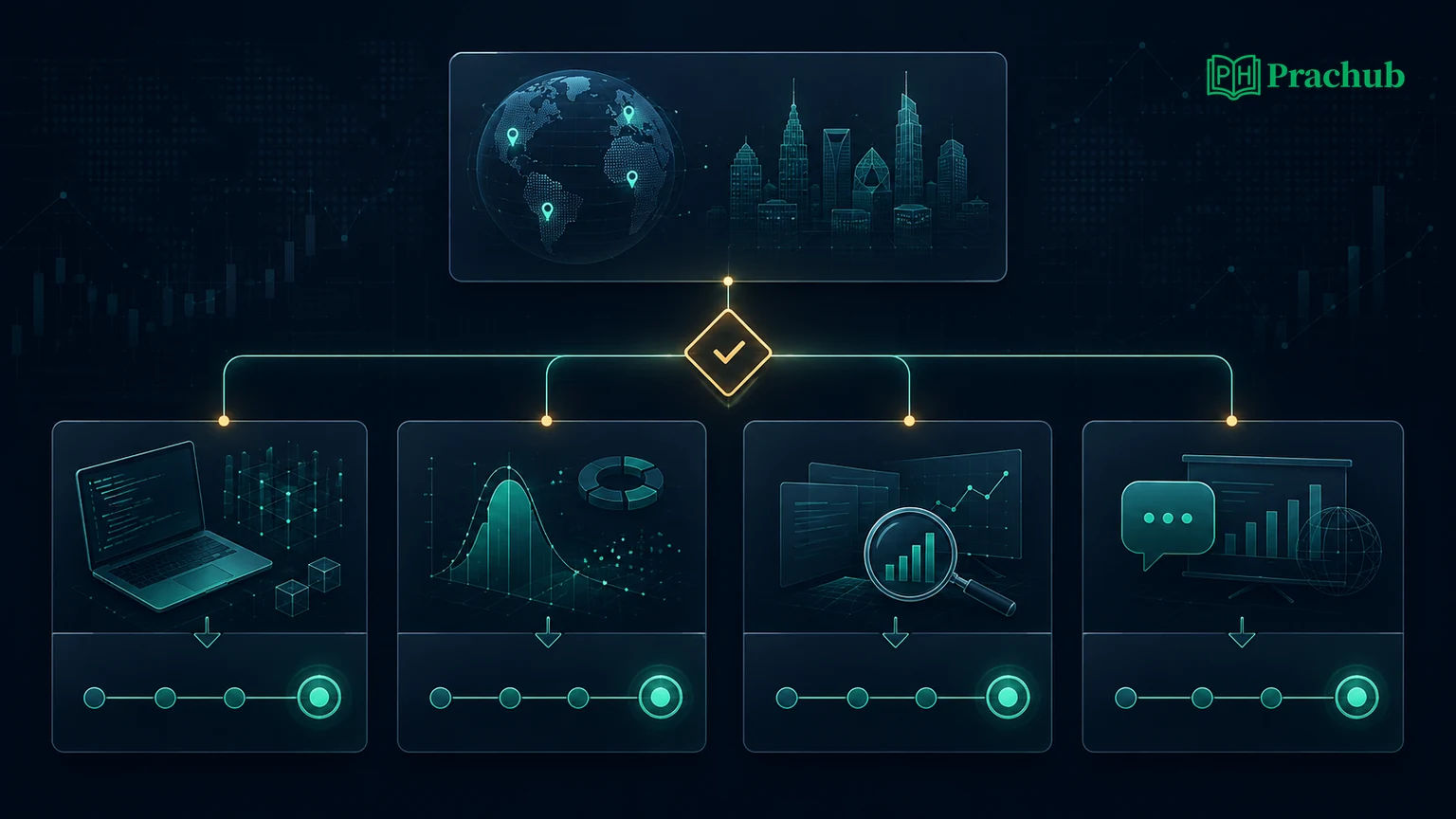
A seven-day QRT preparation sequence
- Day 1: Save the official listing, choose a location, and mark every CV line you can defend.
- Day 2: Do two timed Python or C++ implementations and test missing, duplicate, and out-of-order records.
- Day 3: Derive OLS, compare Ridge and Lasso, and critique a leaky validation workflow.
- Day 4: Practise expectation, conditional probability, covariance, and a random-walk problem aloud.
- Day 5: Present one project from question to data to result, including a failure and next experiment.
- Day 6: Combine coding, a math derivation, and Why QRT in a 45-minute mock.
- Day 7: Write the 80-100 word asset-class answer, submit if eligible, and record your follow-up window.
If your invitation arrives sooner, compress around the missing skill. If you are waiting, use the official listing and your own evidence instead of rumored question counts.
FAQ
Is the QRT Quantitative Research Internship 2027 open?
The official Greenhouse page lists a 2027 Quantitative Research/Trading role in Hong Kong, Singapore, Shanghai, and Beijing. QRT's London Research students page currently shows no jobs in that area, so check your preferred location.
Does QRT require HackerRank?
The official listing names no vendor. Some reports mention HackerRank; others describe technical interviews without a separate assessment. Follow your invitation.
How many interview rounds are there?
There is no universal count. A February 2026 London report described three technical Zoom rounds; an August 2026 report described three to six rounds without a separate assessment.
How long does the process take?
QRT reviews applications on a rolling basis without a response-time guarantee. A recent London report described 1-2 months; use that only for planning.
Which programming languages should I prepare?
The listing names Python and C++ or C#. Choose the language in which you can write, test, and explain code quickly, then review any second language on your CV.
Do I need a finance degree?
QRT targets quantitative fields such as data science, statistics, mathematics, physics, or engineering. Show how your work connects a quantitative question to validation and risk.
Sources and Further Reading
- QRT 2027 Internship/Graduate - Quantitative Research/Trading listing
- QRT About us: research, technology, data, and trading
- QRT Students and New Grads - London Research
- Glassdoor QRT Quantitative Researcher (Intern) interviews
- Wall Street Oasis QRT Quantitative Research intern, London
- QuantBrainteasers QRT interview guide (secondary synthesis)
Research note: official QRT and Greenhouse pages were checked on September 6, 2026. Candidate reports are dated snapshots from particular offices and roles; your invitation and application instructions remain authoritative.
Comments (0)