SHL Deductive Reasoning Test: Scheduling and Constraint Practice
Quick Overview
Translate scheduling rules, use adjacency blocks, test conditional statements and distinguish one valid arrangement from conclusions that hold in every arrangement.
To prepare for an SHL deductive reasoning test, practice turning every sentence into a rule, building an arrangement that satisfies all the rules, and checking exactly what the question asks. A schedule that works proves an answer is possible. It does not prove that the same answer is necessary in every valid schedule.
Official context: SHL describes deductive reasoning as drawing logical conclusions from supplied information and completing scenarios with incomplete information. Its published Verify Interactive fact sheet describes an adaptive, activity-based assessment. This article teaches the underlying reasoning through original examples, rather than reproducing live test items. SHL assessment fact sheet
For an additional ordering exercise, try PracHub's Solve a logical reasoning puzzle. That is a separate practice record, not evidence that your SHL assessment will contain that question.
Check the product name before adopting a timer
Published specification: SHL's Verify Interactive – Deductive Reasoning fact sheet lists 18 minutes, a maximum of 12 questions, and one sitting. The document carries a 2018 copyright date. Treat those numbers as the specification in that document, not as a freshly verified promise about your employer's assessment configuration.
SHL's official retirement notice lists the legacy Verify – Deductive Reasoning among products scheduled for retirement during 2024, with Verify Interactive – Deductive Reasoning as a replacement option. Older multiple-choice descriptions therefore need a version check. SHL retirement notice
Read the name, instructions, and timer in your own invitation or assessment portal. A broader ability assessment may include several reasoning areas; a standalone deductive specification does not establish the duration of that entire bundle. Check navigation and answer-entry instructions before assuming you can revisit a question.
The main SHL catalog and practice pages returned access restrictions during this review. We verified the accessible fact sheet and support pages, but did not complete an interactive practice test. No candidate account is used here to infer a universal cutoff, question sequence, or employer policy.
Translate the words before moving the pieces
Deduction begins with premises you must treat as true within the problem. Everyday expectations do not add extra rules. If the prompt says a workshop occurs before another, it does not necessarily mean the previous day. If two people cannot attend together, that does not automatically mean one of them must attend.
For ordering tasks, number the available positions and write down each item's permitted positions. Translate “before” into a lower position number, “immediately before” into a difference of one, and “not on either endpoint” into exclusion of the first and last slots.
For selection tasks, keep membership separate from order. “P attends only if Q attends” means selecting P requires Q. It does not mean selecting Q requires P. Before drawing arrows, restate the sentence in plain language to make sure the direction is correct.
This is different from searching for a hidden visual pattern. The existing SHL inductive reasoning guide addresses pattern inference. Here, the rules are supplied; the challenge is following their consequences without adding assumptions.
Worked example: five workshops in five slots
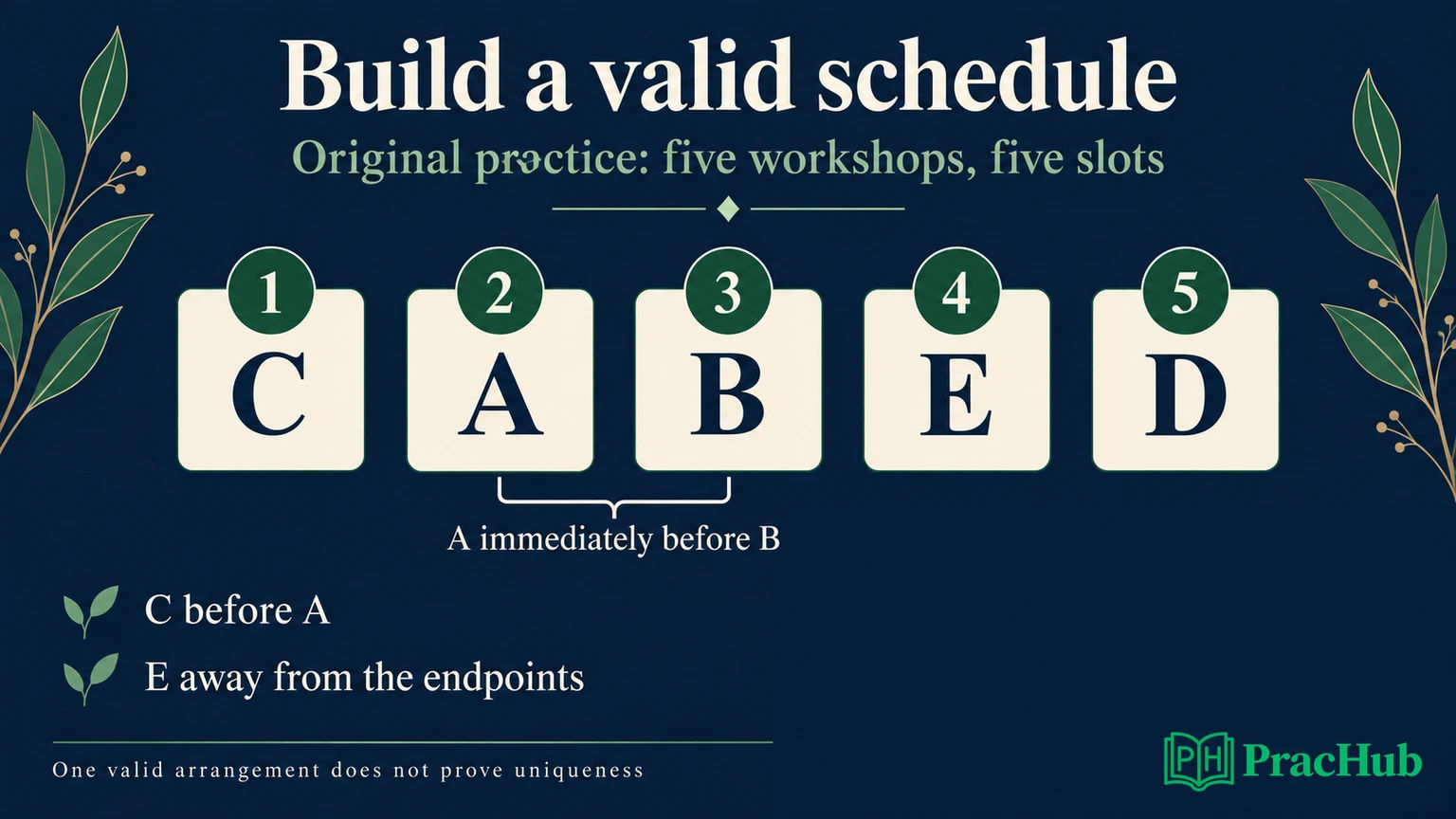
Original practice problem: Schedule workshops A, B, C, D, and E into five consecutive slots numbered 1 through 5. Each workshop appears exactly once, and each slot contains exactly one workshop. All workshops occupy one slot.
The rules are:
- B occurs immediately after A.
- C occurs before A.
- E is neither first nor last.
- D is not in slot 2.
Before looking for a complete schedule, combine the first two rules. A and B form an adjacent block, and C must be somewhere before that block. A cannot be in slot 1 because there would be no earlier place for C. A cannot be in slot 5 because B needs the next slot.
Therefore, the A–B block can occupy only slots 2–3, 3–4, or 4–5. This reduces the search to three meaningful branches. You do not need to rearrange five letters randomly until something looks plausible.
Notice what remains uncertain. C must precede A, but may have other workshops between them. E has three possible interior positions before the other rules are applied. Keep those possibilities open until a constraint removes them.
Solve by branching on the adjacent block
Start with A–B in slots 2–3. C must be in slot 1. The open slots are 4 and 5; E cannot be last, so E takes 4 and D takes 5. This produces C A B E D.
Next, place A–B in slots 3–4. The remaining positions are 1, 2, and 5. E can occupy neither endpoint, so it must take 2. C must be before A and therefore takes 1, leaving D in 5. The result is C E A B D.
Finally, put A–B in slots 4–5. C, D, and E fill positions 1–3. E may be 2 or 3. If E is 2, C and D can appear in either order around it. If E is 3, D cannot be 2, so D must be 1 and C must be 2.
| A–B block | Valid full orders, from slot 1 to slot 5 |
|---|---|
| Slots 2–3 | C A B E D |
| Slots 3–4 | C E A B D |
| Slots 4–5 | C E D A B; D E C A B; D C E A B |
These five orders are exhaustive because every possible position of the adjacent block has been considered, followed by every permitted placement of the remaining workshops. We also checked all 120 permutations locally against the four rules; exactly these five passed.
You do not need to enumerate every arrangement in every timed question. Exhaustive enumeration is useful here because it makes the distinction between possible and necessary conclusions visible and verifies the worked explanation.
Answer “could” and “must” with different evidence
Ask whether C must be first. Several valid schedules begin with C, but D C E A B does not. That one counterexample is enough to disprove the claim. C could be first, but is not forced to be first.
Now ask whether B must occur after slot 2. Because C precedes A and B immediately follows A, the earliest positions for C, A, and B are 1, 2, and 3. B therefore cannot occupy slots 1 or 2. This argument covers every valid schedule without requiring you to inspect each row individually.
For a “could be true” option, one complete valid arrangement is enough. For a “must be true” option, look for a proof or try to construct a valid counterexample. For a “cannot be true” option, show that accepting it would violate at least one rule.
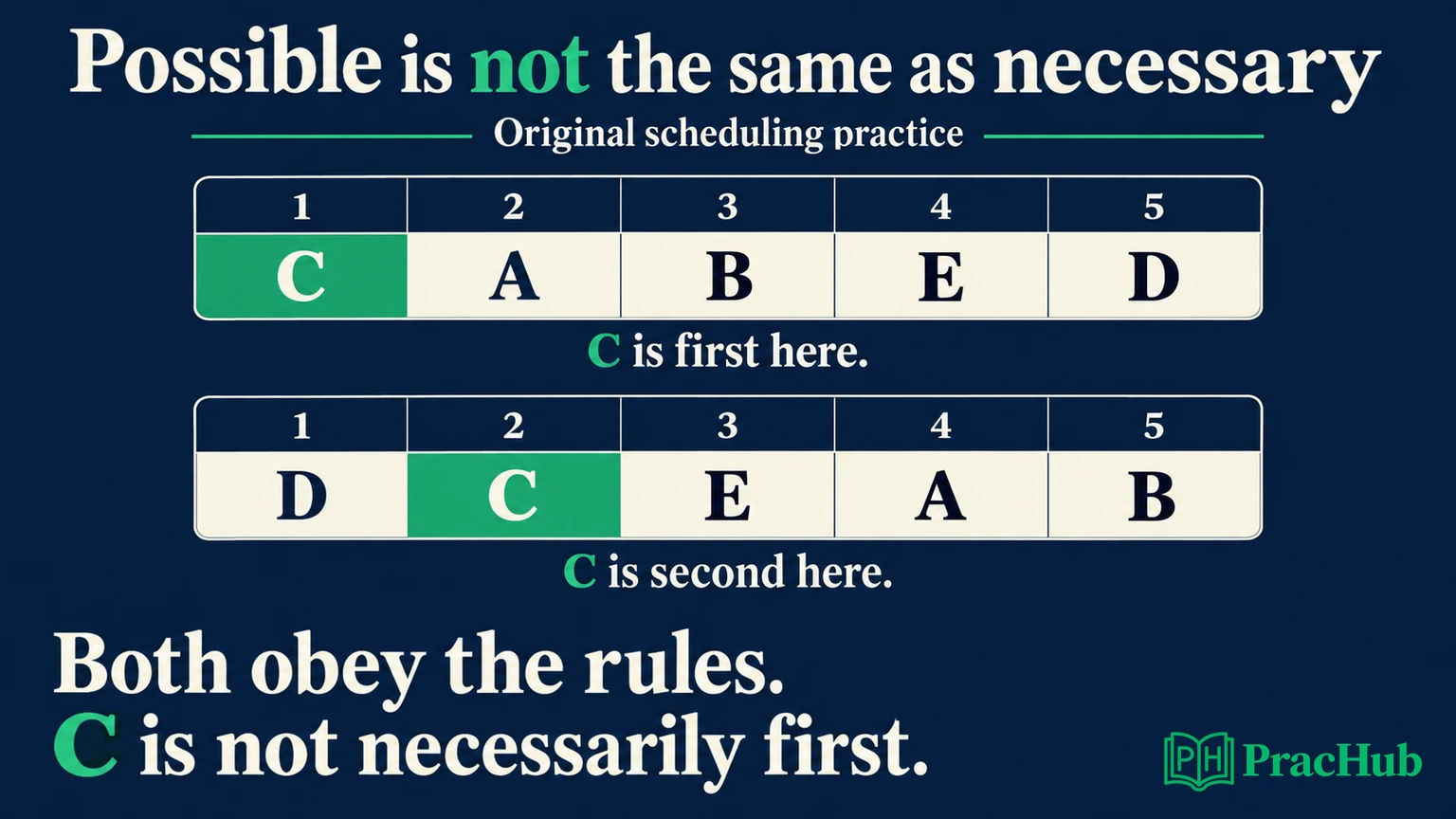
A frequent error is to finish one attractive schedule and read every answer from it. The schedule might be valid while the selected conclusion is wrong. Keep the question's wording beside your schedule or list: possible, necessary, impossible, or exact arrangement.
Add one condition without losing the original rules
Suppose a follow-up adds: E is in slot 3. This is an extra restriction on the original problem; none of the four earlier rules disappears.
The A–B block cannot occupy 2–3 or 3–4 because either placement would use E's slot. The block must therefore be in 4–5. C and D occupy 1 and 2, and D cannot be 2. The unique answer is D C E A B.
Check that answer against all the conditions: B immediately follows A, C comes before A, E is an interior workshop, D is not second, and E is third. This final sweep matters because a local repair can accidentally break a rule you satisfied earlier.
Contrast that with adding “C is first.” It leaves three valid schedules: C A B E D, C E A B D, and C E D A B. An extra condition can reduce uncertainty without creating a unique solution. Do not assume that every follow-up must identify the entire schedule.
Worked example: conditional attendance rules
Original selection problem: Exactly two people from P, Q, R, and S attend a meeting. If P attends, Q attends. R and Q cannot both attend. There are no other restrictions.
There are six possible pairs before applying the rules. P–R and P–S violate the requirement that P brings Q. Q–R violates the exclusion rule. The surviving pairs are P–Q, Q–S, and R–S.
If R attends, S must attend: Q is excluded, and P would require the excluded Q. If Q attends, P does not necessarily attend because Q–S remains valid. If P does not attend, Q may still attend, again demonstrated by Q–S.
This exposes two common conditional mistakes. Reversing “if P, then Q” into “if Q, then P” adds a rule that was never given. Concluding “not P, therefore not Q” makes the same mistake in negative form.
The valid contrapositive is “if Q does not attend, P does not attend.” If P were present without Q, the original rule would fail. For this exercise, you can verify that implication directly from the three surviving pairs instead of relying on terminology alone.
Words such as “only,” “exactly,” “at least,” and “unless” deserve particular attention. Translate their meaning before using them. If a problem says exactly two, selecting three is invalid even if all pairwise conditions appear satisfied.
Audit the arrangement, not just your reasoning notes
For a scheduling answer, check three layers. First, confirm the structure: every required item is used once, every necessary slot is filled, and the stated capacities are respected. Second, check the individual rules. Third, check that the conclusion answers the specific question asked.
In a calendar or availability exercise, distinguish empty space from usable time. A visually blank cell is not automatically available if another rule blocks the person or resource. Check duration, overlap, and any stated travel or preparation buffer rather than assuming meetings can touch.
If instructions explicitly allow back-to-back meetings, a meeting ending at 11:00 can be followed by one starting at 11:00. If a buffer is required, it cannot. The useful habit is to model the endpoint rule you were given, not import a convention from another practice problem.
For interactive answer entry, verify the displayed arrangement after moving an item. Read the selected label and position, check for an omitted item, and confirm the intended response before advancing. These are preparation recommendations, not a claim about one currently verified SHL interface.
Practice efficiently without guessing the scoring system
Start untimed with short problems whose answers you can explain. Record whether each error came from translating a rule, missing a branch, reversing a condition, or answering “must” using only a possible example. A correct answer reached by accident should still be reviewed.
Next, rehearse a consistent sequence: identify the target, compress the rules, place the most constrained block or item, test the remaining choices, and audit the result. With repeated practice, this reduces unnecessary moves and gives you a way to restart when an arrangement fails.
Use the time limit shown for your actual assessment when you later practice pacing. Dividing a published total time by a maximum question count gives an average, not a rule for how long every problem deserves. Do not assume a skip, return, or guessing policy that the instructions have not confirmed.
Official practice guidance: SHL says its practice tests primarily help candidates become familiar with assessment operation. Availability and feedback vary by assessment and language; full-length timed practice answers are not provided, while short examples can give explanations. A practice result is therefore one piece of feedback, not proof of an employer's pass threshold. SHL practice support
Related PracHub reasoning exercises
The records below come from different companies and include some coding-oriented extensions. They are transferable reasoning practice, not SHL replicas or verified reports of your upcoming test. For the technical questions, focus on the ordering or availability logic before any implementation.
| PracHub question | Constraint habit to rehearse |
|---|---|
| Solve a logical reasoning puzzle | Translate before/after and excluded-day rules into positions. |
| Deduce Cat Counts from Conditional Truth Rules | Test conditional statements without assuming their converses. |
| Deduce position from logic clues | Combine relative positions and count restrictions. |
| Parse strings and find meeting slots | Check joint availability and interval boundaries. |
| Deduce row order from logic clues | Distinguish a valid order from a uniquely determined order. |
Start with the ordering puzzle. Explain why each rejected option fails, then change one rule and solve again. That second attempt tests whether you understood the constraint rather than remembered the final arrangement.
Sources and Further Reading
- SHL: Verify Interactive – Deductive Reasoning fact sheet
- SHL: Verify Gen 1 retirement notice
- SHL: Practice Tests and Assessment Advice
Sources checked September 8, 2026. Product specifications are attributed to their published documents; the workshop and attendance exercises are original preparation material.
Comments (0)