Should You Take an OA Immediately or Wait to Prepare? A Rolling-Recruiting Decision Guide
Quick Overview
Should You Take an OA Immediately or Wait to Prepare? A Rolling-Recruiting Decision Guide now pairs its existing format and process guidance with a clearly sourced PracHub practice set. The added section shows each question's actual company, stored round, difficulty, prompt shape, and a timed workflow without claiming guaranteed assessment reuse.
Updated August 15, 2026: An online assessment invitation lands at 4:17 p.m. Suddenly every option feels risky: take it tonight while underprepared, or wait while the recruiting pipeline moves without you.
Before you start the timer, use real interview questions with written solutions on PracHub for one focused diagnostic. The goal is not to squeeze in a week of random grinding. It is to discover whether a short preparation window would materially improve your performance.
So, should you take an OA immediately? Usually not immediately, but also not at the deadline. Prepare for a short period, use your earliest calm and reliable test block, and preserve a full day of deadline buffer when the invitation allows it.

The best test date balances readiness, the stated deadline, rolling-recruiting pressure, and a safe technical buffer.
Quick Answer: Should You Take an OA Immediately?
Take the OA within 24-48 hours if you are already ready and the role is moving on a rolling basis. Wait 2-4 days when a specific weakness can be improved with focused practice and the deadline comfortably allows it. Do not wait until the final night unless an emergency leaves no alternative.
This is a PracHub planning framework, not a rule used by every employer:
| Your situation | Recommended action |
|---|---|
| You can solve a representative problem under time pressure | Take it within 24-48 hours. Extra delay probably adds little while an active pipeline may keep moving. |
| You have one or two fixable gaps and at least a 7-day window | Prepare for 2-4 focused days. A short delay can create a real performance gain without consuming the deadline. |
| The invitation expires within 48-72 hours | Use the earliest calm, uninterrupted block. Setup and deadline risk now matter more than marginal extra study. |
| You are broadly underprepared but have 7+ days | Use the first half of the window, then test. Improve the highest-value gaps while keeping a recovery buffer. |
| The deadline, rules, accommodation, or link is unclear | Contact the hiring team now. Silent delay does not resolve an administrative problem. |
The phrase earliest calm block matters. Starting five minutes after receiving the email while tired, commuting, or using an unreliable laptop is not the same as moving quickly.
Why Timing Matters in Rolling Recruiting
In a rolling process, applications can be reviewed while the posting remains open instead of only after one final deadline. Current Google Careers postings, for example, explicitly encourage early applications because reviews happen on a rolling basis. That establishes a real opportunity cost to unnecessary delay: interviews, projects, or recruiter capacity can begin filling while the broader application window is still open.
But do not turn that fact into a myth. There is no public evidence that every company grades OAs first-in, first-out or rewards an identical score for arriving one day earlier. Results may enter automated scoring, batch review, resume review, or team matching.
Some companies send assessments broadly or automatically, while others screen first. Our guide to why companies send automatic OAs explains why the link is not always proof that a recruiter reviewed your resume. Rolling status is a reason to avoid needless delay, not to sacrifice a meaningful preparation gain.
Start With the Invitation Rules, Not Internet Folklore
Before deciding when to test, read the invitation, login page, and recruiter message from top to bottom. Record the expiration date and time zone, test duration, allowed languages, proctoring requirements, retake policy, and whether opening the link starts the timer.
Platform defaults are not universal employer rules:
- CodeSignal says assessment invitations expire after 14 days by default, but employers can customize the window for up to six months.
- HackerRank lets employers set a specific expiration date, time, and time zone. Its recruiter-side default is no expiration, but a company can override that setting.
- Codility tells candidates to follow the invitation deadline and otherwise recommends completing the assessment within a day or two.
- Amazon's current SDE II guide gives candidates seven days for that documented process. That is a role-specific example, not a promise for every Amazon assessment.
The email in front of you outranks a generic blog, a friend's timeline, and a platform default. If the email and login page disagree, ask the hiring team before starting.
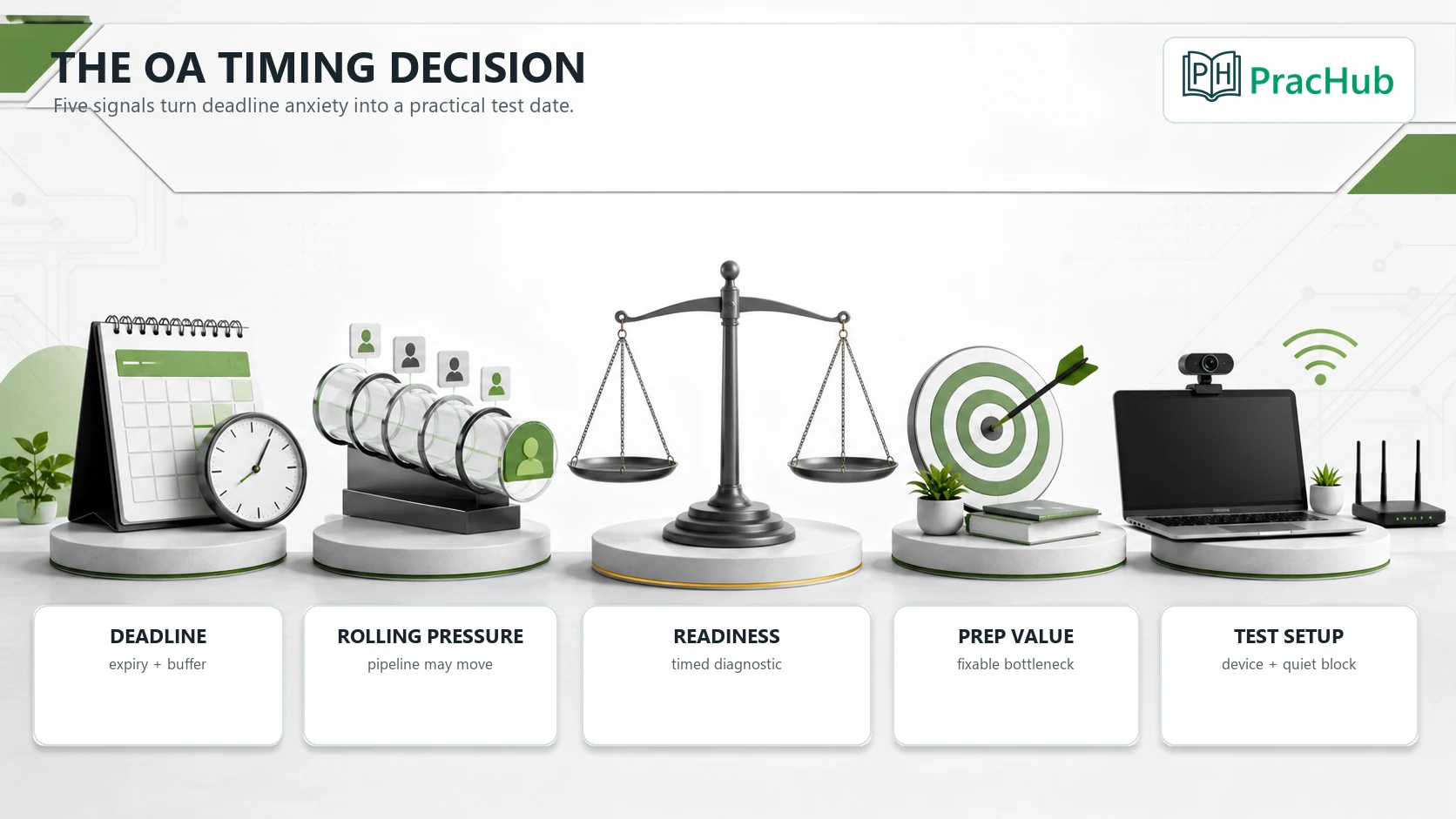
Five signals should determine your OA date: deadline, rolling pressure, current readiness, likely preparation gain, and test-day reliability.
The Cost of Taking an OA Too Early
Speed has value only when you are ready to convert the opportunity. Taking an OA immediately can be a mistake when you have not inspected the environment, cannot reserve an uninterrupted block, or know exactly which skill will stop you.
Platform unfamiliarity is a preventable source of lost time. HackerRank provides a sample test from the login page so candidates can learn the editor and execution flow before the real attempt. Spending 20 minutes on that environment may be more valuable than solving five unrelated practice problems.
The same logic applies to a narrow technical gap. If a diagnostic exposes repeated binary-search boundary errors, two focused sessions on invariants and edge cases may materially improve the result. Testing tonight would simply convert a known weakness into a submitted score.
A quiet room, charged laptop, supported browser, stable internet, and working camera can matter as much as one final algorithm. Speed has no value if preventable setup problems damage the attempt.
The Cost of Waiting Too Long
Delay is also a decision. In a rolling process, interview capacity or team needs can change while you study. The assessment link may also expire, and a browser update, outage, login problem, illness, or time-zone mistake is much harder to fix on the final night.
Waiting can turn preparation into avoidance. There will never be a psychologically perfect date. Stop when the expected gain from another day is smaller than the scheduling and pipeline risk of another day.
Finally, a later submission starts the next clock later. Our guide to what happens after you submit an OA explains why platform processing, employer review, and interview scheduling can already take days or weeks.
The PracHub OA Timing Framework
Use five signals instead of guessing from nerves.
1. Deadline pressure
Calculate the usable window after work, classes, travel, and sleep. Reserve at least one day before expiration as a technical buffer when possible; a seven-day invitation may contain only three realistic test blocks.
2. Rolling-pipeline pressure
Look for phrases such as rolling basis, applications may close early, limited headcount, or interviews begin immediately. These do not prove that your score will be reviewed first, but they increase the cost of spending a week on low-value preparation.
3. Current readiness
Take one timed diagnostic that resembles the expected format. Use company-specific interview prep when the employer is known, or relevant software engineer interview questions. Measure correctness, completion, and debugging time.
4. Expected preparation gain
Name the smallest bottleneck that could change the outcome. "I need more DSA" is too broad; "I lose 15 minutes on graph traversal and miss visited-state edge cases" is actionable. Delay only when the time has a concrete job, then practice coding and algorithms questions that match it.
5. Test-day reliability
Choose the first rested, uninterrupted block that follows the rules. Confirm the browser, camera, identification, charger, and network. A safe Saturday morning can be earlier in every useful sense than a chaotic Thursday night.
When You Should Take the OA Within 24-48 Hours
Move quickly when your diagnostic resembles a passing attempt, the job is explicitly rolling, or the invitation window is short. If you understand the platform and can complete the expected question types under time, do not invent more study because the score feels important. Schedule the test, review lightly, sleep, and take it. This still means using the sample environment and reading every rule before clicking Start.
When Waiting 2-4 Days Is Rational
A short delay is sensible when the invitation gives enough room and your diagnostic reveals a specific, fixable bottleneck: slow input parsing, weak SQL window functions, forgotten graph templates, unfamiliar debugging tools, or poor pacing.
Make the improvement observable with a comparable timed problem. If correctness or completion time has not changed, extending preparation may only postpone the same performance.
For a seven-day window, diagnose on day zero, prepare on days one and two, simulate on day three, and test on day four or five. That leaves room for a technical issue.
A Practical 72-Hour OA Preparation Plan
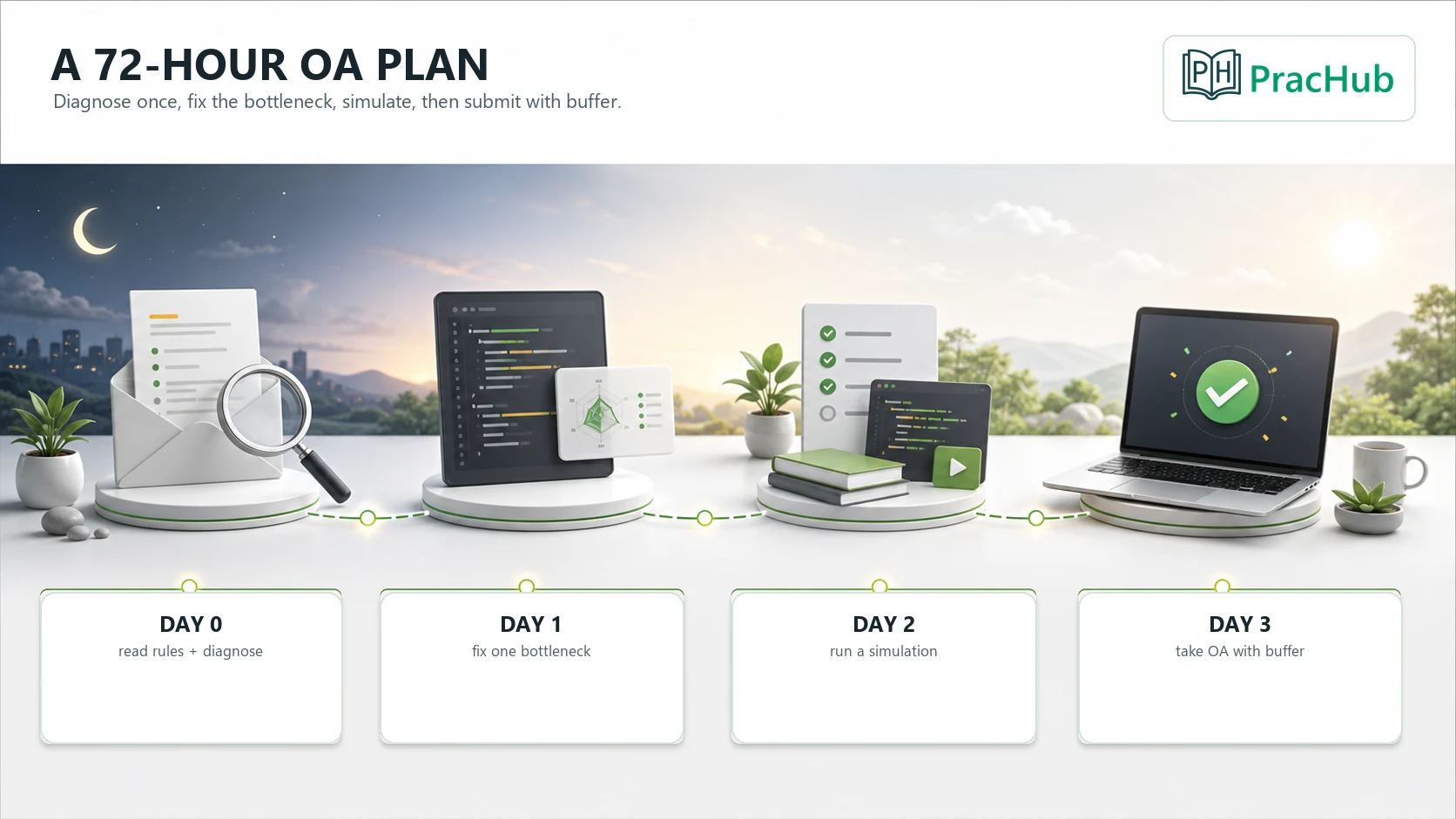
A short plan works when every session has a defined purpose and the test date is scheduled before preparation begins.
| Time | What to do and when to stop |
|---|---|
| First 30 minutes | Read the invitation, calculate the deadline, inspect the format, and run the platform sample. Stop when you know the rules, duration, environment, and available test blocks. |
| Day 1 | Complete one realistic timed diagnostic and review every miss. Finish when you can name the one or two constraints most likely to affect the score. |
| Day 2 | Drill only those constraints, then practice testing and edge cases. Move on when the same mistake no longer repeats in a fresh problem. |
| Day 3 | Run one final simulation, perform the system check, and stop heavy study once you have a stable setup, pacing plan, and enough energy for the real attempt. |
| Test block | Start rested, use only allowed resources, test incrementally, and submit with time remaining before the final-day buffer. |
Do not schedule three days of study and postpone choosing the test time. Put the assessment block on your calendar first; the fixed endpoint keeps preparation focused.
When to Contact the Recruiter Before Starting
Contact the hiring team promptly for an accommodation, ambiguous deadline, broken link, wrong role, illness, or emergency. HackerRank says the hiring company controls rescheduling, and CodeSignal documents that employers can extend pending invitations. That capability does not guarantee approval.
Use a short, factual note:
Hi [Name], thank you for the assessment invitation for the [Role] position. The invitation currently shows an expiration of [Date, Time, Time Zone]. Because of [brief reason], could you confirm whether an extension to [specific date] is possible? I remain very interested and can complete it by that date. Thank you.
Ask before the link expires whenever possible. Do not silently wait and assume the platform will reopen it.
Common OA Timing Mistakes
Starting while distracted. Receiving the invite creates urgency, but urgency is not readiness. A planned block tomorrow is usually better than an impulsive attempt tonight.
Grinding unrelated questions. A hundred random problems can consume the whole window without fixing the constraint that appeared in your diagnostic.
Using the deadline as the test date. The expiration time is the last permissible moment, not the safest appointment. Preserve room for login, equipment, health, and time-zone problems.
Assuming reminders reveal recruiter interest. Assessment platforms let employers automate reminders. Treat them as deadline information, not proof that someone reviewed your application.
Breaking the rules to feel more prepared. Unauthorized notes, external tools, copied solutions, or live assistance can create integrity flags and turn a strong technical attempt into a disqualification risk. Follow the invitation exactly.
Practice with real questions from PracHub
A platform or process article cannot honestly attribute one company's question to every employer that uses the format. This set therefore uses real cross-company PracHub questions to rehearse common OA patterns. Each row shows its actual company and stored round; none is claimed to be supplied by this platform.
| Question | Evidence | Difficulty | Main pattern |
|---|---|---|---|
| Q1: Min boards to cover roof holes | Google · Technical Screen | Medium | Core algorithms |
| Q2: Serialize and deserialize a binary tree | Amazon · Technical Screen | Hard | Graphs |
| Q3: Implement multiple coding round problems | Instacart · Technical Screen | Medium | Intervals |
| Q4: Design a circular queue data structure | Optiver · Technical Screen | Medium | Sliding window |
What the prompts actually ask
Q1. Min boards to cover roof holes
Bank evidence: Google, Technical Screen, Medium. You are given an m x n binary grid roof representing a roof surface: - roof[i][j] = 1 means the cell is intact. - roof[i][j] = 0 means the cell is a hole that must be covered. You can patch holes using wooden boards of two types: 1.
Q2. Serialize and deserialize a binary tree
Bank evidence: Amazon, Technical Screen, Hard. Problem Design two functions to serialize and deserialize a binary tree. - Serialize: convert a binary tree into a single string. - Deserialize: reconstruct the exact same binary tree from that string.
Q3. Implement multiple coding round problems
Bank evidence: Instacart, Technical Screen, Medium. Solve the following coding problems. 1) Bus schedule (next departure) Given: - A sorted list buses[] of bus departure times (minutes since 00:00). - A list arrivals[] of passenger arrival times (minutes since 00:00).
Q4. Design a circular queue data structure
Bank evidence: Optiver, Technical Screen, Medium. Problem Design and implement a fixed-capacity circular queue that supports constant-time operations. A circular queue stores elements in an array of size k and uses wrap-around indices so that freed space at the front can be reused.
Run the set like an assessment
- Read all four prompts first. Give each a difficulty estimate and choose an order before coding.
- Hide the solution. Write the invariant, complexity target, and three edge cases before opening the editor.
- Use one timer. Preserve five minutes at the end for boundary, tie, scale, and output-format tests.
- Log the failure mode. Record the broken invariant or missed edge case, not merely the question title.
OA Timing FAQ
Does submitting an OA earlier improve my chances?
It may keep your application moving in a rolling process, but there is no universal evidence that an identical score receives a ranking bonus for arriving earlier. Submit promptly when ready; do not sacrifice meaningful preparation solely to be first.
Is the OA deadline the date I should take it?
No. Treat the deadline as an expiration boundary. Your planned test date should be earlier, ideally with at least one full day of buffer when the window allows it.
How many days should I prepare for an online assessment?
For a candidate who is already broadly ready, 1-4 days of targeted work is often more useful than a long, unfocused delay. Your invitation and diagnostic should determine the plan. A fundamentally weak area cannot always be repaired within one assessment window.
Does CodeSignal always give candidates 14 days?
No. CodeSignal documents a 14-day default, but employers can customize the expiration window. Use the exact date and time shown in your invitation.
Can I ask for an OA deadline extension?
Yes, when you have a legitimate scheduling, technical, health, or accommodation issue. Ask the hiring team as early as possible and propose a specific completion date. Approval remains the employer's decision.
What if I am already ready when the OA arrives?
Complete the platform sample and system check, choose your earliest calm block, and take it within roughly 24-48 hours. Do not manufacture extra study merely because the invitation feels high stakes.
Final Takeaway
The best answer to "Should I take the OA immediately?" is neither right now nor at the deadline. Read the rules, run one realistic diagnostic, identify the smallest bottleneck that can actually improve, and schedule the earliest calm test block that preserves a safety buffer.
If you are ready, move within 24-48 hours. If two or three focused days can fix a measurable gap, use them. Then stop preparing and submit while the opportunity is active.
Use PracHub's real interview questions and written solutions to make that short preparation window specific. After the OA, continue with company research, technical practice, and behavioral interview preparation so the next invitation does not catch you unprepared.
Sources and Methodology
This guide was researched on August 15, 2026. Deadline and scheduling mechanics come from current documentation for CodeSignal invitation expiration, CodeSignal invitation extensions, HackerRank test invitations, HackerRank candidate preparation and sample tests, and Codility candidate timing guidance.
Employer examples come from Amazon's current SDE II online assessment guide and Google Careers postings that describe rolling application review. Those examples illustrate possible workflows; they are not generalized into universal company rules. The 24-48 hour, 2-4 day, and one-day-buffer recommendations are PracHub planning guidance, not measured employer conversion rates. Your invitation and hiring contact remain the final authority.
Related Articles
Lodely Review 2026: Are 4,000+ Company Interview Questions Worth $49 a Month?
Lodely review 2026: compare its 4,000+ question claim, $49 monthly plan, free tier, strengths, limitations, and interview-prep alternatives.
Software Engineer Interview Difficulty Index 2027: 50 Companies Ranked by Rounds and Time Pressure
See 50 software engineering interview processes ranked by evaluative stages, time pressure, format breadth, and extra gates in a transparent 2027 index.
AI-Assisted Coding Assessments in 2027: Companies, Platforms, Rules, and Scoring
Learn which 2027 coding assessments allow AI, how HackerRank, CoderPad, and CodeSignal differ, what employers can review, and how scoring works.
Repository-Based OAs in 2027: Companies Replacing LeetCode with Debugging Tasks
See which 2027 employers use repository-based OAs, where LeetCode remains, how Amazon and IBM formats vary, and how to prepare for both assessment styles.
Comments (0)