Snowflake Tech Talk Interview: Choose a Project and Defend Your Design Decisions
Quick Overview
Prepare for a Snowflake Tech Talk interview by choosing a project with clear personal ownership, documenting design alternatives, and rehearsing technical follow-up questions. Distinguish official format guidance from historical candidate reports and original preparation exercises.
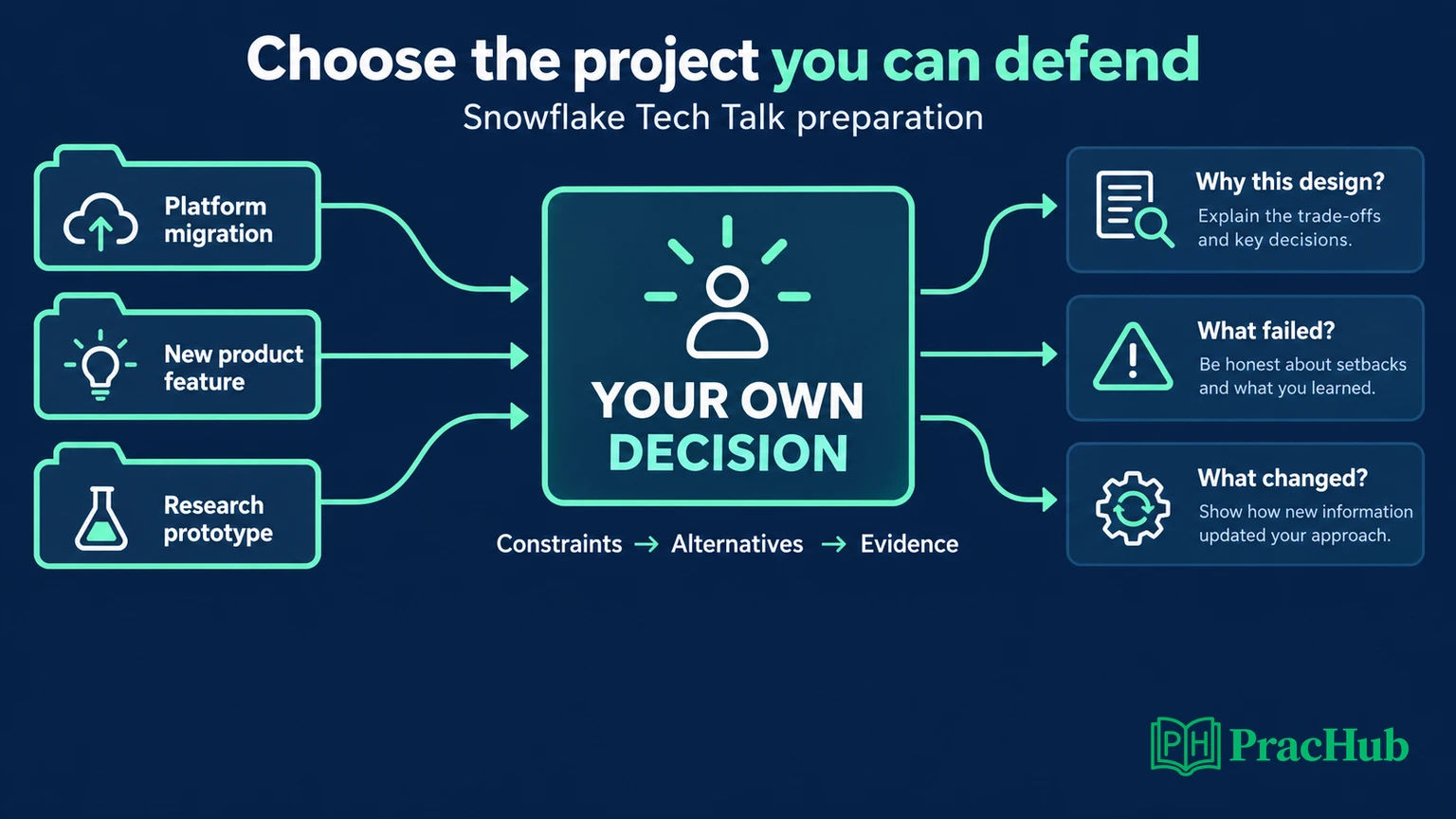
Choose a project for your Snowflake Tech Talk interview that you can explain after the slides stop helping. You know which constraint forced the design, which alternative nearly won, what you personally changed, and what evidence would make you choose differently today.
Start with PracHub’s Snowflake Software Engineer questions for related practice. This article focuses on selecting and defending a technical project, rather than rehearsing the entire interview loop.
Evidence boundary: official process facts, historical candidate reports, and our preparation recommendations are labeled separately below. The project comparisons, decision record, and rehearsal prompts are original exercises—not reported Snowflake questions or a company scoring rubric.
Confirm What Your Tech Talk Invitation Requires
Official fact: Snowflake’s engineering hiring page says a 30-minute Tech Talk presentation may be included depending on the role and level. It describes the broader panel as covering technical, expertise, system design, behavioral, and collaboration interviews. It does not publish a universal IC threshold or a fixed presentation-versus-Q&A allocation. Snowflake’s hiring process
Historical candidate reports: separate Senior Software Engineer accounts hosted by Taro, dated May 1, 2025 in Hungary and July 1, 2025 in Berlin, mention a presentation in their onsite interviews. The Berlin account also names an expertise interview. These anonymous accounts describe presentation stages in those particular loops. We did not establish two independent, completed Tech Talk reports from the current cycle, so the preparation below follows the official boundary and your invitation. Hungary report, Berlin report
Preparation recommendation: confirm whether your invitation requests a past project, a technical topic, or something else; who will attend; whether questions interrupt the presentation; and whether the allotted time includes discussion. Also confirm any slide, demo, or submission requirements. Use those answers to size the talk.
A customer-facing demo, a conversational expertise interview, and a prepared engineering presentation require different material. The label alone does not settle which one you have. For the surrounding SWE rounds, use the separate Snowflake Software Engineer interview guide.
Choose a Project with Decisions You Actually Owned
Our selection method: shortlist three projects and identify a decision you could defend in each without borrowing a teammate’s expertise. Project size matters less than the amount of reasoning you can reconstruct accurately.
Use this fictional comparison as a model:
| Candidate project | Selection judgment |
|---|---|
| Company-wide platform migration; you owned a small dashboard | Broad impact, but limited architectural ownership. Choose only if the dashboard itself contains a substantial decision. |
| Build-execution improvement; you owned measurement, routing, and rollout | Strong candidate: a clear user problem, meaningful alternatives, direct implementation, and operational feedback. |
| Research prototype; you designed the experiment but never deployed it | Viable if the invitation allows it. Explain experimental evidence and limitations without claiming production outcomes. |
For each project, write four sentences: “I owned…,” “The team owned…,” “The hardest choice was…,” and “We learned we were wrong about….” If the last two sentences are vague, investigate your notes or choose a different project.
A narrow contribution can still carry a deep talk. For a build platform, owning the boundary between local execution and remote workers could support discussion of latency, artifact transfer, failure recovery, and adoption. Claim that boundary precisely; do not expand it into ownership of the whole developer platform.
For newer candidates, a substantial academic or open-source project may provide better evidence than a routine internship task. Match the invitation and your actual experience. A prototype with honest experimental limits is more defensible than a production story padded with invented scale.
Use Snowflake’s Engineering Writing to Calibrate Depth
Official engineering example, not interview guidance: Snowflake’s March 2025 Bazel migration account explains why the team considered a unified build experience instead of separate language-specific improvements. It also describes a complication: remote execution and artifact transfers could worsen interactive development, prompting changes that used local compute for some workflows. Fast and Reliable Builds at Snowflake with Bazel
The useful lesson for your talk is the shape of the explanation: a reasonable architecture encountered a workload where its benefits weakened. That creates a technical discussion about assumptions and measurements, rather than a list of tools.
A separate official developer-productivity account describes measuring developer-perceived latency, adoption, and sentiment alongside operational metrics. Continuously Improving Developer Productivity at Snowflake
Our inference: a project talk becomes stronger when it connects system behavior to the people using it. For your own migration, separate a faster benchmark from a better daily workflow. A reduced clean-build time does not by itself establish that edit-test cycles improved or that users adopted the change.
You do not need to retrofit Bazel into your résumé. A frontend rendering project, storage service, experimentation system, or deployment tool can expose equally substantial decisions. Use the target team’s domain to choose the depth you emphasize, while keeping your account faithful to work you actually performed.
Prepare a One-Page Decision Record Before Making Slides
The following is an original hypothetical exercise, not a reconstruction of Snowflake’s implementation. Imagine that you owned execution routing in a build platform. Clean builds need substantial compute, but developers also run small incremental builds throughout the day.
Write a decision record with these six entries:
- Problem and constraint: developers need dependable feedback after edits; CI also needs reproducible clean builds. Network conditions and cache warmth vary.
- Alternatives: keep execution local, move eligible work remotely, or choose an execution path by workload. Include operational complexity in the comparison.
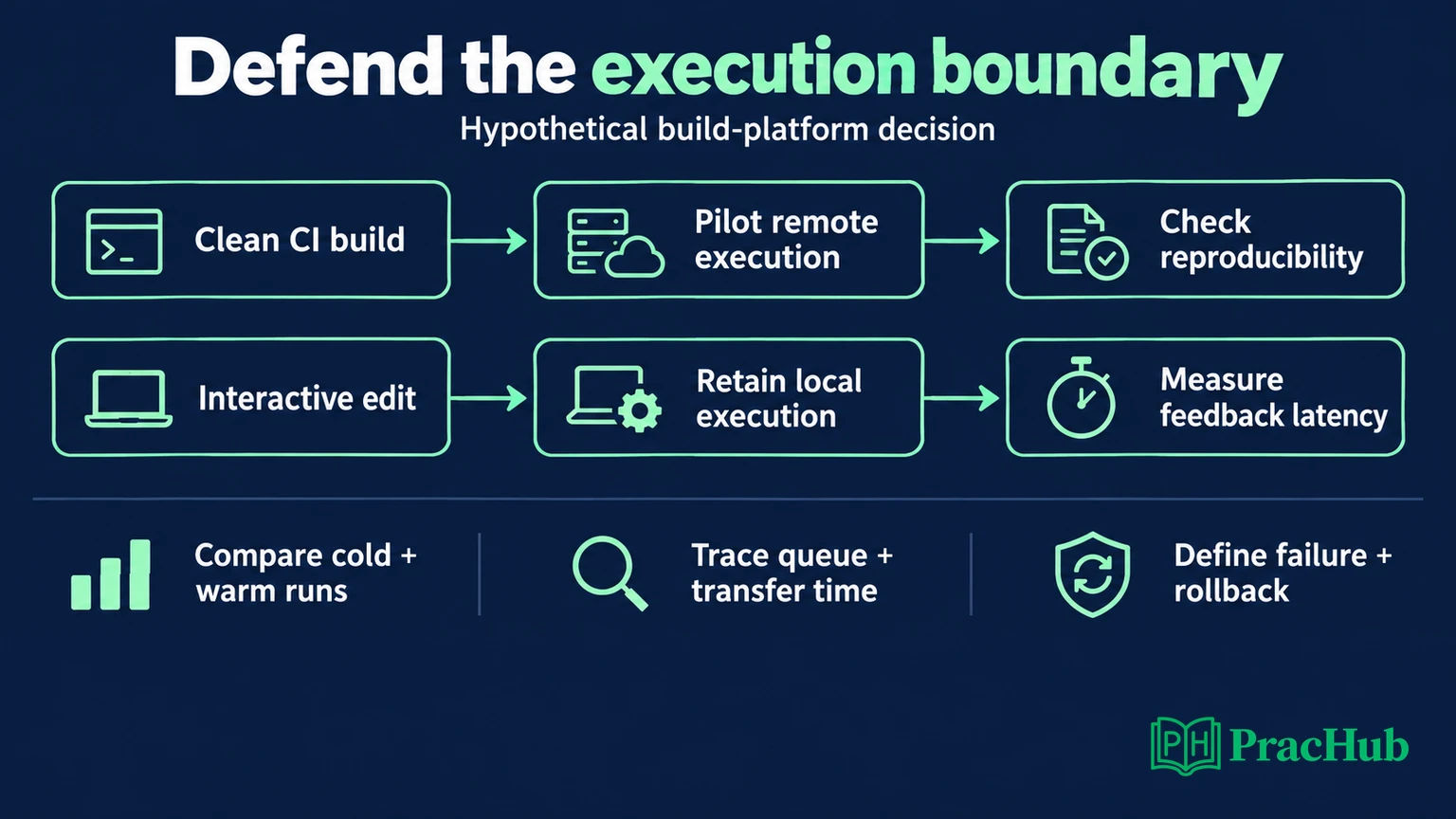
- Decision: pilot remote execution for clean CI workloads while retaining local execution for interactive work until measurements justify expanding remote use.
- Evidence required: compare representative changes under cold and warm conditions; separate queue, execution, and transfer time; check output correctness and user-perceived latency.
- Failure and rollback: a remote outage must have an explicit response. Interactive work might fall back locally, while CI may wait or fail clearly if an equivalent execution environment is unavailable.
- Revisit trigger: reconsider the split if reliable measurements show that remote interactive execution improves the relevant workloads without unacceptable correctness, latency, or cost regressions.
This record separates a proposed design from a measured result. It also prevents a common mistake: treating “remote is faster” as a property of the architecture instead of a claim about a particular workload.
For your real project, list the evidence you actually collected separately from measurements you still need. Name the comparison period, workload, and exclusions. If you only tested on developer laptops, say so. If rollout data was inconclusive, explain what prevented a stronger conclusion.
Add a small ownership note: who proposed the design, who implemented each component, who approved rollout, and what you personally investigated when behavior diverged from expectations. That note is your defense against accidentally turning “we shipped” into “I designed everything.”
Build the Talk Around One Consequential Decision
Our suggested structure: begin with the user’s blocked workflow, trace one request through the system, examine the central decision, and finish with evidence and what changed afterward. Adapt the length to your confirmed invitation; this is not a prescribed slide count.
For the hypothetical build project, the opening could be: “The problem was inconsistent time to trustworthy feedback. I owned how we measured that delay and selected an execution path.” This tells the audience what the system does and where your contribution starts.
Show one architecture diagram containing the developer or CI client, the routing boundary, local or remote execution, and returned artifacts. Label the path you owned. Then walk through one edit and one clean build. The contrast gives the diagram a purpose.
Spend your deepest explanation on the rejected alternative. Why not send everything remotely? What observation would distinguish network transfer overhead from slow execution? Why is a fallback safe for one workflow but potentially invalid for another? Keep these questions connected to your actual design, not a generic distributed-systems syllabus.
End with a concrete revision to your understanding. You might have learned that the initial benchmark overrepresented warm caches, or that a rollout needed better failure messages. Use only events that happened in your project. If no major incident occurred, discuss a discovered limitation or an unresolved risk rather than inventing a dramatic outage.
Prepare backup material for implementation details, measurement definitions, and rollout evidence. It should let you answer a question directly without forcing the entire audience through every internal component.
Defend Design Decisions Without Becoming Defensive
These are original rehearsal questions for the example decision record. Their purpose is to test whether your explanation survives a changed assumption.
“Why not just buy more powerful developer machines?”
Acknowledge the alternative. Explain which bottleneck better hardware could remove and which it would leave. Then cite the measurements or constraints that informed your actual choice. If you never evaluated it, say that and describe the comparison you would run.
“Your clean builds improved, but interactive builds slowed down. Was the project successful?”
Separate the user journeys. Avoid hiding a regression inside an overall average. Explain the affected population, the workaround or rollback, and the condition for expanding rollout. An incomplete improvement can still contain good engineering work if you describe it accurately.
“What happens when the remote service is unavailable?”
Trace the failure from detection to the user-visible result. State whether work retries, queues, falls back, or fails, and why that behavior preserves the build’s correctness requirements. Do not promise seamless fallback unless the alternative environment can produce valid results.
“Which decision was yours?”
Answer with the component and action: “I designed the routing experiment and implemented its instrumentation; another engineer owned worker provisioning.” Follow with one implementation detail you can explain. Clear credit helps the audience understand exactly which decisions you can defend.
“What would make you reverse this decision?”
Name an observable condition. A changed workload, lower transfer overhead, or a different reliability requirement might change the preferred execution path. A design defended through assumptions can evolve without contradicting your original reasoning.
For unfamiliar questions, distinguish what you know from what you would investigate. Give a bounded hypothesis and a validation step. That is more useful than improvising internal details you cannot support.
Rehearse Interruptions and Verify Every Claim
Run one rehearsal for a technically informed listener who does not know your project. Ask them to interrupt at the decision slide, challenge one assumption, and request the failure path. Your goal is to return to the argument without restarting the entire deck.
Run a second rehearsal with less time than your confirmed presentation allocation. Find the material you can remove while preserving the problem, your ownership, the decision, and the evidence. Keep optional implementation detail in backup slides.
Audit every number. Distinguish a target from a measured result, a controlled test from production observation, and a team outcome from your contribution. If exact figures cannot be shared, use an appropriately anonymized comparison and state its limits; do not invent precision.
Remove confidential screenshots, customer identifiers, and internal names that obscure the explanation. A simplified diagram should preserve the important technical relationships while exposing only information you can share. Also rehearse without a live demo so a tool or network failure does not consume the discussion.
Practice with Relevant Snowflake Questions
These are verified PracHub practice destinations, not a confirmed Tech Talk question list. The presentation and metrics exercises are labeled Data Scientist, and the infrastructure exercise DevOps Engineer; adapt their scope to your engineering invitation.
| PracHub question | Use it to prepare |
|---|---|
| Present an end-to-end project and defend decisions | Connect ownership, evidence, setbacks, and follow-up decisions. |
| Discuss a Proud Project, Conflict, Challenge, and Team Advice | Explain disagreement through competing assumptions and evidence. |
| Design under vague distributed requirements | Defend the requirements behind your architecture. |
| Present Your Infrastructure and Platform Experience | Trace one workflow and distinguish implementation from exposure. |
| Decide and justify product metrics amid trade-offs | Explain why your success measure needs guardrails. |
The linked presentation exercise has its own time and slide constraints; those are practice instructions, not Snowflake’s universal format. Continue with Snowflake Software Engineer practice, then apply the hardest follow-up to your chosen project.
Comments (0)