Technical Product Manager Interview Questions: APIs, Metrics, Systems, and Product Trade-Offs
Quick Overview
A practical Technical Product Manager interview guide covering API contracts, product metrics, system boundaries, reliability, build-versus-buy decisions, technical communication, a reusable answer framework, and directly linked PracHub practice questions.
A Technical Product Manager interview can turn from strategy to API behavior in one sentence: "A partner retries after a timeout. How do you prevent a duplicate order, and how would you know the fix worked?" The test is whether you connect a customer outcome to a technical contract, measurable risk, and defensible decision.
This guide gives you a practical framework for API, metrics, systems, and trade-off questions. Start with Product Manager interview questions on PracHub, then use the four linked prompts below.
Quick answer: what Technical PM interviews evaluate
A strong Technical PM does not compete with the engineer who can implement the system. The PM makes sure the team is solving the right problem, exposes the constraints that change the product decision, and defines how the team will know whether the result is valuable and healthy.
| Interview area | What a strong answer demonstrates | Weak signal |
|---|---|---|
| APIs | Clear users, resources, contracts, errors, compatibility, and operational limits. | Listing endpoints without explaining the customer workflow. |
| Metrics | A primary outcome, leading inputs, reliability guardrails, and a decision tied to each metric. | Offering a dashboard of unrelated numbers. |
| Systems | Boundaries, data ownership, dependencies, failure behavior, and a realistic launch path. | Drawing an elaborate architecture before clarifying the problem. |
| Trade-offs | Alternatives, decision criteria, opportunity cost, reversibility, and residual risk. | Saying every dimension must be maximized. |
| Leadership | Precise communication, productive challenge, clear ownership, and measurable follow-through. | Using technical vocabulary to avoid making a decision. |
Current roles make this combination visible. Amazon asks technical product leaders to own roadmaps, use hard data, lead engineering discussions, and manage feature trade-offs. Microsoft's connector-platform role combines partner APIs, enterprise security, adoption metrics, and build-versus-enable choices.
Technical Product Manager vs PM, TPM, and engineer
A Product Manager owns the customer outcome, priorities, and measures of success. A Technical Program Manager usually owns dependencies, milestones, risks, and coordination across programs. An engineer or architect owns implementation quality and technical design.
A Technical Product Manager still owns outcomes, but the product may be an API, platform, data system, developer tool, or infrastructure capability. The PM needs enough fluency in contracts, data, reliability, security, and scale to make sound choices with engineering.
Avoid both extremes. "I would ask engineering" hides your judgment, while choosing every implementation detail overstates your role. Explain the customer requirement, identify the technical decision that matters, compare the consequences, and make a measurable recommendation.
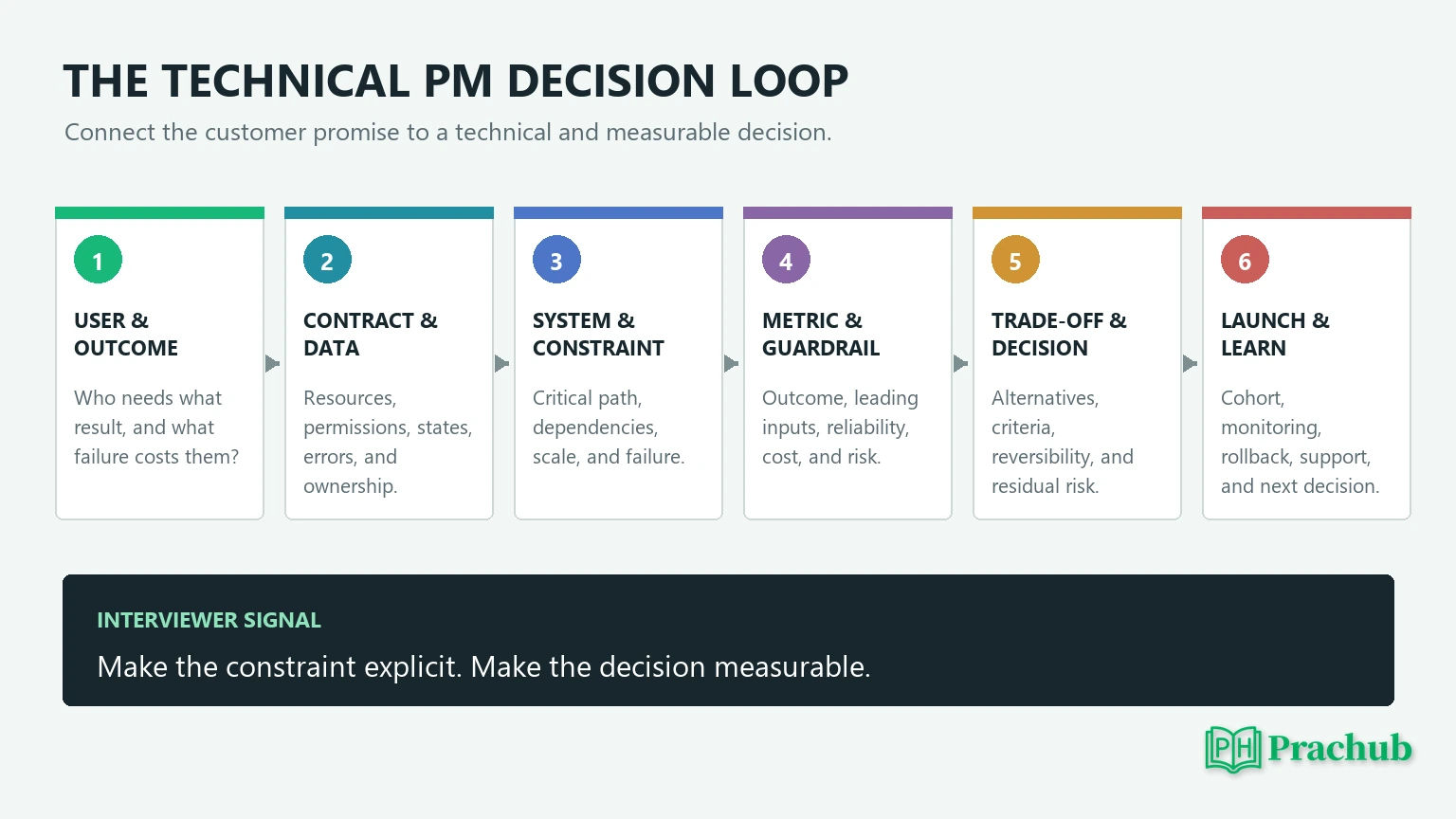
Use the CONTRACT framework for technical product questions
Use CONTRACT when a prompt mixes product, API, system, and execution concerns. It keeps the answer centered on a decision.
C - Customer and outcome
Define the primary user, job, pain, business outcome, and cost of failure. Internal developers, enterprise administrators, partners, and consumers need different interfaces and reliability promises.
O - Operations and contract
Name the core action and contract: resources, authentication, permissions, request behavior, errors, pagination, quotas, and compatibility. For a platform, clarify who can publish, discover, configure, and operate capabilities.
N - Numbers and guardrails
Choose one product outcome, two or three leading inputs, and guardrails for reliability, latency, cost, quality, privacy, or abuse. Define each metric so it supports a launch decision.
T - Technical boundaries
Map the critical path, systems of record, data ownership, and external dependencies. Know where a timeout, schema change, stale record, permission error, or partial failure becomes a product problem.
R - Risks and alternatives
Compare two credible options across customer impact, effort, operating burden, security, cost, time to value, vendor dependency, and reversibility. Name the assumption that could change your choice.
A - Alignment and decision
Recommend one path and name the key owners. Make disagreement useful by showing the decision criteria, evidence, and escalation point instead of claiming universal consensus.
C - Controlled launch
Describe a narrow first release, compatibility plan, monitoring, support readiness, and rollback trigger. A launch is incomplete if the team cannot detect harm or recover safely.
T - Track and learn
Say when results will be reviewed, which segments matter, what qualitative evidence complements telemetry, and what decision follows a good, mixed, or bad result.
API interview questions: think like the API is a product
Common prompts include "Design an API for partner onboarding" or "A client wants a breaking schema change. What do you do?" Start with the API consumer and workflow, not endpoint syntax.
Define the resources, actions, permissions, and valid state transitions. Discuss authentication separately from authorization, then cover errors, request identifiers, limits, documentation, sandbox access, observability, and the path to production.
Compatibility is a product commitment. Microsoft recommends considering pagination, filtering, asynchronous operations, and versioning because clients do not upgrade on the API provider's schedule. A strong PM answer identifies what counts as a breaking change, how long older behavior is supported, how clients are notified, and how adoption is measured.
Retries reveal whether your answer is operational. Stripe documents idempotency keys so a client can safely repeat a state-changing request without creating the same effect twice. Connect this to trust: define a duplicate-effect rate and recovery path, not merely the word "idempotency."
Rate limits are product policy. Ask what saturates, how quotas should differ, and what clients see when limited. Capacity should be fair, predictable, and debuggable.
Metrics interview questions: build a decision stack
For "How would you measure this platform?" weak answers list adoption, revenue, latency, NPS, and errors. Strong answers show how metrics drive distinct decisions.
Begin with the value exchange. For a partner API, the primary outcome might be weekly successful production integrations, not raw calls. Inputs could include time to first sandbox call, activation, approval time, and successful calls per integration.
Add guardrails for availability, tail latency, errors by cause, duplicate effects, security, support, and cost. Google SRE guidance recommends a small set of indicators reflecting what users care about; averages can hide the slow tail or an important segment.
Define the numerator, denominator, window, exclusions, segment, source, and expected decision. If successful calls rise but active partners fall, one large customer may mask churn. If latency improves while duplicate errors rise, the faster system may be a worse product.
For experiments, name the hypothesis, unit, primary metric, guardrails, duration, and practical significance. When A/B tests do not fit, use phased cohorts, matched comparisons, synthetic load, shadow traffic, or a migration holdout.
Systems questions: reason about boundaries, not boxes
Start a system question with one critical user path. Identify the system of record, synchronous dependencies, asynchronous work, stale data, and operations that require a stronger guarantee.
Ask who owns each fact. If identity and subscription state live in different services, which one authorizes access? If events arrive twice or out of order, what behavior is acceptable? If a partner is unavailable, should the request fail, queue, degrade, or remain pending?
Make reliability measurable. Google distinguishes an SLI, the measured behavior, from an SLO, the target. Choose latency, availability, correctness, freshness, or durability based on the journey. If the service spends its error budget, decide whether to pause launches, narrow exposure, or add capacity.
Security and privacy belong in the first design. Cover data classification, least privilege, tenant isolation, retention, deletion, auditability, and incident response. State which risks are unacceptable and which can be controlled through staged access.
Product trade-offs: make the decision falsifiable
Expect build versus buy, speed versus reliability, platform versus bespoke work, consistency versus availability, or cost versus latency. Do not stop at "it depends." State the decision factors and recommend one path under explicit assumptions.
For build versus buy, compare differentiation, time to value, ownership cost, integration, security, customization, vendor health, data portability, and exit cost. Define what a pilot must prove.
For platform versus bespoke work, identify reuse honestly. Premature abstraction delays the first customer and forces imagined requirements into every team. One practical path is to ship narrowly, learn from a second use case, then extract the stable contract.
AWS's Well-Architected guidance frames architecture as trade-offs among operational excellence, security, reliability, performance, cost, and sustainability. Translate those dimensions into customer consequences. A lower-cost eventually consistent store is not simply "cheaper." It may show stale entitlement state, so decide whether that is acceptable for browsing, billing, or access control.
End with falsifiability: "I recommend A because time to production and partner control matter most. I would switch to B if the pilot misses security, p99 latency, or two-year cost targets."
Worked example: launch a partner order API
Suppose partners need to create orders, read status, and cancel eligible orders. Define the partner operations team as the user and correct order submission as the outcome. Clarify volume, geography, cancellation rules, sensitivity, and confirmation needs.
Design the contract around orders and state transitions. Use scoped credentials, client-generated idempotency keys for creates, stable request IDs, cursor pagination for lists, documented error categories, and webhook delivery for status changes. Version breaking changes and provide a sandbox plus migration telemetry.
The primary product metric could be weekly partners completing valid production orders. Inputs include time to first call, integration completion, and successful order rate. Guardrails include duplicate-order rate, p99 latency, authorization failures, webhook delivery delay, support contacts, and cost per order.
Begin with two design partners and low quotas. Review failures and support evidence daily, and expand only after correctness and reliability targets hold. If synchronous confirmation creates fragile latency, return an accepted state and process asynchronously, while explaining the changed experience.
The API, metrics, system behavior, and rollout should support one product promise. No diagram substitutes for that connection.
Practice Technical PM questions on PracHub
These questions exercise the same product and technical judgment; they are not predictions of any one company's loop. Each complete title in the first column opens the question and written solution.
| PracHub question | Practice focus | Why it helps |
|---|---|---|
| Design API That Aggregates Three Downstream APIs | API contract, latency, errors, dependencies, and observability | Forces you to connect a customer response to partial failure and SLO choices. |
| Meta Pay: Metrics & Prioritization | North Star, supporting metrics, prioritization, and diagnosis | Trains metric definitions and product decisions when signals disagree. |
| Build vs. Buy Decision Framework | Cost, speed, scale, maintenance, lock-in, and differentiation | Builds a falsifiable recommendation instead of a generic comparison. |
| Explaining Technical Work to Non-Technical Stakeholders | Technical translation, measurable outcomes, and cross-functional influence | Shows whether your technical depth can improve a decision across functions. |
A seven-day Technical PM preparation plan
| Schedule | Focus | Deliverable |
|---|---|---|
| Day 1 | Role and product | Map target users, technical surface, business model, and highest-cost failure. |
| Day 2 | APIs | Answer one partner API prompt with contracts, errors, versioning, limits, and migration. |
| Day 3 | Metrics | Build two decision stacks with primary outcomes, inputs, guardrails, and segments. |
| Day 4 | Systems | Trace one critical path through ownership, dependencies, failure, and recovery. |
| Day 5 | Trade-offs | Complete the four linked PracHub prompts and compare the written solutions. |
| Day 6 | Leadership | Rehearse conflict, prioritization, failed launch, and technical influence stories. |
| Day 7 | Mock loop | Run one 40-minute case, then repeat it with a shorter and clearer recommendation. |
Frequently asked questions
Do Technical Product Managers need to code in interviews?
It depends on the company and role. Many Technical PM loops test technical fluency rather than implementation, but platform, developer-product, or highly specialized roles may add SQL, data, or coding screens. Treat the job description and recruiter guidance as the source of truth.
How technical should a Technical PM system design answer be?
Identify contracts, data ownership, dependencies, failure modes, security, and meaningful trade-offs. Let engineers own detailed implementation unless the prompt asks you to go deeper. Make the product consequence and decision criteria precise.
What is the difference between a Technical PM and a Technical Program Manager interview?
Technical PM interviews center on product outcomes, customers, prioritization, metrics, and technical product decisions. Technical Program Manager interviews usually emphasize execution across teams, dependency management, schedules, risk, and operational coordination. Some companies blur the titles, so read the responsibilities, not only the label.
What is the biggest mistake in API product questions?
Starting with endpoint syntax before defining the consumer and workflow. Authentication, authorization, errors, idempotency, pagination, limits, compatibility, and support become easier to reason about once the user promise is clear.
Final takeaway
The best Technical Product Manager answers connect four layers: a valuable customer outcome, a clear technical contract, metrics that support a decision, and an explicit trade-off. They show enough depth to earn engineering trust without turning the PM into a solo architect.
Use the Product Manager question bank on PracHub to practice those layers with complete prompts and written solutions. Attempt each question before opening the solution, state the constraint that drives your recommendation, and finish with the evidence that would change your mind.
Sources and further reading
- Amazon Principal Product Manager - Tech, Global Application Experience
- Amazon Product Manager - Tech Role: Roadmaps, Metrics, and Requirements
- Microsoft Principal Product Manager, Eventstream Connector Ecosystem
- Google Product Manager II, Infrastructure, Google Cloud
- Microsoft Azure Architecture Center: RESTful Web API Design
- Stripe API Reference: Idempotent Requests
- Google SRE Book: Service Level Objectives
- AWS Well-Architected Framework
- Atlassian: Product Metrics to Track and Analyze
Research note: This guide was checked on August 24, 2026. Technical Product Manager titles and interview loops vary by company, product surface, seniority, and whether the role focuses on APIs, platforms, data, infrastructure, enterprise integrations, or customer-facing products. Use the current job description and recruiter guidance as the source of truth.
Comments (0)