Uber SWE Intern OA 2027: Three Coding Questions, 65 Minutes, and What Comes Next
Quick Overview
An evidence-based guide to the Uber SWE Intern 2027 online assessment, including the reported three-question, 65-minute format, likely coding patterns, pacing strategy, hidden-test preparation, and what candidates may encounter after submission. Built for internship applicants who want company-specific practice without treating candidate reports as guaranteed assessment rules.
Sixty-five minutes for three coding questions sounds manageable until the first prompt demands careful preprocessing, the second hides a simulation edge case, and the third turns into a tree or graph problem. That is the pressure candidates describe in recent Uber software engineering internship online assessments.
The useful question is not whether every Uber OA uses the same set. It does not. The useful question is how to protect points when the format is short, the sets vary, and a complete score is only one part of the hiring decision.
Start with Uber Software Engineer questions to practice company-specific patterns, then use this guide to build a timed strategy for the assessment and the interviews that may follow.
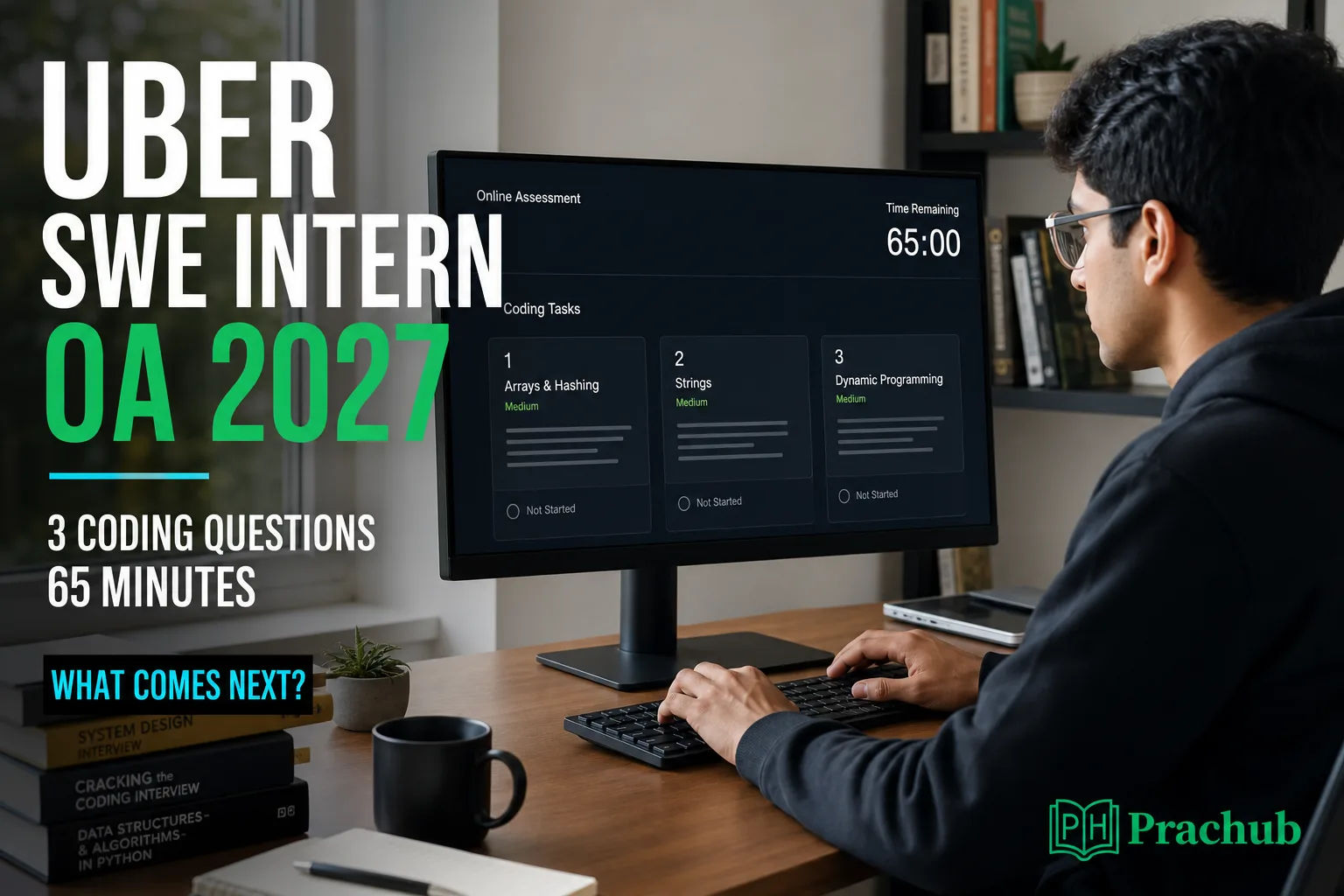
Quick answer: What should you expect from the Uber SWE Intern OA?
Recent candidate reports describe an Uber internship assessment with three coding questions in 65 minutes. The reported difficulty ranged from medium to hard, and candidates encountered different sets, including arrays, strings, graphs, trees, dynamic programming, simulation, and query-processing problems.
Treat that format as a current recruiting signal, not a universal contract. Uber runs multiple internship pipelines across countries, schools, and teams. Your invitation remains the source of truth for the platform, timer, deadline, allowed languages, and monitoring rules.
| Detail | Best current answer | Confidence |
|---|---|---|
| Number of questions | Three in several recent internship reports | Candidate-reported, pipeline-specific |
| Time limit | 65 minutes in multiple recent reports | Candidate-reported, not a global policy |
| Platform | HackerRank appears in recent reports; older regional reports mention CodeSignal | Check your invitation |
| Difficulty | Often described as medium to hard, with implementation pressure | Subjective and set-dependent |
| What comes next | Application review and one or more technical interviews may follow | Varies by location and hiring track |
Is the three-question, 65-minute format universal?
No. A current 2027 discussion described three questions in 65 minutes for an on-campus internship opportunity. Another recent Uber internship write-up also reported three DSA problems on HackerRank in 65 minutes, while an older India process used CodeSignal with three questions in 60 minutes.
Those reports are useful because they reveal recurring time pressure and problem families. They are not enough to claim that every 2027 candidate receives the same provider, timing, or questions.
Why candidates see different Uber OA sets
Assessment systems commonly draw from multiple question pools. Uber may also use different configurations for campus partnerships, direct applications, countries, degree levels, or role families.
Current candidate discussions mention different combinations of string DP, graphs, arrays, trees, subtree queries, simulation, and competitive-programming-style tasks. Memorizing one recalled set is therefore a fragile strategy. Prepare for the underlying skills instead.
What the OA invitation tells you
Read the complete invitation before choosing your preparation plan. Confirm the assessment provider, exact duration, expiration time and time zone, permitted languages, proctoring requirements, and whether a practice test is available.
If a forum post conflicts with the invitation, follow the invitation. Rules for external references, copy-paste, camera access, or leaving the assessment tab can be configured differently across tests.
What kinds of coding questions are being reported?
Recent reports should be used to identify problem shapes, not to reproduce proprietary prompts. Four families stand out because they combine algorithm selection with fast, accurate implementation.
1. Preprocessing and repeated queries
A prompt may look easy if each query is solved independently, yet that approach can exceed the time limit. Look for information that can be computed once, such as prefix counts, sorted positions, cumulative costs, or a reusable index.
Ask: what remains constant across all queries, and what is the smallest summary that answers each query quickly? State the preprocessing cost and per-query cost before coding.
2. Simulation and state transitions
Collision, movement, scheduling, and event problems reward precise modeling. Most failures come from ambiguous update order, simultaneous events, boundary conditions, or mutating state before all dependent values are read.
Write the state variables and one transition in plain language. Then test the smallest input, simultaneous events, no-op behavior, and a case where two rules compete.
3. Trees, graphs, and hierarchy queries
Hierarchy prompts may require traversal, subtree aggregation, path reasoning, or repeated updates. Decide whether the structure is truly a tree, whether edges are directed, and whether queries justify preprocessing.
For graphs, define the visited invariant and consider disconnected components. For trees, make the parent-child relationship explicit and test a single node, a chain, and a branching case.
4. Dynamic programming and strings
Some candidates report string or DP-heavy sets. Before writing a recurrence, define what one state represents, how it transitions, and which base cases make the definition true.
If the state space becomes too large, inspect whether only the previous row or a small rolling window is needed. A correct recurrence with careless initialization still fails hidden tests.
How to divide 65 minutes across three questions
A timer should guide decisions, not create panic. The goal is to bank correct tests early, preserve enough time to inspect all three prompts, and avoid spending half the assessment proving that one approach is stuck.
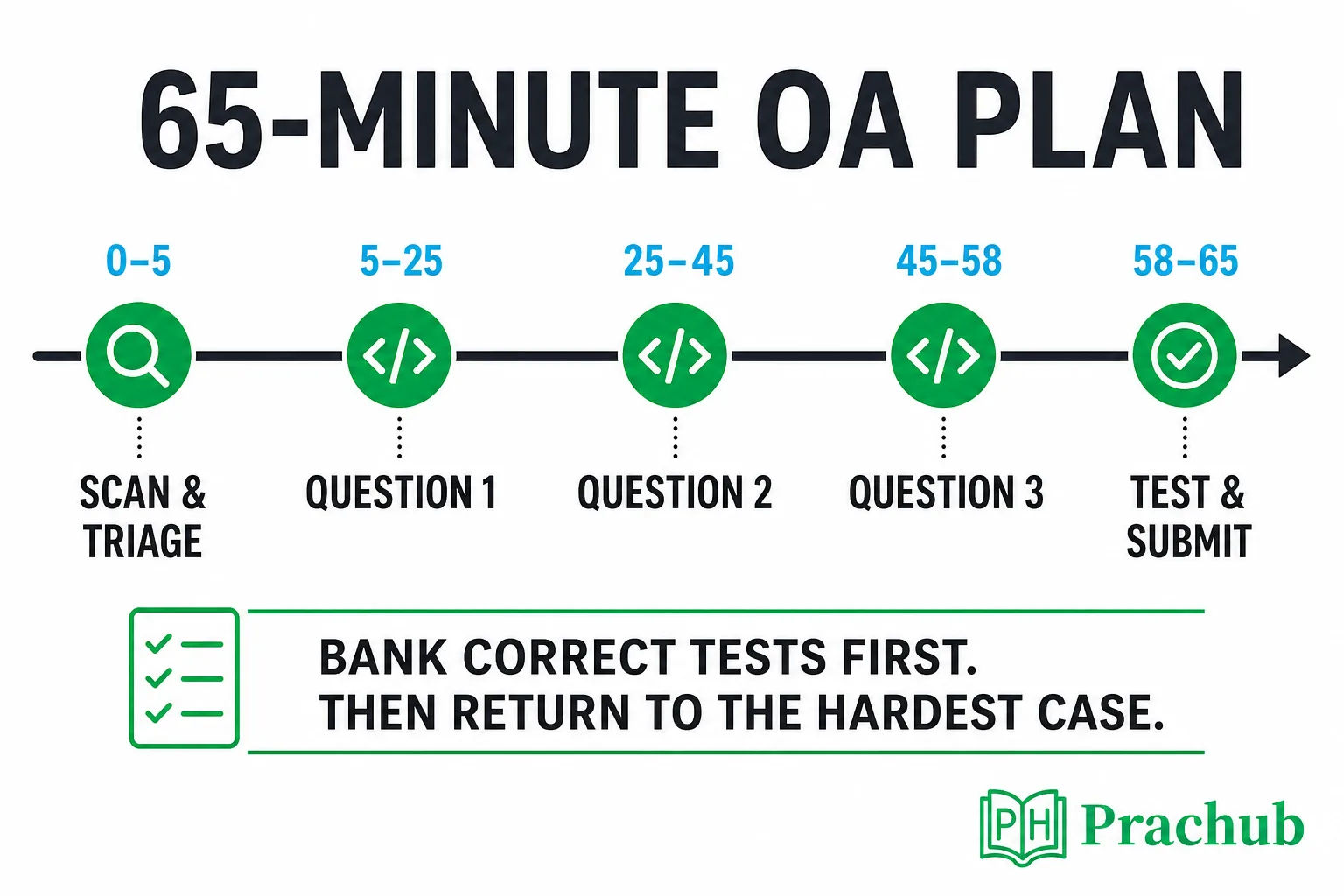
| Time | Action | Decision rule |
|---|---|---|
| 0-5 minutes | Scan all questions, constraints, examples, and required output | Rank by expected completion time, not by question number |
| 5-25 minutes | Implement the clearest high-confidence solution | Submit once core and edge cases pass |
| 25-45 minutes | Complete the second-best opportunity | Prefer a correct simpler solution unless constraints forbid it |
| 45-58 minutes | Work the hardest or least certain problem | Capture partial tests instead of leaving it blank |
| 58-65 minutes | Re-run tests, inspect boundaries, and submit final changes | Do not begin a risky rewrite without evidence |
When should you abandon a stuck approach?
Set a checkpoint before you start coding. If ten minutes pass and you still cannot state the invariant, complexity, or a path to a working implementation, return to another question or simplify the goal.
A partial solution can earn tests and demonstrate progress. A complicated half-rewrite at minute 58 can erase working behavior and leave you with less evidence than before.
Should you solve the easiest question first?
Usually, but “easiest” means easiest for you to finish correctly. A familiar-looking prompt with tricky parsing may be more expensive than a graph problem whose invariant is immediately clear.
The opening scan matters because question order does not necessarily match difficulty. Read constraints and examples before committing your first twenty minutes.
How are Uber OA results evaluated?
There is no reliable public universal cutoff for Uber's 2027 internship assessments. Online discussions may contain score anecdotes, but different sets, hiring pipelines, applicant pools, and resume screens make those numbers difficult to compare.
Does partial completion mean automatic rejection?
No. One recent Uber internship candidate reported solving the first two questions and passing 9 of 15 tests on the third, then advancing through technical interviews and receiving an internship offer. That is a useful counterexample to the belief that only a perfect submission can move forward.
It is not a promise that the same result will advance in every pipeline. It shows why you should maximize correct tests, submit partial progress, and keep the rest of your application strong instead of treating one failed hidden case as a final verdict.
What hidden tests are likely to expose
Hidden tests often distinguish a plausible solution from a production-quality one. Check empty or minimal input, duplicates, negative or large values, integer overflow, disconnected data, repeated events, invalid assumptions about ordering, and asymptotic behavior near the maximum constraints.
Before the final submission, trace one case by hand and compare each state change with the code. That short review catches more defects than adding random examples without a hypothesis.
What happens after the Uber SWE Intern OA?
The next step depends on the program and location. A strong assessment may be followed by an application or resume review, recruiter coordination, and one or more technical interviews. Some historical internship reports also describe project discussion, behavioral questions, or a machine-coding-style round.
Do not assume that passing public tests produces an automatic interview. Hiring teams still consider role eligibility, graduation date, location, work authorization, resume evidence, and available headcount.
How long should you wait?
Response times vary from days to several weeks. Recruiting volume, interview capacity, campus schedules, and headcount can delay an otherwise active application.
If the recruiter supplied a timeline, wait until that window has passed. Then send one concise follow-up with the role title, assessment date, and continued interest, while continuing other applications.
How should you prepare for the next round?
Move from silent OA execution to explainable problem solving. Practice clarifying requirements, stating a simple baseline, selecting a data structure, coding in small verified steps, and discussing complexity before the interviewer asks.
Also prepare a two-minute project overview, a difficult bug, a design trade-off, and a collaboration story. The Uber Software Engineer interview guide maps the broader loop, while behavioral and leadership questions help you rehearse concise evidence.
Practice with Uber questions from PracHub
These Uber question-bank records train patterns relevant to timed coding and later technical rounds. They are not predictions or leaks of your exact 2027 assessment. Each complete title in the first column links directly to the question and written solution.
| PracHub question | Practice focus | Why it helps |
|---|---|---|
| Find Minimum Reversals to Orient Edges Away From Root | Graphs, DFS/BFS, edge direction | Trains explicit invariants and careful traversal over directed relationships. |
| Count Subarrays With at Least K Fruit Pairs | Sliding window, frequency maps | Builds fast implementation and boundary control under a timer. |
| Compute Outer Boundary of an N-ary Tree | Trees, traversal, edge cases | Forces a precise definition of hierarchy, ordering, and duplicate suppression. |
| Find Earliest Time All Riders Become Connected | Union-find, sorting, connectivity | Combines event ordering with a reusable connectivity data structure. |
Attempt each question without opening the solution. Afterward, compare not only the algorithm but also your input handling, invariant, complexity explanation, and test coverage. Those details are what convert practice into interview performance.
A seven-day Uber OA preparation plan
| Schedule | Focus | What to do |
|---|---|---|
| Day 1 | Baseline | Run a 65-minute three-question simulation. Record time spent, solved tests, and the exact reason for every failure. |
| Day 2 | Arrays and strings | Practice sliding windows, frequency maps, sorting, and parsing. Retest duplicates, empty inputs, and index boundaries. |
| Day 3 | Trees and graphs | Solve one traversal and one connectivity problem. State the visited or parent invariant before coding. |
| Day 4 | Queries and simulation | Practice preprocessing repeated queries and modeling ordered state transitions. Compare a direct baseline with an optimized approach. |
| Day 5 | Dynamic programming | Define states and base cases for two string or sequence problems, then reduce memory only after correctness is clear. |
| Day 6 | Full simulation | Repeat the exact timing plan: five-minute scan, two twenty-minute blocks, thirteen minutes on the hardest task, and seven minutes to test. |
| Day 7 | Final review | Retest failed problems, review language pitfalls, confirm invitation logistics, and stop learning new topics. |
Common mistakes that cost candidates points
Committing to question one without scanning. The third question may match your strongest pattern. Spend the first few minutes comparing constraints and expected implementation cost.
Optimizing before establishing correctness. Begin with the clearest valid approach. Optimize only when the constraints require it and you can explain why the new structure works.
Ignoring the input contract. Many timed failures come from parsing, return types, mutation, or ordering rather than the central algorithm. Re-read the function signature and examples before submitting.
Waiting for perfection before submitting. Save working checkpoints and bank passing tests. A partial third answer is stronger than an empty editor, and a working first answer is stronger than an unfinished rewrite.
Preparing only for the OA. If the process moves quickly, you may have little time before a technical interview. Continue practicing explanation, projects, and behavioral evidence alongside timed coding.
Frequently asked questions
Is the Uber SWE Intern OA always three questions in 65 minutes?
No. That format appears in multiple recent candidate reports, but Uber can vary the platform, timing, and question set by program, region, and recruiting channel. Follow the details in your own invitation.
Is the Uber OA on HackerRank or CodeSignal?
Recent internship reports mention HackerRank, while older regional reports mention CodeSignal. Do not infer your provider from another candidate's experience; the assessment link and invitation identify the correct platform.
Do I need to solve all three questions?
Solve as much as you can, but there is no verified universal cutoff. A recent candidate advanced after two complete solutions and partial tests on the third. Results can still depend on set difficulty, application review, hiring capacity, and the rest of the process.
Are the same Uber OA questions reused?
Candidates report different sets, so do not rely on one recalled list. Train recurring patterns such as arrays, strings, graphs, trees, query preprocessing, simulation, and dynamic programming.
Can I use AI or external resources during the assessment?
Use only tools and references explicitly permitted by your invitation and the assessment provider. A rule described in a forum post for another pipeline does not grant permission in your test.
What should I do after submitting?
Save the completion confirmation, monitor email and spam, and prepare for technical and project discussions. Follow up once if a stated response window passes, but keep other applications moving.
Final verdict
The current three-question, 65-minute reports make the Uber SWE Intern OA a test of prioritization as much as algorithms. The strongest plan is to scan first, bank correct tests, switch deliberately, and reserve the final minutes for boundaries and hidden-test risks.
Use Uber Software Engineer questions for company-specific practice and written solutions. Then continue with PracHub's Uber interview preparation so an OA pass does not catch you unprepared for the next round.
Sources and Further Reading
- Uber: 2027 Career Prep Software Engineering Internship
- Uber: Emerging Talent
- Current candidate report: Uber 2027 SWE internship OA with three coding questions
- Current candidate discussion: Uber SWE Intern 2027 question-set variation
Research note: This guide was checked on August 19, 2026. Uber sources establish official role and early-career information. Assessment format, question families, scores, and timelines are based on candidate reports and may not apply to every role, location, or recruiting channel.
Comments (0)