Walleye Capital Quantitative Developer Intern 2027: Coding, Systems, and Timeline
Quick Overview
An evidence-labeled guide to Walleye Capital’s Boston Quantic Quantitative Developer internship, with official eligibility and recruiting details, a bounded 2027 OA report, and original Git/Linux and execution-data exercises.
The Walleye Capital Quantitative Developer Intern 2027 opportunity is a Boston-based role on the Quantic team. The preparation signal is broader than algorithm practice: the official posting emphasizes data infrastructure and operating systems, while a same-cycle candidate account describes Git/Linux, programming, and written explanation in the assessment.
That account is useful, but it does not establish a universal format. This guide separates the official recruiting framework from candidate reports and original exercises. Its central question is practical: can you explain why your code, development workflow, and resulting dataset are trustworthy?
Start with PracHub Software Engineering Fundamentals questions, then work through the repository-debugging and execution-report examples below. These are preparation exercises, not disclosed Walleye assessment questions.
Confirm the Boston Quantic role before planning
Official facts: The Quantic Quantitative Developer internship lasts 10 weeks in Boston, from June to August 2027. Applicants should be pursuing an undergraduate or advanced degree in a relevant technical field, with expected graduation between December 2027 and June 2028. The posting asks for scripting proficiency, giving Python, Bash, and Perl as examples; UNIX/Linux/BSD experience; and familiarity with statistical or machine-learning packages. Official 2027 role
The advertised work includes quantitative infrastructure, data-pipeline integrity and traceability, collaboration with researchers and traders, and risk or execution analysis using a proprietary columnar database. AI tools also appear in the job description. These are job expectations, not confirmation of an interview language, database product, or permission to use AI during an assessment.
Official application distinction: Walleye’s campus FAQ asks applicants to choose only one of Quantic’s Quantitative Researcher and Quantitative Developer opportunities. It also says international intern work authorization is supported; confirm the arrangements relevant to you with recruiting. Campus FAQ
Do not substitute the process for a Miami research position, a New York volatility developer role, or a generic technology internship. A deadline or interview account attached to one of those openings does not automatically apply to Boston Quantic QD.
What is known about the assessment and interviews
Official framework: The campus FAQ describes a team-dependent process of generally four to six rounds, beginning with an assessment or coding test and continuing with behavioral and/or technical interviews. Most positions include a case study. This is a company-wide outline, not a guaranteed sequence for this particular internship. Walleye recruiting FAQ
Same-cycle candidate report: In a thread explicitly titled for Quantic Quantitative Developer Interns 2027, a June 26, 2026 commenter said they had completed an assessment covering Git/Linux, data structures and programming, and a longer English response explaining key points. Other participants acknowledged receiving invitations. Only one detailed completed-assessment account was established here; those acknowledgments do not independently confirm its format. 2027 QD discussion
That commenter also described section-specific AI rules. Treat this as an anecdote, not authorization: read your invitation and each section’s instructions. Permission for a coding section would not necessarily extend to the written response. Neither an AI-oriented job description nor another candidate’s experience overrides your own rules.
Historical candidate reports: A November 2024 QD-intern discussion includes replies describing algorithmic interviews with differing perceived difficulty. It supports retaining coding practice, but says little about the 2027 platform or complete loop. Historical QD discussion
Two independent, detailed same-cycle process reports were not available. Consequently, this guide does not promise HackerRank, a fixed timer, a passing score, or a mandatory take-home assignment. Prepare for the supported themes and use recruiting correspondence to resolve the remaining details.
Coding preparation: make the contract survive optimization
Preparation inference: Practice problems that require careful input handling, explicit state, and an explanation of complexity. Use the language you can debug confidently within the permitted environment. Python is a sensible practice choice given the scripting requirement, but selecting it does not remove the need to understand memory use and failure behavior.
For a sorted-stream problem, clarify whether equal values represent duplicate deliveries or separate legitimate events. Those contracts produce different outputs. With inputs [2, 2, 5] and [2, 4], a merge preserving occurrences produces [2, 2, 2, 4, 5]; a distinct-value union produces [2, 4, 5].
Start with a correct version. For two sorted streams, track the next available element from each and explain how you advance one input at a time. If output must be lazy, do not materialize the entire result merely to simplify testing. Check empty streams, repeated values, and an input that finishes much earlier than the other.
When asked to optimize, name the actual bottleneck. Is time spent comparing elements, reading data, allocating objects, or waiting on an API? Distinguish algorithmic complexity from service latency. If you propose caching or concurrency, explain invalidation, bounded resource use, and what changes when a dependency fails.
Original Git/Linux exercise: the test passed locally, but what ran?
This original debugging exercise combines the reported tooling theme with development practices useful for data infrastructure. It is not a reconstruction of the OA.
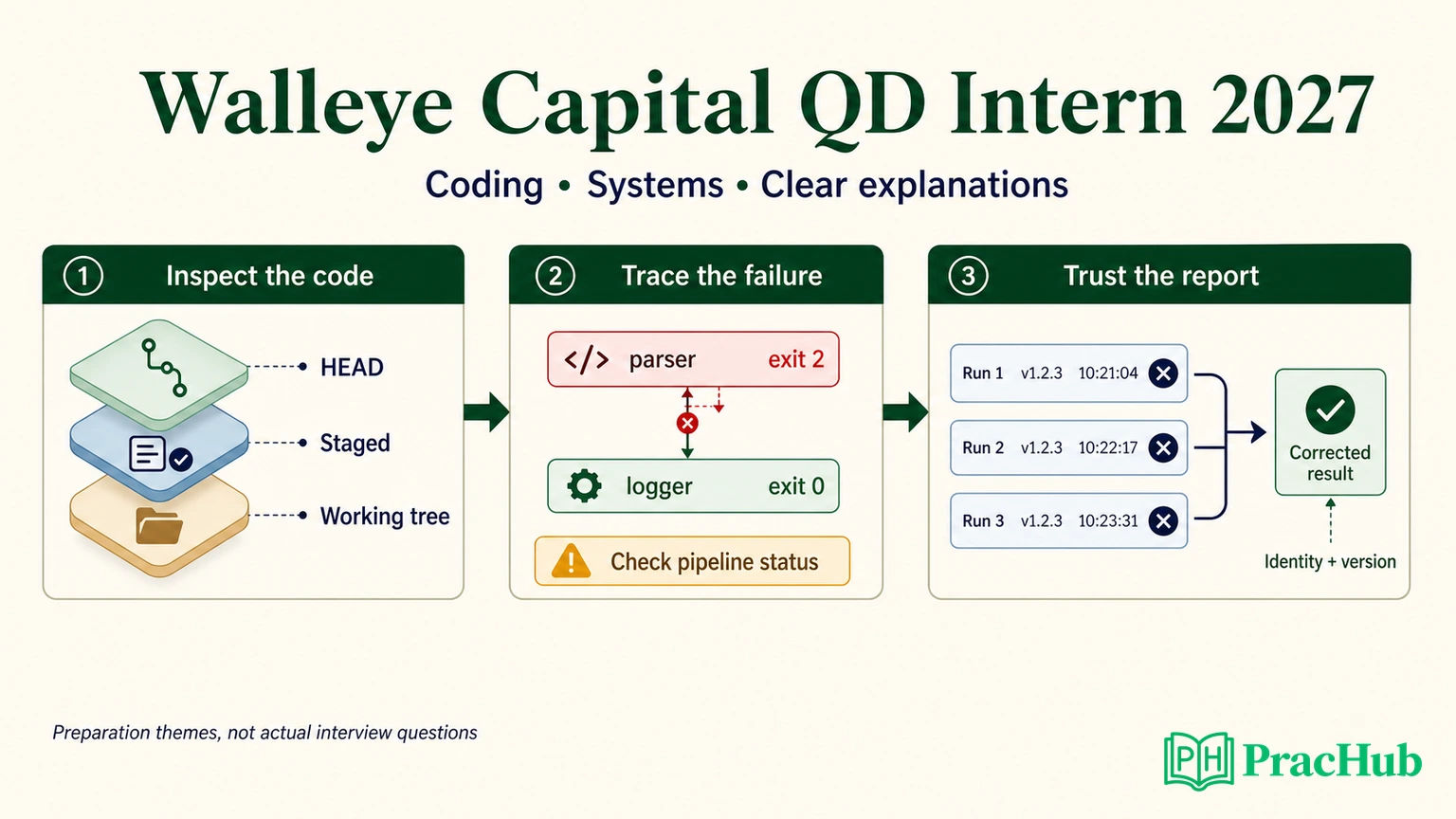
You change parser.py, stage that version, and then make another fix without staging it. You also create a local input fixture but leave it untracked. Tests pass on your laptop. A teammate checks out your commit and sees a failure.
There are now three relevant code states: the committed version, the staged version, and the working-tree version. Normal local tests read the working tree; a commit normally records the staged contents. Ask which one the local test executed and which one the teammate received. Inspect git status, then compare unstaged changes with git diff and staged changes with git diff --cached. The official Git documentation distinguishes these comparisons; ordinary diffs do not include an untracked fixture. git diff documentation
The repair is not simply “commit everything.” Review the intended fix, include an appropriate test fixture, exclude unrelated files, and rerun from a clean checkout of the exact commit. Record the command and relevant dependencies. This separates reproducibility from a local success that depends on files nobody else has.
Now inspect the test wrapper. In this hypothetical Bash pipeline, the parser emits partial output and exits with status 2, while tee successfully writes the log and exits with status 0:
python parser.py sample.csv | tee run.log
By default, Bash reports the last command’s status for the pipeline, so the wrapper can appear successful. With set -o pipefail, the pipeline instead reflects the rightmost nonzero exit status when a command fails. Bash pipeline semantics
A nonzero status is only a signal. The caller must check it and prevent publication of incomplete results. pipefail does not undo partial output, make writes transactional, or guarantee that a later command will not run. For a batch tool, write into a temporary destination, validate completion, and publish only after the required checks succeed.
In an interview explanation, connect each observation to a hypothesis: an untracked fixture explains a missing input; an unstaged fix explains different behavior; a masked exit code explains a falsely green job. That is more useful than reciting a list of Linux commands without showing what they establish.
Original systems exercise: repeated executions are not extra volume
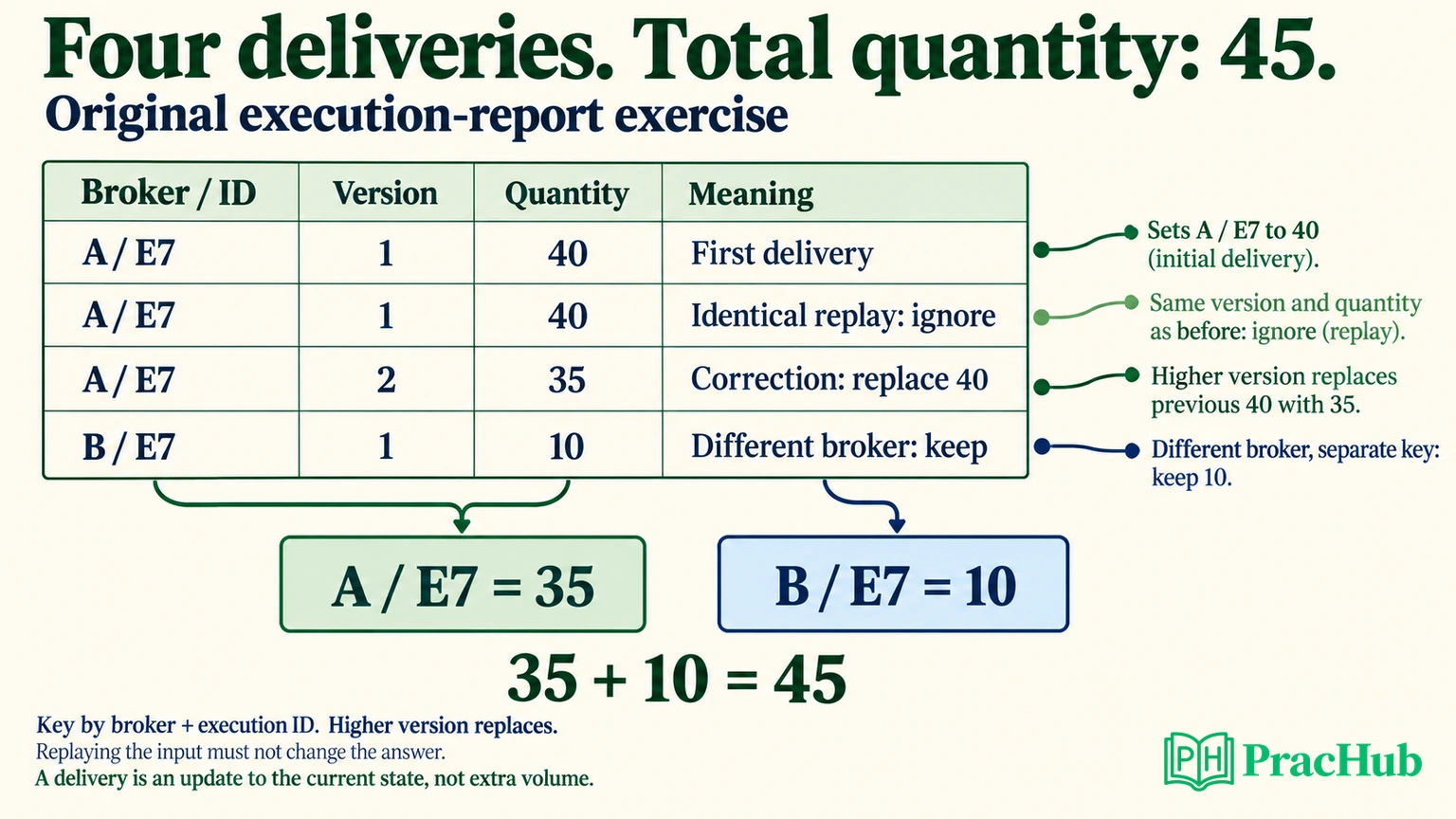
Original design scenario: Build a research-facing execution report. It consumes fictional records containing a broker, execution ID, version, and filled quantity. A higher version replaces the earlier quantity for the same logical execution; it is not an incremental fill. The identifier is unique only within a broker.
| Incoming record | Meaning under this contract | Contribution after processing |
|---|---|---|
| Broker A, E7, version 1, quantity 40 | First delivery | A/E7 contributes 40 |
| Broker A, E7, version 1, quantity 40 | Identical replay | A/E7 still contributes 40 |
| Broker A, E7, version 2, quantity 35 | Correction replaces version 1 | A/E7 contributes 35 |
| Broker B, E7, version 1, quantity 10 | Different broker, different execution | B/E7 contributes 10 |
The final total is 45, not 125. Summing arrivals counts both a replay and a superseded value. Deduplicating only on execution ID makes the opposite mistake: it can erase the valid record from Broker B.
Keep current state keyed by (broker, execution_id). Accept a higher version as a replacement and ignore an identical replay. In this exercise, retain an older version for audit but do not let it replace current state. If the same key and version carry conflicting quantities, flag the conflict rather than silently choosing whichever arrived last. Preserve raw deliveries separately so the report can be traced back to its inputs.
Next, introduce a crash. The worker commits the corrected execution but fails before acknowledging the input message. The message is delivered again. An idempotent write should leave the contribution unchanged. If you maintain both current execution state and a stored aggregate, update them within a consistency mechanism that prevents one from changing without the other.
PostgreSQL’s transaction tutorial explains all-or-nothing grouping of database changes. That is one conceptual reference for the design, not evidence that Walleye uses PostgreSQL. A database transaction alone also does not make an external message acknowledgment atomic with the database commit. Transaction documentation
An alternative is to calculate totals from the current-state table, avoiding a separately maintained aggregate at the cost of query work. Explain the trade-off before adding infrastructure. Whatever design you choose, replay the same input twice and verify that the answer stays 45.
Discuss a research platform through observable failure modes
Recommended practice: Extend the execution example into a small system discussion. Separate raw ingestion, validated current state, analytical queries, and report publication. Define freshness and correctness independently: a quickly refreshed report can still be wrong, while a correct report can be too stale for its intended use.
For an analytical query, identify the fields and time range needed before discussing storage. Reading only relevant columns and partitions can reduce work when the chosen database supports it. Do not assume the posting’s columnar database provides a particular query language, transaction model, or streaming guarantee. State requirements and ask about the actual interface.
Choose metrics that diagnose the example: duplicate delivery count, conflicting-version count, rejected records, time since the latest accepted input, and reconciliation differences. Explain who sees an alert and what action it supports. An alert called “pipeline unhealthy” is less useful than identifying which dataset is stale and which reports depend on it.
For backfills, decide how corrected historical data becomes visible without mixing incomplete new output with an existing report. For concurrency, explain how simultaneous versions for one execution are ordered or rejected. A read-then-write version check needs coordination; two workers must not let an older update overwrite a newer one. Keep these as design choices to justify, rather than assuming a particular implementation is always required.
Plan the timeline using separate clocks
Official timing: The FAQ says applications are reviewed on a rolling basis, with role-specific deadlines. Materials are reviewed over the following weeks, and applicants receive email decisions; responses may come after an application deadline. The inspected Quantic QD posting did not display an exact closing date. Campus FAQ
Keep four dates separate: application submission, the closing date on your specific role, the assessment completion deadline in your invitation, and the next update promised by recruiting. The June–August internship window does not determine any of those dates. A job-board repost timestamp is not an official opening date either.
Before starting an assessment, confirm whether sections have separate clocks, whether breaks are permitted, which tools are allowed, and how the written portion is submitted. If an update date passes, a concise follow-up can name the role, your last completed stage, and your availability. Do not treat silence for a few days as proof of rejection.
Five PracHub questions to connect the preparation
These are cross-company practice records, not confirmed Walleye questions. Some full details may require access. Use each to rehearse a specific explanation, rather than presenting another employer’s prompt as a forecast.
| PracHub question | What to practice | Follow-up for this guide |
|---|---|---|
| Demonstrate Git and build workflow | Reproducible repository state | Prove the committed version passes |
| Explain Linux Command Execution, Filesystems, and Isolation | Process and exit-status reasoning | Explain why the wrapper looked green |
| Design a Lazy Union Iterator for Sorted Inputs | Explicit streaming contracts | Preserve legitimate repeated values |
| Reason About Duplicate Data and Scaling in Spark | Identity and replay behavior | Keep the corrected total at 45 |
| Explain ETL schema changes and ensure integrity | Validation and reconciliation | Handle a vendor changing field meaning |
Finish with Demonstrate Git and build workflow, then write a short explanation of the failure you reproduced, the evidence that isolated it, and the check that prevents recurrence. Being able to connect those three points is useful preparation for both a technical conversation and a written explanation.
Sources and Further Reading
- Walleye Capital: Quantic Quantitative Developer Intern, Summer 2027
- Walleye Capital: Campus FAQs
- Reddit: Quantic Quantitative Developer Interns 2027 OA discussion, June 2026
- Reddit: historical Quant Developer Intern interview discussion, November 2024
- Git: git diff documentation
- GNU Bash: pipeline exit-status behavior
- PostgreSQL: transaction fundamentals
Research checked September 7, 2026. Official role details and the company-wide recruiting framework are distinct from individual candidate reports. Exercises are original and hypothetical; your invitation controls assessment rules and deadlines.
Comments (0)