XGBoost
Asked of: Machine Learning Engineer
Last updated
What's being tested
Interviewers are probing whether you understand gradient-boosted decision trees beyond “call XGBoost.fit().” For an Amazon Machine Learning Engineer, the important skill is connecting the learning algorithm to scalable training behavior: split finding, parallelism, sparse data handling, memory layout, distributed execution, and production tradeoffs. You should be able to explain why XGBoost can train efficiently on large tabular datasets, when it bottlenecks, and how you would tune or deploy it in a real ML pipeline. Strong answers combine algorithmic understanding with systems awareness: CPU cache, feature sparsity, distributed workers, evaluation, and online/offline parity.
Core knowledge
-
Gradient boosting trains an additive ensemble of weak learners, usually trees:
Each new tree fits the negative gradient of the loss, so training is sequential across boosting rounds but parallelizable within each round. -
Second-order optimization is a key
XGBoostidea. For loss , it uses gradients and Hessians to score splits:
where , . -
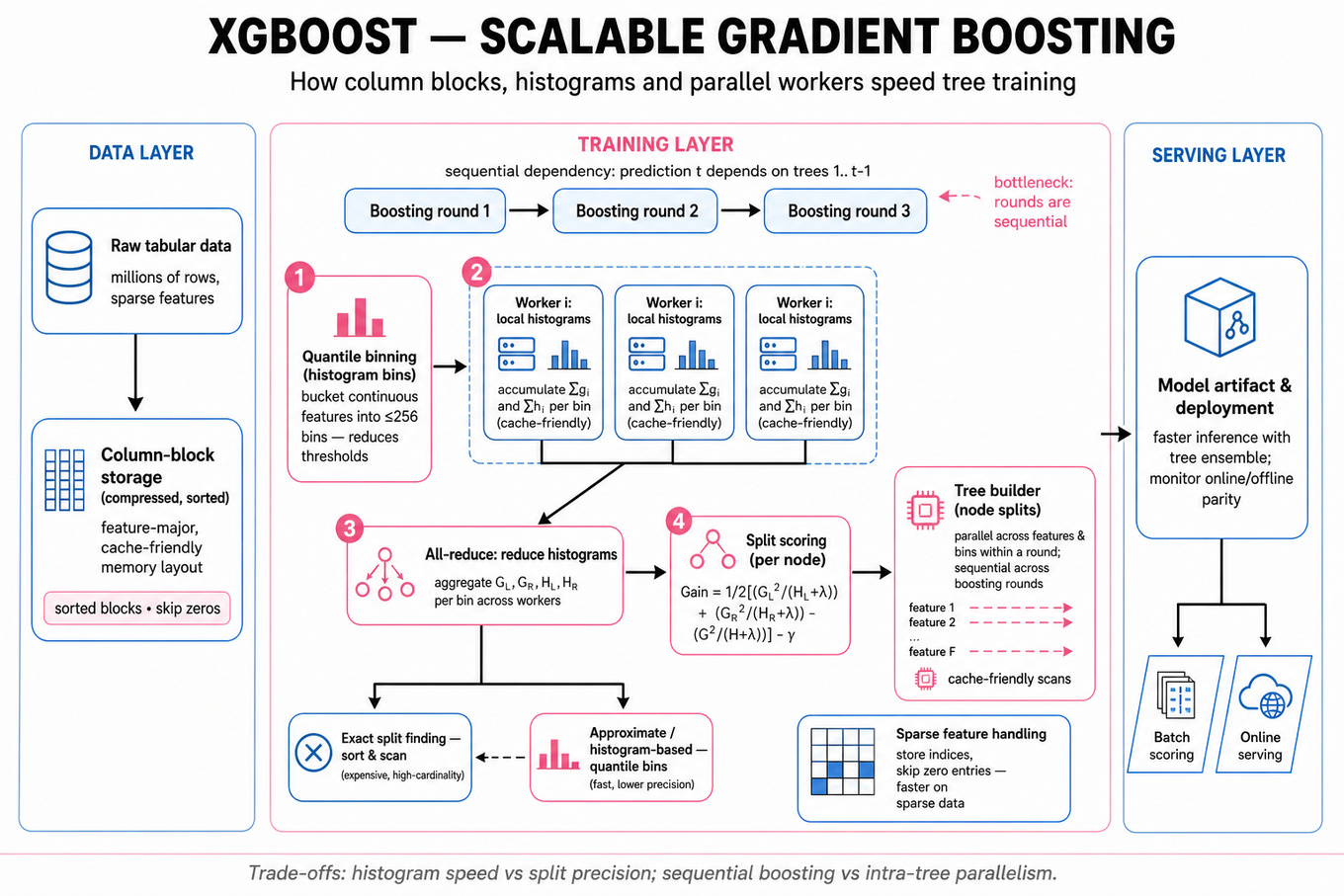
Tree-level dependency limits parallelism: boosting rounds are inherently sequential because tree depends on predictions from trees . The main parallelism is within a tree: evaluating candidate splits across features, data partitions, nodes, and histogram bins.
-
Exact split finding sorts feature values and scans thresholds, which can be expensive for high-cardinality or large datasets.
XGBoostsupports approximate split finding and histogram-based algorithms, where continuous features are bucketed into quantile bins, reducing computation from many thresholds to typically 256 or fewer bins per feature. -
Histogram-based split finding accumulates gradient and Hessian statistics per feature bin. This is cache-friendly and enables parallel workers to build local histograms and reduce them. It trades some split precision for major speed and memory benefits, especially on datasets with millions of rows.
-
Column block storage is central to
XGBoostefficiency. Data is stored in compressed, sorted blocks by feature so that split scans access memory sequentially. This improves CPU cache locality and reduces random memory access, which often matters more than raw arithmetic throughput. -
Sparsity-aware split finding handles missing values and one-hot sparse features efficiently. For each split,
XGBoostlearns a default direction for missing values by evaluating whether missing entries should go left or right. Sparse-aware traversal avoids explicitly iterating over zeros in sparse matrices. -
Parallelism strategies include feature parallelism, data parallelism, node-level parallelism, and histogram parallelism. In practice, modern implementations often favor histogram/data parallelism because it maps well to multicore machines and distributed workers while minimizing synchronization overhead.
-
Distributed training usually has each worker compute local gradient/Hessian histograms on a shard of data, then perform an
AllReduce-style aggregation. Communication cost scales with number of features, bins, and active nodes, so wide datasets or deep trees can become network-bound. -
Regularization controls overfitting and serving cost. Important knobs include
max_depth,min_child_weight,gamma,lambda,alpha,subsample,colsample_bytree, andlearning_rate. Smaller trees and fewer boosting rounds improve latency and memory footprint for online inference. -
Evaluation discipline matters because boosted trees can overfit quickly. Use validation sets,
early_stopping_rounds, calibration checks for probabilistic outputs, and task-appropriate metrics such asAUC,NDCG,logloss,RMSE, orMAPE. For ranking, userank:pairwise,rank:ndcg, orrank:mapobjectives when appropriate. -
Production MLE concerns include feature consistency, model artifact size, inference latency, and drift monitoring.
XGBoostmodels are often strong baselines for tabular prediction, but large ensembles can hurtp99latency; you may need model compression, feature pruning, or a latency-aware hyperparameter search.
Worked example
For “Explain XGBoost Parallelism Strategies”, a strong candidate should first frame the answer around the constraint that boosting rounds are sequential, so the useful parallelism is mostly inside each tree. I would clarify whether the interviewer wants single-node multicore behavior, distributed training, or both, and I would state that I’m assuming histogram-based training on sparse tabular data. Then I’d organize the answer around four pillars: split finding, data representation, sparse handling, and distributed synchronization. For split finding, I’d explain that exact threshold search is expensive, while histogram-based methods aggregate and into bins and evaluate gains per bin. For systems behavior, I’d mention compressed column blocks, cache locality, and local histogram construction across threads.
Next, I’d describe distributed training: each worker processes a data shard, builds local histograms, and aggregates them so every worker can choose the same best split. The tradeoff I’d explicitly flag is that histogram binning reduces precision but dramatically lowers CPU, memory, and communication cost; for most large-scale tabular workloads this is the right tradeoff. I’d also discuss sparse-aware default directions for missing values because Amazon-scale datasets often have high-dimensional categorical or behavioral features with many zeros. I would close by saying that, if I had more time, I’d benchmark hist versus approx, tune max_bin, measure training throughput and validation quality, and check whether the bottleneck is CPU, memory bandwidth, or network communication.
A second angle
For “Explain key ML theory and techniques”, the same concept may appear as one component in a broader ML discussion rather than a standalone systems question. Here, you need a concise but accurate explanation that contrasts XGBoost with other model families such as neural networks, collaborative filtering models, or bandit algorithms. The framing should emphasize that XGBoost is a supervised, batch-trained, tree-ensemble method especially strong on structured tabular data. Instead of diving only into parallelism, connect the algorithm to training objective, regularization, missing-value handling, and deployment implications. The key is to show you can move between theory and practical MLE concerns without treating XGBoost as a black box.
Common pitfalls
Pitfall: Saying “
XGBoostparallelizes trees” without qualification.
That answer is tempting but mostly wrong. Boosting rounds are sequential because each tree depends on residuals or gradients from the previous ensemble. A better answer is: “Trees are added sequentially, but split evaluation, histogram construction, feature scans, and distributed gradient aggregation can be parallelized within each boosting round.”
Pitfall: Explaining only model quality and ignoring systems tradeoffs.
For an MLE interview, “it has regularization and usually performs well on tabular data” is not enough. You should discuss training throughput, memory layout, sparse matrices, distributed communication, model size, and inference latency. Interviewers want to see that you can operate the model in a production pipeline, not just choose it in a notebook.
Pitfall: Treating histogram binning as a free optimization.
Histogram methods approximate continuous split points, so max_bin affects both accuracy and cost. Too few bins can underfit or miss important thresholds; too many bins increase memory and communication overhead. A strong answer names the tradeoff and proposes validation-based tuning rather than claiming one setting is universally best.
Connections
Interviewers may pivot from XGBoost to LightGBM, CatBoost, distributed training, feature stores, or model serving latency. They may also ask how boosted trees compare with deep learning for tabular data, how to monitor feature drift, or how to calibrate probability outputs before using scores in downstream ranking or decision systems.
Further reading
-
XGBoost: A Scalable Tree Boosting System — the original paper explaining sparsity-aware split finding, weighted quantile sketch, cache-aware access, and distributed training.
-
Elements of Statistical Learning, Chapter 10 — strong conceptual grounding for boosting, additive models, and tree ensembles.
-
LightGBM: A Highly Efficient Gradient Boosting Decision Tree — useful contrast on histogram algorithms, leaf-wise growth, and large-scale GBDT optimization.
Featured in interview prep guides
Practice questions
Related concepts
- Tree Ensembles And XGBoost For Tabular ML
- Supervised ML, Imbalance, Overfitting, And OptimizationMachine Learning
- Logistic Regression, Regularization, And Imbalanced ClassificationMachine Learning
- Supervised ML Fundamentals, Evaluation And Feature EngineeringMachine Learning
- Growth Diagnostics, Metric Trees, Estimation, and A/B Testing
- Distributed GPU Computation And Parallel MLML System Design