What to expect
This guide is for data scientists preparing for Uber's interview loop, and it lays out exactly what each round tests, how to prepare, and what separates a strong answer from an average one. Uber's Data Scientist process is analytics-first: it leans heavily on SQL, experimentation, and marketplace judgment rather than pure machine learning or algorithmic coding. The full loop is commonly described as a multi-stage sequence and typically runs end to end in about three to six weeks, from recruiter screen to final round.
What sets Uber apart is the two-sided marketplace lens. Interviewers want to see how you reason about riders, drivers, and the platform at the same time, not just one side of a tradeoff. Across the rounds, be ready for a SQL-heavy technical evaluation, an experimentation- and statistics-focused round, and open-ended product analytics cases tied to retention, cancellations, ETAs, incentives, and marketplace health. Many teams also push on causal inference and ambiguous business judgment, and some specialized teams add modeling or ML system design.
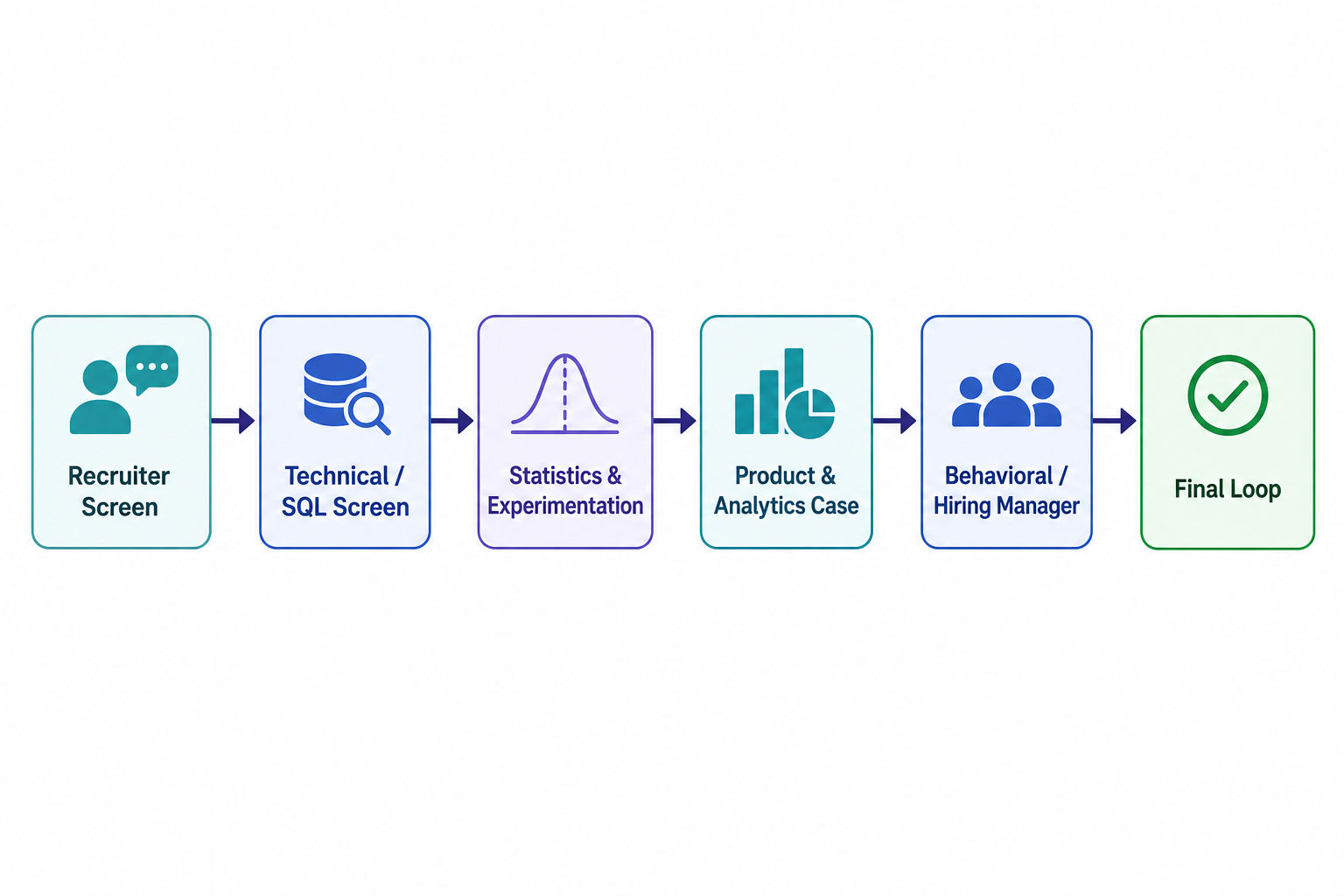
The interview loop at a glance
The exact structure and round names vary by team and level. The table below reflects what candidates commonly encounter; treat it as the typical building blocks rather than a fixed sequence.
| Round | Typical length | Primary focus | What good looks like |
|---|---|---|---|
| Recruiter screen | 30-60 min | Background, level fit, motivation | Crisp "why Uber / why this team" and a clear map of your experience to the role |
| Technical / SQL screen | 45-60 min | SQL, sometimes Python/pandas | Correct, readable queries; stated assumptions; thinking out loud |
| Statistics & experimentation | 45-50 min | A/B design, metrics, causal reasoning | Choosing the right metric and randomization unit; handling messy results |
| Product & analytics case | 45-50 min | Product sense, metric design, root-cause | A structured approach with explicit rider/driver/platform tradeoffs |
| Behavioral / hiring manager | 30-45 min | Ownership, influence, collaboration | Specific stories with business outcomes attached |
| Final loop | half/full day, 4-5 interviews | All of the above, harder | Consistency and depth across formats |
| ML / ML system design (when applicable) | 45-60 min | Modeling, features, deployment | Framing, metric choice, and realistic productionization tradeoffs |
Typical interview rounds
Recruiter screen
A short conversation by phone or video, usually around 30 to 60 minutes, covering your background, level fit, logistics, and motivation. Be ready to explain why Uber, why this team, and how your experience maps to areas like experimentation, product analytics, marketplace work, or fraud and risk.
Technical screen
Usually a live, SQL-heavy interview of roughly 45 to 60 minutes, sometimes with Python or pandas included. Interviewers evaluate whether you can write correct queries, manipulate data cleanly, reason through assumptions, and explain your approach under time pressure. On some teams this round also folds in a short business or case discussion.
Statistics and experimentation round
A technical discussion of about 45 to 50 minutes, often in a shared doc or whiteboard format, focused on experiment design, metric choice, and statistical reasoning. You'll be evaluated on how you interpret noisy or inconclusive results. Strong candidates get pushed beyond textbook A/B testing into interference, confounding, delayed labels, sparse outcomes, and quasi-experimental alternatives.
Product case and analytics round
An open-ended business problem, typically 45 to 50 minutes, that tests product sense, metric design, prioritization, root-cause analysis, and comfort with ambiguity. Cases often involve rider retention, driver incentives, city expansion, conversion drops, cancellations, ETAs, or overall marketplace health.
Behavioral and hiring manager round
More operational than purely cultural, usually 30 to 45 minutes. Interviewers assess ownership, judgment, stakeholder management, collaboration, and your ability to influence decisions across product, engineering, and operations. Expect questions about analyses that changed a decision, failed experiments, cross-functional disagreement, and working in ambiguous, high-impact environments.
Final loop
Typically a half-day or full-day set of four to five back-to-back interviews. It generally combines harder SQL or coding, product analytics, experimentation, and behavioral interviews into one broader assessment of your full-stack data science ability. Some teams add a challenge round, and more modeling-heavy roles may include machine learning content.
Machine learning and ML system design (when applicable)
This round is not universal and typically runs 45 to 60 minutes when it appears. It's more common for senior, specialized, or applied-scientist-leaning roles (for example fraud and risk, ranking, pricing, or forecasting). When it appears, you may be asked to frame a modeling problem, design features from trip or user data, choose evaluation metrics, and discuss deployment tradeoffs such as drift, class imbalance, thresholding, and monitoring.
What they test
Across the loop, Uber is checking whether you can operate as a product-facing, decision-driving data scientist in a marketplace. Four areas carry the most weight.
SQL and data manipulation
SQL is one of the highest-weighted skills. Expect joins, aggregations, nested queries, CTEs, window functions, ranking, cohort analysis, and event-log-style data work. Python or pandas may appear for data cleaning, manipulation, or light scripting, but the process is more analytics-heavy than LeetCode-heavy.
Example prompt: Given a trips event table with rider_id, city_id, requested_at, and status (completed, cancelled), find each city's day-over-day change in completion rate for the last 30 days. A strong answer reaches for a window function or self-join, states how it treats nulls and in-progress trips, and sanity-checks the denominator before writing a line of SQL. You can drill window functions and cohort patterns in the PracHub question bank.
Statistics and experimentation
Be comfortable with hypothesis testing, confidence intervals, variance, and regression basics, and especially A/B test design: primary metrics, guardrails, unit of randomization, power, sample size, duration, and readout interpretation. Uber goes further by testing causal reasoning in messy real-world settings - confounding, selection bias, delayed outcomes, sparse labels, and network effects - and when to reach for methods like difference-in-differences, matching, or other quasi-experimental approaches.
Example prompt: "We tested a new driver incentive and saw a small lift in completed trips, but it wasn't significant. What do you do?" A weak answer just reports the p-value. A strong answer asks about the randomization unit (was it riders, drivers, or cities?), flags spillover between treatment and control in a shared marketplace, checks whether the effect was diluted by under-powering, and proposes a switchback or geo-based design if rider-level randomization leaks.
Product analytics with a marketplace lens
You'll need to define KPIs, investigate anomalies, diagnose changes in retention or conversion, segment users, size opportunities, and recommend next steps. What makes Uber-specific prep matter is the marketplace framing: supply-demand balance, surge or pricing logic, ETAs, cancellations, driver incentives, rider conversion, and platform health. For fraud or risk teams, also expect scenarios involving chargebacks, fake accounts, promo abuse, identity verification, false positives, delayed labels, and the tradeoff between adding friction and preventing loss.
Communication and judgment
Interviewers often challenge assumptions directly, so you need to defend your methodology, state tradeoffs clearly, and connect analysis to actual product or business decisions. The strongest answers don't stop at "here is the metric" or "here is the model" - they explain why that choice is right for riders, drivers, and Uber as a platform.
Thinking like a marketplace
The single habit that most separates strong Uber candidates is reflexively reasoning about both sides of the market. A change that helps riders can starve drivers, and a change that boosts driver earnings can price out riders. Before you propose any metric or experiment, name the effect on each side and on the platform.
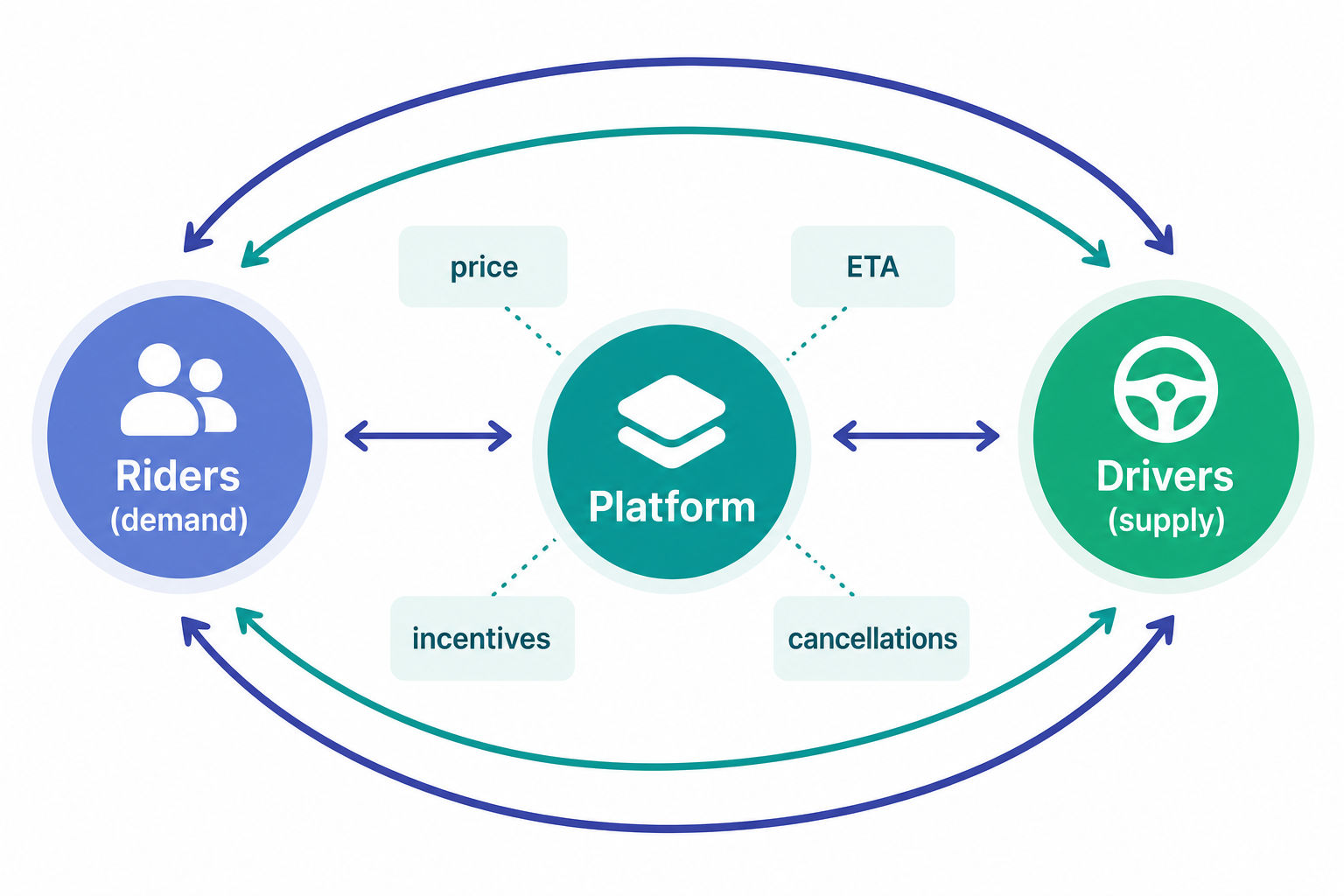
When you frame a case this way, structure the answer in steps: clarify the goal and the decision being made, pick a north-star metric plus guardrails for each side, segment by city or rider tenure or driver supply level, form a hypothesis, then propose the analysis or experiment that would confirm it. For more on building reusable interview stories, see the PracHub resources library.
A practical preparation plan
You don't need months if you focus on the highest-leverage areas. Use the rubric below to self-assess, then spend most of your time on the rows where you're weakest.
| Skill | Drill until you can... | Common pitfall |
|---|---|---|
| SQL | Write window-function and cohort queries cold, narrating assumptions | Jumping to syntax before defining the metric |
| Experimentation | Design an A/B test end to end and critique a flawed one | Ignoring the randomization unit and interference |
| Product cases | Structure an ambiguous problem in under a minute | Diving into one side of the marketplace only |
| Behavioral | Tell five stories with quantified outcomes | Vague impact ("it went well") with no numbers |
| ML (role-dependent) | Frame a model, pick a metric, discuss deployment | Optimizing offline metrics with no product tie-in |
A workable rhythm: spend the first stretch rebuilding SQL fluency on realistic event-log schemas, the middle stretch on experiment design and causal reasoning, and the final stretch doing timed product cases out loud. Practice against real prompts rather than generic puzzles - Uber rewards domain realism. You can filter for relevant questions by role on the Data Scientist questions page and by company on the Uber page.
How to stand out
- Treat every case as a two-sided marketplace problem. Explicitly discuss rider, driver, and platform impact instead of analyzing only one side.
- Overprepare SQL, especially window functions, CTEs, cohorting, and event-style schemas. Weak SQL is a common failure point, and Uber weights it heavily.
- Lead with structure in product and experimentation rounds: define the problem, identify stakeholders, choose a north-star metric and guardrails, state assumptions, then propose analysis or experiments.
- Show real-world experimentation sense. Talk about randomization unit, interference, delayed outcomes, and sparse events, and what you'd do when a clean A/B test isn't feasible.
- Quantify your behavioral stories with business outcomes: lift, revenue impact, retention change, latency reduction, fraud loss prevented, or cancellation rate improvement.
- Expect pushback and handle it calmly. Acknowledge uncertainty, defend your reasoning, and adjust your approach without getting flustered.
- Tailor examples to the team domain. If you've worked on marketplace optimization, pricing, incentives, fraud, risk, or support workflows, make those stories central.
How to Use This Page as a Prep Plan
Do not treat this as passive reading. Convert the ideas in this page into a short weekly loop: learn one idea, practice it under interview conditions, then write down what changed. That is the fastest way to turn advice into visible interview behavior.
| Prep area | What you need to prove | Practice artifact |
|---|---|---|
| Metric framing | Define the unit, window, and denominator. | One clear metric contract. |
| SQL execution | Use readable CTEs and test row counts. | A query with checks after each join. |
| Statistics | Connect methods to decision risk. | Assumptions, confidence, and caveats. |
| Communication | Turn findings into a recommendation. | One concise business interpretation. |
For Uber Data Scientist Interview Guide 2026, the strongest candidates usually do three things well: they make their assumptions explicit, they use concrete examples instead of vague claims, and they review mistakes quickly enough that the next practice rep is better than the last one.
Video Walkthrough
Session With Sumit walks through the Uber Data Scientist loop first-hand. It is one candidate's account rather than an official spec, so treat the round order as indicative.
FAQ
How long does the Uber Data Scientist interview process take?
Candidates commonly report the full loop runs about three to six weeks from recruiter screen to final round, though timing varies with scheduling, team, and level. Use the gap between rounds to drill SQL and rehearse product cases rather than waiting passively.
How much SQL do I really need?
A lot. SQL is one of the most heavily weighted skills, and weak SQL is a frequent reason candidates fail the technical screen. You should be able to write joins, aggregations, CTEs, and window functions fluently, and narrate your assumptions as you go. Practice on event-log-style schemas, not just textbook tables.
Is machine learning required?
Not for every role. Many Data Scientist roles are analytics-first and may include little or no modeling. ML and ML system design rounds are more common for senior, specialized, or applied-scientist-leaning roles such as fraud, ranking, pricing, or forecasting. Ask your recruiter what your specific loop includes.
What makes an Uber answer different from a generic data science answer?
The marketplace lens. Interviewers want to see you reason about riders, drivers, and the platform together. Whenever you propose a metric, experiment, or recommendation, name the effect on each side and the tradeoffs between them.
How should I handle an interviewer who challenges my approach?
Treat pushback as part of the format, not a sign you're wrong. Acknowledge the uncertainty, restate your assumptions, and explain why you made the choice you did. If their point is valid, adjust your approach out loud. Composure and clear reasoning under challenge are exactly what's being scored.
Where can I practice realistic Uber-style questions?
Work through real prompts rather than generic puzzles. The PracHub question bank covers SQL, experimentation, and product cases, and you can narrow by the Uber company page or the Data Scientist role page.