Bloomberg Software Engineer Interview Prep Guide
Everything Bloomberg actually asks Software Engineer candidates — concept walkthroughs, worked examples, and the real interview questions, drawn from candidate reports. Free to read.
Last updated
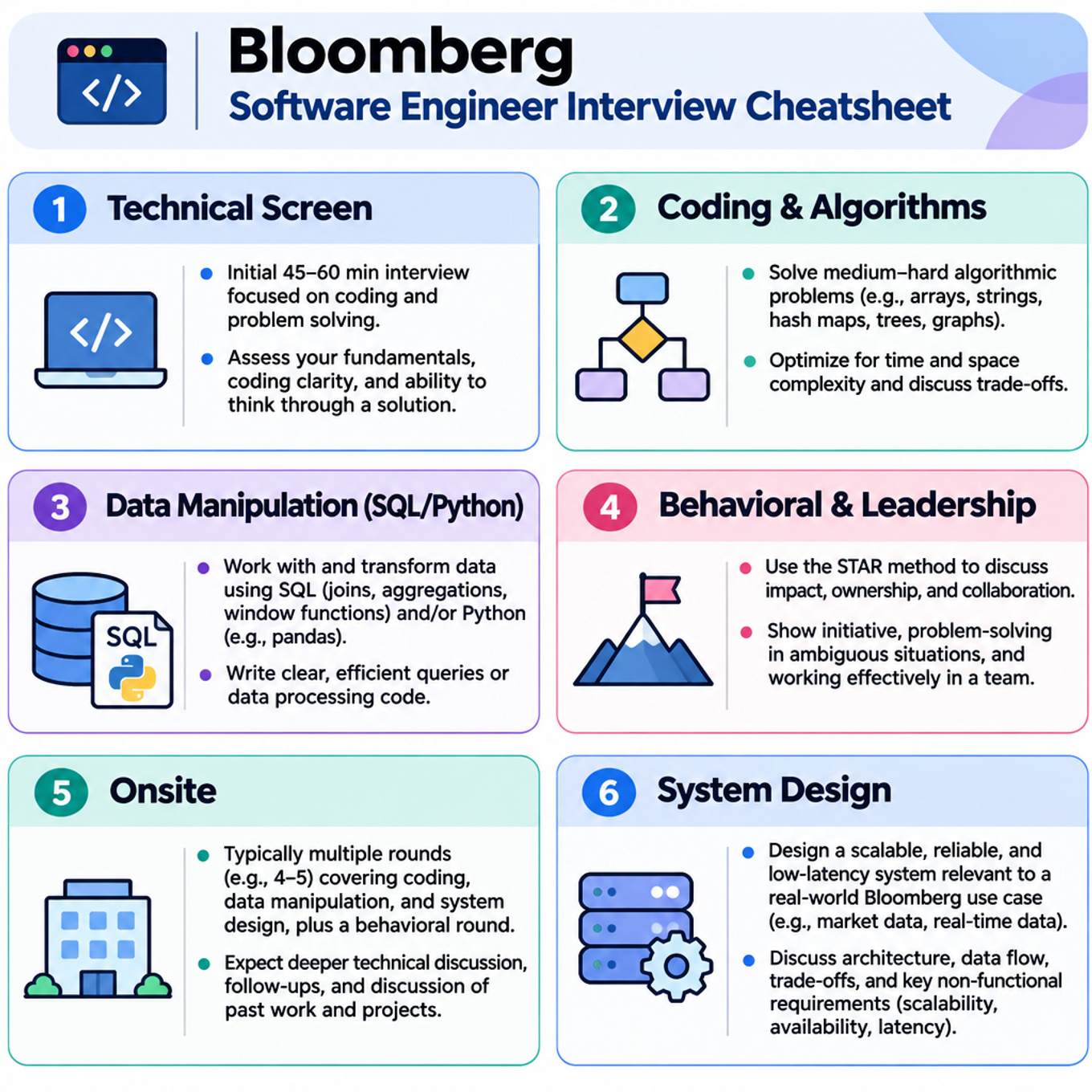
Focus most on system design: your 1/5 self-rating, zero solved signals, and selected topics point to gaps in reliability, sharding, rate limiting, search indexing, concurrency, and query planning. You're solid on order-book data structures and C++ runtime fundamentals, and most core coding topics were not marked weak, so those stay normal except string parsing, which you rated shaky. The Bloomberg-specific emphasis is market-data/API reliability: rate limits, time-series partitioning, instrument/news autocomplete, concurrent queues, and deterministic ranking/reporting. With 1–2 weeks left, prioritize the 60-minute onsite block first, then rotate through the technical screen coding/parser work and one behavioral pass.
Technical Screen — 39 min
Coding & Algorithms
-
String Parsing, Decoding And CLI Text Processing (Focus) — covered in depth under Other below.
-
Number Of Islands, Grid BFS/DFS And Backtracking — covered in depth under Other below.
-
Two Pointers, Sliding Windows And Intervals — covered in depth under Other below.
Data Manipulation (SQL/Python)
- Query Plan Optimization, Column Pruning And Filter Pushdown (Focus) — covered in depth under Onsite below.
Bloomberg reports often use ranking/tie contracts; no weakness signal, so review deterministic ordering and SQL/Python variants.
What's being tested
These problems test frequency aggregation followed by ranking, tie-breaking, and returning only the top results. You must translate requirements precisely into GROUP BY/window-function SQL or hash-map plus sorting/heap algorithms, while accounting for ties, duplicates, filters, and ordering complexity.
Patterns & templates
- Use
COUNT(*)withGROUP BYfor frequencies; rank byfrequency DESC, then the stated tie-break column. - Use
ROW_NUMBER(),RANK(), orDENSE_RANK()over partitions; chooseDENSE_RANKwhen equal values share a salary level. - Extract URL components with
SPLIT_PART,SUBSTRING, orREGEXP_REPLACE; filter dates before aggregation to reduce rows. - For Python frequency counts, use
collections.Counteror a dictionary; sorting costsO(n log n)time andO(u)space. - For fixed small
k, maintain a size-kmin-heap keyed by frequency and tie priority; updates costO(log k). - Dynamic multiset queries need a frequency map plus ordered structure; support increment, decrement, deletion, and deterministic tie handling.
- Distinguish
ROW_NUMBERfromRANK: the former returns exactlykrows, while the latter preserves ties and may return more.
Common pitfalls
Pitfall: Sorting only by frequency produces nondeterministic or incorrect results when equal-frequency values require descending numeric order.
Pitfall: Confusing top three employees with top three rows; distinct salary levels require
DENSE_RANK, notROW_NUMBER.
Pitfall: Applying a global
LIMITbefore partitioning or forgetting weekday/date grouping changes the requested result.
Practice these
The practice cards below cover the canonical variants — solve all of them and time yourself.
Practice questions
Behavioral & Leadership
No behavioral exclusion or weakness was given; prepare concise STAR stories and Bloomberg motivation without over-allocating time.
What's being tested
These interviews test whether you can turn ambiguous engineering work into a clear story of ownership, sound technical judgment, collaboration, and measurable impact. The interviewer is looking for evidence that you can define a problem, make and communicate tradeoffs, deliver reliable software, respond constructively to failure or disagreement, and learn from the outcome. Bloomberg cares because software engineers operate systems where correctness, availability, latency, and client trust directly affect financial professionals’ decisions; strong ownership must therefore include both implementation depth and disciplined communication.
Core knowledge
-
STAR—Situation, Task, Action, Result—provides a structure, not a script: spend roughly 15% on context, 60% on your decisions and implementation, and 25% on measurable results and reflection.
-
Ownership means driving an outcome across ambiguity, dependencies, testing, rollout, and follow-up—not merely writing your assigned code. Explain how you identified risks, clarified responsibilities, and stayed accountable when another team or service was involved.
-
Quantify impact with engineering metrics such as
p99latency, error rate, throughput, availability, deployment frequency, rollback rate, memory usage, or incident duration. Establish a baseline first: reducing latency from 800 ms to 300 ms is more credible than saying “made it faster.” -
Technical decisions should expose explicit tradeoffs: synchronous versus asynchronous calls, strong versus eventual consistency, normalized versus denormalized storage, or simpler code versus a more extensible abstraction. Tie the choice to workload, failure behavior, operational cost, and correctness requirements.
-
For a production change, describe observability: structured logs, request IDs, dashboards, traces, and alerts tied to actionable thresholds. A successful implementation without a way to detect elevated
p99latency or failed requests is incomplete ownership. -
Risk management is concrete: feature flags, canary releases, backward-compatible schemas, timeouts, bounded retries with jitter, circuit breakers, idempotency keys, and rollback plans. Explain which mechanism protected users and what failure mode it addressed.
-
When describing debugging, use a hypothesis loop: reproduce, narrow the fault domain, inspect logs and metrics, form a falsifiable hypothesis, make the smallest safe change, and verify with regression tests. Avoid presenting “I looked around until I found it” as a method.
-
Collaboration stories should distinguish disagreement over goals, constraints, or implementation. State the other person’s concern fairly, compare options against measurable criteria, document the decision, and escalate only when unresolved risk or authority boundaries require it.
-
Code quality is more than style: clear interfaces, cohesive modules, meaningful tests, safe error handling, and maintainable documentation. Mention unit, integration, contract, load, or failure-injection tests according to the risk, rather than claiming that “we tested everything.”
-
A strong reflection identifies a specific counterfactual: “I would add load testing before the migration,” “I would involve the API owner earlier,” or “I would split the rollout into smaller cohorts.” Connect the lesson to a changed practice, not a generic claim that you learned to communicate better.
-
For client-facing delivery, separate requirements from implementation: clarify users, workflows, latency and availability expectations, security constraints, acceptance criteria, and out-of-scope requests. Confirm assumptions in writing and renegotiate scope before quality or reliability silently deteriorates.
-
Bloomberg-specific motivation should connect your experience to technically demanding, information-critical systems: high-volume data access, low-latency interactions, resilient services, and software used by professionals. Avoid generic claims about prestige; explain why the engineering constraints and user responsibility motivate you.
Worked example: Answer core behavioral questions using STAR
For “Answer core behavioral questions using STAR,” I would first clarify whether the interviewer wants an ownership, conflict, failure, prioritization, or feedback example, then choose one project with a clear personal contribution and measurable result. I would state the situation and constraints in two or three sentences, including scale, deadline, affected users, and why the problem mattered. My answer would then follow four pillars: the goal and success criteria, the technical actions I personally led, how I aligned collaborators and managed risk, and the result plus retrospective. For example, I might explain how I reduced a service’s p99 latency by profiling a hot path, changing an inefficient query pattern, adding targeted indexes, and validating the rollout with dashboards and a canary. I would explicitly flag the tradeoff between adding an index for read latency and increasing write cost and storage usage, explaining how workload measurements supported the decision. I would also describe an initially rejected approach or production signal to demonstrate judgment rather than portraying the project as effortless. I would close with the exact metric improvement, customer or operational effect, and one practice I changed afterward. If I had more time, I would also discuss the rollback plan, test coverage, and how I would validate that the optimization remained effective under future traffic growth.
A second angle
For “Describe leading an end-to-end client project,” the framing shifts from an internal engineering improvement to requirements discovery, expectation management, and delivery reliability. I would explain how I converted client workflows into technical acceptance criteria, separated must-have functionality from optional scope, and established communication checkpoints. The main technical emphasis would be maintainable interfaces, validation, error handling, deployment safety, and documentation so the solution could be operated after handoff. I would explicitly discuss the tradeoff between meeting a near-term deadline with a narrow vertical slice and building a broader abstraction whose value was not yet proven. I would close with adoption or defect metrics, client feedback, and what I would change in the next project.
Common pitfalls
Pitfall: Giving a team summary instead of demonstrating individual ownership. “We redesigned the service and improved performance” does not show what you decided, implemented, or verified; use “I” for your contribution and “we” only for genuinely shared work.
A common analytical mistake is claiming impact without a baseline or causal link. “Users were happier after launch” is weak; explain the measurement, such as error rate falling from 2.1% to 0.4%, and distinguish your change from unrelated releases or traffic changes.
Pitfall: Treating conflict as a personality story. Saying “the other engineer was difficult” signals poor judgment; describe the technical disagreement, the evidence used, the decision process, and how you preserved the working relationship.
A depth mistake is naming tools without explaining failure modes: “we used Kafka, caching, and retries” is not an engineering answer. State why each mechanism was selected, what could go wrong, and how monitoring, tests, or rollback reduced that risk.
Connections
An ownership discussion can pivot into incident response, system design tradeoffs, code review, testing strategy, observability, or backward compatibility. It may also become a deeper debugging question, so be prepared to explain the specific code path and evidence behind your story.
Further reading
- Designing Data-Intensive Applications — Martin Kleppmann’s treatment of reliability, consistency, scalability, and tradeoffs helps strengthen technical behavioral stories.
- Accelerate — Research-backed discussion of delivery performance metrics and the engineering practices that improve them.
Practice questions
Onsite — 60 min
Coding & Algorithms
-
String Parsing, Decoding And CLI Text Processing (Focus) — covered in depth under Other below.
-
Number Of Islands, Grid BFS/DFS And Backtracking — covered in depth under Other below.
-
Two Pointers, Sliding Windows And Intervals — covered in depth under Other below.
System Design
Focus area — System design is 1/5, reliability is new, and many selected topics map here: leases, retries, idempotency, caching, backpressure.
What's being tested
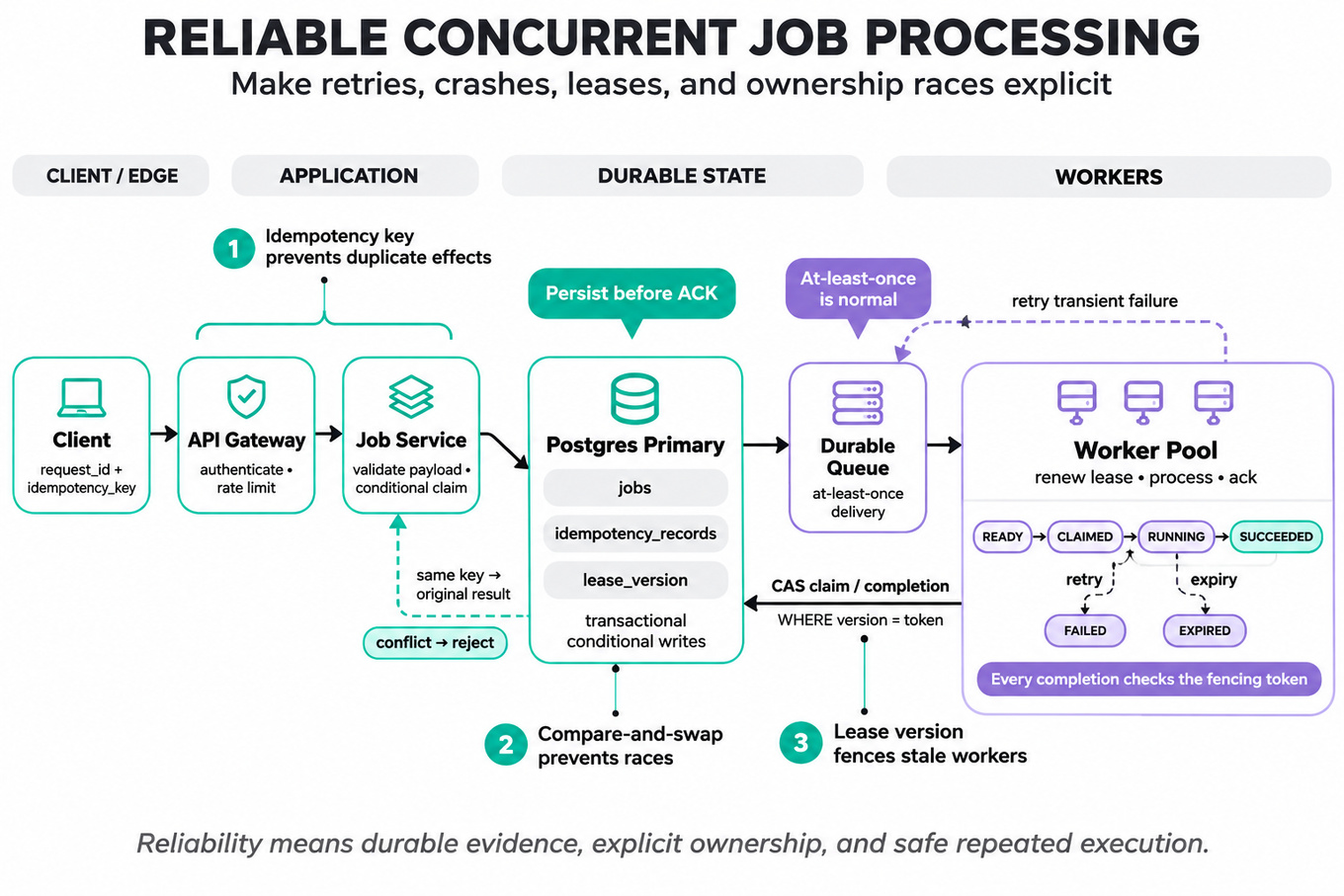
These problems test whether you can turn vague reliability requirements into explicit invariants, failure semantics, and concurrency-safe interfaces. You must reason about durable state, retries, leases, idempotency, ordering, backpressure, and what happens when processes crash at the worst possible moment. Bloomberg cares because software supporting market data, analytics, and internal workflows must remain correct under high concurrency and partial failure—not merely appear available. The interviewer is probing whether you can explain tradeoffs precisely and build a design whose behavior is observable and testable.
Core knowledge
-
At-least-once delivery is the practical default when acknowledgments can be lost; make handlers idempotent with request IDs, deduplication records, or conditional writes. “Exactly once” usually means exactly-once effects, not exactly-once network delivery.
-
Model each resource with a state machine rather than scattered booleans:
PENDING → CLAIMED → RUNNING → SUCCEEDED, with explicitFAILED,EXPIRED, and retry transitions. Define legal transitions and the actor permitted to perform each one. -
A lease is time-bounded ownership: a worker claims work until
lease_expiry; it must renew periodically. Every completion must verify a fencing token or lease version so a delayed old worker cannot overwrite a newer owner’s result. -
Idempotency keys prevent duplicate effects across client retries. Store the key with the operation result atomically; distinguish “same key, same payload” from “same key, conflicting payload,” and return the original result for the former.
-
Use compare-and-swap or transactional conditional updates for claims:
UPDATE jobs SET owner=?, version=version+1 WHERE id=? AND state='READY'. Check the affected-row count; a read-then-write sequence is unsafe under races. -
Fair scheduling needs a declared policy. Weighted round-robin is simple for fixed classes; Deficit Round Robin handles variable job sizes using credits. With unknown runtimes, use observed runtime estimates, aging, or bounded execution quanta to reduce starvation.
-
Separate durability from visibility. A job acknowledged after an in-memory enqueue can disappear on process failure; persist the job before acknowledging, and define whether “accepted,” “started,” and “completed” each have durable evidence.
-
Retries require classification: retry transient timeouts, lease loss, or overloaded dependencies; avoid retrying deterministic validation errors. Use exponential backoff with jitter, a maximum attempt count, and a dead-letter or manual-repair path.
-
For concurrent in-memory structures, choose ownership deliberately: a single event loop can avoid locks but may bottleneck; sharded locks scale across independent keys; lock-free structures improve throughput only when their memory-ordering and reclamation costs are justified.
-
Backpressure protects the system when arrival rate exceeds service rate. Bound queues, reject or defer work explicitly, and expose queue depth and age. Unbounded buffering converts overload into latency growth or an eventual out-of-memory crash.
-
End-to-end integrity requires a cryptographic checksum such as
SHA-256computed from the bytes at ingestion and verified after retrieval. Replication protects availability, but only independent verification, scrubbing, and repair detect silent corruption. -
For packet or stream reassembly, maintain per-message state keyed by an identifier, validate offsets and lengths, reject overlaps unless the protocol defines them, and enforce memory/time limits. Completion requires all expected ranges, not merely receiving the final fragment.
Worked example: Design a Fair Distributed Job Scheduler with Unknown Runtimes
A strong candidate first clarifies job volume, priority classes, maximum acceptable queue age, persistence requirements, whether jobs may run more than once, and what “fair” means—equal job count, weighted share, or bounded waiting time. They might assume modest scale, durable metadata in Postgres, a dispatcher, and stateless workers communicating through a durable queue. The answer can be organized around four pillars: durable job state and idempotent submission, fair dispatch, lease-based worker ownership, and retry/recovery observability. They should describe a claim transaction that atomically selects eligible work, increments a fencing version, and records the lease owner. A worker heartbeat extends the lease, while completion succeeds only if its version still matches, preventing a paused worker from completing after reassignment. The explicit tradeoff is between strict fairness and throughput: weighted or deficit scheduling improves fairness, but tracking runtime estimates and per-tenant credits adds state and dispatcher complexity. Unknown runtimes also make FIFO unfair, so the candidate should discuss aging, time quanta, or runtime caps for jobs that monopolize workers. They can close by saying, “If I had more time, I’d specify the schema, failure-injection tests, queue-age dashboards, and recovery behavior when the metadata store is unavailable.”
A second angle
In Design an in-memory trade subscription processor, the durable lease problem becomes a low-latency ownership and ordering problem. The candidate should clarify whether subscriptions are keyed by instrument, whether callbacks may block, and whether updates must preserve per-instrument order. Sharding instruments across worker threads can eliminate global locking, while copy-on-write subscriber lists make reads cheap but make subscription churn more expensive. The key tradeoff is lock granularity: a global lock simplifies correctness but harms throughput, whereas per-shard or per-key locks require careful ordering and lifecycle management. The answer should also define behavior for a callback failure—usually isolate it, record the error, and avoid blocking unrelated subscribers.
Common pitfalls
Pitfall: Analytical mistake. Saying “use a distributed lock” without defining lock expiry, renewal, fencing, and crash behavior is incomplete; a delayed process can still act after its lock appears to have expired. Explain the state transition and the conditional write that makes stale ownership harmless.
Pitfall: Communication mistake. Jumping directly into
Kafka,Redis, orPostgresbefore stating scale, consistency, and failure assumptions makes the design sound arbitrary. Start with requirements, name the invariant, then introduce each component as a consequence of that requirement.
Pitfall: Depth mistake. Claiming “exactly once” or “the checksum guarantees durability” confuses different properties. Separate delivery semantics, effect idempotency, availability through redundancy, and corruption detection; identify what remains possible during crashes and partitions.
Connections
The interviewer may pivot to CAP tradeoffs, linearizability, transaction isolation, consistent hashing, backpressure, or observability through queue age, retry rate, lease expiry, and p99 latency. Be ready to connect the design to failure-injection testing and Jepsen-style reasoning about histories.
Further reading
- Designing Data-Intensive Applications —
Martin Kleppmann’s practical treatment of replication, transactions, stream processing, and failure semantics. - Time, Clocks, and the Ordering of Events in a Distributed System —
Leslie Lamport’s foundational discussion of ordering and causality. - The Tail at Scale — explains why rare slow components dominate distributed request latency and motivates hedging, isolation, and deadlines.
Practice questions
Focus area — You selected rate limiting and quotas under system design with 1/5 confidence; connect tokens, fairness, overload protection, and client contracts.
What's being tested
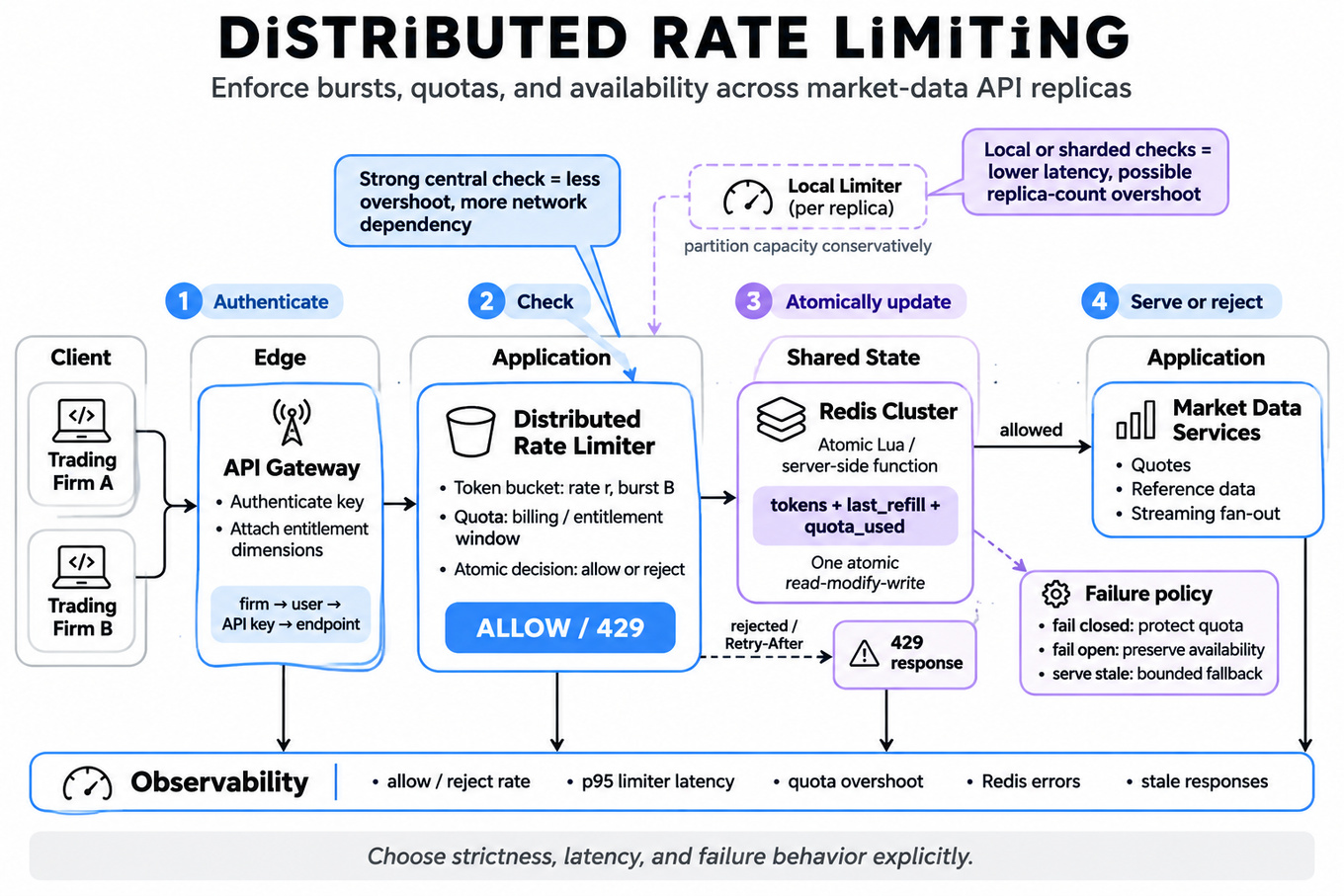
This topic tests whether you can design a distributed rate limiter that enforces customer quotas without harming latency, correctness, or availability. Bloomberg cares because market-data APIs serve high-value, latency-sensitive traffic from many clients with different entitlements, burst patterns, and contractual limits. The interviewer is probing requirement clarification, algorithm selection, distributed coordination, failure handling, observability, and the tradeoff between strict enforcement and serving stale or excess requests.
Core knowledge
-
A rate limit controls request frequency over time; a quota limits aggregate usage over a billing or entitlement period. Clarify whether limits apply per API key, user, firm, IP, instrument, endpoint, or a hierarchy of dimensions.
-
The token bucket algorithm stores tokens refilled at rate up to capacity . Each request costs tokens and succeeds when available; it permits bursts up to while maintaining long-run throughput near .
-
A leaky bucket emits work at a fixed rate and smooths bursts, while a token bucket admits bursts. Use token buckets for API admission and leaky-bucket-like queues for downstream smoothing; never hide unbounded queues behind “rate limiting.”
-
A fixed window is simple but allows boundary bursts: a client can consume requests at the end of one window and at the beginning of the next. A sliding-window counter or GCRA gives smoother enforcement with modestly greater state and computation.
-
GCRA models a theoretical arrival time rather than storing every request. For a period and burst tolerance , a request is accepted when its arrival is no earlier than the permitted theoretical time, making it efficient for high-cardinality keys.
-
A single-process limiter is insufficient behind multiple API servers. A shared store such as
Rediscan provide atomic token updates using Lua or server-side functions;Postgresrow locks are correct but generally add too much contention and latency for a hot request path. -
Distributed enforcement needs an explicit consistency choice. Strong centralized checks minimize quota overshoot but add network dependency; sharded or local limiters reduce latency and failure blast radius but can overshoot by roughly the number of replicas unless capacity is partitioned conservatively.
-
Make the state transition atomic: read current tokens and timestamp, compute refill, conditionally consume, and write the new state together. Use server-side time where possible; client clocks create inconsistencies and make replay or clock-skew behavior difficult to reason about.
-
Market-data access often has hierarchical limits: an API key may have an endpoint limit, a user limit, a firm-wide entitlement, and a provider-wide safety limit. Evaluate all applicable buckets and reject if any fails, while defining whether a failed request consumes quota.
-
Separate admission control from entitlement authorization. A client may be below its request rate but still lack permission for a security, venue, field, or data tier; authorization must not be inferred from quota state.
-
Return
429 Too Many Requestswith a stable error body andRetry-Afterwhen throttled. Include remaining-limit metadata carefully, because exposing exact global state can leak information and concurrent responses make counters approximate. -
Design for failures: decide whether an unavailable limiter fails open, fails closed, or uses a bounded local fallback. For paid or restricted data, fail closed or use a preallocated emergency budget; for low-risk public endpoints, a short-lived local fallback may preserve availability.
-
Idempotent retries matter. If a client retries after a timeout, charging each attempt can unfairly consume quota, while deduplicating requires a request identifier and bounded retention. Define whether limits count attempts, successful responses, bytes, symbols, or weighted data units.
-
Observe
allow,deny, effective rate, bucket saturation, limiter latency, store errors, synchronization lag, and overshoot. Use per-tenant dimensions and exemplars, but avoid high-cardinality unbounded metrics; sample detailed events and protect sensitive customer identifiers. -
Protect the limiter itself with bounded key cardinality, TTL cleanup, admission limits, and hot-key mitigation. A malicious client can generate many API keys or dimensions; never let attacker-controlled identifiers create unbounded state in
Redis.
Worked example
For Design a Rate Limiter for a Market Data API, I would first clarify whether the requirement is requests-per-second, weighted symbols or bytes, firm-wide contractual quotas, burst tolerance, and the acceptable overshoot during a regional failure. I would declare an initial assumption of per-entitlement token buckets, a 10,000-request-per-second steady rate, a 2-second burst, and a target decision latency below a few milliseconds. I would organize the answer around the algorithm, distributed state and atomicity, API behavior, and failure/observability strategy. The request path would authenticate the client, derive all applicable quota keys, atomically evaluate their buckets in Redis, then either forward the request or return 429. I would explicitly choose centralized sharded buckets for strict contractual limits, while acknowledging that a cross-region global bucket increases latency and creates a larger dependency. I would discuss replica ownership, failover, clock source, TTLs, hot tenants, and whether rejected requests consume tokens. A strong design would also distinguish rate limits from security entitlements and use weighted costs for expensive bulk snapshots. I would close by saying that, with more time, I would load-test burst boundaries, simulate Redis partitions and failover, and verify fairness and overshoot with production-like tenant distributions.
A second angle
For a firm-wide monthly data quota, the framing changes from short-term admission control to durable accounting and reconciliation. A fast token bucket can protect the API path, but usage should also be recorded in an append-only event stream or durable usage store with an idempotency key. The design must define calendar versus rolling periods, late responses, refunds, administrative adjustments, and what happens when the durable accounting system is unavailable. A practical architecture may use an in-memory limiter for immediate protection and asynchronous durable aggregation, with periodic reconciliation against request logs.
Common pitfalls
Pitfall: A tempting analytical mistake is to claim that a fixed-window counter provides a strict requests-per-second guarantee. It does not: boundary effects permit nearly twice the nominal rate over adjacent windows. Prefer token bucket, sliding-window, or GCRA and explain the burst semantics mathematically.
Pitfall: A communication mistake is jumping directly to
Rediscommands without clarifying what is being limited or how strict enforcement must be. Start with dimensions, units, burst tolerance, latency, multi-region behavior, and failure policy; the storage choice follows from those requirements.
Pitfall: A depth mistake is saying “use a distributed lock” and stopping there. Locks can serialize hot keys and still leave clock, failover, retry, and partial-update problems; describe an atomic state transition, bounded state, observability, and behavior when the limiter dependency fails.
Connections
An interviewer may pivot to distributed consistency, API gateway design, backpressure, circuit breakers, or idempotency. Be prepared to compare centralized coordination with local admission, and to explain how quotas interact with caching, retries, bulk requests, and entitlement services.
Further reading
- “The Token Bucket” — Cisco documentation — clear treatment of token-bucket policing and burst behavior.
- RFC 6585 — Additional HTTP Status Codes — defines
429 Too Many Requestsand retry signaling. - “Rate Limiting” — Stripe Engineering — practical discussion of distributed API limiting and limiter tradeoffs.
Practice questions
Focus area — You selected search indexing/autocomplete; Bloomberg-style instrument/news lookup needs inverted indexes, prefixes, ranking, and freshness trade-offs.
What's being tested
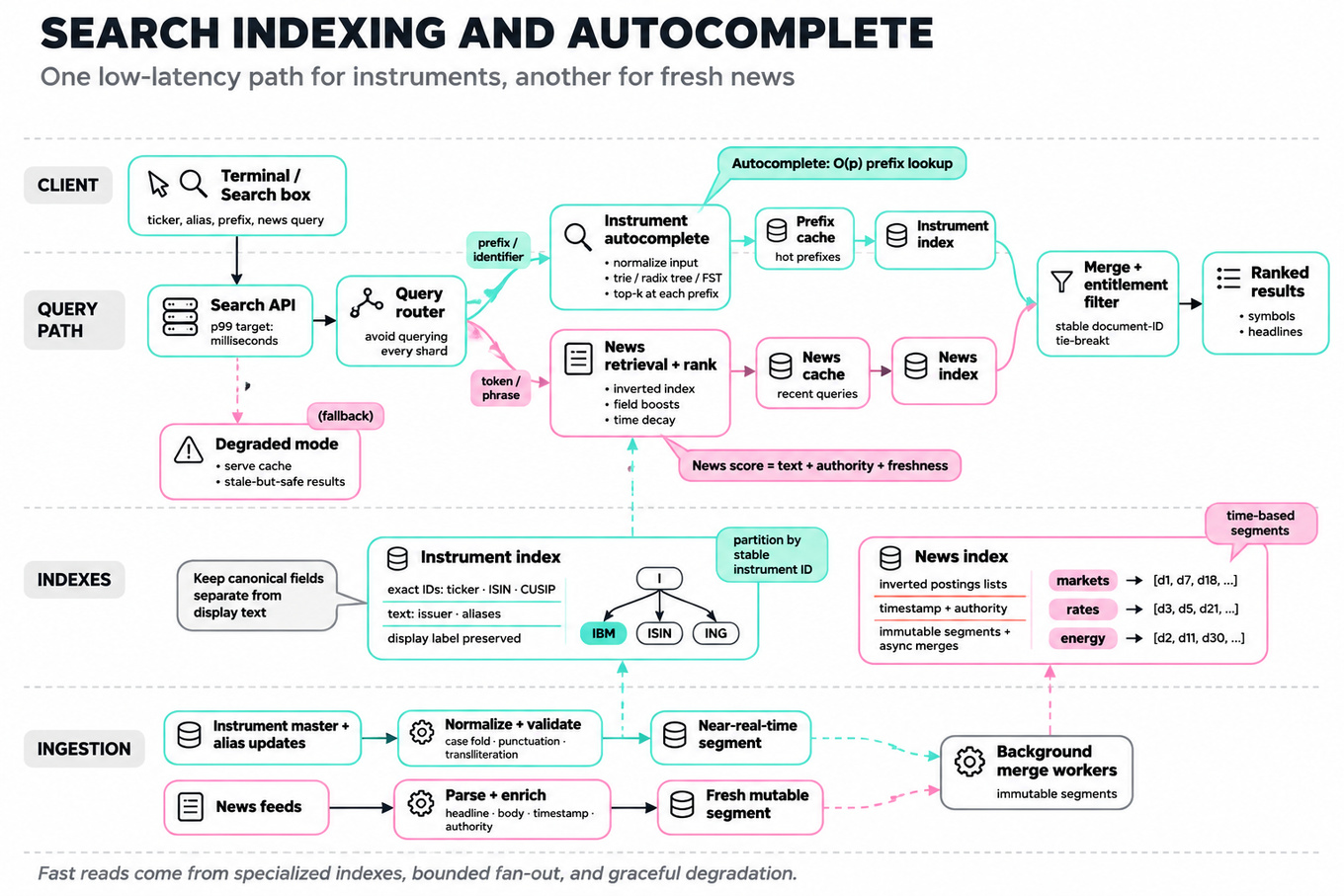
This topic tests whether you can design a low-latency, high-availability search path over two very different datasets: structured financial instruments and rapidly changing news. The interviewer is probing your command of inverted indexes, prefix-search data structures, partitioning, caching, freshness, and graceful degradation—not merely whether you can name Elasticsearch. Bloomberg cares because a trader or terminal user expects a correct result in milliseconds, even during market spikes, while identifiers, aliases, entitlements, and news relevance are changing continuously.
Core knowledge
-
An inverted index maps normalized terms to document identifiers, commonly storing postings lists with fields, positions, timestamps, and scores. It supports token search efficiently, but plain term indexes do not directly solve prefix completion.
-
Autocomplete is usually implemented with a trie, compressed radix tree, or finite-state transducer such as
FST. A trie gives prefix lookup for prefix length , while storing top- completions at each node trades memory for predictable latency. -
Instrument search needs multiple fields: ticker,
ISIN,CUSIP, exchange symbol, issuer name, product type, and aliases. Keep exact identifiers, normalized text, and display labels separate soIBM,US4592001014, and “International Business Machines” can rank appropriately. -
Normalize before indexing: Unicode case folding, punctuation handling, whitespace collapsing, transliteration where appropriate, and exchange-specific symbol rules. Preserve the original string for display; otherwise a canonicalization step can make results impossible to explain.
-
News search typically combines token retrieval with time decay and field boosts. A simple score might be ; keep ranking deterministic with a stable document ID tie-breaker.
-
Partitioning should support the dominant query path. Shard instrument documents by stable instrument ID or hash for balanced writes, while news may use time-based segments plus a routing strategy; avoid a design that requires querying every shard for every keystroke.
-
Use immutable index segments and background merges, as in
Lucene, to make reads lock-light. New documents can enter a small mutable or near-real-time segment, then merge asynchronously; expose the resulting freshness bound explicitly. -
Treat indexing as at-least-once and make updates idempotent using a stable document or instrument version. Tombstones, version checks, and replayable change events prevent stale updates from overwriting newer data.
-
A serving API should enforce bounded work: minimum prefix length, maximum result count, request deadlines, cancellation, and pagination or continuation tokens. Return structured results containing ID, display label, type, exchange, timestamp, and entitlement metadata.
-
Cache hot prefixes and common exact queries at the edge or service tier. Use short TTLs for news, longer TTLs for relatively stable instrument metadata, and include locale, entitlement context, and index version in the cache key.
-
Consistency is usually deliberately mixed: instrument identity and entitlement changes need stronger correctness, while news ranking can tolerate eventual freshness. If an index is stale, return a safe older result or fail over to a previous snapshot rather than serving partial corrupt state.
-
Measure
p50,p95, andp99latency separately for cache hits, cold prefixes, and fan-out searches; also track zero-result rate, stale-index age, correction rate, and availability. Log query normalization, selected shard, index version, and result reason without leaking restricted content.
Worked example
Representative prompt: “Design Search Indexing and Autocomplete for Instruments and News.” In the first 30 seconds, clarify whether the API must support prefix completion, full-text search, or both; ask for expected QPS, latency target, update rate, languages, entitlement rules, and acceptable freshness. State an assumption such as 100,000 autocomplete requests per second globally, p99 below 100 ms, near-real-time news, and strongly correct instrument identifiers. Organize the answer around the data model and normalization pipeline, index structures and shard layout, query serving and ranking, and reliability plus observability. Use a compressed trie or FST for instrument prefixes and a Lucene-style inverted index for news, with separate serving paths because their update and ranking characteristics differ. Explicitly flag the tradeoff between storing top completions at every prefix node for low latency and storing less metadata to reduce memory and rebuild cost. Explain versioned immutable snapshots, idempotent updates, cache keys, deadlines, and a fallback to the last known-good index. Close by saying that, with more time, you would validate shard fan-out under realistic symbol distributions and test entitlement changes, corrections, and regional failover.
A second angle
Representative prompt: “How would you support typo-tolerant autocomplete for security names without harming ticker accuracy?” The framing changes from broad architecture to query interpretation and bounded algorithmic cost. Use exact and prefix matches first, then apply bounded edit distance, character n-grams, or phonetic alternatives only when the high-confidence path returns too few results. Do not apply fuzzy matching equally to identifiers such as ISIN, where one-character substitutions can produce a different valid instrument. Measure false-positive selection risk separately from ordinary zero-result rate, and make the fallback behavior explainable.
Common pitfalls
Pitfall: Analytical mistake: Saying “put everything in
Elasticsearch” without separating instrument identity from news retrieval ignores different freshness, ranking, and correctness requirements. A stronger answer names the index structures, update semantics, shard strategy, and query path that the chosen engine provides.
Pitfall: Communication mistake: Jumping into trie implementation before asking about latency, QPS, update rate, and entitlements makes the design appear arbitrary. State assumptions early, then tie every major choice back to one of them.
Pitfall: Depth mistake: Claiming that a cache solves performance without discussing invalidation, authorization context, or hot-prefix skew is incomplete. Explain TTLs, cache-key isolation, versioning, and what happens when the index or cache is stale.
Connections
An interviewer may pivot to distributed caching, event-driven indexing, consistent hashing, rate limiting, or authorization-aware data access. They may also ask about Lucene segment merges, zero-downtime index rebuilds, multi-region failover, or designing a top- data structure for prefix results.
Practice questions
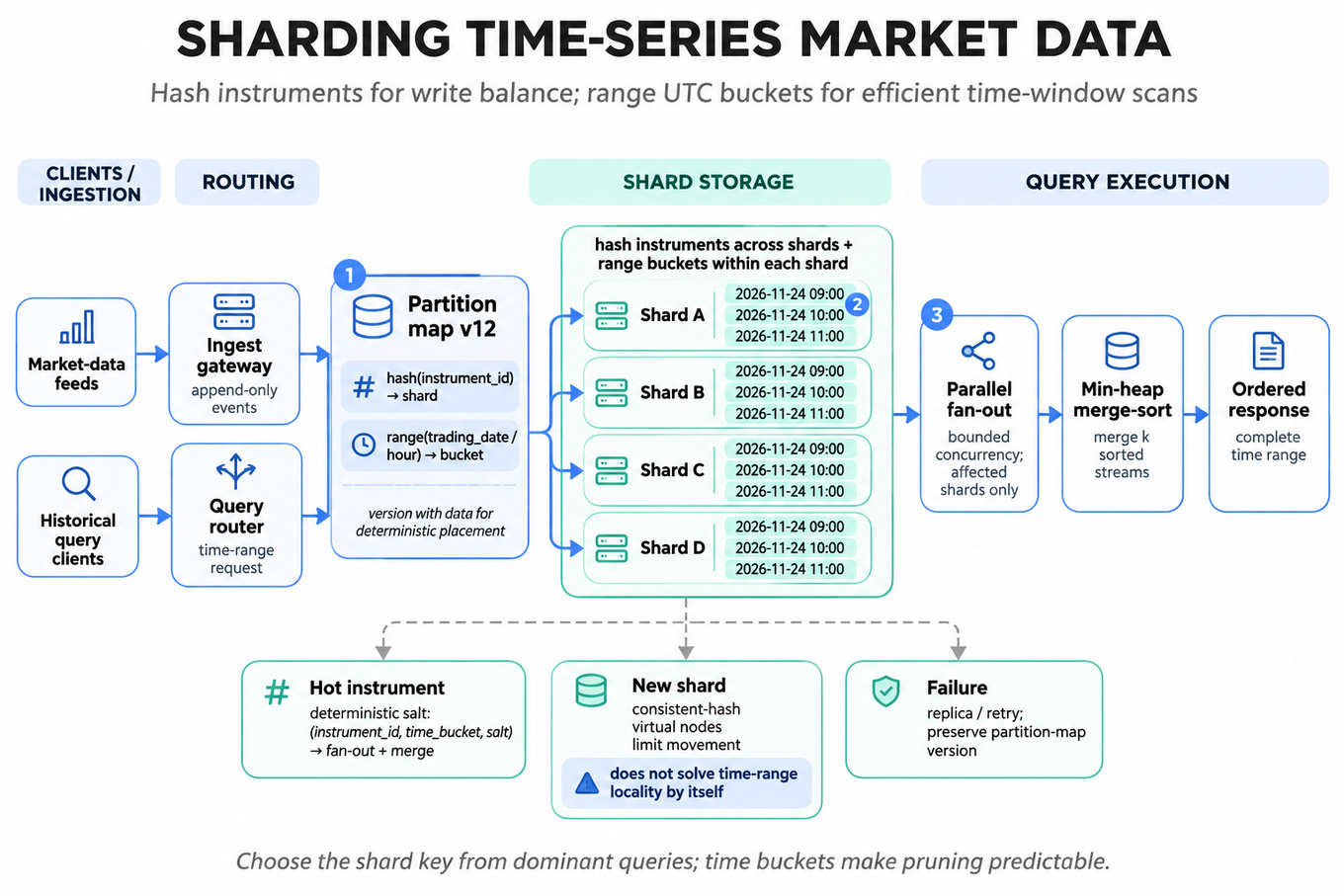
Focus area — You selected sharding/partitioning and data modeling; emphasize time-series keys, hot partitions, replication, and query patterns.
What's being tested
This topic tests whether you can design a distributed storage and query path for high-volume, append-heavy market data while preserving predictable latency and correctness. The interviewer is probing your ability to choose shard keys, reason about time-range queries, handle hot partitions, and explain rebalancing and failure behavior. Bloomberg cares because market-data systems must serve large concurrent workloads with strict latency expectations, while avoiding incorrect or incomplete results during outages and topology changes.
Core knowledge
-
Partitioning dimensions: Time-series data is commonly partitioned by instrument, venue, event type, and time bucket. A composite key such as
(instrument_id, trading_date)localizes historical queries but can create hotspots for heavily traded instruments. -
Range versus hash partitioning: Range partitioning makes time-window scans efficient and supports pruning, while hash partitioning distributes writes evenly. A practical design often hashes instruments across shards and ranges within each shard by day or hour.
-
Shard-key locality: Queries such as “one security over six months” benefit from instrument locality; queries such as “all securities during the last minute” benefit from time locality. State the dominant query patterns before choosing, because no shard key optimizes both dimensions simultaneously.
-
Time bucketing: Use fixed UTC buckets such as hour, day, or trading session, with bucket size chosen from data volume and query latency. Smaller buckets improve pruning and parallelism but increase metadata, file, index, and request overhead.
-
Hot-key mitigation: A popular instrument or live market interval can overload one shard. Mitigations include deterministic sub-sharding, such as
(instrument_id, time_bucket, salt), followed by fan-out reads and merge-sort; avoid random salts unless reads can discover every destination. -
Consistent hashing: A consistent-hashing ring or virtual-node scheme limits movement when adding shards, but it does not by itself solve time-range locality or hot instruments. For deterministic placement, persist the partition map and version it with the data.
-
Query execution: A time-range query should prune irrelevant buckets, route only to affected shards, issue requests in parallel with bounded concurrency, and merge sorted streams using a min-heap. For streams and returned records, merge cost is .
-
Ordering semantics: Market events may share timestamps or arrive with corrections. Define a stable ordering such as
(event_time, sequence_number, venue, event_id)and distinguish event time from ingestion time; never rely on wall-clock timestamps alone. -
Replication and consistency: Replication factor three is a common starting point, with quorum or leader-based writes depending on durability needs. Clarify whether readers require strongly consistent snapshots, read-after-write behavior, or merely eventually consistent historical data.
-
Indexes and physical layout: Partition pruning should eliminate most storage before row-level filtering. Within each partition, sorted segments, zone maps, Bloom filters, or columnar indexes can reduce I/O; indexes that duplicate enormous time-series volumes may cost more than they save.
-
Rebalancing: Moving a shard requires copying a consistent snapshot, replaying changes, switching routing atomically, and garbage-collecting the old copy. Use epochs or routing generations so requests do not mix incompatible partition maps.
-
Retention and corrections: Historical data may require retention tiers, such as hot recent data and colder object storage. Corrections, cancellations, and corporate actions should be modeled as immutable events or versioned records rather than silently overwriting data.
Worked example
Design a sharded time-series market-data store for historical price queries. In the first 30 seconds, clarify the read patterns, retention period, expected write and read rates, acceptable p99 latency, ordering requirements, correction semantics, and whether queries target one instrument or broad market slices. I would organize the answer around four pillars: the data model and time-bucketed layout, shard-key and routing strategy, distributed query execution, and replication/failure handling. I would initially choose instrument hashing across shard groups plus daily time buckets, because single-instrument history is likely to be common and daily partitions provide manageable pruning. For broad “market at time T” queries, I would explicitly support bounded fan-out across instrument shards rather than pretending the primary layout makes that query cheap. A key tradeoff is whether to sub-shard highly active instruments: it protects write and storage hotspots but requires parallel reads and a deterministic merge of ordered events. I would describe versioned routing metadata, snapshot-plus-replay movement during rebalancing, and deduplication using stable event identifiers. I would close by saying that, with more time, I would quantify shard sizes using production-like distributions and test p50, p99, failover, and rebalance behavior under a skewed workload.
A second angle
Design a low-latency query path for all instruments during a one-minute market interval. Here, time locality matters more than keeping one instrument’s entire history together, so a time-based partition or a secondary time-oriented index may be preferable. The main challenge becomes bounded fan-out and response-size control: parallelize across shards, enforce deadlines, and stream or aggregate results rather than buffering an unbounded response. You should also discuss partial-result policy, because returning stale or incomplete market-wide data may be worse than returning an explicit error for a pricing-sensitive client.
Common pitfalls
Pitfall: Choosing hash partitioning on
instrument_idand claiming every query becomes efficient. Hashing distributes load, but it makes market-wide time-window queries fan out to many shards; explain the query workload and quantify that cost.
Pitfall: Saying “use replication” without defining consistency, failover, or duplicate behavior. A stronger answer specifies the acknowledged-write rule, reader behavior during failover, stable event IDs, and how retries remain safe.
Pitfall: Jumping directly to
Kafka,Cassandra, orS3without explaining the storage and routing invariants. Technology names do not replace a shard-key rationale, partition-map versioning, merge strategy, or recovery plan.
Connections
An interviewer may pivot to consistent hashing, quorum replication, LSM-tree compaction, backpressure, or distributed snapshot consistency. Be ready to connect partition choice to cache locality, tail latency, observability, and exactly-once effects without treating “exactly once” as a substitute for idempotent application behavior.
Further reading
- Designing Data-Intensive Applications —
Martin Kleppmann’s treatment of partitioning, replication, consistency, and stream processing. - The Google File System — foundational discussion of large-scale distributed storage, chunk placement, replication, and recovery.
- Dynamo: Amazon’s Highly Available Key-value Store — seminal paper on consistent hashing, quorum techniques, and availability tradeoffs.
Practice questions
Software Engineering Fundamentals
- Concurrent Queues, Ring Buffers And Lock-Free Synchronization (Focus) — covered in depth under Other below.
Focus area — You marked query-plan optimization new; start from tables, rows, indexes, filters, projections, and why pushdown reduces work.

What's being tested
Two core skills: implementing column pruning and filter pushdown on a query-plan tree, and writing correct, efficient tree rewrites. Interviewers check recursive AST traversal, tracking required columns and predicates across Scan, Project, Filter, and Join nodes, plus sound handling of expression lineage and semantics.
Patterns & templates
-
Bottom-up recursion: compute required columns for each node from its parent, revisit children with that set; linear time
O(nodes)for fixed-size expressions. -
Predicate classification: split predicates into pushable (refer only to one child) and residual; push pushables down early to reduce rows.
-
Column projection: at
Scanemit only needed physical columns; atProjectrewrite expressions to map child columns, prune unused projections. -
Join handling: push predicates that reference only one side into that side; predicates referencing both become join conditions. Handle outer joins conservatively.
-
Expression substitution: maintain a mapping from parent output to child expressions for safe rewrite; avoid re-evaluating complex expressions.
-
Immutability & CAS: return new nodes (functional updates) so rewrites are testable; memoize visited nodes to avoid exponential work.
Common pitfalls
Pitfall: Pushing a predicate that references columns produced by a
Projectwithout rewriting to the underlyingScannames — causes invalid plans.
Pitfall: Ignoring
NULLsemantics on outer joins and pushing predicates that change result cardinality.
Pitfall: Over-pruning columns used inside non-project side-effects (e.g.,
EXISTS,ORDER BYexpressions) — leads to incorrect answers.
Practice these
The practice cards below cover the canonical variants — solve all of them and time yourself.
Practice questions
Other — 39 min
Coding & Algorithms
Focus area — You marked string scanning/parsing shaky; Bloomberg often asks CLI/text parsers, so spend extra time on contracts and edge cases.
What's being tested
These problems test deterministic string parsing, careful boundary handling, and translating textual rules into simple state machines or lookup structures. You should demonstrate linear-time scans, explicit validation order, appropriate use of maps/stacks/recursion, and awareness of malformed input, case normalization, and combinatorial output size.
Patterns & templates
- Bijective base-26 conversion — repeatedly decrement before dividing by 26;
1→A,26→Z,27→AA;O(log₍₂₆₎ n)time and output space. - Flat-tree decoding — maintain a current node, consume each child index, emit at leaves, then reset to root; validate indices and incomplete final paths.
- Tokenization and validation — split once, verify token count and numeric fields, normalize case, then mutate state only after the entire command is valid.
- Sorted temporal scan — parse records into typed fields, use a moving time window or neighboring comparisons, and preserve required output order; avoid unnecessary
O(n²)pair checks. - Backtracking for wildcards — append each possible replacement, recurse, then undo;
O(2^k · L)output-sensitive time forkwildcards and lengthL. - Hash maps for ledger state — map normalized account names to balances; use wide integer types, reject overdrafts, and keep transfers atomic.
- Explicit edge-case contracts — define behavior for empty strings, zero values, duplicate records, negative numbers, trailing spaces, invalid indices, and wildcard-free inputs.
Common pitfalls
Pitfall: Treating spreadsheet labels as ordinary zero-based base 26 makes multiples of 26 produce incorrect
Zboundaries.
Pitfall: Updating balances while parsing a partially validated transaction can leave state corrupted when a later token or account check fails.
Pitfall: Assuming sorted input eliminates all transaction comparisons; a time-window rule may still require tracking every relevant prior city or record.
Practice these
The practice cards below cover the canonical variants — solve all of them and time yourself.
Practice questions
Frequent Bloomberg coding topic; no graph weakness signal, but zero solved means keep one BFS/DFS drill.
What's being tested
These problems test grid traversal as graph search: modeling cells as vertices, using four-directional adjacency, and finding connected components with BFS or DFS. They also probe backtracking with visited-state restoration, boundary safety, and the ability to justify correctness and or bounded-search complexity.
Patterns & templates
- Flood fill: scan every cell; on unvisited land, increment islands and call
dfsor enqueue it; each cell is processed once, time. - BFS template: use
deque, mark cells visited when enqueuing, and explore(row + dr, col + dc)for four direction vectors. - DFS template: stop on out-of-bounds, water, or visited cells; mark before recursion to prevent cycles and duplicate work.
- In-place visitation: mutate land to water when allowed; otherwise maintain a boolean matrix, trading input preservation for auxiliary space.
- Perimeter counting: each land cell contributes four edges; subtract one for every adjacent land neighbor, or count water/out-of-grid sides directly.
- Backtracking search: mark a cell, recurse to the next character, then unmark on return; reject immediately on bounds, mismatch, or reuse.
- API rectangle search: recursively split inclusive rectangles, prune empty regions using the presence query, and track the strict call budget carefully.
Common pitfalls
Pitfall: Marking a cell after exploring it allows cycles and duplicate queue entries; mark it when discovered, not when removed.
Pitfall: Confusing four-directional connectivity with diagonals, or mixing inclusive rectangle bounds with half-open indexing.
Pitfall: Forgetting to restore
visited[row][col]during backtracking causes one failed path to corrupt all later paths.
Practice these
The practice cards below cover the canonical variants — solve all of them and time yourself.
Practice questions
No weakness was flagged, but these are high-frequency screen patterns; review invariants and off-by-one boundaries.
What's being tested
These problems test recognizing when two pointers, sliding windows, or interval sweeps reduce a seemingly quadratic search to linear or near-linear time. You must maintain clear invariants while handling boundaries, duplicates, overlap, and invalid states. Strong solutions explain why pointer movement is safe and state time and space complexity precisely.
Patterns & templates
- Opposing pointers for palindrome checks: compare
left/right, and on one mismatch test both deletion branches;O(n)time,O(1)space. - Expanding/contracting sliding window for positive products: expand
right, divide while product>= target, then addright - left + 1;O(n). - Monotonic reachability window for bounded jumps: track the furthest reachable zero and process newly available indices once; avoid rescanning ranges, targeting
O(n). - Sort plus two pointers for triangle counting: fix the largest side, move
left/right; ifa[left] + a[right] > a[k], countright - leftat once,O(n²). - Sort intervals and merge/sweep meeting ranges: merge when
next.start <= current.end + 1for inclusive dates; count uncovered days without expanding every day. - Preserve invariants explicitly: pointers only move forward, the window remains valid after contraction, and each element is inserted and removed at most once.
- Guard edge cases: target
<= 1, empty or singleton arrays, all-zero products, duplicate values, adjacent intervals, endpoint inclusivity, and integer overflow.
Common pitfalls
Pitfall: Applying product-window division when values can be zero or negative; split at zeros or use a different technique because monotonicity no longer holds.
Pitfall: Counting
right - left + 1before restoring the validity condition, or forgetting that inclusive intervals require merging touching ranges.
Pitfall: Claiming
O(n)for a sorted two-pointer algorithm while ignoring theO(n log n)sort, or mutating input without stating that tradeoff.
Practice these
The practice cards below cover the canonical variants — solve all of them and time yourself.
Practice questions
Software Engineering Fundamentals
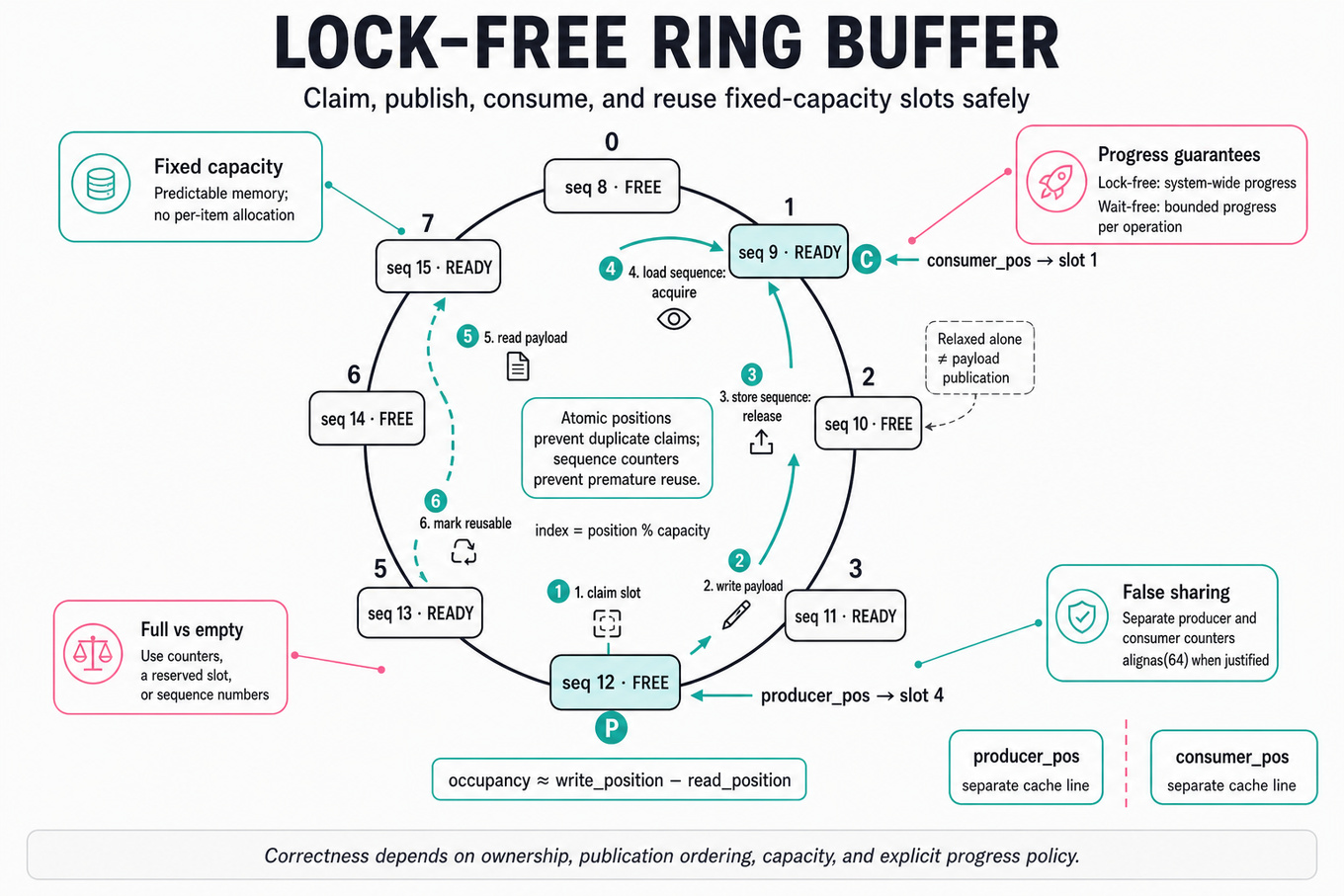
Focus area — You marked concurrent queues and lock-free synchronization shaky; Bloomberg market-data pipelines make producer/consumer correctness high leverage.
What's being tested
This topic tests whether you can reason about concurrent data structures rather than merely add a mutex around shared state. The interviewer is probing atomicity, ownership of memory locations, progress guarantees, memory ordering, bounded-capacity behavior, and correctness under contention. For a Software Engineer at Citadel, these skills matter because market-data and task-processing paths often demand both predictable latency and exact behavior when updates, consumers, and failures occur simultaneously.
Core knowledge
-
A ring buffer stores elements in fixed-capacity storage, using indices modulo capacity:
index = position % capacity. It avoids allocation and provides predictable memory usage, but must distinguish full from empty using counters, a reserved slot, or sequence numbers. -
For a single producer, only that thread advances the write position; consumers must atomically claim read positions, commonly with
compare_exchange_weak. Claiming before reading prevents two consumers from processing the same element. -
Publication requires correct memory ordering: the producer writes payload data, then performs a
store(..., release)on its publication marker; the consumer performs anacquireload before reading. Relaxed atomics alone do not publish payload writes. -
A lock-free algorithm guarantees system-wide progress: some thread completes in finitely many steps. Wait-free additionally bounds every individual operation. A mutex may be correct but blocking; lock-free does not mean starvation-free or automatically faster.
-
Sequence counters per slot solve both publication and reuse: a producer waits until a slot’s sequence indicates free, writes the payload, then advances the sequence; a consumer validates readiness before reading and marks the slot reusable afterward.
-
Capacity must account for outstanding work. With monotonic unsigned positions, occupancy is approximately
write_position - read_position; ensure counters cannot overflow ambiguously, or use sufficiently wide integers and carefully defined wraparound arithmetic. -
False sharing occurs when independent atomic counters share a cache line, causing cache-coherence traffic. Place producer and consumer positions on separate cache lines using padding or
alignas(64)where the target architecture justifies it. -
A queue’s progress policy must be explicit: spin, yield, block with
condition_variable, or return “full/empty.” Spinning can reducep99latency at low contention but wastes CPU and can starve lower-priority work. -
A conflating queue needs two structures: a map from symbol to its current entry and an ordered container of symbols awaiting delivery. Updating an existing symbol replaces its value without creating a duplicate, while new symbols preserve arrival order.
-
Sentinel values such as
-1are unsafe when negative prices are valid. Usestd::optional, a taggedstd::variant, or an explicit validity bit; define whether zero, negative values, and deletion are valid domain states. -
ABA occurs when a location changes from value A to B and back to A, making a compare-and-swap mistake an old state for an unchanged one. Version tags, per-slot sequence numbers, or ownership schemes reduce this risk.
-
Correctness includes destruction and exception behavior. Decide whether objects are constructed in-place, when destructors run, what happens if a consumer exits after claiming an item, and whether producers may overwrite storage containing an unread object.
Worked example
For “Implement a single-producer multi-consumer ring buffer”, I would first clarify whether each item is consumed exactly once, whether operations may block, whether overwriting is allowed, and whether the expected interface is C++-specific. I would state a bounded-capacity assumption, single producer ownership of writes, and that consumers compete to claim each item rather than broadcasting it to every consumer. I would organize the answer around storage and index layout, producer publication, consumer claim/read/release, and full/empty behavior. The producer would reserve or write the next slot, publish it with release semantics, and advance a sequence or write marker. Each consumer would use CAS to claim a unique read position, acquire the corresponding publication state, copy or move the payload, and make the slot reusable. The explicit tradeoff is between a simple CAS-based shared read index and per-slot sequence numbers: sequence numbers handle wraparound and producer/consumer visibility more robustly at the cost of metadata and complexity. I would mention cache-line padding and bounded spinning as latency considerations rather than hiding them inside correctness logic. If I had more time, I would add stress tests with randomized consumer scheduling, wraparound tests, ThreadSanitizer runs, and benchmarks for contention and p99 latency.
A second angle
For “Conflating Quote Queue That Keeps Only the Latest Price per Symbol”, the central issue shifts from claiming slots safely to defining update semantics under concurrency. A strong design uses a symbol-to-entry map plus an ordered queue, carefully marking whether a symbol is already enqueued so repeated updates do not create duplicate work. The candidate must clarify whether a consumer may observe an intermediate price and whether ordering means first arrival or most recent update. A mutex may be the best initial implementation; lock-free replacement is only worthwhile after measuring contention and latency.
Common pitfalls
Pitfall: Treating
volatileas synchronization is incorrect; it may inhibit some compiler optimizations but does not provide atomicity, inter-thread visibility, or ordering. Usestd::atomicand explain the happens-before relationship.
Pitfall: Saying “the ring buffer is lock-free because it uses atomics” skips the hard parts: multi-consumer index claiming, slot reuse, wraparound, and payload publication. Show who owns each mutation and what prevents overwrite or duplicate consumption.
Pitfall: Jumping directly to a complex lock-free algorithm without clarifying semantics signals poor engineering judgment. Start with a correct mutex-based or single-owner design, state its bottleneck, then justify each atomic optimization and its testing plan.
Connections
The interviewer may pivot to linearizability, memory reclamation such as hazard pointers or epoch-based reclamation, and backpressure under overload. They may also connect the queue to Kafka delivery semantics, priority queues, deadlock avoidance, or cache-coherence effects.
Further reading
-
C++ Concurrency in Action, 2nd Edition — practical treatment of atomics, memory ordering, lock-free structures, and thread coordination.
-
The Art of Multiprocessor Programming, 2nd Edition — rigorous coverage of linearizability, progress guarantees, CAS, ABA, and concurrent queues.
-
cppreference:
std::memory_order— precise reference for C++ acquire/release, relaxed ordering, and synchronization guarantees.
Practice questions