Walmart Labs Software Engineer Interview Prep Guide
Everything Walmart Labs actually asks Software Engineer candidates — concept walkthroughs, worked examples, and the real interview questions, drawn from candidate reports. Free to read.
Last updated
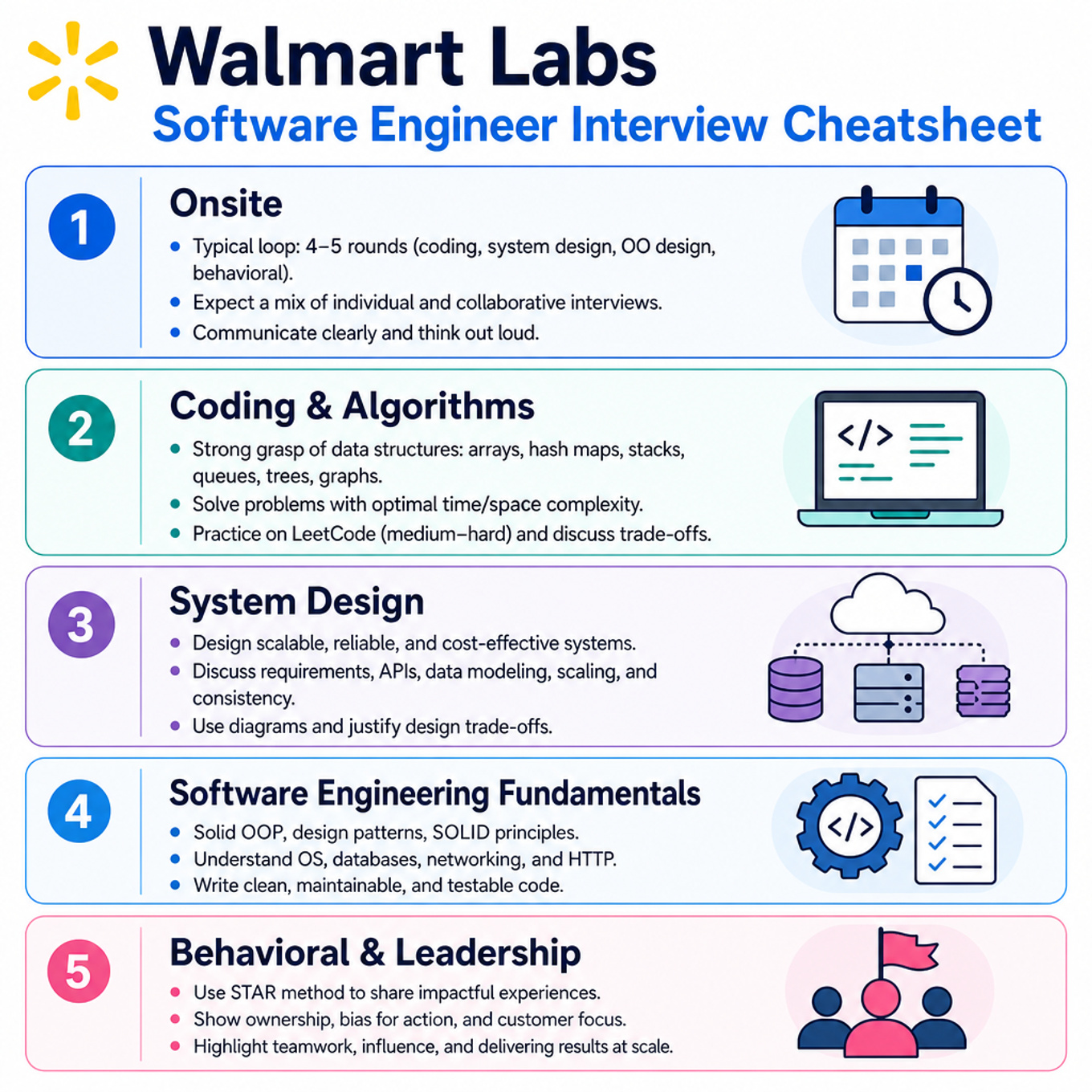
Your biggest focus is onsite coding: arrays/hashing, sliding windows, intervals, and in-place pointer manipulation all sit in a 2/5 self-rated category with no solved-question signal yet. There are no clear strong areas from your ratings or solved history, so non-onsite topics like DP, graphs, and full-stack debugging stay as lighter review rather than core time sinks. For Walmart Labs, this plan highlights commerce correctness, scalable API/data modeling, and event-stream coordination because they map directly to retail checkout, inventory, payments, and backend platform work. With 1–2 weeks left, the budget is coding-heavy first, then short focused passes on system design, backend fundamentals, and behavioral stories.
Onsite — 24 min
Coding & Algorithms
Focus area — You self-rated Coding 2/5 and have not solved platform coding questions, so this core onsite pattern needs timed practice.
What's being tested
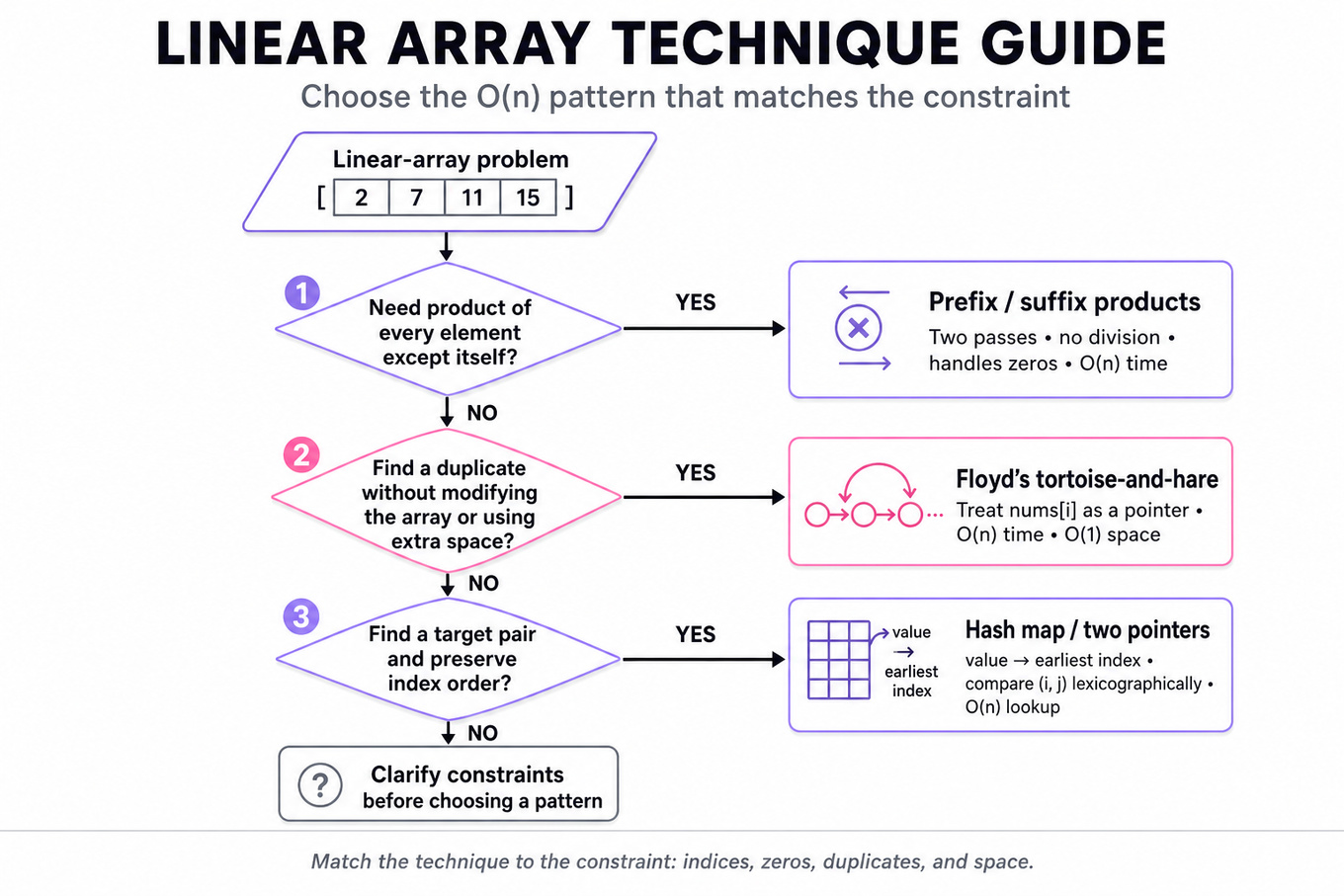
These problems test linear-array reasoning: choosing hashing, two pointers, cycle detection, or prefix/suffix accumulation to achieve O(n) time. You must preserve index semantics, handle duplicates and zeros correctly, and explain why the chosen approach meets constraints such as constant extra space or lexicographic ordering.
Patterns & templates
-
Floyd’s tortoise-and-hare treats
nums[i]as a pointer; detect the duplicate cycle inO(n)time andO(1)space without modifying the array. -
Hash-map Two Sum stores
value → earliest index, enablingO(n)lookup; explicitly define whether lexicographic order means smallest first index, then smallest second. -
For lexicographically smallest pairs, scan indices in ascending order and update only when
(i, j)is strictly smaller than the current best candidate. -
Prefix/suffix products compute
output[i] = prefix[i] × suffix[i]without division, using a prefix pass and a right-to-left accumulator inO(n)time. -
Initialize each product output to
1; multiply the running prefix before or after assignment consistently, especially at the first and last indices. -
Handle zero, multiple zeros, negatives, repeated values, empty arrays, and integer overflow; use a wider numeric type when products can exceed the 32-bit range.
Common pitfalls
Pitfall: Using a
setor sorting solves duplicate detection but violates the constant-space or non-mutating constraint; explain Floyd’s cycle mapping instead.
Pitfall: Returning the first valid Two Sum pair is not necessarily lexicographically smallest; compare index pairs or prove the scan order guarantees optimality.
Pitfall: Division-based products fail with zeros and violate the requirement; use prefix and suffix products with clearly stated update order.
Practice these
The practice cards below cover the canonical variants — solve all of them and time yourself.
Practice questions
Sliding Window And Two-Pointer Scanning
Focus areaFocus area — This is an onsite and assessment staple; your Coding 2/5 rating and no solved signal make invariants worth drilling.
What's being tested
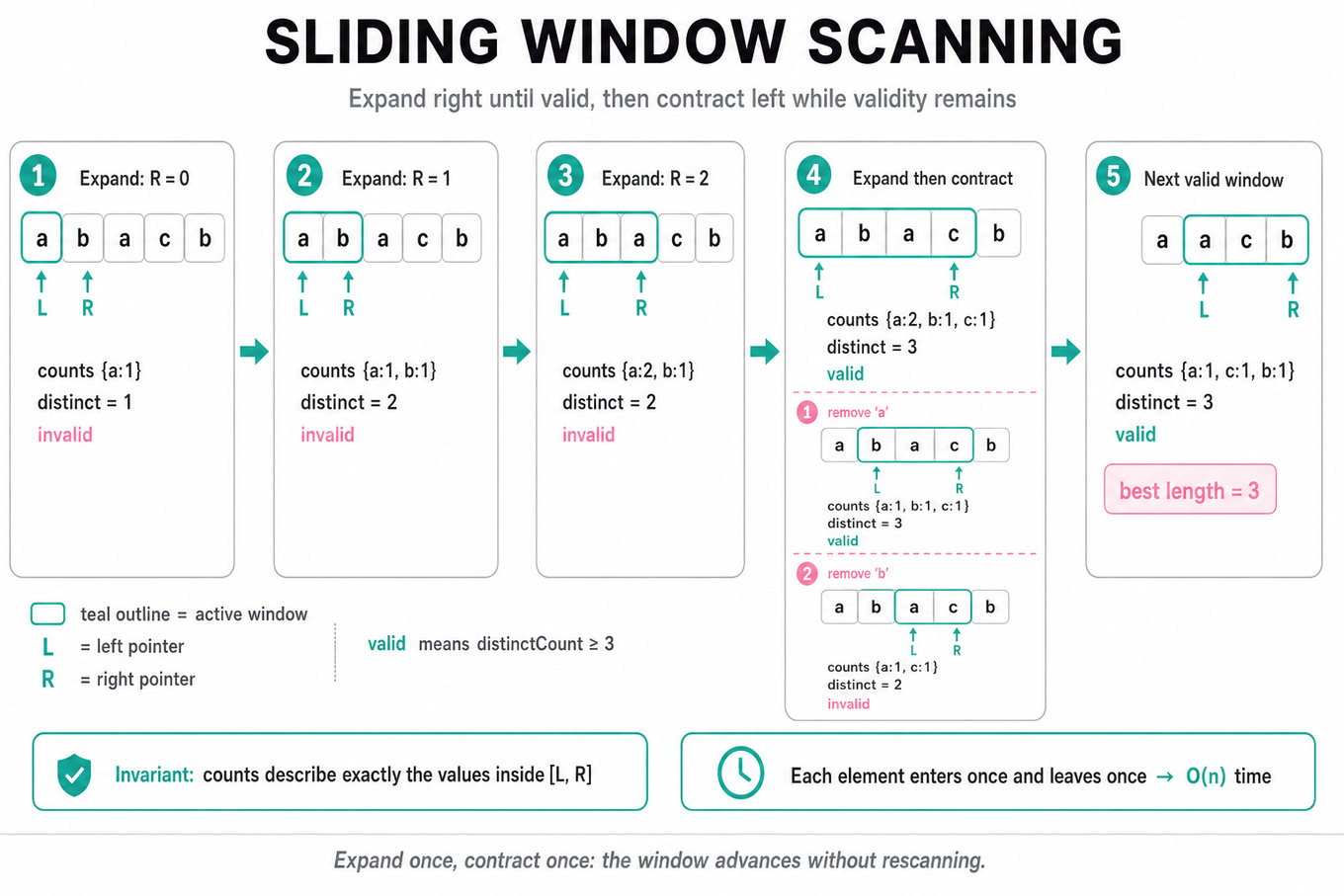
These questions test sliding-window and two-pointer scanning over strings and contiguous arrays. You must maintain a precise window invariant, update counts as pointers move, and explain why each element enters and leaves the window at most once. The interviewer is also checking edge-case handling, especially filtering characters, duplicate counts, impossible windows, and O(n) complexity.
Patterns & templates
-
Opposite-end pointers for palindrome checks: advance inward, skip non-alphanumeric characters, compare normalized characters;
O(n)time andO(1)space. -
Expand-and-contract window: move
rightuntil valid, then advanceleftwhile validity remains; track the shortest valid interval. -
Frequency map with
Mapor dictionary: increment on expansion, decrement on contraction, and delete zero-count keys to track distinct values. -
For every starting index, use a left-to-right window and record the first valid
right; avoid restarting scans, preservingO(n)total time. -
Define validity explicitly:
distinctCount >= korcounts.size === requiredTypes; distinguish “at least” from “exactly.” -
Use
isalnum()or an equivalent predicate plustoLowerCase()for normalization; decide whether Unicode letters and digits are required. -
Return
-1for an impossible window, and handle empty input,k <= 0,k > number of types, and single-element inputs explicitly.
Common pitfalls
Pitfall: Removing a character from the frequency map without decrementing first can make the distinct-count invariant incorrect.
Pitfall: Claiming
O(n)while copying or rescanning each candidate window creates hiddenO(n²)behavior.
Pitfall: Confusing one global minimum window with the shortest valid window required from every starting index.
Practice these
The practice cards below cover the canonical variants — solve all of them and time yourself.
Practice questions
Interval Sweep Line And Merge Algorithms
Focus areaFocus area — Intervals are in the onsite outline, and your current coding signal suggests practicing boundary and sorting decisions explicitly.
What's being tested
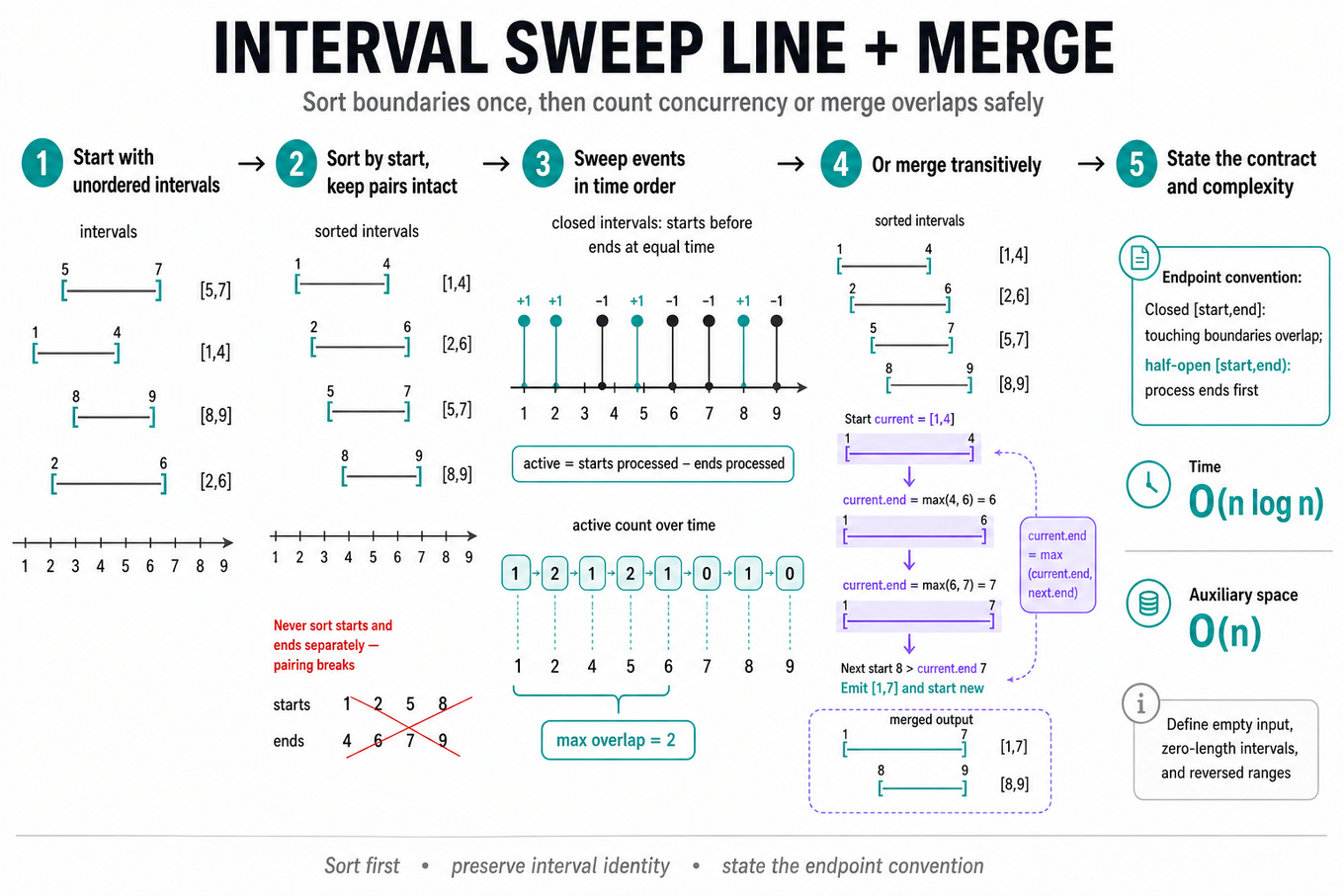
These problems test the interval sweep-line pattern: converting interval starts and ends into ordered events to count concurrent activity, or sorting intervals to merge overlaps. You must handle touching boundaries, chained overlaps, arbitrary input order, and clearly justify O(n log n) time and O(n) space.
Patterns & templates
-
Sweep line: create
(+1)start and(-1)end events, sort by time, accumulate an active counter, and track its maximum. -
For equal timestamps, process starts before ends when intervals are closed; process ends first for half-open intervals
[start, end). -
Merge intervals: sort pairs by start, extend the current interval while
next.start <= current.end, otherwise emit and reset. -
Parallel start/end lists require pairing by index before sorting; never sort the lists independently because that destroys interval identity.
-
Chained overlaps merge transitively: update
current.end = max(current.end, next.end)rather than replacing it. -
Sorting dominates both solutions:
O(n log n)time andO(n)auxiliary space; a bounded integer-time domain may enable counting. -
Define empty input, zero-length intervals, touching endpoints, reversed ranges, and whether output intervals should preserve or normalize boundaries.
Common pitfalls
Pitfall: Sorting starts and ends separately, or comparing only adjacent original inputs, loses interval pairing and misses chained overlaps.
Pitfall: Mishandling equal timestamps changes whether touching intervals count as simultaneous; state the endpoint convention before coding.
Pitfall: Reporting only the algorithm without invariants—explain that the active count equals starts processed minus ends processed.
Practice these
The practice cards below cover the canonical variants — solve all of them and time yourself.
Practice questions
Focus area — Pointer and index precision is easy to lose under pressure, especially with your Coding 2/5 self-rating.
What's being tested
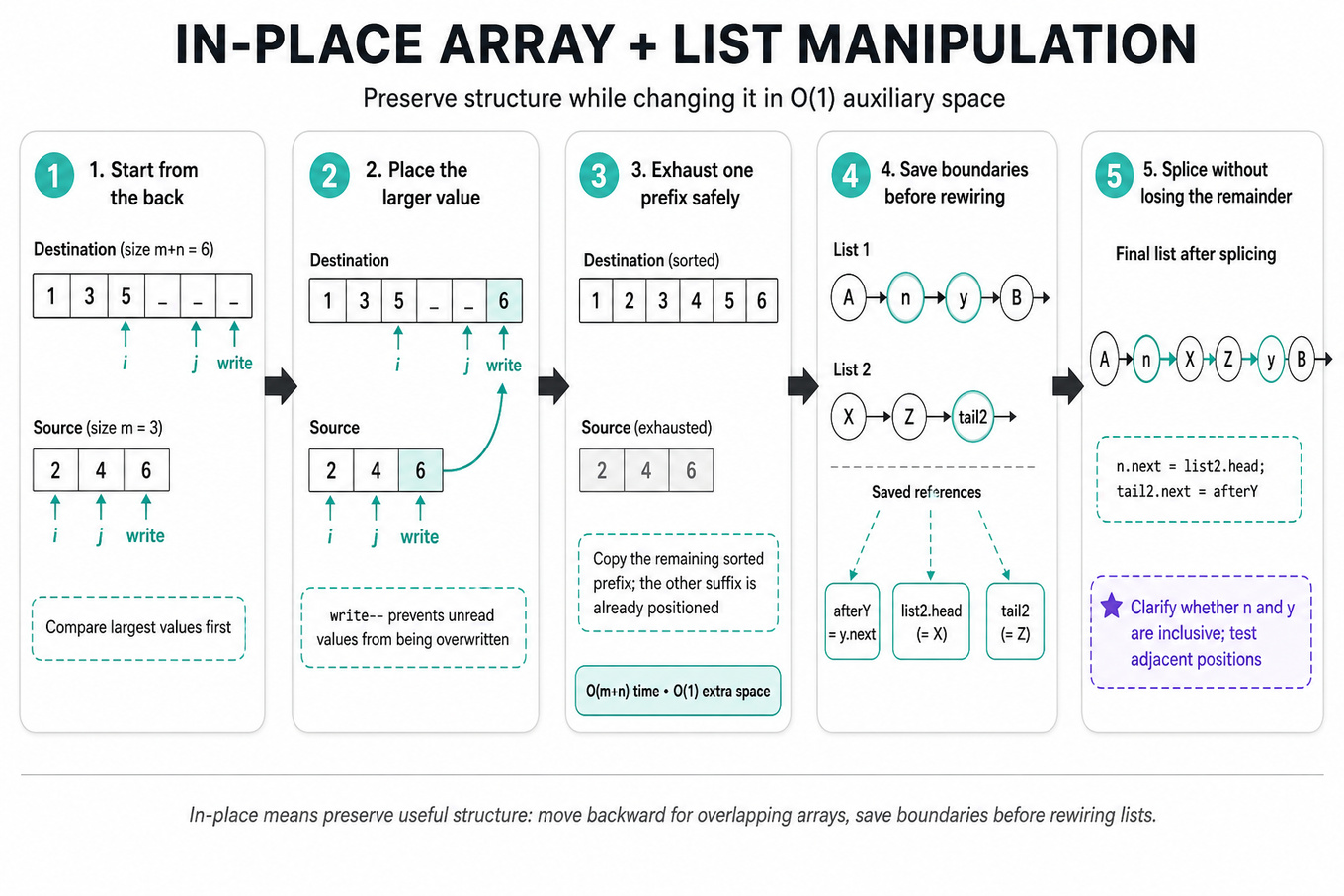
These problems test in-place manipulation: preserving useful structure while modifying arrays or linked lists with O(1) auxiliary space. You must demonstrate two-pointer traversal, careful boundary handling, and accurate time-complexity analysis without allocating a replacement collection.
Patterns & templates
-
Backward two-pointer merge — when the destination array has trailing capacity, compare from the ends; runs in
O(m+n)time andO(1)space. -
Maintain
i,j, andwrite; place the larger value atwrite--, preventing unread destination values from being overwritten. -
Handle exhausted inputs explicitly: once one sorted prefix remains, copy it; the other suffix is already correctly positioned.
-
For linked-list splicing, locate predecessor node
n, successor nodey, and the second list’s tail before changing links. -
Save boundary references before rewiring:
afterY = y.next, then connectn.nextto list two and its tail toafterY. -
Clarify whether positions are zero- or one-based, whether
nandyare inclusive, and whether either list may be empty. -
State complexity precisely: traversal is
O(N+M)time; pointer rewiring usesO(1)extra space, excluding input nodes.
Common pitfalls
Pitfall: Merging forward into the first array overwrites values that have not been compared; merge from the back when storage overlaps.
Pitfall: Losing
list2’s head or tail during splicing makes the remainder unreachable; store both boundary pointers before assignment.
Pitfall: Off-by-one errors around
nandycan retain or discard the wrong node; draw a small pointer diagram and test adjacent positions.
Practice these
The practice cards below cover the canonical variants—solve all of them and time yourself.
Practice questions
Onsite — 12 min
System Design
Onsite — 6 min
Software Engineering Fundamentals
Focus area — Your SE Fundamentals rating is 2/5, and event-stream coordination maps well to Walmart inventory, order, and fulfillment systems.
What's being tested
These problems test concurrency, coordination, and time- or order-sensitive distributed-system design. You must reason about ownership, synchronization, backpressure, failure, shutdown, and observable guarantees—not merely name a data structure or thread primitive. Walmart Labs operates high-throughput services where delayed work, event ordering, and graceful degradation affect inventory, checkout, fulfillment, and customer-facing reliability.
Core knowledge
-
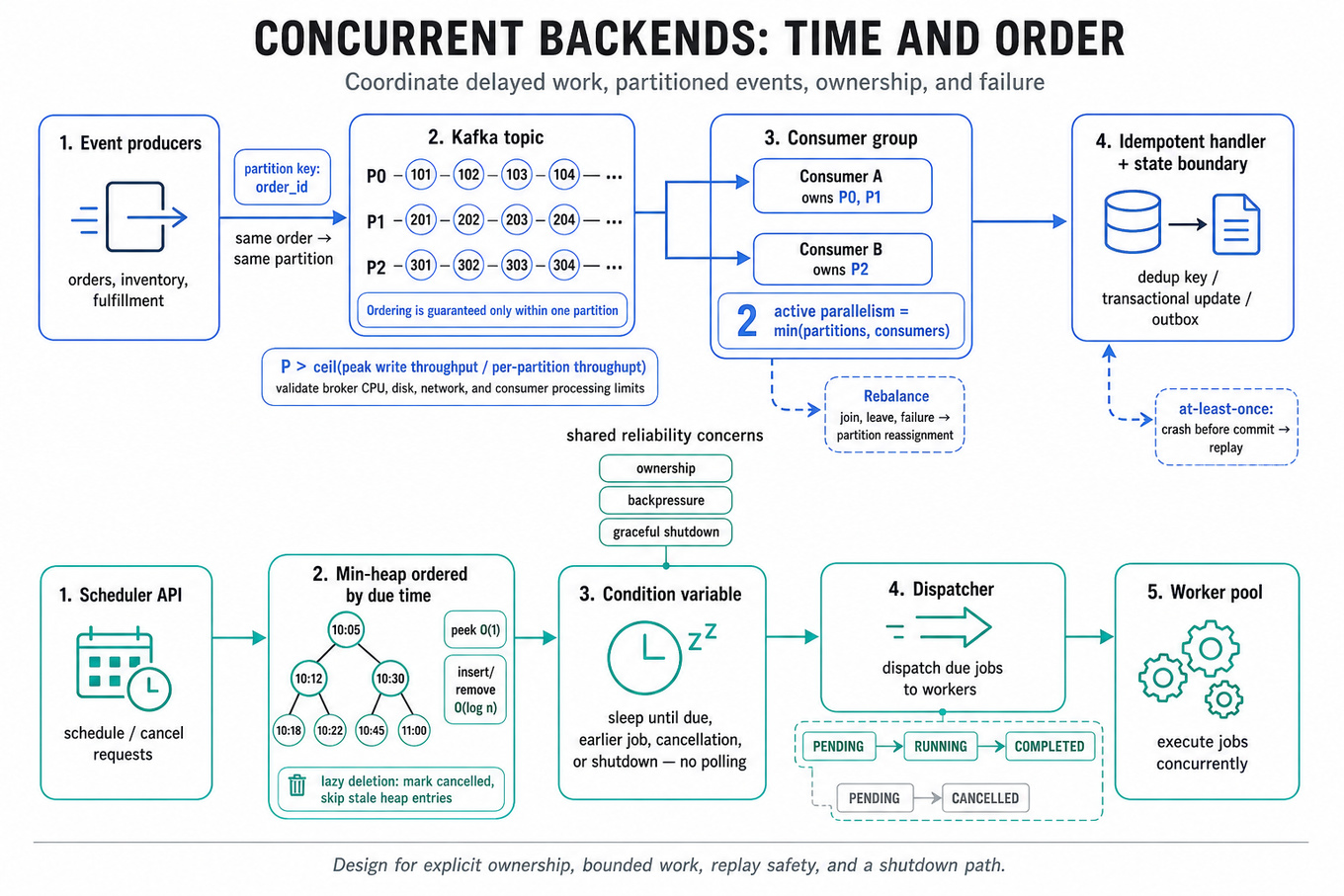
Kafka-style partitioning distributes a topic across independent logs. Within one consumer group, each partition is assigned to at most one consumer, so maximum active consumption parallelism is
min(partitions, consumers). -
Choose partition count from peak throughput and future growth: approximately , then validate broker CPU, disk, network, and consumer processing limits.
-
A consumer group provides horizontal scaling and failover. More consumers than partitions leave workers idle; fewer consumers increase per-worker ownership, potentially creating lag and reducing parallelism.
-
Preserve ordering only within a partition. Use a stable partition key such as
order_idwhen all events for an entity must remain ordered; random or round-robin keys improve distribution but sacrifice entity-local ordering. -
Rebalancing transfers partitions when consumers join, leave, or fail. Prefer cooperative or incremental assignment when available, and make handlers resilient to revoked ownership, duplicate delivery, and paused processing.
-
At-least-once delivery means a crash after processing but before offset commit can replay an event. Use idempotent handlers, deduplication keys, transactional state changes, or an outbox-style boundary where correctness requires it.
-
A delayed-job scheduler should maintain jobs in a min-heap ordered by due time, giving insertion and removal cost and earliest-job lookup cost . A sorted list is simpler but usually makes insertion .
-
Coordinate scheduler threads with a condition variable, not periodic polling. The worker waits until either a job is due, a newly inserted job becomes earlier, cancellation changes the head, or shutdown is requested.
-
Cancellation needs an explicit state model:
PENDING,RUNNING,CANCELLED, andCOMPLETED. Lazy deletion avoids expensive heap removal; the worker skips cancelled entries when they reach the top. -
Separate scheduling from execution using a bounded worker pool. A scheduler thread should enqueue due work quickly; otherwise one long-running job blocks unrelated deadlines and causes unbounded lateness.
-
Backpressure is essential when jobs become due faster than workers can execute them. Bound the ready queue, define rejection or retry behavior, and expose queue depth, execution latency, failures, and dropped-work counters.
-
Shutdown should distinguish graceful and immediate modes. Graceful shutdown stops accepting jobs and drains accepted work; immediate shutdown signals workers, cancels pending jobs where permitted, and documents that already-running code may not stop safely.
-
Time handling should use a monotonic clock for delays because wall-clock adjustments from NTP or daylight-saving changes can move deadlines backward or forward. Persisted schedules may still require wall-clock timestamps plus explicit timezone rules.
-
Kafkathroughput is constrained by the slowest stage: producer, broker, network, consumer fetch, or handler. Monitor consumer lag andp99processing latency; increasing partitions will not fix a slow downstream dependency or serialized handler. -
A robust design states its guarantees precisely: per-key ordering versus global ordering, at-most-once versus at-least-once execution, cancellation before start versus cancellation during execution, and whether delayed jobs survive process failure.
Worked example: Design and Implement an In-Memory Job Scheduler for Delayed Jobs
A strong candidate first asks whether jobs must survive process failure, whether delays are relative or absolute, what cancellation guarantees mean, and whether submitted jobs may run concurrently. They then declare an in-memory, single-process assumption and organize the answer around a min-heap, condition-variable coordination, worker execution, and lifecycle state transitions. submit(delay, task) creates a unique job record, inserts it under a lock, and signals the scheduler if the new deadline becomes the heap head. The scheduler waits indefinitely when empty, otherwise waits only until the earliest deadline and rechecks state after every wake-up to handle spurious notifications. Due jobs move to a bounded executor queue, while cancellation marks records rather than relying on unsafe arbitrary heap deletion. A key tradeoff is lazy cancellation: it keeps operations simple and efficient, but cancelled records can temporarily consume heap memory and require periodic compaction. The answer should explicitly state that cancellation cannot guarantee stopping a task already running unless the task cooperatively observes a cancellation token. To close, the candidate would add deterministic tests using an injected clock, metrics for scheduling lateness, and fault behavior for rejected or failed tasks.
A second angle
For Allocating Partitions and Consumers for a Kafka-Style Event Topic, the same concurrency reasoning shifts from local thread coordination to distributed ownership. Clarify required ordering, peak throughput, acceptable lag, consumer processing time, and failure-recovery expectations before choosing partition count. Organize the response around partition-key selection, consumer-group assignment, rebalancing, and offset or duplicate semantics. The central tradeoff is that more partitions increase parallelism and future capacity but also add broker metadata, rebalance overhead, and operational cost.
Common pitfalls
Pitfall: Saying “Kafka guarantees ordering” without qualification is analytically wrong; ordering is guaranteed only within a partition, so explain how the key maps related events to the same partition.
A tempting scheduler answer uses sleep(100ms) in a loop to check deadlines. That introduces unnecessary wakeups and scheduling jitter, and it may miss an earlier newly submitted job; a condition variable with timed waits demonstrates correct coordination.
Many candidates describe a heap and worker threads but omit ownership and lifecycle races. Explicitly discuss shutdown while a worker is dequeuing, cancellation concurrent with execution, spurious wakeups, duplicate event delivery, and what happens when the executor queue is full.
Connections
The interviewer may pivot to backpressure, idempotency, leader election, retry policies, or dead-letter queues. They may also ask how to replace the in-memory scheduler with a durable design using Redis, Postgres, or a managed queue while preserving visibility and delivery guarantees.
Further reading
-
Kafka Documentation: Consumer Groups — authoritative explanation of partitions, group membership, and assignment.
-
The Little Book of Semaphores — practical treatment of locks, condition coordination, and concurrency patterns.
-
Designing Data-Intensive Applications by Martin Kleppmann — strong coverage of logs, ordering, delivery semantics, and distributed-system tradeoffs.
Practice questions
Onsite — 6 min
Behavioral & Leadership
Focus area — With 10 years of experience and a 2/5 behavioral rating, strong ownership and impact stories need deliberate preparation.
What's being tested
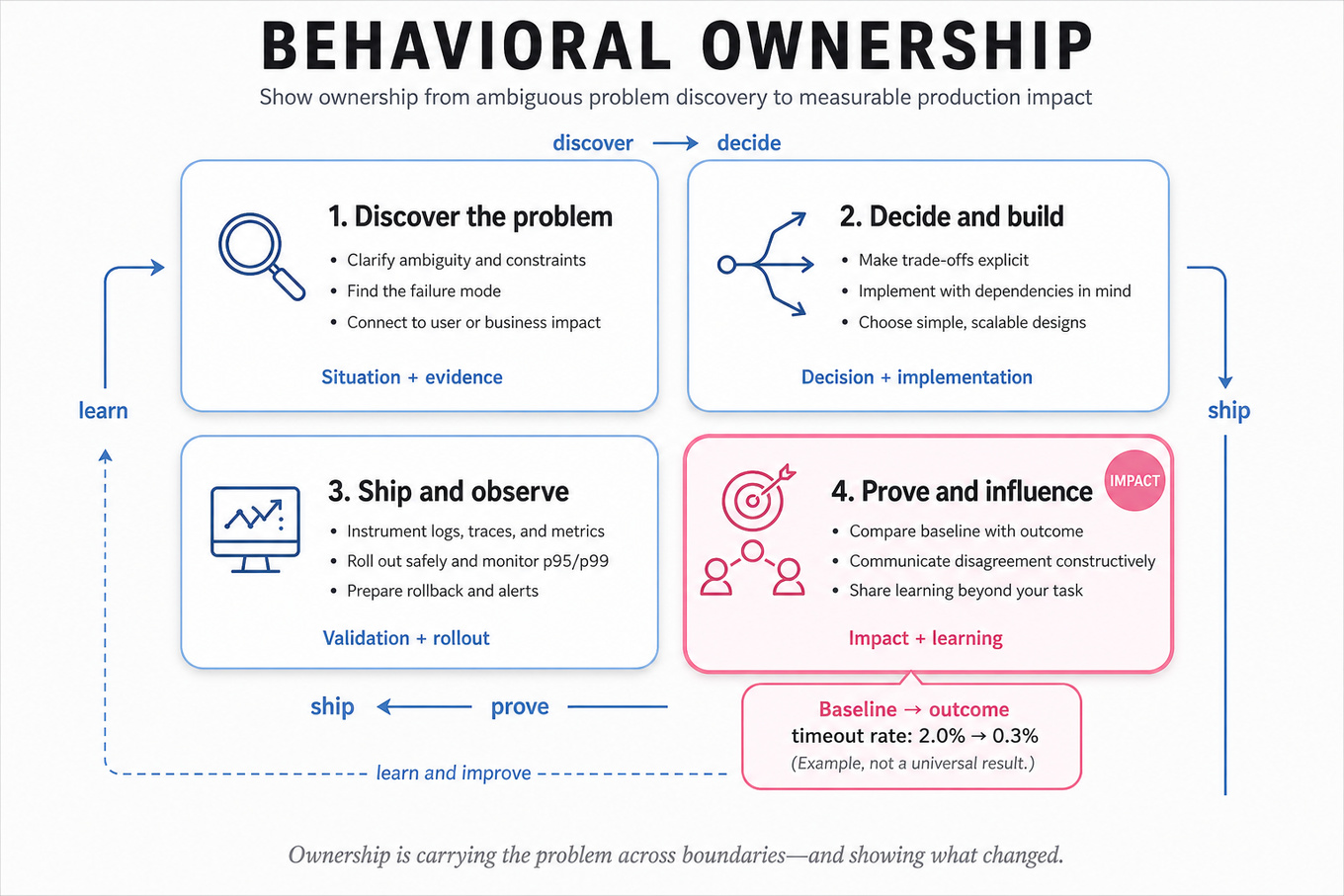
These prompts test whether you can show ownership from ambiguous problem discovery through implementation, rollout, and measurable outcome—not merely describe tasks assigned to you. The interviewer is probing technical judgment, debugging discipline, communication under disagreement, and influence without requiring formal management authority. Walmart Labs cares because production software operates at large scale: a seemingly small change can affect checkout reliability, inventory accuracy, latency, cost, and millions of customers. Strong answers connect your individual engineering decisions to system behavior and business-relevant outcomes while being candid about trade-offs and mistakes.
Core knowledge
-
STAR is useful, but the strongest behavioral answer is technically causal: situation and constraints, your specific decision, implementation details, validation, measurable result, and what you learned. Spend most time on decisions and evidence rather than team background.
-
Ownership means carrying a problem across boundaries: clarifying requirements, identifying dependencies, writing or reviewing code, instrumenting behavior, deploying safely, monitoring
p95/p99latency and error rate, and following through after release. Do not equate ownership with doing every task yourself. -
Quantify impact with a baseline and comparison: “timeout rate fell from 2.0% to 0.3%” is stronger than “performance improved.” For reliability, discuss availability,
MTTR, deployment frequency, rollback rate, saturation, and error-budget consumption; distinguish correlation from causation. -
For a hard technical problem, explain the failure mode before the fix. Examples include a thundering herd after cache expiry, duplicate writes caused by retries, stale reads from replica lag, an
N+1query pattern, or a race condition around shared state. -
Make trade-offs explicit: synchronous versus asynchronous processing, strong versus eventual consistency, relational transactions versus distributed coordination, caching versus freshness, or a simple local fix versus a reusable platform abstraction. State why the chosen option fit the scale and failure tolerance.
-
Observability turns ownership into evidence. Mention structured logs with request or trace IDs, actionable metrics, distributed traces, dashboards, and alerts tied to user impact. A deploy is not complete until you can detect regressions and identify the failing dependency.
-
Safe delivery demonstrates engineering judgment: feature flags, canary releases, backward-compatible schema changes, automated tests, staged rollout, rollback criteria, and idempotent handlers. For a high-risk change, define “stop” conditions before deployment rather than improvising during an incident.
-
Influence without authority relies on artifacts and experiments: a short design document, reproducible benchmark, failure analysis, API contract, or test demonstrating the concern. Invite critique, separate people from technical claims, and escalate only after attempting direct resolution.
-
In conflict, distinguish facts, constraints, preferences, and decision rights. Compare alternatives using measurable criteria such as correctness, operational complexity, latency, cost, security, and reversibility; record the decision and commit once the decision owner chooses.
-
Mentoring and code quality are engineering leverage, not merely interpersonal activities. Use focused code reviews, pairing, test-design guidance, static analysis, API conventions, and runbooks to raise the team’s ability to ship safely without becoming a single point of failure.
-
Integrity matters when pressure conflicts with correctness or compliance. Do not hide a failing test, silently weaken authorization, manipulate a metric, or ship known data-loss risk; state the risk, propose a safe alternative, document the decision, and escalate through the appropriate channel.
-
A credible failure story includes a concrete correction. Examples are adding a
UNIQUEconstraint after duplicate records, introducing an idempotency key after retry-induced double processing, or adding contract tests after a breaking downstream API change. Explain how the process changed afterward.
Worked example: “Describe a Hard Technical Problem You Solved and a Coworker Conflict You Resolved”
In the first 30 seconds, I would clarify the system context, my exact responsibility, the severity of the technical issue, the disagreement’s subject, and the measurable outcome expected. I would state assumptions such as: “This was a backend service in production, and I owned the change and rollout, while the coworker owned the dependent client.” I would organize the answer around four pillars: diagnosing the failure with logs, metrics, and traces; comparing the competing designs; resolving the disagreement respectfully; and deploying and validating the fix. A concrete technical decision might be choosing an idempotent asynchronous workflow over a synchronous retry loop because retries were amplifying load and creating duplicate writes. I would explain the trade-off: asynchronous processing improved resilience but introduced eventual consistency, so I added status visibility and clear retry semantics. For the conflict, I would describe a one-on-one conversation, restate the coworker’s reliability concern, and use a reproducible load test rather than treating disagreement as resistance. I would close with the result—such as lower duplicate-write rate, improved p99, and no regression during a canary—and the lesson that design assumptions should be tested early. If I had more time, I would also describe the monitoring, rollback threshold, and follow-up documentation that prevented the same class of incident.
A second angle
For “Handle conflict and motivate engineering teams,” the core concept shifts from one technical incident to sustaining execution across several engineers. I would frame my role as creating clarity and reducing friction, not acting as the team’s manager: define the technical goal, split work by ownership boundaries, surface risks, and make progress visible through a lightweight plan. Motivation should be grounded in engineering autonomy, achievable milestones, useful feedback, and recognition of specific contributions—not generic encouragement. I would include how I handled a missed commitment or design disagreement while protecting code quality and the delivery date.
Common pitfalls
Pitfall: Saying “I improved performance” without a baseline, workload, or measurement makes the claim unverifiable. State the tested traffic shape, the bottleneck, the before-and-after metric, and whether the result held in production.
A communication mistake is presenting a coworker as incompetent or describing conflict as something you “won.” That signals poor collaboration; instead, explain the legitimate concern on each side, the evidence used, how the decision was made, and how you preserved the working relationship.
A depth mistake is naming tools—Kafka, caching, microservices, or Kubernetes—without explaining the failure mode or trade-off. “We added retries” is incomplete unless you discuss timeout budgets, backoff, jitter, idempotency, retry limits, and how you prevented a retry storm.
Connections
An interviewer may pivot from these stories to incident response, distributed-systems consistency, observability and SLOs, or code-review and testing strategy. Be ready to connect behavioral evidence to a concrete design artifact, algorithmic choice, debugging method, or production safeguard.
Further reading
-
The Site Reliability Workbook — practical guidance on SLOs, error budgets, incident response, and safe operational ownership.
-
[Debugging Teams](https://pragprog.com/titles/ate disputing/debugging-teams/) — techniques for diagnosing collaboration and communication failures with the same discipline used for technical failures.
-
Staff Engineer: Leadership beyond the management track by Will Larson — useful frameworks for technical influence, scope, and leading without formal authority.
Practice questions