Coinbase Software Engineer Interview Prep Guide
Everything Coinbase actually asks Software Engineer candidates — concept walkthroughs, worked examples, and the real interview questions, drawn from candidate reports. Free to read.
Last updated
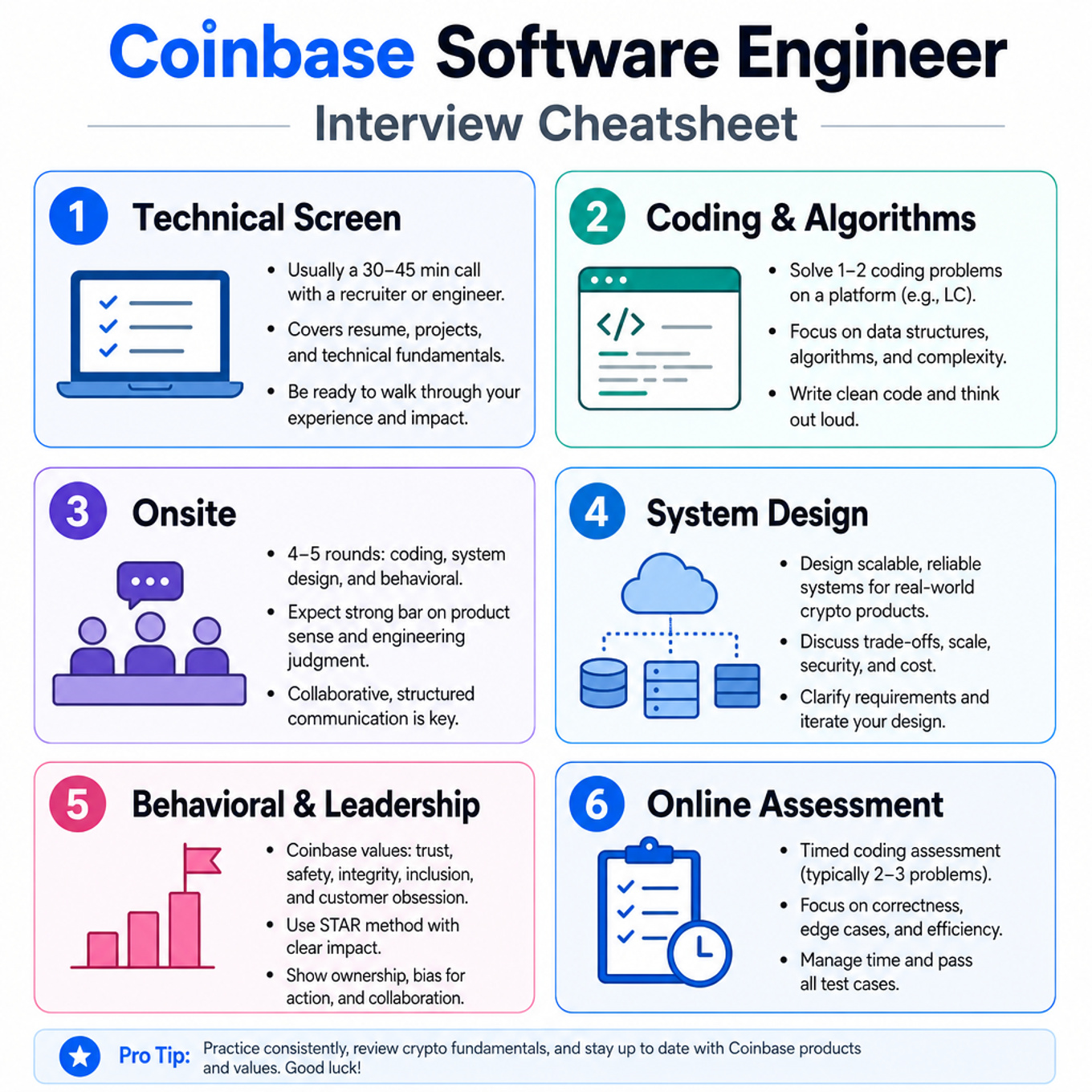
Focus most on Coinbase-scale system design, reliability, regulated crypto/financial semantics, and M7 Senior Engineering Manager scope because your System Design self-rating is 3/5 and your platform activity is heavily design-focused. You're relatively strong in Behavioral & Leadership at 4/5, so basic STAR mechanics stay shorter while senior-manager ownership, org leadership, and executive tradeoffs get expanded. The Coinbase-specific emphasis is on ledgers, crypto order lifecycle, idempotency, risk/compliance judgment, and reliable financial workflows under failure. With less than a week, this plan keeps niche coding drills brief and concentrates the time on high-signal M7 architecture and leadership conversations.
Technical Screen — 11 min
Coding & Algorithms
-
Mempool Block Assembly And CPFP — covered in depth under Onsite below.
-
Cursor-Based Pagination — covered in depth under Onsite below.
Onsite — 65 min
System Design
Focus area — Added for M7 interviews where you must guide architecture without coding every detail and explain durable technical strategy.
What's being tested
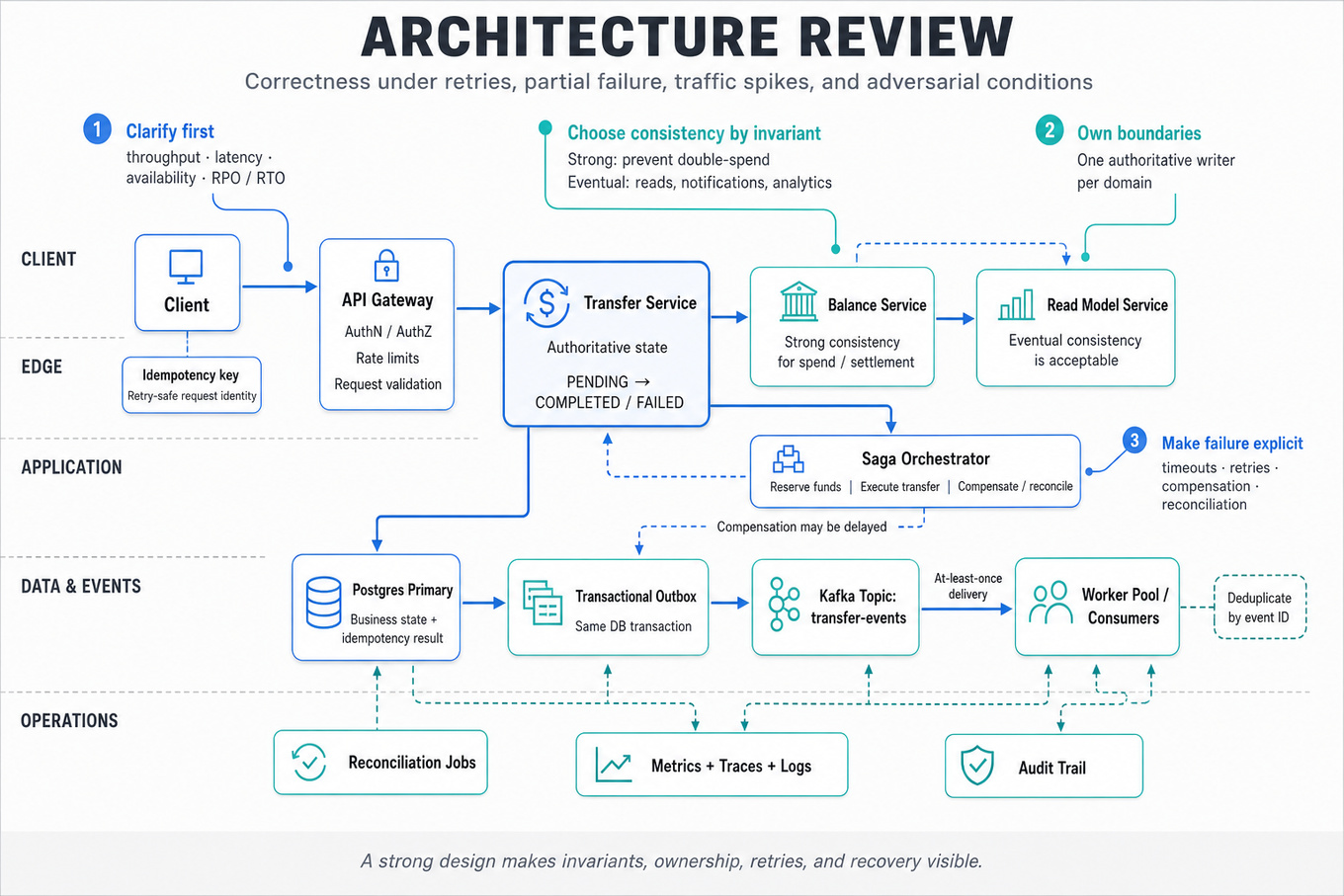
An architecture review tests whether you can turn ambiguous requirements into a reliable, evolvable system design and explain the tradeoffs behind it. The interviewer is probing for judgment across API boundaries, data consistency, failure handling, observability, security, and operational complexity—not just whether you can name `Kafka` or a database. Coinbase cares because financial systems must preserve correctness under retries, partial failures, traffic spikes, and adversarial conditions while remaining understandable enough to operate safely.
Core knowledge
-
Requirement clarification comes first: establish throughput, latency targets, availability, durability, consistency, recovery-point objective (RPO), recovery-time objective (RTO), geographic scope, and correctness invariants. Separate hard requirements from assumptions you can revisit.
-
Bounded contexts keep ownership clear. Define which service is authoritative for balances, orders, transfers, or identity, and expose state through versioned APIs rather than allowing multiple services to write the same records.
-
Consistency choices must follow the invariant. Strong consistency may be required when preventing double-spend or duplicate settlement; eventual consistency is usually acceptable for read models, notifications, and analytics. State the anomaly you are willing to tolerate.
-
Idempotency is essential for money-moving operations. Accept a client-supplied idempotency key, persist the request and final outcome atomically, and return the original result on retry. A timeout must not cause the client to submit an untracked second operation.
-
Transactions and the outbox pattern solve different parts of distributed writes. Commit the business state and an outbox event in one
`Postgres`transaction, then publish asynchronously with retries; consumers use event IDs or deduplication keys because delivery is at-least-once. -
Sagas coordinate multi-service workflows without pretending a distributed transaction exists. Each step has a compensating action, explicit states such as
PENDING,COMPLETED, andFAILED, and reconciliation for cases where compensation is impossible or delayed. -
Partitioning and ordering require a deliberate key. Partition events by account, wallet, or operation ID when per-entity ordering matters; avoid a single global partition that creates a bottleneck. Ordering is normally guaranteed only within a partition, not across topics.
-
Backpressure and load shedding protect dependencies. Use bounded queues, rate limits, circuit breakers, exponential backoff with jitter, and bulkheads. A queue improves resilience but does not remove capacity limits; monitor age and depth, not merely enqueue success.
-
Availability math exposes unrealistic designs. Independent services with availabilities and have sequential availability approximately ; redundant parallel components provide , assuming failure independence. Call out correlated-zone failures.
-
Data modeling should encode invariants, not rely only on application checks. For a ledger, use append-only entries, immutable transaction IDs, explicit debit/credit semantics, and reconciliation such that total debits equal total credits. Avoid floating-point currency calculations; use integer minor units or exact decimal types.
-
Observability needs three layers: structured logs for individual operations, metrics such as
`p95`,`p99`, error rate, queue age, and reconciliation lag, and distributed traces using a correlation ID. Define alerts around customer impact and correctness, not only CPU utilization. -
Security and safe rollout belong in the design. Apply least-privilege service identities, encryption in transit and at rest, audit trails, secret rotation, request authentication, and authorization at the resource boundary. Use feature flags, canaries, schema compatibility, and rapid rollback for migrations.
Worked example — “Architecture Review: Reliable Crypto Transfer Service”
No interview question was supplied, so this representative architecture-review prompt shows the expected reasoning structure. In the first 30 seconds, clarify whether the service initiates blockchain withdrawals or only internal transfers, required confirmation semantics, supported assets, expected throughput, latency, custody boundaries, and whether duplicate submission is financially dangerous. State the invariant explicitly: a transfer must have one durable business outcome, and the ledger must remain balanced even if workers, networks, or clients retry. Organize the answer around the API and idempotency contract, the ledger and state machine, asynchronous execution and blockchain integration, and observability/reconciliation. I would persist a transfer request, immutable ledger entries, and an outbox event in one `Postgres` transaction, then let workers process the external broadcast with an idempotent operation record. The key tradeoff is strong synchronous confirmation versus asynchronous acceptance: return PENDING quickly for availability, while exposing clear status and reserving funds before external settlement. I would explicitly discuss reorgs, fee changes, stuck transactions, provider outages, and the distinction between broadcast success and final blockchain confirmation. If I had more time, I would design the reconciliation job, multi-region failover behavior, key-management boundary, and migration plan for adding a new asset.
A second angle
The same reasoning applies to an order-placement service, but the critical invariant shifts from ledger balance to preventing unauthorized or duplicate execution. Clarify whether orders can be amended, how exchange availability is represented, and whether the client needs synchronous acceptance or final fill confirmation. An order state machine, idempotency key, reservation model, and event-driven execution pipeline remain central, but market-data freshness and partial fills become first-class failure cases. The design should separate accepted order intent from execution reports and make recovery safe when an exchange acknowledgement is lost.
Common pitfalls
Pitfall: Saying “use exactly-once processing” as if it were a property provided end to end. Most systems provide at-least-once delivery; achieve effectively-once business effects with durable operation IDs, unique constraints, idempotent handlers, and reconciliation.
A common analytical mistake is choosing technology before identifying invariants. “Use `Kafka` and microservices” is not an architecture; explain what must be atomic, what may be delayed, where state lives, and what happens during each partial failure.
Pitfall: Treating a retry as harmless for a financial mutation. Retries without idempotency can double-reserve funds, create duplicate withdrawals, or produce conflicting status records.
A communication mistake is presenting a perfect diagram without stating assumptions or alternatives. Strong candidates narrate the critical path, label synchronous versus asynchronous edges, identify the source of truth, and name one rejected design with its cost.
Pitfall: Ignoring operations after the happy path. A design without dashboards, replay procedures, reconciliation, dead-letter handling, schema evolution, and rollback is incomplete even if its request flow looks correct.
Connections
Expect pivots to distributed transactions, event sourcing and CQRS, database replication and failover, API versioning, rate limiting, and threat modeling. The interviewer may also ask how you would test failure modes with contract tests, property-based tests, fault injection, or controlled production canaries.
Further reading
-
Designing Data-Intensive Applications — Martin Kleppmann’s treatment of consistency, replication, streams, transactions, and distributed-system tradeoffs.
-
Microservices Patterns — Chris Richardson’s practical coverage of sagas, transactional outbox, idempotency, and service boundaries.
-
The SRE Book — Google’s framework for SLOs, error budgets, monitoring, incident response, and safe operations.
Practice questions
Focus area — Added for Coinbase-specific leadership: balance speed, customer trust, regulatory obligations, security, incident response, and risk acceptance.
What's being tested
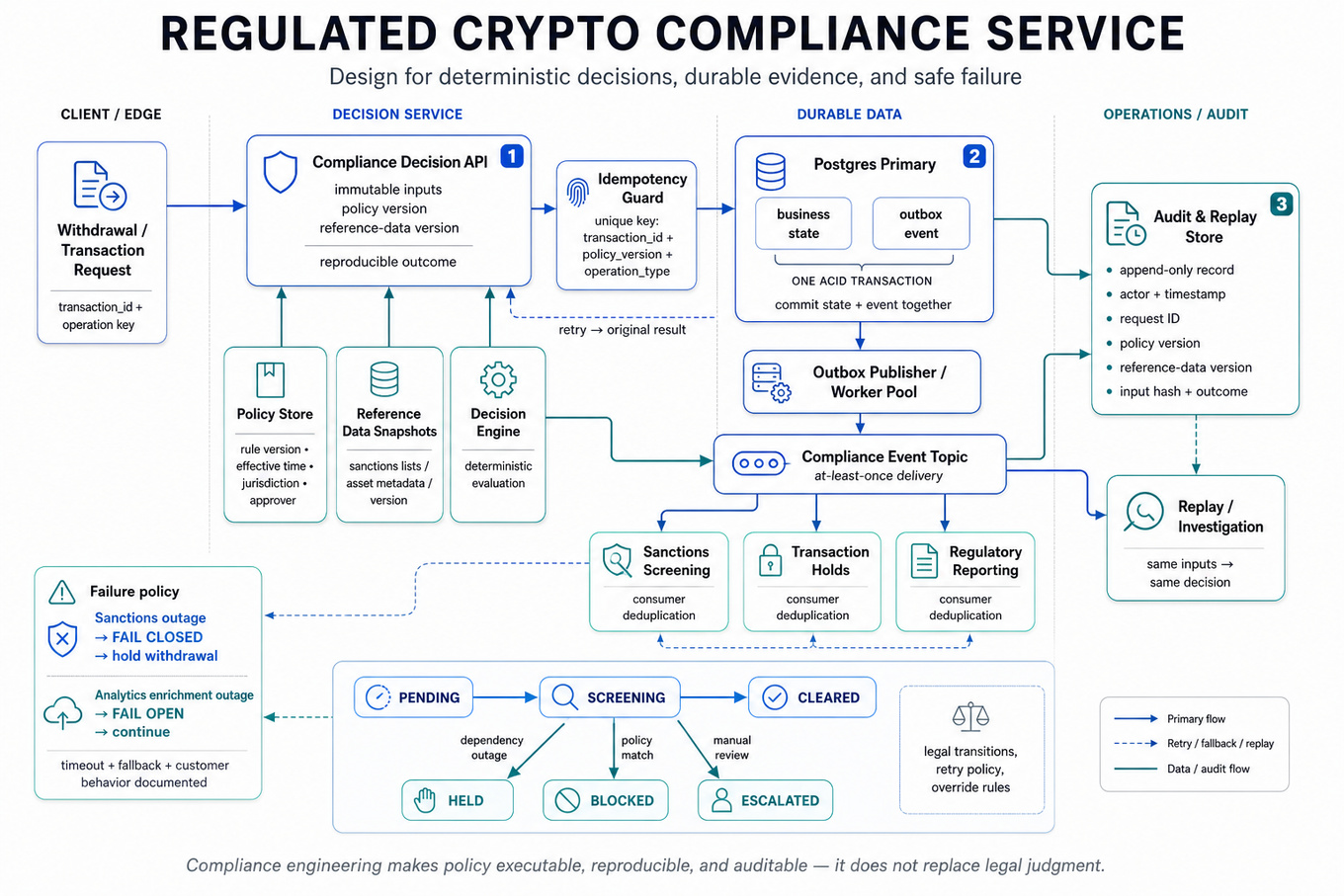
A Software Engineer should be able to design compliance-critical services that are correct, auditable, resilient under failure, and safe to change. Coinbase cares because transaction holds, sanctions decisions, identity checks, and regulatory reporting directly affect customer funds and legal obligations; an unavailable or non-reproducible decision can become both a customer incident and a compliance incident. The interviewer is probing whether you can translate policy requirements into explicit system invariants, durable data models, reliable workflows, and operational controls without pretending that engineering alone determines legal policy. No concrete interview question was supplied, so the examples below use representative prompts from this domain.
Core knowledge
-
Policy-as-data separates changing rules from deployment code: store rule versions, effective timestamps, jurisdictions, asset scope, and approver metadata. A decision must record the exact policy version used, not merely the current configuration.
-
Decision determinism is essential for audit and replay. Given immutable inputs, policy version, and reference-data versions, the same request should produce the same outcome; nondeterministic ordering, mutable lookups, and wall-clock dependence must be controlled.
-
Idempotency prevents duplicate screening, holds, or reports when clients retry. Use a stable operation key such as
(transaction_id, policy_version, operation_type), enforce uniqueness in durable storage, and return the original result for repeated requests. -
Transactional outbox reliably publishes compliance events after a database commit. Write the business state and outbox record in one
Postgrestransaction, then publish asynchronously; consumers use deduplication because delivery is at-least-once. -
State machines make lifecycle behavior explicit:
PENDING → SCREENING → CLEARED, with terminal or review states such asBLOCKED,HELD, andESCALATED. Define legal transitions, retryable failures, operator overrides, and whether a transition is reversible. -
Fail-closed versus fail-open must be chosen per operation. A sanctions-screening dependency outage may safely hold a withdrawal, while a noncritical analytics enrichment may proceed; document the choice, timeout, fallback, and customer-visible behavior.
-
Audit trails need append-only records containing actor, timestamp, request identity, old and new values, reason, correlation ID, and policy/reference-data versions. “The row currently says blocked” is weaker than a history proving who changed it and why.
-
Reference-data versioning applies to watchlists, jurisdiction mappings, and risk policies. Pin each decision to a snapshot or version, retain enough data for replay, and define propagation latency so one service does not screen against stale data unknowingly.
-
Exactly-once effects are rarely provided end to end. Design for at-least-once messages, idempotent consumers, deduplication keys, reconciliation jobs, and a dead-letter workflow; do not confuse
Kafkaoffset commits with successful business processing. -
Privacy and access control are engineering requirements, not afterthoughts. Minimize sensitive fields, encrypt in transit and at rest, restrict case access by role and jurisdiction, redact logs, and define retention/deletion behavior that respects legal holds.
-
Reliability targets should distinguish synchronous decision latency from asynchronous case completion. Track
p50,p95, andp99latency, dependency error rate, backlog age, replay success, and reconciliation discrepancies rather than relying only on uptime. -
Operational controls include circuit breakers, bounded retries with jitter, bulkheads, backpressure, and manual-review queues. A queue that grows without an age-based alert can silently create regulatory exposure even while every service reports healthy.
Worked example
Because no concrete title was provided, consider the representative prompt: “Design a transaction compliance screening service for crypto withdrawals.” In the first 30 seconds, clarify supported assets and jurisdictions, required decision latency, whether the result must block settlement, expected peak throughput, screening-provider guarantees, and the retention and replay requirements. State the assumptions explicitly: withdrawals cannot settle before a required successful decision, providers may be unavailable, and duplicate requests must not create duplicate holds or cases. Organize the answer around four pillars: the withdrawal state machine, durable decision and audit storage, provider integration with retries and idempotency, and observability plus manual-review operations. A strong design would persist a screening attempt and outbox event transactionally, invoke the provider with a stable idempotency key, record the provider response and reference-data version, then advance the withdrawal only through validated transitions. The key tradeoff is fail-closed behavior: holding withdrawals during provider failure protects compliance guarantees but increases customer impact and queue pressure. Explain how operators can inspect evidence without editing history, while a controlled override creates a new auditable transition rather than mutating the original decision. Close by saying that with more time you would add a replay tool, reconciliation against the settlement ledger, capacity testing for incident spikes, and a disaster-recovery exercise.
A second angle
A different representative prompt is “Design an auditable compliance case-management workflow for suspicious activity escalations.” The core concepts transfer, but the dominant constraint changes from low-latency transaction gating to durable human workflow, authorization, and evidence integrity. Model assignment, investigation, escalation, filing, and closure as explicit states with optimistic concurrency so two investigators cannot silently overwrite one another. The system should preserve immutable evidence snapshots while allowing append-only investigator notes and supervisor approvals. The main tradeoff is flexibility versus control: free-form workflows help investigators, but tightly defined transitions and separation of duties provide stronger auditability.
Common pitfalls
Pitfall: Treating compliance as a single synchronous boolean such as
is_allowed = trueloses policy versions, evidence, provider failures, manual review, and the distinction between “blocked,” “pending,” and “unable to decide.” Model the decision lifecycle and its provenance instead.
Pitfall: Saying “use retries and exactly-once delivery” is not a complete distributed-systems design. Retries can duplicate external effects, and message systems commonly provide at-least-once delivery; explain idempotency keys, durable state, deduplication, and reconciliation.
Pitfall: Overstepping into legal or product ownership by inventing what transactions must legally be blocked. A better answer says engineering enforces an approved policy contract, makes policy changes versioned and reviewable, and escalates ambiguous requirements to compliance stakeholders.
Connections
An interviewer may pivot to distributed sagas, event sourcing, RBAC/ABAC authorization, disaster recovery, or reconciliation between a compliance ledger and a settlement ledger. Be prepared to discuss consistency boundaries, recovery-point objectives, and how to prove that operational actions match the recorded audit history.
Further reading
-
NIST SP 800-61 Rev. 2: Computer Security Incident Handling Guide — useful for incident response, escalation, evidence preservation, and post-incident controls.
-
Designing Data-Intensive Applications by Martin Kleppmann — strong treatment of idempotency, logs, consistency, transactions, and stream-processing tradeoffs.
-
The Twelve-Factor App: Admin Processes and Logs — concise operational guidance relevant to auditable jobs, repeatable tasks, and structured service logging.
Practice questions
- Banking Ledger And Transaction Semantics (Focus) — covered in depth under Online Assessment below.
Crypto Trading Order Lifecycle
Focus areaFocus area — Highly Coinbase-specific and useful for M7 architecture discussions around state machines, exchange integration, reconciliation, and operational risk.
What's being tested
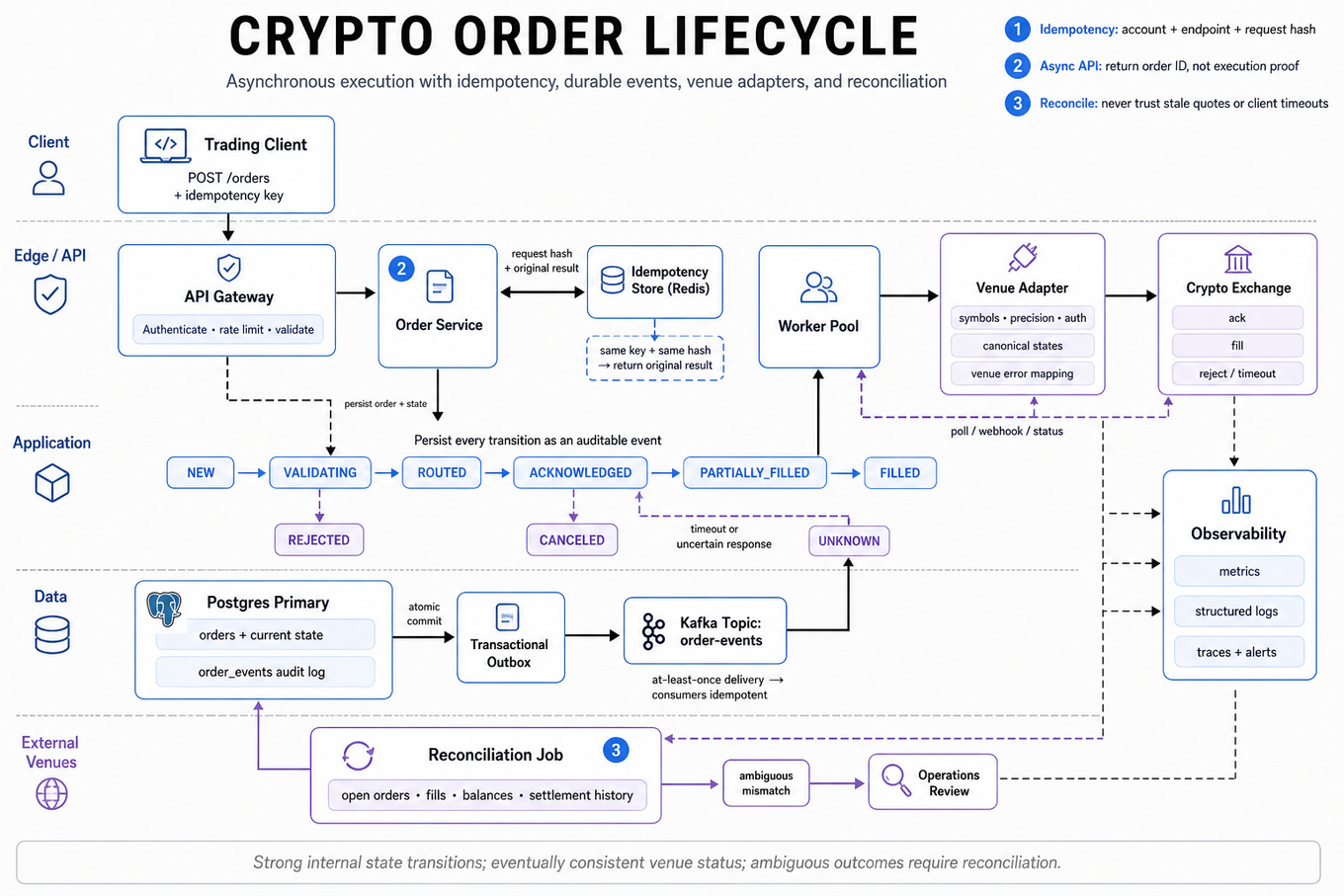
These designs test whether you can model an order as a distributed state machine, preserve correctness across retries and partial failures, and expose an API whose behavior remains understandable under asynchronous execution. The interviewer is probing your command of idempotency, consistency boundaries, external exchange integration, reconciliation, rate limiting, and operational observability. Coinbase cares because an incorrect balance, duplicate order, or silently lost fill directly affects customer funds and requires strong reliability engineering from Software Engineers.
Core knowledge
-
Order lifecycle modeling should use explicit states such as
NEW,VALIDATING,ROUTED,ACKNOWLEDGED,PARTIALLY_FILLED,FILLED,CANCELED,REJECTED, andUNKNOWN; define legal transitions and persist every transition as an auditable event. -
Idempotency prevents client retries or worker retries from creating duplicate orders. Accept an idempotency key scoped to the account and endpoint, store the request hash plus terminal or in-progress result, and return the original result for repeated identical requests.
-
The order API should usually be asynchronous: validate synchronously, persist an order, enqueue work, and return an order ID. A synchronous response from an exchange is not proof of execution; distinguish accepted, rejected, timed out, and unknown outcomes.
-
Use a transactional outbox to atomically commit the order and an outbound event in
Postgres, then publish throughKafkaor a queue. Consumers must still be idempotent because at-least-once delivery can repeat messages. -
Consistency boundaries matter: the internal order ledger should be strongly consistent for accepted state transitions, while market data and exchange status may be eventually consistent. Never claim
FILLEDfrom a stale quote or an unverified client timeout. -
Treat each third-party venue as an adapter translating capabilities, symbols, precision, authentication, error codes, and lifecycle events into a canonical model. A venue may support limit orders but not post-only, fractional quantities, amend-in-place, or durable client order IDs.
-
Reconciliation resolves divergence between internal state and venue state. Periodically query open orders, fills, balances, and settlement history; compare by stable venue IDs, repair safe mismatches, and send ambiguous cases to an operational review path rather than guessing.
-
Routing can optimize price, fees, liquidity, latency, and venue reliability, but begin with deterministic rules before introducing complex optimization. Avoid splitting an order unless you can correctly aggregate partial fills, fees, rounding, cancellation, and customer-visible status.
-
Rate limiting and backpressure must exist per customer, API credential, asset pair, venue, and global worker pool. Use token buckets or leaky buckets, bounded queues, exponential backoff with jitter, and circuit breakers; never retry permanent validation or authentication failures.
-
Exactly-once execution is generally unavailable across an internal service and an external exchange. Design for at-least-once delivery plus idempotent submission, durable client-generated IDs, timeout reconciliation, and a
UNKNOWNstate that blocks unsafe duplicate placement. -
Money correctness requires integer smallest units or fixed-point decimals, never binary floating point. Validate minimum quantity, tick size, price bands, quote-currency precision, available balance, and fee reservation before routing; test zero, maximum, and rounding-boundary values.
-
Observability and recovery should include correlation IDs, order-to-venue IDs, transition latency, acknowledgment latency, fill latency, rejection rate, unknown-order count, reconciliation drift, queue age, and
p99API latency. Alerts should distinguish customer impact from a single venue outage.
Worked example: Design a crypto trading platform
For Design a crypto trading platform, start by clarifying supported order types, custody model, target throughput and p99 latency, venue count, cancellation guarantees, and whether the platform owns execution or routes to exchanges. Declare an assumption such as asynchronous placement with durable order status, multiple venues, and no promise of exactly-once external execution. Organize the answer around the API and idempotency layer, the canonical order state machine and ledger, the asynchronous routing/adapter workers, and reconciliation plus observability. Explain that validation and persistence happen in one transaction, while an outbox publishes work after commit. Explicitly flag the tradeoff between strong internal consistency and eventual venue visibility: synchronous venue calls simplify the client experience but make request latency and failure handling much worse. Describe timeout handling as UNKNOWN, followed by venue lookup using the client order ID before any retry. Close by saying that, with more time, you would detail balance reservation, multi-region failover, venue-specific rate limits, and recovery drills.
A second angle: Design Crypto Order Routing
For Design Crypto Order Routing, the central challenge shifts from a general trading API to selecting and coordinating venues under latency, liquidity, fee, and reliability constraints. Begin by clarifying whether routing is best-execution-oriented, latency-sensitive, or simply failover-based, and whether orders may be split. A strong design introduces a routing decision service, venue adapters, a durable execution coordinator, and an aggregate order view that combines fills across venues. The important edge case is partial success: one venue may fill while another rejects or times out, so cancellation and customer reporting must be coordinated without pretending atomicity. Keep routing policy deterministic and auditable before discussing more sophisticated optimization.
Common pitfalls
Analytical mistake: Saying “retry on timeout” is insufficient and can duplicate an order. A timeout is an ambiguous result; use a durable client order ID, query the venue, and model UNKNOWN until reconciliation establishes the outcome.
Pitfall: Treating an exchange API as a transactional database leads to incorrect claims about exactly-once execution.
Communication mistake: Jumping directly into Kafka, databases, and microservices without clarifying order types, scale, venue behavior, and customer-visible guarantees makes the design appear unfocused. State assumptions first, then tie each component to a requirement or failure mode.
Pitfall: Listing technologies without explaining the consistency or reliability property each one provides.
Depth mistake: A simple “orders table plus worker” answer misses duplicate submission, partial fills, cancellation races, stale balances, and exchange outages. Show at least one concrete state transition, one retry path, and one reconciliation loop to demonstrate production readiness.
Pitfall: Assuming an acknowledged order is filled, or that cancellation is instantaneous and guaranteed.
Connections
The interviewer may pivot to ledger design, distributed transactions, event sourcing, rate limiting, or multi-region disaster recovery. Be ready to discuss optimistic concurrency, balance reservations, dead-letter handling, and how API contracts expose eventual consistency without confusing customers.
Further reading
-
Designing Data-Intensive Applications — Martin Kleppmann’s treatment of replication, streams, consistency, and distributed-system failure modes.
-
Stripe Idempotent Requests — a practical reference for idempotency-key semantics and safe API retries.
-
The Log: What every software engineer should know about real-time data's unifying abstraction — foundational context for durable event streams and replayable processing.
Practice questions
- Reliable Distributed Systems And Idempotency (Focus) — covered in depth under Online Assessment below.
Coding & Algorithms
Coinbase-adjacent crypto topic, but less central for an M7 manager than architecture, reliability, and leadership.
What's being tested
These problems test dependency-aware greedy selection: maximizing fees under a fixed block-size budget while respecting parent-before-child constraints and Child-Pays-For-Parent (CPFP) fee incentives. You must demonstrate graph traversal, effective-fee ranking, efficient indexing for a very large mempool, and careful handling of capacity, duplicates, and cycles.
Patterns & templates
-
Compute transaction density as
fee / size; use a max-heap for greedy selection, yielding roughlyO(n log n)time andO(n)space. -
Represent parent links with adjacency lists and
in_degree; select ancestors before descendants using topological ordering or iterative DFS. -
For CPFP, rank a package by
sum(fees) / sum(sizes); include the unconfirmed parent and child atomically when package capacity permits. -
Maintain
selectedandvisitedsets; these prevent duplicate inclusion when multiple chosen transactions share ancestors. -
Before insertion, verify
used_size + tx.size <= block_limit; never assume a high-fee transaction fits the remaining capacity. -
Use a dependency-aware priority queue with lazy invalidation when package scores change after ancestors are selected.
-
Validate malformed input—missing parents, self-links, cycles, zero sizes, and oversized transactions—rather than allowing infinite traversal or division by zero.
Common pitfalls
Pitfall: Sorting only by individual
fee / sizecan reject a low-fee parent required by a highly profitable child; compare dependency packages instead.
Pitfall: Adding a child first violates consensus ordering, while recursively adding parents without deduplication overcounts size and fees.
Pitfall: Claiming globally optimal knapsack selection for a huge
mempoolis usually unrealistic; state the greedy approximation and its complexity clearly.
Practice these
The practice cards below cover the canonical variants—solve all of them and time yourself.
Practice questions
Useful for API design and senior-level correctness conversations, especially stable ordering and mutation behavior.
What's being tested
These problems test cursor-based pagination: maintaining a deterministic position through ordered results without relying on fragile offset arithmetic. You must demonstrate cursor encoding, tie-breaker ordering, boundary handling, bidirectional state management, and efficient filtering or iteration.
Patterns & templates
-
Use a stable sort
(primary_key, unique_id)so equal timestamps or scores never produce duplicates or skipped records. -
Encode the last item’s sort keys into an opaque cursor; validate, decode, and reject malformed or incompatible cursors.
-
Forward query: fetch
limit + 1, return the firstlimit, and sethasNextPagefrom the extra record. -
Backward query: reverse comparison and ordering, fetch
limit + 1, then reverse the returned page before responding. -
Prefer keyset predicates such as
created_at < cursor_time OR (created_at = cursor_time AND id < cursor_id)overOFFSET. -
Keep iterator state explicit: current index, direction, exhausted flag, and page boundaries; define behavior for empty input and
limit <= 0. -
Target
O(log n + k)indexed retrieval forkresults; filtering an unsorted array generally costsO(n)per page.
Common pitfalls
Pitfall: Sorting only by a non-unique field allows ties to move between pages, causing duplicates or omissions.
Pitfall: Returning exactly
limitrecords cannot reliably determine whether another page exists; fetch one extra item.
Pitfall: Treating a cursor as a raw array index breaks when records are inserted or deleted between requests.
Practice these
The practice cards below cover the canonical variants — solve all of them and time yourself.
Practice questions
Behavioral & Leadership
Focus area — Although you rated behavioral 4/5, M7 interviews require deeper scope, judgment, tradeoffs, and measurable leadership outcomes.
What's being tested
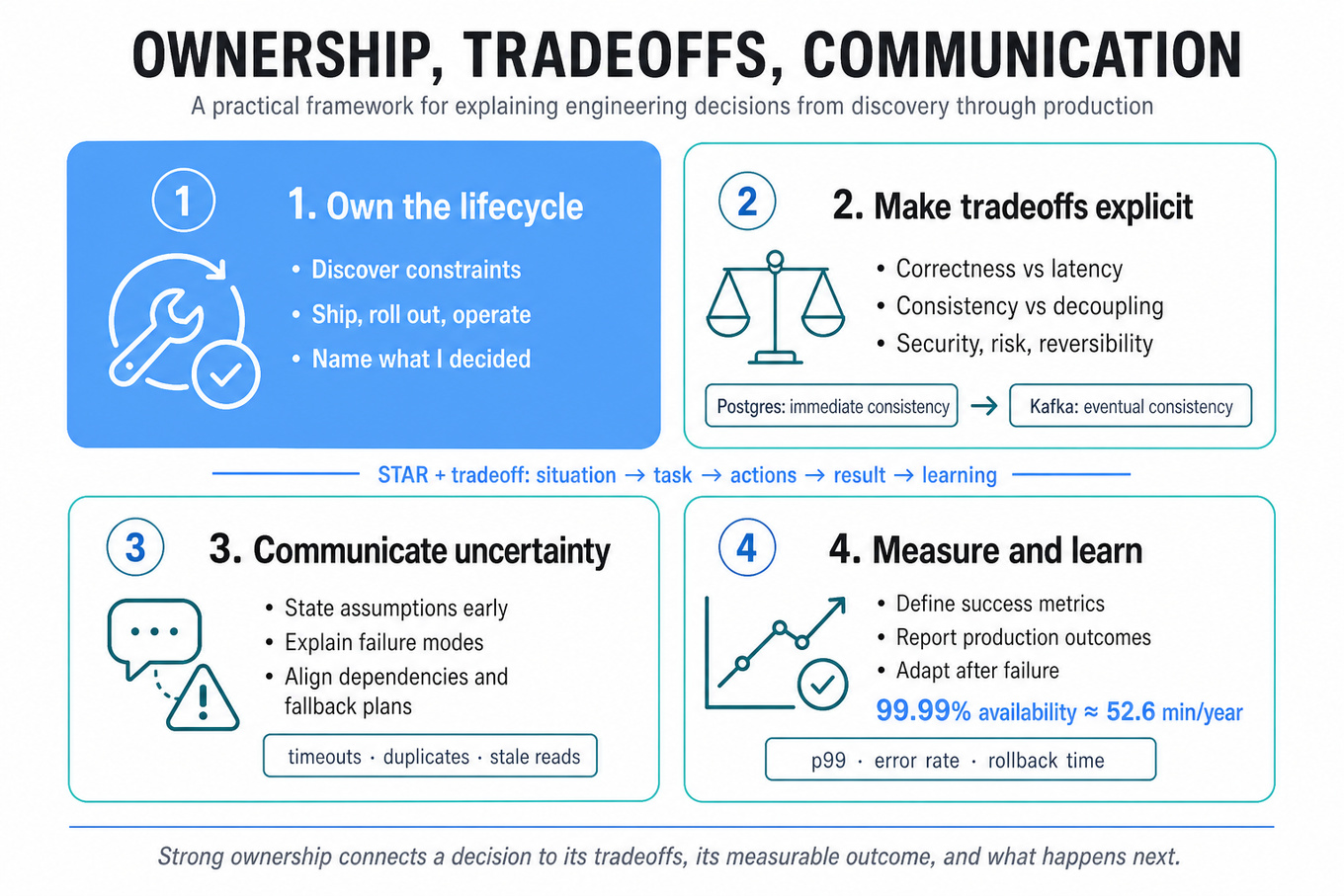
These prompts test ownership, technical judgment, and the ability to communicate an engineering decision from problem definition through production outcome. The interviewer is looking for a precise account of what you personally did, which alternatives you rejected, how you handled uncertainty, and how you measured success—not a polished description of a team project. Coinbase cares because financial systems require engineers who can make responsible tradeoffs among reliability, security, latency, delivery speed, and operational risk while keeping collaborators aligned.
Core knowledge
-
Ownership means carrying a problem through discovery, implementation, rollout, and operation. Distinguish your decisions from team output using “I”; name dependencies, risks you surfaced, and what you did after launch or during failure.
-
Use a STAR-plus-tradeoff structure: situation and constraints, task and success criteria, actions and alternatives, result with metrics, then what you learned. State assumptions early instead of hiding ambiguity until the end.
-
Define engineering success with measurable outcomes:
`p99`latency, error rate, throughput, availability, deployment frequency, rollback time, alert volume, or incident count. For availability, communicate the budget explicitly: 99.99% permits roughly 52.6 minutes of annual downtime. -
Compare alternatives against explicit dimensions: correctness, consistency, latency, scalability, operational complexity, security, reversibility, and delivery time. A synchronous
`Postgres`transaction may maximize immediate consistency; an asynchronous`Kafka`workflow may improve decoupling but introduce retries, duplicates, and eventual consistency. -
Idempotency is essential when requests can be retried. Use a client-supplied idempotency key, persist the result or operation state, and enforce a uniqueness constraint; never rely only on an in-memory deduplication cache across processes.
-
Explain failure modes rather than claiming a design “handles scale.” Cover timeouts, partial writes, duplicate messages, stale reads, dependency outages, malformed input, deploy rollback, and recovery after a process or region failure.
-
For a distributed write, identify the consistency boundary: validate authorization and invariants before committing, make state transitions atomic where required, and use an outbox or durable event record when a database change must reliably produce an event.
-
Show incremental delivery: feature flags, dark reads, canary deployment, bounded blast radius, dashboards, and a rollback plan. A reversible first release is often preferable to a theoretically optimal design that cannot be safely tested.
-
Use observability as an engineering responsibility: structured logs with correlation IDs, metrics for success and failure paths, traces across services, and alerts tied to user-visible symptoms. Avoid logging secrets, private keys, authentication tokens, or sensitive financial data.
-
Decompose complex work by stable interfaces and risk, not merely by service count. A useful plan identifies API contracts, ownership boundaries, migration sequencing, compatibility requirements, and exit criteria; for large datasets, prefer resumable, checkpointed migrations over one unbounded job.
-
Communicate disagreement with evidence and a decision record. An ADR should capture context, options, decision, consequences, and revisit triggers; this prevents repeated debate while making the tradeoff visible to reviewers and future on-call engineers.
-
Quantify scale and edge cases. A single-process solution might be adequate for records or low request volume, while millions of records may require pagination, batching, backpressure, indexes, and bounded memory; state the threshold that changes your design.
Worked example
For “Discuss complex project and multi-approach example,” I would begin by asking what complexity the interviewer wants emphasized—scale, cross-service coordination, ambiguous requirements, reliability, or security—and I would state the project’s users, constraints, my role, and the measurable definition of success. I would organize the answer around four pillars: decomposition and interfaces, the alternatives I evaluated, execution and risk control, and production results plus lessons learned. I might describe replacing a fragile synchronous workflow with a durable command API and asynchronous processing, while preserving an idempotent status endpoint for clients. The key tradeoff would be lower coupling and better recovery versus eventual consistency and more operational machinery. I would explain how I compared the approaches using latency, correctness, retry behavior, on-call complexity, and migration risk rather than asserting that one was simply “more scalable.” I would then cover contract tests, dashboards, a canary rollout, duplicate-event handling, and the rollback mechanism. Results should include concrete changes such as reduced `p99` latency, fewer failed operations, or shorter recovery time, while separating my contribution from teammates’ work. I would close with, “If I had more time, I would add a failure-injection test plan and revisit the design against the next order-of-magnitude increase in traffic.”
A second angle
For “Discuss complex project choices,” the same concept is framed less around the entire project narrative and more around judgment at a decision point. I would present the decision context, two or three viable designs, the invariant that could not be compromised, and the evidence used to choose. For example, choosing a transactional database update plus an outbox over a direct publish-first flow prioritizes state correctness and recoverability, at the cost of storage and reconciliation work. I would also explain who disagreed, how I incorporated valid objections, and which production signal would cause me to revisit the choice.
Common pitfalls
Pitfall: Giving a technically impressive solution without analyzing alternatives. Saying “we used microservices because we needed scale” is weak; explain the actual bottleneck, the simpler option considered, and the specific cost introduced by the chosen design.
A strong answer connects decisions to constraints such as `p99` latency, consistency, deploy safety, or operational load. If you cannot name what would have changed your decision, the tradeoff was probably not understood clearly enough.
Pitfall: Using “we” for every action or taking sole credit for team results. The interviewer needs your individual ownership, but not exaggerated ownership.
Say, “I designed the retry state machine, partnered with the platform team on deployment, and the team reduced timeout errors by 35%.” Also acknowledge contributions, disagreement, and dependency failures instead of presenting collaboration as frictionless.
Pitfall: Staying at architecture-diagram altitude. Naming
`Kafka`, caching, or retries without explaining duplicate delivery, poison messages, stale data, timeout budgets, or recovery makes the answer sound memorized.
Go one level deeper into one critical path: its invariant, failure handling, observability, and test or rollout strategy. You do not need every implementation detail, but you must demonstrate that the design could survive production.
Connections
The interviewer may pivot to incident response, distributed-systems consistency, API and schema evolution, observability, or secure coding. Be ready to connect ownership to on-call behavior, rollback decisions, idempotent APIs, and protecting financial or authentication data.
Further reading
-
Site Reliability Engineering — Google’s practical treatment of service-level objectives, error budgets, monitoring, and incident response.
-
Designing Data-Intensive Applications — rigorous coverage of consistency, replication, transactions, streams, and distributed-system tradeoffs.
-
Architecture Decision Records — a concise format for documenting technical context, decisions, and consequences.
Practice questions
Focus area — Added because you specified M7 Senior Engineering Manager; prepare coaching, performance, hiring, succession, and org-health stories.
What's being tested
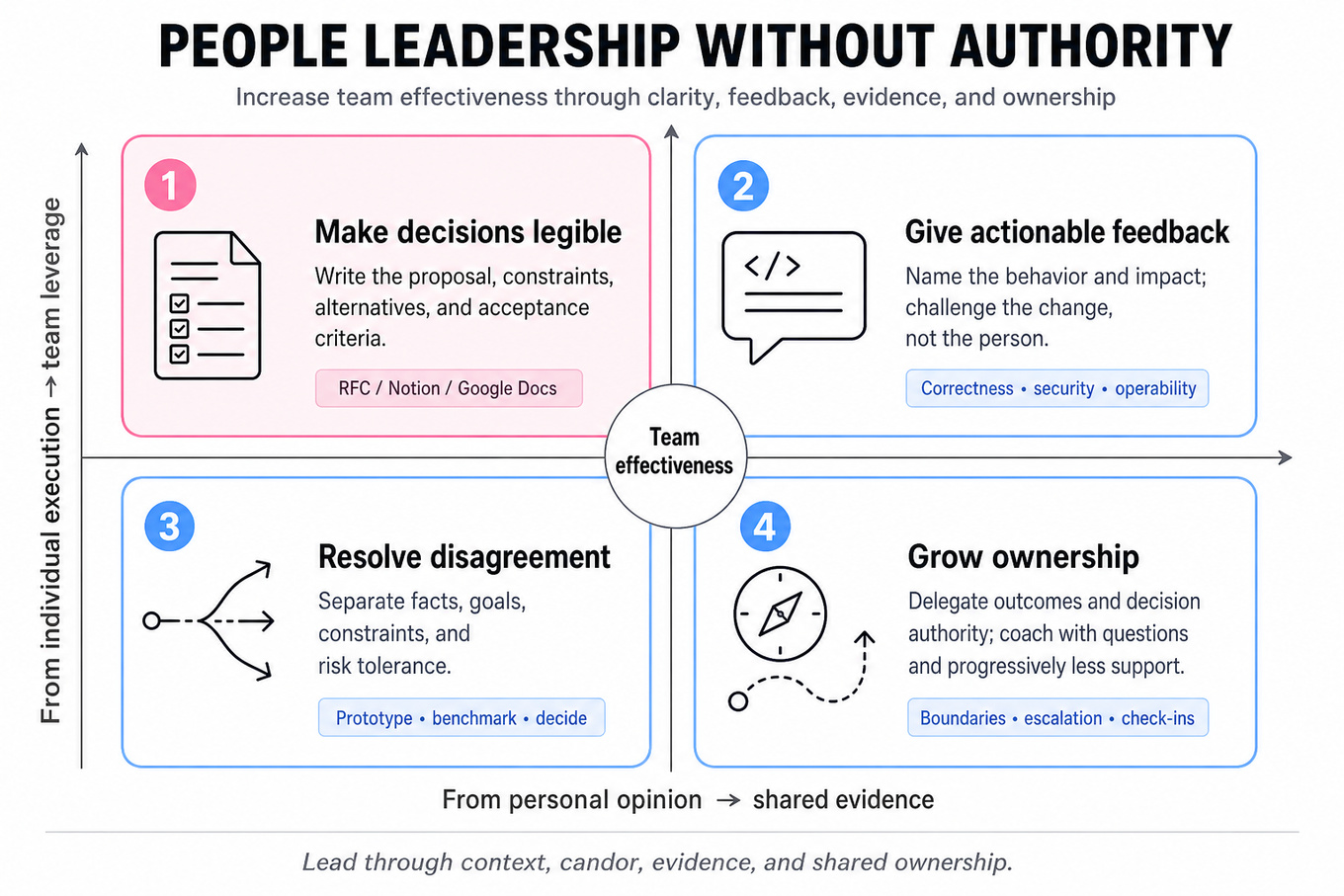
The interviewer is testing whether you can increase team effectiveness without formal authority: make technical decisions legible, give and receive actionable feedback, resolve disagreement, and help teammates grow. As a Software Engineer, the focus is not compensation, performance-rating processes, or organizational design; it is how your behavior affects code quality, delivery reliability, psychological safety, and operational ownership. Coinbase cares because high-risk financial systems require engineers who communicate clearly, challenge unsafe decisions, and support one another during ambiguity and incidents.
Core knowledge
-
Servant leadership means removing obstacles and improving the team’s ability to make sound decisions, not becoming the person who approves every pull request. Describe how you create leverage through context, delegation, standards, and coaching.
-
Technical influence without authority relies on a written proposal, explicit constraints, alternatives, and measurable acceptance criteria. A design document in
Google Docs,Notion, or an RFC repository scales better than repeated hallway conversations or positional arguments. -
Constructive feedback should be specific, timely, behavior-based, and connected to impact: “The retry loop hides the upstream failure and increased
p99latency,” rather than “You need to think more about reliability.” Ask for the other person’s perspective before prescribing a solution. -
Radical candor combines direct challenge with genuine care. In a code review, separate the person from the change, distinguish blocking correctness issues from preferences, and explain why a concern matters for security, operability, or maintainability.
-
Disagreement resolution starts by identifying whether the conflict concerns facts, goals, constraints, or risk tolerance. Write down competing options, gather evidence with a prototype or benchmark, assign a decision owner, and record the outcome rather than seeking endless consensus.
-
Delegation should transfer both responsibility and decision authority. Define the outcome, boundaries, interfaces, escalation conditions, and check-in points; avoid “delegating” implementation while retaining every meaningful decision yourself.
-
Mentoring is different from solving someone’s problem. Use questions, pairing, targeted examples, and progressively reduced support; evaluate improvement through observable outcomes such as independently leading a design review or debugging a production issue.
-
Psychological safety is compatible with high standards. Teams should be able to report a mistaken deploy, suspicious transaction behavior, or an unsafe design early, while still using blameless analysis and concrete corrective actions.
-
Incident leadership requires calm role separation: an incident commander coordinates, an investigator tests hypotheses, and a communications owner posts updates. During a
PagerDutyevent, prioritize mitigation and customer impact over proving who introduced the defect. -
Accountability means making commitments, surfacing risk early, and following through on corrective actions. A strong answer distinguishes an individual mistake from a system weakness such as unclear ownership, missing alerts, unsafe defaults, or an overloaded on-call rotation.
-
Inclusive technical discussion improves decision quality. Invite dissent before convergence, prevent the loudest voice from dominating, rotate presentation opportunities, and use written pre-reads so contributors do not need to improvise in a high-pressure meeting.
-
Growth feedback should connect a person’s goals to engineering opportunities: owning an API migration, improving the test strategy, or leading an operational review. Do not promise promotions or compensation outcomes; instead, clarify observable expectations and create opportunities to demonstrate them.
Worked example
Representative scenario: “Tell me about a time you disagreed with a teammate on a technical decision.” In the first 30 seconds, clarify the system context, the decision at stake, the constraints, each person’s concern, and the eventual customer or operational impact. Frame the answer around four pillars: shared goal, competing options, evidence-based decision, and relationship or team outcome. Explain that you would first restate the teammate’s argument to verify understanding, then compare options against reliability, latency, security, delivery time, and long-term ownership. A concrete tradeoff might be choosing a simpler synchronous path for an initial release instead of introducing an asynchronous Kafka workflow whose operational complexity the team could not yet support. State how you made the decision reversible where possible, documented the rationale, and invited a review after real production data. Close by explaining what changed in your own behavior, such as writing decision criteria before advocating for a preferred design. If you had more time, you would also describe how you checked whether the disagreement reflected a broader team concern or an unclear architectural principle.
A second angle
Representative scenario: “Tell me about a time you helped a teammate who was struggling.” The same leadership principles apply, but the central constraint is development rather than technical consensus. Start by separating observed behavior from assumptions, asking what is blocking the person, and agreeing on a specific outcome such as independently shipping a change or owning an incident follow-up. Use pairing, smaller milestones, and deliberate handoffs rather than taking over the work. Measure success by increased autonomy and confidence, not merely by finishing the immediate task.
Common pitfalls
Pitfall: Saying “I resolved the disagreement by choosing the best technical solution” skips the people dimension and often sounds like authority-based decision-making. Explain how you defined evaluation criteria, incorporated dissent, made ownership explicit, and preserved the working relationship.
Pitfall: Giving a long chronology with vague references such as “we discussed it a lot” makes your role difficult to assess. Use a compact structure—context, conflict, actions, result, lesson—and name the exact conversation, artifact, or behavior that changed the outcome.
Pitfall: Treating mentorship as answering questions or reviewing code more quickly is a weak answer. Show how you diagnosed the learning gap, calibrated support, transferred ownership, and verified that the teammate could handle a similar situation independently.
Connections
The interviewer may pivot to incident response, code review culture, technical decision records, on-call sustainability, or conflict management. Be ready to connect people leadership to measurable engineering outcomes such as escaped defects, review latency, deployment frequency, change-failure rate, and retention of operational knowledge.
Further reading
-
The Manager’s Path — Camille Fournier’s practical treatment of mentorship, feedback, and engineering leadership.
-
An Elegant Puzzle — Will Larson’s framework for engineering effectiveness, organizational constraints, and leadership leverage.
-
Accelerate — Research-backed engineering metrics connecting team practices with delivery and reliability outcomes.
Practice questions
M7 Org Strategy And Execution
Focus areaFocus area — Added for senior EM scope: roadmap tradeoffs, resource allocation, metrics, cross-functional alignment, and multi-team execution.
What's being tested
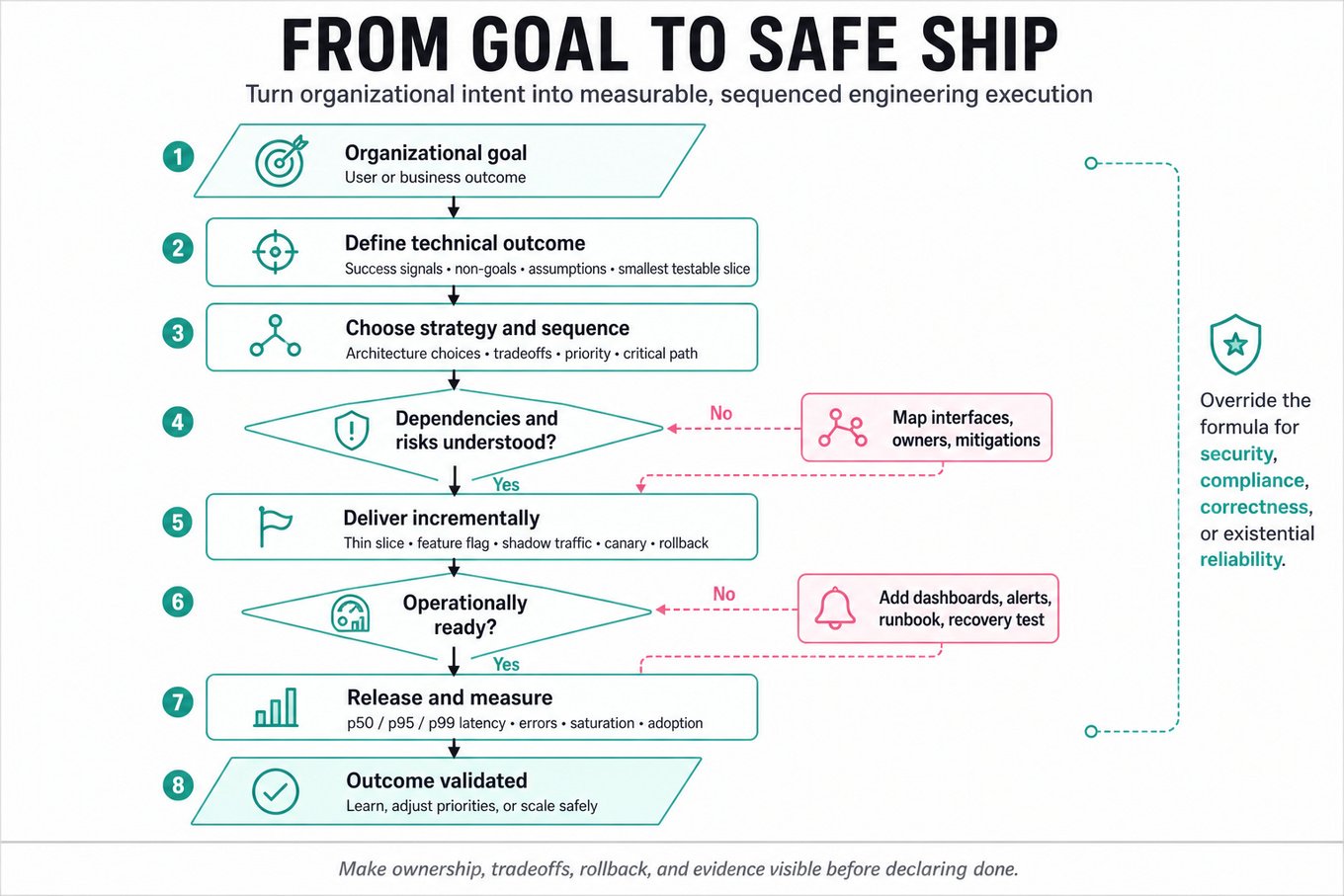
This topic tests whether you can translate an organizational goal into an executable engineering plan: define the technical outcome, identify dependencies, sequence delivery, and make tradeoffs visible. The interviewer is probing judgment under ambiguity rather than asking you to recite a project-management framework. Coinbase needs engineers who can ship safely across teams, protect reliability and security, and adjust execution when priorities, constraints, or market conditions change.
Core knowledge
-
Outcome-oriented planning connects engineering work to a measurable user or business result, while preserving technical constraints. State the desired outcome, success signals, non-goals, assumptions, and the smallest deliverable that can validate direction.
-
Technical strategy is a coherent set of architectural choices and sequencing decisions, not a list of projects. Explain why a platform investment, API change, reliability effort, or migration enables future execution and which alternatives you rejected.
-
Prioritization should account for impact, urgency, confidence, effort, risk reduction, and dependencies. A useful heuristic is , but explicitly override it for security, compliance, correctness, or existential reliability work.
-
Dependency mapping identifies upstream APIs, data contracts, client releases, infrastructure capacity, compliance reviews, and other teams’ milestones. Build a dependency graph, find the critical path, and reduce coordination by introducing stable interfaces or parallelizable work.
-
Incremental delivery uses thin vertical slices, feature flags, shadow traffic, dual writes, canaries, and reversible releases. Avoid a “big bang” launch; each slice should produce a usable capability or meaningful operational evidence.
-
Execution plans make ownership and decision rights explicit. A lightweight
RACIor directly responsible individual model helps distinguish who implements, reviews, approves, operates, and communicates the system. -
Risk management separates known risks from unknowns and attaches mitigation, owner, trigger, and rollback criteria to each. For a financial system, cover correctness, asset or payment loss, privacy, security, regulatory exposure, availability, and operational recovery.
-
Operational readiness is part of “done”: dashboards,
p50/p95/p99latency, error rates, saturation, audit logs, alerts, runbooks, on-call ownership, capacity tests, and rollback procedures. A feature that cannot be safely operated is not execution-complete. -
Architecture decision records and design reviews preserve context: problem statement, constraints, alternatives, decision, consequences, and revisit conditions. This prevents repeated debates and makes organizational decisions legible to engineers joining later.
-
Tradeoff communication should quantify consequences where possible: “Option A ships two weeks sooner but adds a six-month migration burden,” or “Option B costs 20% more capacity but removes a single-region failure mode.” Name what you optimize and what you accept.
-
Change management requires explicit re-planning when assumptions fail. Compare actual progress, incidents, staffing, and dependency status with the plan; cut scope before cutting safety controls, and communicate the change with its rationale and impact.
-
Technical debt allocation should be tied to concrete failure modes: slower delivery, rising incident frequency, unsafe deploys, cloud cost, or inability to meet latency targets. Reserve capacity deliberately rather than treating debt work as an unowned remainder.
Worked example
Representative question: “How would you execute a large-scale migration of a critical service?”
In the first 30 seconds, clarify the migration’s outcome, deadline, traffic volume, compatibility requirements, data-loss tolerance, teams involved, and whether rollback must be instantaneous. I would organize the answer around four pillars: target architecture and contracts, incremental rollout and data consistency, operational safeguards, and team ownership with milestones. I would first establish invariants—such as no duplicated financial actions, complete auditability, and bounded recovery time—before choosing implementation details. I would use an anti-corruption layer or versioned API, migrate one capability or cohort at a time, and compare old and new behavior through shadowing or reconciliation. The key tradeoff is between a fast dual-write migration and a slower single-source-of-truth approach: dual writes reduce cutover time but introduce consistency and repair complexity. I would define go/no-go thresholds for error rate, reconciliation mismatch, latency, and rollback duration, then document them in an RFC and launch checklist. I would close by saying that, with more time, I would validate capacity assumptions using production-shaped load tests and run a failure-injection exercise before expanding traffic.
A second angle
Representative question: “How do you handle two teams disagreeing about the technical approach and schedule?”
The same execution discipline applies, but the central problem is decision latency and alignment rather than migration mechanics. Start by writing the shared outcome, constraints, options, and decision deadline; disagreements often persist because teams are optimizing different objectives. Compare proposals against explicit criteria such as correctness, delivery time, operability, security, and reversibility, then run a short spike if uncertainty is the real blocker. Assign a decision owner, record the decision and dissenting risks, and define a review trigger rather than seeking indefinite consensus.
Common pitfalls
Pitfall: Treating organizational strategy as a feature prioritization exercise. Saying “I would build the highest-impact feature first” is incomplete; connect the work to technical constraints, dependencies, reliability, security, and a concrete execution sequence.
A communication mistake is presenting a polished plan without exposing assumptions or asking clarifying questions. A stronger answer says, “Assuming we need zero asset loss and can tolerate a gradual rollout, I would…” and explains how the plan changes if either assumption is false.
A depth mistake is naming process artifacts—roadmap, RACI, RFC, milestones—without describing engineering mechanisms. Explain how flags, versioned contracts, observability, canaries, rollback, reconciliation, and ownership make the plan safe in production.
Connections
An interviewer may pivot to system design, incident management, reliability engineering, API versioning, or technical debt prioritization. Be ready to connect execution choices to SLOs, error budgets, deployment safety, and failure recovery rather than treating them as separate concerns.
Further reading
-
Accelerate — empirical research connecting delivery practices, reliability, and organizational performance.
-
Team Topologies — useful models for team boundaries, cognitive load, and reducing coordination dependencies.
-
Google SRE Book — concrete guidance on
SLOs, error budgets, incident response, and operational ownership.
Practice questions
Online Assessment — 21 min
System Design
Banking Ledger And Transaction Semantics
Focus areaFocus area — Core Coinbase financial-domain topic, and System Design is 3/5; practice invariants, auditability, and failure-safe money movement.
What's being tested
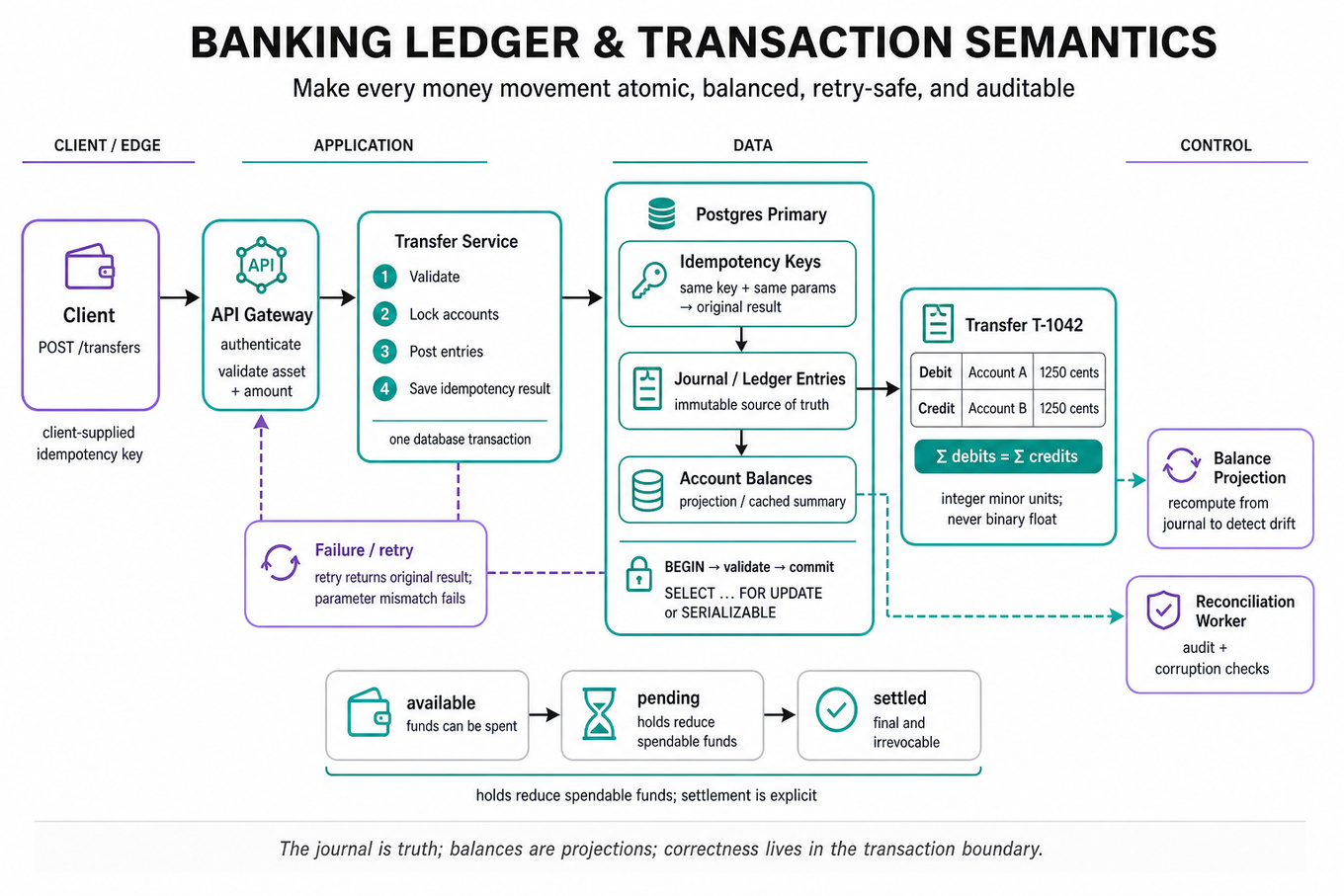
These questions test whether you can model money movement as a set of transactional invariants, not merely mutate an account balance. You should demonstrate double-entry ledger design, atomic transfers, idempotent APIs, concurrency control, validation, and immutable auditability. Coinbase cares because a race condition, duplicate retry, or incorrect decimal calculation can create real customer loss and regulatory exposure; the interviewer is probing whether your design remains correct during failures and concurrent requests.
Core knowledge
-
A double-entry ledger records every movement as balanced postings: for each transaction, . A transfer from account A to B creates at least two immutable entries, preserving auditability and enabling reconstruction.
-
Treat the journal as the source of truth and balances as a projection or cached summary. An account’s balance is ; periodically recompute projections from journal entries to detect corruption or missed updates.
-
Use integer minor units or exact decimal arithmetic, never binary floating point. Store cents, satoshis, or asset-specific base units with an explicit currency/asset; validate multiplication and addition for overflow before committing.
-
A transfer must be atomic: validation, debit posting, credit posting, and idempotency-record creation commit in one database transaction. If any step fails, none becomes visible. In
Postgres, this usually means one transaction with appropriate constraints. -
Enforce concurrency control around available funds. Row locks such as
SELECT ... FOR UPDATE, optimistic version checks, orSERIALIZABLEisolation prevent two withdrawals from both spending the same balance; choose based on contention and retry cost. -
Separate available, pending, and settled balances when operations can be asynchronous. A withdrawal hold should reduce spendable funds without pretending the final settlement has occurred; state transitions must be explicit and valid.
-
Make mutation APIs idempotent with a client-supplied idempotency key scoped to an account or operation type. Persist the key with the resulting transaction and request parameters; a retry returns the original result, while reuse with different parameters fails.
-
Define invariants before selecting storage: no account becomes negative unless overdrafts are explicitly supported, every posting references valid accounts, a transaction balances per asset, and finalized entries cannot be edited or deleted.
-
Use database constraints for local correctness: foreign keys, nonnegative amounts, unique
(account_id, idempotency_key), asset consistency, and check constraints. Application validation improves errors, but constraints protect against races and buggy callers. -
Design read APIs around consistent snapshots and indexed access patterns. Index
(account_id, created_at, transaction_id)for history pagination; prefer cursor pagination over offsets, which become expensive and unstable as rows change. -
Keep audit trails immutable. Corrections are compensating entries, not updates to historical rows; record actor, request ID, timestamps, reason, and correlation IDs so support and reconciliation can trace every change.
-
Distinguish database commit from external settlement. A bank or blockchain call cannot generally participate in the same ACID transaction, so model pending, submitted, confirmed, failed, and reversed states with retry-safe workers and reconciliation.
Worked example: Design a basic banking system
For “Design a basic banking system,” I would first clarify supported operations, currencies, overdraft policy, expected throughput, consistency requirements, and whether transfers are internal or involve external institutions. I would state that internal transfers require atomic, strongly consistent balance effects, while external settlement is asynchronous and stateful. I would organize the design around the account and immutable ledger schema, transactional transfer APIs, concurrency/idempotency controls, and auditability plus operational recovery. The transfer endpoint would validate the request, acquire deterministic locks or use serializable isolation, create balanced postings, persist the idempotency result, and commit once. I would explicitly choose a journal as the source of truth with a balance projection for fast reads, accepting projection-rebuild complexity in exchange for auditability. I would also define failure behavior: retries return the original result, while a crashed external operation is reconciled from provider status rather than blindly repeated. If I had more time, I would add authorization boundaries, key rotation, reconciliation jobs, archival strategy, and load-test scenarios for hot accounts.
A second angle
For “Design an in-memory banking system,” the same invariants apply, but durability, crash recovery, and distributed coordination may be intentionally out of scope. A map from account ID to account state can provide average lookup, while a mutex or single-threaded event loop serializes mutations. The main challenge shifts toward API semantics, invalid-input handling, deterministic operation ordering, and testable transaction behavior. I would still use integer amounts, idempotency semantics where retries matter, and an append-only in-memory event list if history is required. I would clearly state that process restart loses state unless snapshots or durable storage are added.
Common pitfalls
Pitfall: Treating a transfer as
balanceA -= amount; balanceB += amountwithout a transaction allows partial updates, lost writes, and double spending under concurrent requests. Model balanced postings and commit all effects atomically.
A tempting communication mistake is jumping directly into tables or frameworks without clarifying whether negative balances, pending states, and external transfers are allowed. State assumptions early, then explain how changing each assumption affects the design.
A depth mistake is saying “use a distributed lock” or “make it eventually consistent” without explaining correctness. For a financial mutation, name the isolation or locking strategy, idempotency-key storage, retry behavior, and invariant that the mechanism protects.
Connections
An interviewer may pivot to ACID isolation levels, outbox/inbox patterns, event sourcing, reconciliation, or authorization and fraud-prevention boundaries. Be ready to explain why exactly-once effects are usually achieved through durable idempotency and transactional state, not by assuming the network delivers exactly once.
Further reading
-
Designing Data-Intensive Applications — Martin Kleppmann’s treatment of transactions, consistency, replication, and event-driven systems.
-
Stripe: Idempotent Requests — concrete production semantics for safely retrying mutation APIs.
-
Martin Fowler: Event Sourcing — useful background on reconstructing state from immutable events.
Practice questions
Focus area — Critical for Coinbase financial systems and M7-level judgment; practice retries, reconciliation, backpressure, observability, and rollout risk.
What's being tested
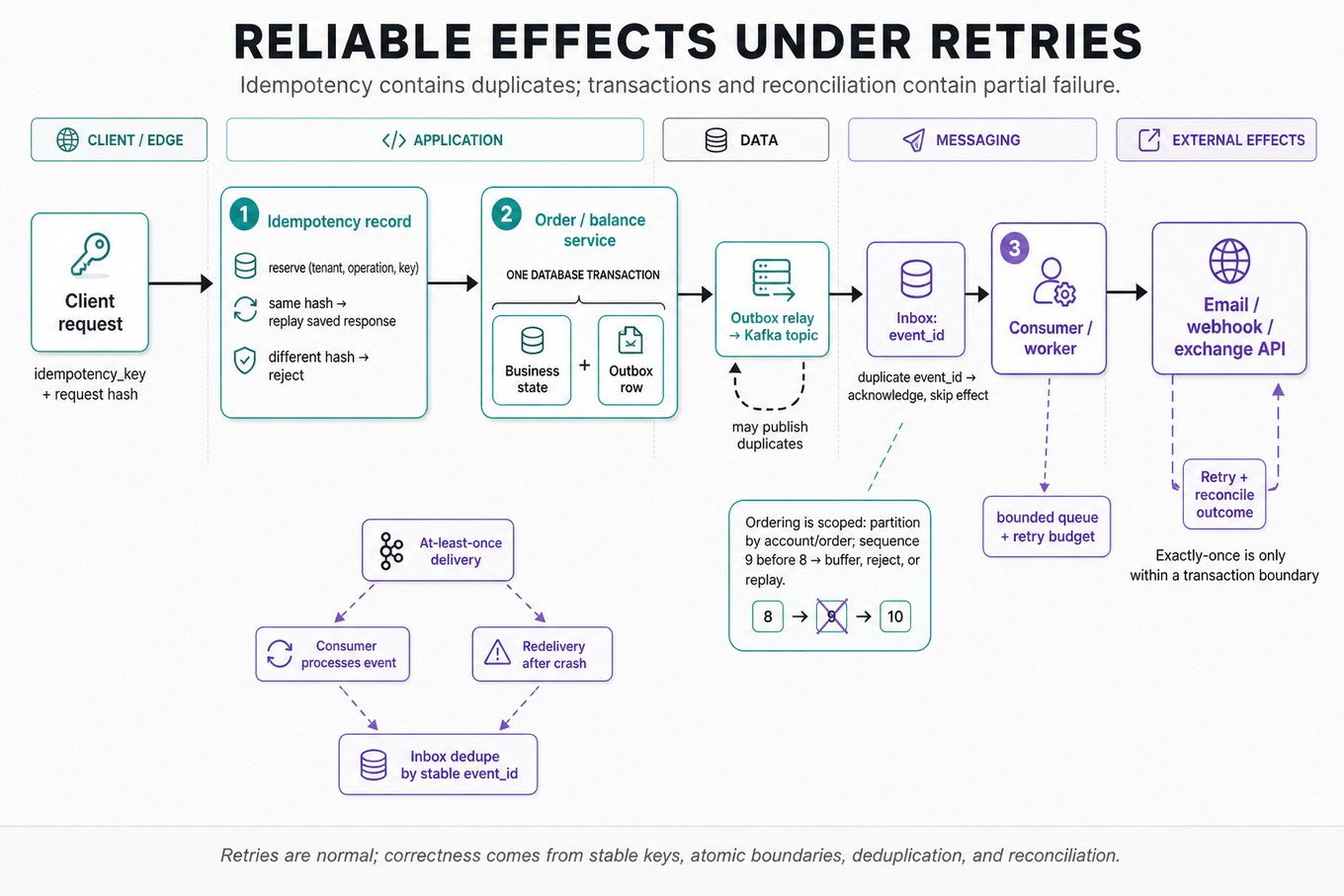
This topic tests whether you can design reliable distributed workflows when requests, messages, and downstream effects may be retried, duplicated, delayed, or reordered. The interviewer is probing for a precise understanding of idempotency, at-least-once delivery, transactional boundaries, concurrency control, and recovery after partial failure—not a claim that “exactly once” magically exists. Coinbase cares because trading, balances, notifications, and custody-related operations must remain correct when services, networks, consumers, and external providers fail independently.
Core knowledge
-
Idempotency means repeating the same logical operation produces the same externally visible result. Require a client-supplied idempotency key, scope it to the authenticated account and operation, and return the originally persisted response for later retries.
-
An idempotency record should atomically reserve
(tenant, operation, key), store request-hash and status, then persist the final result. Reject the same key with different parameters; otherwise concurrent requests can accidentally represent two operations. -
At-least-once delivery is the practical default: a broker may redeliver after a consumer commits work but crashes before acknowledging. Consumers therefore need an inbox or deduplication table keyed by stable
event_id, not merely a broker offset. -
Exactly-once semantics usually mean exactly-once effects within a narrowly defined transactional boundary. They do not guarantee one external email, webhook, exchange order, or network request happened once; model external calls as retryable and reconcile outcomes.
-
Use a transactional outbox when a database mutation and event publication must agree: commit business state plus an outbox row in one transaction, then publish asynchronously. A relay may publish duplicates, so consumers remain idempotent.
-
For event consumers, an inbox pattern records
event_idand business effects in one transaction. If the event is already recorded, acknowledge it without reapplying the effect; retain dedupe state at least as long as replay and retry windows. -
Ordering is normally scoped, not global. Partition by account, order, or notification recipient; attach monotonically increasing sequence numbers, detect gaps, and decide whether to buffer, reject, or request replay when
sequence=9arrives before8. -
Backpressure requires bounded queues, per-consumer limits, leases, exponential backoff with jitter, and a dead-letter or retry queue. Isolate slow consumers so one blocked webhook or mobile client cannot exhaust shared worker capacity.
-
For financial state, use a double-entry ledger: every transaction has balanced debit and credit postings, with . Make the ledger append-only, derive balances from postings or controlled snapshots, and use database constraints to prevent partial application.
-
Concurrency control prevents two valid requests from overspending or filling the same order incorrectly. Choose serializable transactions, optimistic version checks (
UPDATE ... WHERE version = v), or per-key serialization; retries must preserve the original idempotency key. -
Retry safety depends on classifying failures. A timeout after an external submission is ambiguous, while a validation error is definitive; retry ambiguous operations only with a provider idempotency key or reconciliation query, never by blindly submitting again.
-
Durability and recovery require explicit state machines such as
PENDING → APPLIED → PUBLISHED → DELIVERED, durable timestamps, and replayable events. Recovery workers scan stale leases and reconcile states; “marked complete before doing the work” is unsafe. -
Consistency choices should follow the invariant: strong consistency for available-balance checks and one-time state transitions, eventual consistency for notification fanout and search views. State the user-visible consequence of stale reads rather than calling everything “eventually consistent.”
-
Observability should expose idempotency-hit rate, duplicate-event rate, outbox age, consumer lag, retry counts, dead-letter volume, reconciliation mismatches, and
p99processing latency. Correlation IDs and event IDs must follow a request across services without leaking sensitive payloads.
Worked example: Deliver Limit-Order Fill Notifications under Consumer Backpressure
I would first clarify delivery channels, notification latency, retention, per-order ordering guarantees, duplicate tolerance, fanout scale, and whether a provider offers idempotent webhook submission. I would declare that fills are durable facts, delivery is at least once, and a notification may be delayed but must not be silently lost. I would organize the answer around an append-only fill event, a transactional outbox or durable event log, per-recipient fanout with scoped ordering, and isolated delivery workers with retry and dead-letter handling. Each fill gets a stable event_id and sequence number, while each consumer stores an inbox entry before acknowledging so redelivery cannot create a duplicate notification. To handle backpressure, I would use bounded per-consumer queues, leases, exponential backoff with jitter, and quotas so one slow recipient cannot block other recipients or the matching system. I would explicitly trade strict ordering for a recipient against latency and storage cost, preserving order per order or account rather than imposing a global sequence. For external providers, I would treat timeout-after-submit as ambiguous and use their idempotency key or a reconciliation endpoint before retrying. If I had more time, I would detail retention, replay tooling, provider-specific rate limits, and metrics such as outbox age and delivery lag.
A second angle
In Design a bank account service, the same principle applies to money movement rather than notification delivery. The key framing changes from consumer backpressure to atomic balance invariants, authorization, concurrent transfers, and auditability. A client retry of POST /transfer must return the original transfer result, while the debit, credit, idempotency record, and ledger entries commit atomically. The difficult failure is an uncertain response after commit, so querying by idempotency key or transfer ID is safer than issuing a second transfer. Reconciliation then compares derived balances, ledger postings, and external settlement records.
Common pitfalls
Pitfall: Saying “use exactly-once processing” as though it solves retries across services is analytically incomplete. Explain the transactional boundary, then combine at-least-once delivery, durable deduplication, idempotent state transitions, and reconciliation for external effects.
Pitfall: Jumping directly into
Kafkapartitions, databases, and worker pools without first stating invariants and failure assumptions makes the design difficult to evaluate. Start with what must never happen—double debit, lost fill, or out-of-order user-visible state—and map each mechanism to that invariant.
Pitfall: Treating a timeout as proof that an external operation failed is a depth mistake. A timeout means the outcome is unknown; use provider-side idempotency, status lookup, durable operation state, and a reconciliation loop rather than blindly retrying.
Connections
An interviewer may pivot to transaction isolation, leader election and leases, message ordering, transactional outbox/inbox, or reconciliation jobs. They may also ask how to design APIs and schemas so retries remain safe during deploys, failovers, and regional outages.
Further reading
-
Designing Data-Intensive Applications — Martin Kleppmann’s treatment of transactions, streams, consistency, and distributed-system failure modes.
-
Stripe API Idempotent Requests — a concrete production pattern for safely retrying APIs with idempotency keys.
-
Making Reliable Networked Systems in the Presence of Bugs — useful background on replication, failure handling, and correctness under distributed faults.
Practice questions